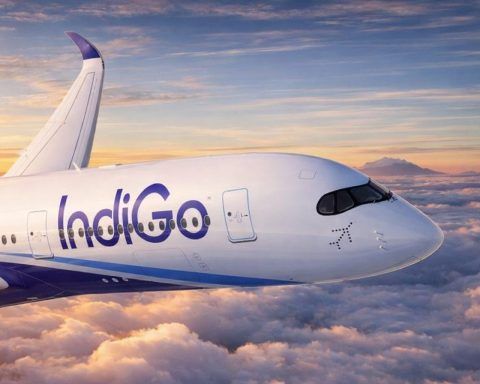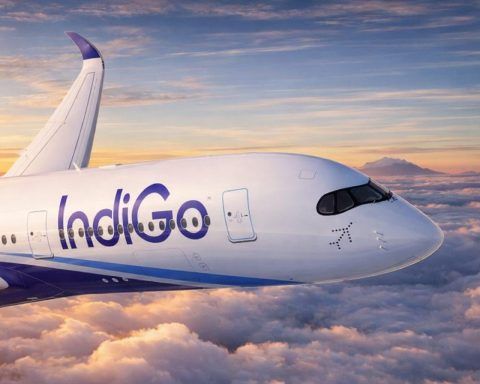

InterGlobe Aviation Ltd, the operator of IndiGo and a constituent of the Nifty 50, is in the middle of one of the most intense periods of scrutiny in its history. A wave of flight cancellations, new pilot fatigue rules and regulatory intervention has knocked the stock sharply off its highs, even as most major brokerages insist the airline’s long‑term story remains intact.
As of mid‑session on 10 December 2025, InterGlobe Aviation shares were trading around ₹4,840–4,870 on the NSE, down roughly 2–2.5% intraday and about 22% below their 52‑week high of ₹6,232.50. The stock has fallen around 13–18% over the past week, extending a steep slide that began with mass flight cancellations.
Below is a deep dive into the latest news, forecasts and analyses as of 10 December 2025, and how they fit together.
InterGlobe Aviation share price today: pressure after DGCA’s 10% schedule cut
On Wednesday, December 10, IndiGo shares resumed their downward trend after a brief pause. Reports from multiple market data providers show: Moneycontrol+2Groww+2
- Price zone: roughly ₹4,840–₹4,870
- Day’s range: about ₹4,835 to just under ₹5,000
- Market cap: roughly ₹1.85–1.9 lakh crore
- 52‑week range: ₹3,945 (low) to ₹6,232.50 (high) Moneycontrol+1
Economic Times’ stock page notes that the share price is down more than 13% over the past week and a similar amount over six months, underlining how fast sentiment has flipped after a multi‑year rally.
Mint points out that IndiGo’s market capitalisation has dropped from about ₹2.41 lakh crore to ₹1.87 lakh crore in a matter of days – a value erosion of more than ₹53,000 crore.
What triggered the IndiGo chaos?
The immediate catalyst is India’s new pilot fatigue rules, known as Flight Duty Time Limitations (FDTL). These rules increased minimum weekly rest for pilots to 48 hours and tightened restrictions on night‑time flying and night landings.
IndiGo – which runs a very high‑utilisation, lean‑staffing model – misjudged how many pilots it needed under the new regime. Reuters reports that the airline admitted to the regulator that disruptions arose from “misjudgement and planning gaps” in implementing the updated rules. Reuters+1
The fallout:
- Around 2,000 flights were cancelled in a week, including over 1,000 in a single day at the peak of the crisis, leaving airports in major metros snarled with stranded passengers.
- Business Standard estimates over 4,200 cancellations in eight days, equivalent to almost 23% of IndiGo’s scheduled December flights.
- Reuters and Reuters’ India File newsletter highlight how the episode exposed India’s dependence on a duopoly of IndiGo and Air India; IndiGo alone controls roughly 60–65% of domestic traffic.
The regulator, the Directorate General of Civil Aviation (DGCA), initially relaxed some of the new rules temporarily to stabilise operations, but political and passenger anger ensured that regulatory scrutiny intensified rather than faded.
Government and DGCA order 10% cut in IndiGo’s winter schedule
The turning point for the stock on 10 December was the decision by India’s civil aviation ministry and the DGCA to mandate a 10% cut in IndiGo’s domestic winter schedule.
Key elements of this order:
- The earlier demand for a 5% cut in scheduled flights was raised to 10% after a meeting between Civil Aviation Minister Ram Mohan Naidu and IndiGo CEO Pieter Elbers.
- The reduction applies across IndiGo’s domestic winter schedule till March, with priority to cutting flights where alternative options exist, and protecting routes with limited connectivity.
- Mint and other outlets estimate that the 10% cut removes at least 220 daily flights from IndiGo’s network, based on pre‑crisis daily operations of about 2,300 flights.
Moneycontrol notes that IndiGo’s shares fell more than 2% in early trade on December 10, marking losses in eight of the last nine sessions, as investors digested the implications of the deeper cut.
At the same time, IndiGo told exchanges and media that it has:
- Reinstated operations across the network on an adjusted schedule
- Delivered almost all bags stuck during the disruption
- Completed refunds for flights cancelled up to December 6 Business Today+1
Reuters separately reports that IndiGo has told the regulator that it expects operations to be fully restored by 10 February 2026, aligning crew and schedules with the new FDTL rules, though the airline has asked for some relief on particularly restrictive night‑duty provisions.
How bad is the financial hit from cancellations?
Brokerages have rushed to quantify the damage.
Emkay Global: 17% hit to FY26 pre‑tax profit
Emkay Global calculates that the crisis could: Business Standard
- Cut FY26 revenue by about 3%
- Lower EBITDA by about 8%
- Knock pre‑tax profit down by 17% (excluding forex)
Their assumptions include:
- Roughly 4% volume impact for Q3 FY26 due to cancelled capacity
- ASK (capacity) growth dropping from earlier guidance of 16–17% to about 12–13% for Q3 and about 2 percentage points lower than guided in Q4
- Higher pilot costs as IndiGo plans to add over 850 pilots by end‑2026, which could lift pilot salary costs by 6–7%
Emkay has trimmed its target price from earlier levels to ₹6,300, but still maintains a ‘Buy’ rating, arguing that IndiGo remains strategically vital to India’s aviation system.
HSBC: ‘No structural damage’, but target cut to ₹5,977
HSBC has become one of the most closely watched voices in this episode. A widely cited note, summarised by The Times of India and Mint, argues that: The Times of India+1
- IndiGo faces “major headwinds” from mass cancellations, permanent cost increases and reputational damage.
- The airline has likely cancelled around 11,000 flights this fiscal, erasing about ₹1,200–1,400 crore in revenue and ₹300–500 crore in profit.
- HSBC has cut its FY26–FY27 EBITDA forecasts by 4–5% and reduced its target price from ₹6,920 to ₹5,977.
Despite that, HSBC maintains a ‘Buy’ rating and repeatedly stresses that it sees “no structural damage” to IndiGo’s cost advantage or market position. It also argues that a government‑imposed 50% domestic market‑share cap is unlikely, given tight capacity at other airlines and IndiGo’s role in meeting demand. The Times of India+1
Moody’s and JM Financial: credit and earnings risk
Mint reports that Moody’s Ratings has flagged negative credit implications, pointing to weaknesses in planning, supervision and resource management, and has downgraded IndiGo’s internal “human capital” score because of slower hiring. mint
Brokerage JM Financial estimates an 8–9% hit to FY26 earnings if the disruption lasts about 15 days in total and retains a ‘Reduce’ rating, arguing that the stock has not fully priced in higher structural costs, possible penalties and management‑related risks.
Brokerages vs. charts: bullish long‑term calls, bearish near‑term technicals
There’s a clear split this week between fundamental analysts, who mostly stay constructive, and technical analysts, who see the stock in a down‑trend.
Big broker calls as of 10 December 2025
- Jefferies – Buy, target ₹7,025
- Expects the 10% winter schedule cut to wipe out IndiGo’s year‑on‑year capacity growth for the season.
- Notes IndiGo is operating about 1,800 departures vs ~2,300 normally, but is achieving around 85% on‑time performance as of the latest update.
- Still sees a positive long‑term outlook and thinks capacity cuts may actually lift fares across the industry.
- Kotak Institutional Equities – Add, target ₹5,700
- Cuts FY26 earnings by about 26% and trims FY27–FY28 estimates by ~8%.
- Warns that penalties and higher costs could erode IndiGo’s cost advantage, drawing a parallel with Southwest Airlines’ 2022 meltdown.
- Emkay Global – Buy, target ₹6,300 (post‑cut).
- HSBC – Buy, target ₹5,977 (post‑cut).
- JM Financial – Reduce, citing higher structural cost risk.
On aggregate, TradingView data shows a 1‑year consensus price target of about ₹6,135, with a range from ₹3,420 to ₹7,400, and an overall ‘Buy’ rating based on 25 analysts over the past three months.
Algorithmic forecasters are also bullish: WalletInvestor’s model pegs a one‑year target near ₹6,723 and a 5‑year projection above ₹12,900, implying roughly +165% upside over five years – but this is purely technical/quantitative and not a fundamental research view.
Technical picture: downtrend in force
ETMarkets’ technical column notes that the stock has broken down from a multi‑week consolidation between roughly ₹5,550 and ₹5,900, with heavy volumes. It is now trading below its 200‑day moving average around ₹5,450, and technicians see: The Economic Times+1
- Support zone: ₹4,700–₹4,800
- Resistance on pullbacks: ₹5,100–₹5,350
A separate Mint technical view warns that unless the stock reclaims the broken base with conviction, the “path of least resistance” may point towards the ₹4,000 zone. mint
Third‑party screeners and Investing.com’s technical panel currently classify the stock as a “Strong Sell” on the daily timeframe, reflecting the momentum damage over the last fortnight. Screener+2Investing.com+2
Q2 FY26 results: big forex loss hides stronger core operations
It’s easy to forget that just a few weeks before the cancellations crisis, IndiGo reported fairly solid underlying operations for Q2 FY26 (July–September 2025).
According to Moneycontrol and independent write‑ups of the results: Moneycontrol+1
- Consolidated net loss: ₹2,582 crore, more than 2.5× the loss of ₹987 crore a year earlier.
- The loss was driven primarily by a sharp jump in foreign‑exchange losses, mainly on dollar‑denominated lease liabilities – FX losses swelled to around ₹2,892 crore.
- Excluding FX impact, IndiGo actually delivered a net profit of about ₹104 crore, versus a ₹754 crore loss a year ago.
- Revenue from operations: about ₹18,555 crore, up 9–10% year‑on‑year; total income around ₹19,600 crore.
- Capacity (ASKs) up about 7.8%, passenger numbers up 3.6%, load factor steady near 82.5%, and yields up about 3.2%.
- EBITDAR excluding forex surged to roughly ₹3,800 crore, lifting the margin to around 20.5% from about 15.7% a year earlier.
On the balance‑sheet side, IndiGo closed the quarter with: Yacht News and Trends+1
- A fleet of 417 aircraft
- Daily peak operations of 2,244 flights covering 94 domestic and 41 international destinations
- Total cash of about ₹53,500 crore
- Total debt, including capitalised lease liabilities, near ₹74,800 crore
In other words, the core airline operation was profitable and scaling, but heavy currency volatility turned the reported bottom line deep red.
Strategy and expansion: IndiGo’s long‑haul and international push
Despite the crisis, IndiGo has not slowed down its expansion strategy, particularly on international routes and long‑haul operations.
Recent announcements from the airline’s own investor relations site include: IndiGo
- Mumbai–London Heathrow non‑stop on Boeing 787‑9s, IndiGo’s new wide‑body aircraft, launched as a daily service in October 2025 – a key plank in building a long‑haul network.
- Bengaluru–Riyadh (daily), Mumbai–Madinah (daily) and additional connectivity to Bali (Denpasar) from Mumbai, strengthening its Middle East and Southeast Asia footprint.
- The reinstatement of daily flights between Kolkata/Delhi and Guangzhou, reconnecting India and mainland China.
- Plans to fly India’s first A321XLR long‑range narrow‑body to Athens from Delhi and Mumbai starting January 2026.
- A partnership with Bluebox Aviation Systems to roll out a next‑generation digital inflight experience on future A321‑XLR aircraft.
- A co‑branded IndiGo SBI credit card, plugging into its loyalty ecosystem and ancillary revenue streams.
These moves underline why many brokerages still frame IndiGo as the central capacity provider in India’s aviation growth story, even while they mark down near‑term earnings.
Growth forecasts and valuation snapshot
Analyst growth forecasts
Research aggregation platform Simply Wall St currently shows that consensus forecasts expect InterGlobe Aviation to: Simply Wall St
- Grow earnings by about 26% per year over the next few years
- Grow revenue by about 12.5% per year
- Deliver a return on equity near 41% in three years
These forecast growth rates are materially higher than the projected growth for the broader Indian market, although the same source has previously flagged that the stock looked overvalued after its earlier rally in 2025.
Valuation metrics
Fundamental data providers broadly converge on the following ballpark metrics at current prices: Moneycontrol+2Groww+2
- Trailing P/E: around 36–38×, above the Indian airline sector average (roughly 27×).
- Price‑to‑book: around 20–22×, reflecting both high profitability and capital‑light lease‑heavy accounting.
- ROE (trailing): north of 50–60% after the post‑pandemic rebound.
- Debt‑to‑equity (including lease liabilities): high single‑digit multiples, indicating substantial leverage typical of airlines.
Some screeners also note that promoter holding has ticked down modestly in recent quarters and highlight the stock’s rich valuation multiples as a key risk factor.
Key risks the market is obsessing over
1. Regulatory and political risk
- The government has already ordered a 10% cut in IndiGo’s winter schedule, imposed fare caps on certain short‑haul routes and publicly rebuked the airline’s management.
- Emkay and others warn of potential penalties and additional compensation directives that could further weigh on earnings.
- Market commentators like Sudip Bandyopadhyay have suggested that policymakers will be reluctant to allow any private airline to command 65–70% market share indefinitely, raising the prospect of forced route sharing or slot redistribution over time.
2. Execution and operational risk
- IndiGo must rebuild its roster planning, accelerate pilot hiring and training, and comply fully with the new FDTL rules by February 10, 2026.
- Emkay estimates that closing staffing gaps and handling disruptions could raise unit costs (CASK) via higher pilot pay, customer compensation, hotels, logistics and other incidentals.
- Moody’s and JM Financial both emphasise that the crisis exposed weaknesses in planning and resource management, not just bad luck.
3. Reputational and competitive risk
- The cancellations have damaged IndiGo’s reputation for punctuality and reliability domestically and internationally – just when it is pushing aggressively into long‑haul markets.
- While some brokerages doubt that rivals can quickly capitalise on IndiGo’s problems given their own capacity constraints, the crisis has invited calls for more competition and highlighted the systemic risk of a duopoly.
So what does all of this mean for InterGlobe Aviation stock?
Put together, the news and analysis as of 10 December 2025 paint a nuanced picture:
- Short‑term
- The stock is in a clear technical downtrend, trading below major moving averages with support only slightly under current levels.
- Earnings estimates for FY26–FY27 have been cut almost across the board, and credit/operational risks have risen.
- Newsflow is still negative: penalties, further regulatory action or fresh operational disruptions could trigger more volatility.
- Medium‑ to long‑term
- IndiGo remains central to India’s aviation growth, with a dominant domestic share, strong liquidity, a massive order book and a rapidly expanding international network.
- Consensus forecasts still bake in high double‑digit earnings growth and robust returns on equity once current disruptions are absorbed.
- Many major brokerages – HSBC, Emkay, Jefferies, Kotak – remain buyers or at least constructive, albeit with trimmed targets and heavy caveats on execution and regulation.
- Valuation
- Even after the correction, the stock does not look cheap on traditional metrics relative to peers or the broader market.
- That leaves less margin of safety if regulatory pressure intensifies, if cost inflation proves stickier than expected, or if demand growth wobbles.
For investors, the IndiGo situation is now a classic high‑quality‑but‑controversial setup: a structurally important franchise, temporarily hit by self‑inflicted operational errors and regulatory backlash, trading below recent highs but still at premium multiples.
Whether that combination is attractive depends heavily on:
- Time horizon (months vs. years)
- Tolerance for volatility and regulatory risk
- Confidence in management’s ability to fix planning gaps and navigate tighter rules
What is clear from the latest research is that, as of December 10, 2025, most institutional analysts see turbulence rather than terminal damage – but the market, via price and technicals, is still firmly in risk‑off mode.
Related articles: NSE:INDIGO