
As of December 10, 2025, a rare interstellar comet is putting on a quiet but scientifically spectacular show across the solar system — from X‑rays to organic chemistry.
A Once‑in‑a‑Lifetime Visitor From Another Star
Interstellar comet 3I/ATLAS , also cataloged as C/2025 N1, is only the third confirmed interstellar object ever seen passing through our solar system, after 1I/ʻOumuamua and 2I/Borisov.
Discovered on July 1, 2025 by the NASA‑funded Asteroid Terrestrial‑impact Last Alert System (ATLAS) telescope in Chile, the comet’s hyperbolic trajectory and high speed show that it is not bound to the Sun’s gravity ; once it leaves, it’s gone for good.
Key orbital milestones (all in 2025–26):Wikipedia
- Oct 3, 2025 – Passed Mars at ~0.19 AU (~19 million miles / 30 million km).
- Oct 29, 2025 – Reached perihelion, about 1.36 AU from the Sun.
- Nov 3, 2025 – Flew ~0.65 AU past Venus.
- Dec 19, 2025 – Will make its closest pass to Earth at ~1.8 AU (~170 million miles / 270 million km) .
- Mar 16, 2026 – Will pass within ~0.36 AU of Jupiter.
Despite breathless headlines, that Earth “close approach” on December 19 is very distant and poses no threat , according to NASA and multiple independent analyses.NASA Science+ 1
From Earth, 3I/ATLAS remains a faint telescopic object . At its peak, it hovers around magnitude 9–11 — far dimmer than anything you can see with the naked eye, though it can be spotted with serious amateur telescopes and good binoculars under dark skies, especially while it moves through Virgo and Leo in early December .
Hubble Reobserves 3I/ATLAS: A Bright, Blue‑Green Coma
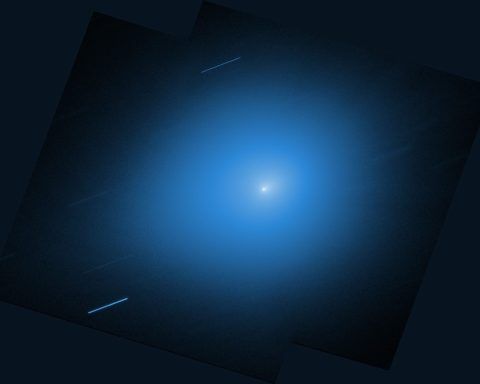
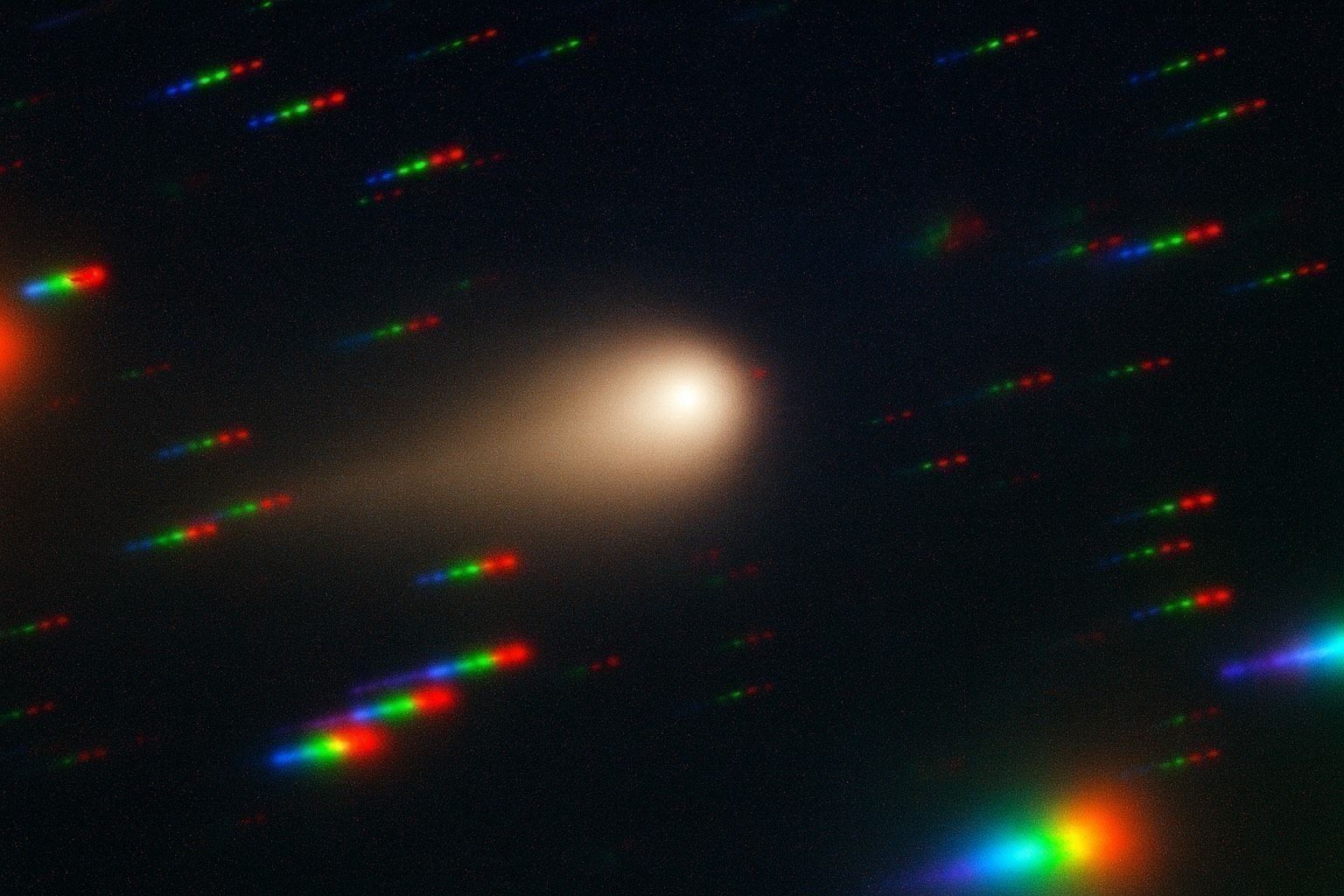
On November 30, 2025 , NASA’s Hubble Space Telescope turned its Wide Field Camera 3 back toward 3I/ATLAS for a highly anticipated second look.
At that moment, the comet was about 178 million miles (286 million km) from Earth . Hubble tracked the comet itself, so the background stars appear as streaks while the comet shows up as a sharp, compact nucleus wrapped in a glowing halo of dust and gas.
Highlights from Hubble’s new observations:
- The comet’s coma forms a bright blue‑green glow , likely dominated by gases such as cyanogen and ammonia along with dust reflecting sunlight.
- Compared with typical comets, 3I/ATLAS appears unusually bright for its distance , suggesting a very active surface or a lack of the “dust mantle” that normally dulls a comet after repeated passes around the Sun.Discover Magazine+ 1
- Faint structure in the outer regions hints at jets and early tail development , later confirmed more clearly by other spacecraft.
NASA first imaged 3I/ATLAS with Hubble in July 2025, soon after discovery, revealing a teardrop‑shaped cocoon of dust around the icy core. The new November 30 image lets scientists track how the coma and tails evolved as the comet swung through perihelion and began outbound.
Hubble is just one part of a multi‑mission campaign to chase this interstellar visitor from multiple vantage points across the solar system.
ESA’s Juice Spacecraft Catches the Comet With a Navigation Camera
While Hubble watched from Earth orbit, the European Space Agency’s Jupiter Icy Moons Explorer (Juice) got its own look at 3I/ATLAS from tens of millions of kilometers away — on the way to Jupiter.
During November 2025 , Juice pointed out five scientific instruments and its Navigation Camera (NavCam) at the comet. The team downlinked just a quarter of a single NavCam frame as a teaser, and it was enough to surprise them:European Space Agency+ 1
- The image, taken Nov 2 , shows a bright central coma with clear signs of two tails .
- A plasma tail of electrically charged gas stretches upward in the frame.
- A fainter dust tail appears to fan out toward the lower left.
Juice was about 66 million km from the comet at its closest approach on Nov 4 , catching 3I/ATLAS when it was fresh off perihelion and highly active . Detailed data from Juice’s JANUS, MAJIS, UVS, SWI and PEP instruments won’t arrive on Earth until February 2026 , because the spacecraft is using its high‑gain antenna as a heat shield , forcing it to send science data back at a reduced rate.
For comet researchers, Juice offers something unique: a deep‑space, side‑on view of an interstellar comet’s coma and tails, rather than the Earth‑centric angles we usually get.
A Solar System–Wide “Camera Array” Tracking 3I/ATLAS
NASA has effectively turned much of the solar system into a giant, distributed observatory for 3I/ATLAS. A dedicated campaign, summarized in “View Interstellar Comet 3I/ATLAS Through NASA’s Multiple Lenses,” coordinates observations from at least a dozen missions .NASA Science+ 1
These include:
- At Mars – Mars Reconnaissance Orbiter (HiRISE) and MAVEN captured some of the closest images and ultraviolet maps of hydrogen around the comet as it swept past Mars at ~19 million miles in early October. The Perseverance rover even snagged a faint smudge of the comet from the Martian surface.
- Near the Sun – Solar missions STEREO , SOHO , and the new PUNCH mission watched the comet sail through the inner heliosphere and behind the Sun from Earth’s point of view, tracking its evolving tail when ground‑based telescopes couldn’t see it at all.
- Deep‑space probes – Missions such as Lucy , Psyche , Europa Clipper , Parker Solar Probe and others have either already grabbed data or are ready to pounce when geometry allows.
This is the first time heliophysics missions have deliberately targeted an object from another star system , offering a new way to study how interstellar material behaves inside the Sun’s wind and magnetic field.
Psyche’s Long‑Distance Assist: Refining the Comet’s Path
One especially creative contribution comes from NASA’s Psyche mission , which is ultimately headed for a metal‑rich asteroid but briefly moonlighted as a comet tracker.
On Sept 8–9, 2025 , Psyche’s multispectral imager watched 3I/ATLAS for about eight hours when the comet was roughly 33 million miles (53 million km) from the spacecraft. Even at that distance, the imager’s sensitivity allowed precise tracking of the comet against the star field.
Those measurements help:
- Sharpen the trajectory and speed of the comet.
- Cross‑check ground‑based orbit solutions.
- Improve predictions for later encounters with Earth and Jupiter — crucial for planning additional observations and avoiding confusion with background stars.
It’s a preview of how multi‑mission coordination may become standard for future interstellar interlopers.
Chemistry Shock: Loaded With Methanol and Hydrogen Cyanide
If the new images are dramatic, the chemistry of 3I/ATLAS may be even more startling.
Using the Atacama Large Millimeter/submillimeter Array (ALMA) in Chile, a NASA-led team measured the gases escaping from the comet and found that it is unusually rich in methanol (CH₃OH) and hydrogen cyanide (HCN) — both key ingredients in many origin-of-life scenarios.
According to the ALMA study:
- Roughly 8% of all vapor leaving the comet is methanol , about four times higher than typical solar‑system comets.
- Hydrogen cyanide is also significantly enriched compared with normal cometary abundances.
- The molecules seem to come both from the solid nucleus and from tiny icy grains lifted into the coma.
A NASA astrochemist leading the work described these abundances as “among the most enriched values measured in any comet,” suggesting complex chemical reactions may be occurring within or just beneath the surface of 3I/ATLAS.Chrono+ 1
Scientists are excited for two big reasons:
- Prebiotic chemistry: Methanol and hydrogen cyanide are classic starting points for chemical pathways that build sugars, amino acids and other biologically relevant molecules. The discovery strengthens the idea that comets could deliver important raw materials for life to young planets — and that other planetary systems may brew similar chemistry .
- Interstellar fingerprints: These ratios differ markedly from those in most comets born in our own Oort Cloud or Kuiper Belt, giving a direct sample of chemistry from another star system .
Two recent research preprints go further, arguing that 3I/ATLAS shows signs of a metal-rich, carbonaceous composition and a surface layer that’s been heavily altered by galactic cosmic rays , which may explain some of its unusual coma chemistry and spectra.
XRISM’s Historic First: X‑Rays From an Interstellar Object
The biggest new development this week — and the one defining 3I/ATLAS news on December 10, 2025 — is that the comet has now been caught glowing in X‑rays .
Japan’s X‑Ray Imaging and Spectroscopy Mission (XRISM) , a joint project of JAXA , NASA and ESA , used its Xtend softxrism.jaxa.jp+ 1
What XRISM saw:
- A faint X‑ray halo stretching roughly 250,000 miles (400,000 km) around the comet , forming a broad emission structure around the nucleus.
- A spectrum showing excess X‑ray emission at energies associated with carbon, nitrogen and oxygen ions , beyond the background of our galaxy and Earth’s atmosphere.
This marks the first confirmed detection of X‑rays from any interstellar object , and specifically the first X‑ray detection of 3I/ATLAS .
The mechanism, however, appears to be entirely natural :
- As the comet approaches the Sun, it releases a vast cloud of neutral gas.
- The solar wind , a stream of charged particles, slams into that cloud.
- Through charge‑exchange reactions , ions from the solar wind steal electrons from the neutral atoms and emit X‑rays in the process.
This same process has been seen in ordinary solar‑system comets since the mid‑1990s, but never before around an interstellar visitor.
XRISM scientists caution that the faint extended glow must be teased apart from potential instrumental effects such as vignetting or detector noise, so follow‑up analysis is underway . But early results strongly suggest that 3I/ATLAS is wrapped in a giant, X‑ray–emitting gas envelope — a powerful new probe of its interaction with the solar wind.
Not an Alien Spaceship: Why Scientists Are Skeptical
The dramatic chemistry, odd brightness and now X‑ray glow have fueled a wave of online speculation that 3I/ATLAS is “alien technology” or a probe . Some of that energy comes from high‑profile commentary by Harvard astrophysicist Avi Loeb , who has argued that certain anomalies could, in principle, be consistent with artificial origins.Chrono+ 1
A recent analysis from the University of Washington’s Center for an Informed Public shows how those cautious scientific musings have been amplified into full-blown conspiracy narratives on social platforms — often stripping away caveats and presenting exotic explanations as if they were on equal footing with standard comet physics.
The mainstream scientific view, however, remains clear:
- All current observations — trajectory, non‑gravitational forces, coma chemistry, tails, and now X‑rays — can be explained by natural cometary processes : outgassing, solar heating, and cosmic‑ray processing of icy material.
- 3I/ATLAS follows a hyperbolic but gravitationally consistent orbit , with tiny deviations attributable to jets of vapor and dust, just as with many long‑period comets from our own Oort Cloud.
- Extraordinary claims (like a powered alien craft) require extraordinary evidence , and nothing so far demands an artificial explanation.
In other words: 3I/ATLAS looks weird because it’s interstellar and chemically unusual — not because it’s steering itself.
How Close Will 3I/ATLAS Get, and Can You See It?
To recap the geometry:
- Closest approach to Earth: about 1.8 AU (~170 million miles / 270 million km) on December 19, 2025 .
- Brightness: At best, around magnitude 9–11 , far below naked-eye visibility, and often fainter.
- Best viewing window: Early December 2025 , when the comet passes through Virgo and Leo in the predawn sky, visible in medium‑to large‑aperture telescopes under dark skies.
By the time most people hear about it, 3I/ATLAS will already have faded significantly. That’s why spacecraft observations — not backyard telescopes — are carrying most of the scientific load this time.
Why 3I/ATLAS Matters So Much
3I/ATLAS is scientifically precious for several reasons:
- Direct sample of another planetary system
Its material formed around another star, giving astronomers a rare chance to compare “alien” comet chemistry with our own . The methanol‑ and HCN‑rich coma, extreme CO₂ enrichment and possible metal‑bearing composition all hint that not all planetary systems build comets the same way.Chrono+ 2arXiv+ 2 - Galactic cosmic‑ray laboratory
The comet appears to have spent millions of years cruising through interstellar space , its outer layers baked by cosmic rays that convert CO into CO₂ and build organic‑rich crusts. Studying that crust tells us how interstellar ices evolve between star systems . - Multi‑mission coordination template
The 3I/ATLAS campaign — spanning Hubble, Juice, Mars orbiters and rovers, XRISM, ALMA and more — is a real‑world rehearsal for the next interstellar visitor. It demonstrates how quickly space agencies can pivot assets and share data when something truly rare appears. - Clues to life’s building blocks
The enhanced methanol and hydrogen cyanide show that prebiotic molecules can form efficiently in other star systems and survive long interstellar journeys. That supports scenarios where comets — both homegrown and interstellar — help seed young planets with complex organic chemistry . - Public engagement and misinformation stress‑test
Finally, 3I/ATLAS is a live case study in how mystery plus social media can spin speculative science into viral conspiracy theory. How the scientific community communicates about this comet may shape public expectations for the next, perhaps even stranger, interstellar visitor.
Timeline: 3I/ATLAS at a Glance (2025–2026)
- July 1, 2025 – Discovered by ATLAS telescope in Chile; hyperbolic orbit reveals interstellar origin.
- July 21, 2025 – Hubble captures first detailed image, showing a teardrop‑shaped dust cocoon.
- October 3, 2025 – Close pass by Mars (~0.19 AU); imaged by Mars orbiters and Perseverance rover.
- October 29, 2025 – Perihelion at ~1.36 AU from the Sun.
- November 2–4, 2025 – ESA’s Juice observes the comet, including the NavCam teaser image with two tails; closest approach to 3I/ATLAS at ~66 million km.
- Nov 19, 2025 – NASA publishes “View Interstellar Comet 3I/ATLAS Through NASA’s Multiple Lenses,” highlighting its solar system-wide campaign.NASA Science
- Nov 26–28, 2025 – XRISM’s Xtend telescope records the first X‑ray image of an interstellar object, revealing a halo ~250,000 miles across.
- Nov 30, 2025 – Hubble reobserves 3I/ATLAS with WFC3 at 178 million miles from Earth.
- Dec 3–4, 2025 – NASA details Psyche’s tracking campaign and releases the Hubble reobservation blog; ESA posts the Juice NavCam teaser.
- Dec 8–10, 2025 – New ALMA results (methanol and HCN) and XRISM X‑ray detections hit the news, cementing 3I/ATLAS as one of the most chemically and physically unusual comets ever studied .
- Dec 19, 2025 – Closest approach to Earth at ~1.8 AU.
- February 18 & 20, 2026 – Juice downlinks full datasets from its five science instruments.
- March 16, 2026 – 3I/ATLAS passes near Jupiter and continues outward into interstellar space, never to return.
Related articles: Space Exploration