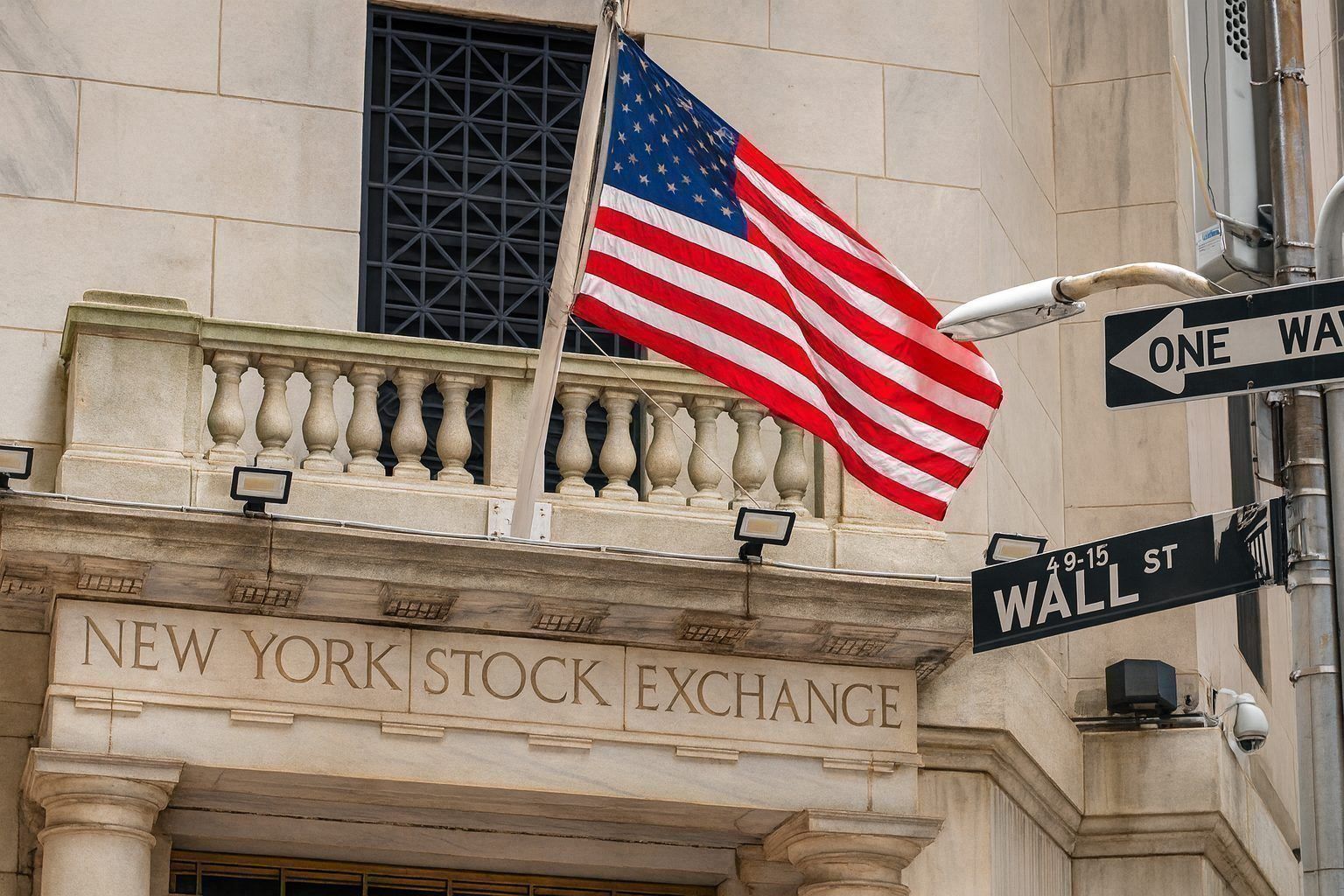

NEW YORK — Friday, December 12, 2025 — The United States stock market is heading into Friday with a split tone: Dow futures are modestly higher, while S&P 500 and Nasdaq futures are lower as investors reassess the cost—and profitability—of the AI buildout after fresh signals from Broadcom and Oracle.
In premarket trading at 5:41 a.m. ET, Dow E-minis were up 82 points (+0.17%), S&P 500 E-minis were down 13.5 points (-0.20%), and Nasdaq 100 E-minis were down 142.75 points (-0.56%).
That tension—AI “bubble” fears versus a broader rally powered by rate-cut optimism and sector rotation—has become the defining storyline of the week, especially after Thursday’s session left the Dow and S&P 500 at fresh record closes while the Nasdaq lagged. Reuters+1
Stock market snapshot: What just happened and what’s at stake today
Wall Street is coming off a record-setting Thursday in the blue chips and the benchmark index:
- Dow Jones Industrial Average:48,704.01 (+1.34%)
- S&P 500:6,901.00 (+0.21%)
- Nasdaq Composite:23,593.86 (-0.25%) Reuters
That split close matters because it reflects a market that is broadening out beyond mega-cap tech, even as some of the most crowded AI-linked trades show new cracks.
Today’s setup is essentially a test of whether the rally can keep expanding (financials, materials, value, small caps) even if AI enthusiasm cools at the margin.
Why futures are mixed: Broadcom’s margin warning reignites “AI bubble” anxiety
The immediate catalyst Friday is Broadcom—a key AI infrastructure bellwether.
Broadcom shares fell about 5% in premarket trading after the company warned that future margins could come under pressure due to a higher mix of AI-related business (including system sales), even while forecasting strong revenue.
That margin narrative quickly spread across semiconductors:
- AMD was down about 1.2% premarket
- Nvidia was down about 0.8% premarket Reuters
Broadcom’s own outlook highlights the tradeoff investors are now pricing in: AI demand may be robust, but the “quality” of AI revenue (margin, capex intensity, customer concentration) is becoming just as important as top-line growth. Reuters
Oracle’s stumble keeps pressure on the AI trade—even as the broader market holds up
The other major overhang is Oracle, whose results and spending outlook revived a question many investors hoped was behind them: Are companies overspending on AI before proving the returns?
Reuters reported Oracle shares dropped as much as 16.5% Thursday after the company pointed to an additional $15 billion in capital expenditures for fiscal 2026 versus what it had indicated in September—fueling concerns about timelines for AI payback.
Oracle’s move hit sentiment “under the hood” of the market, not because one stock defines the entire theme, but because it touches the core premise of the AI rally: a multi-year capex cycle that eventually translates into durable earnings growth. Strategists quoted by Reuters emphasized that investors have become more selective—less willing to reward AI spending automatically. Reuters
Notably, even with that anxiety swirling, the S&P 500 still ended Thursday at an all-time closing high—evidence that money is rotating rather than fleeing equities altogether.
The bigger story: a broadening bull market driven by rotation into value and small caps
While tech and AI names have been absorbing the headline pressure, Thursday’s tape looked like classic rotation:
- Materials and financials led, while technology and communications services lagged.
- The Russell 2000 (small caps) also closed at a record high on Thursday, alongside the Dow and S&P 500.
This is why many desks are framing Friday less as “risk-off” and more as “risk-on, but reallocated.” In other words: investors are still willing to own stocks, but they’re increasingly asking where the next leg of returns comes from if AI leadership becomes less reliable week-to-week. Reuters+1
MarketWatch also pointed to an early arrival of the so-called “January effect,” with small caps pushing ahead of larger indexes in mid-December—another sign that breadth is improving and that investors are hunting for laggards rather than simply chasing the biggest tech winners. MarketWatch
Fed policy: rate cuts are helping—yet today’s market is still arguing with the Fed’s own forecast
The macro backdrop remains supportive, but nuanced.
What the Fed did this week
The Federal Reserve delivered a widely expected 25-basis-point rate cut this week, its third straight cut, but also signaled caution about further easing—an important reason the market’s reaction has been rotation rather than a simple “everything rallies” melt-up. Reuters+1
What traders are pricing now
Even with the Fed projecting fewer cuts than the market would like, Reuters noted that traders are pricing about 50 basis points of cuts by the end of 2026, which is more easing than the Fed signaled.
The “surprise” liquidity angle
In a Reuters “Morning Bid” commentary published today, Fed Chair Jerome Powell was also described as announcing a Treasury bill buying program starting at $40 billion per month, a surprise detail that some investors interpret as an additional liquidity support. Reuters
What to watch today: Fed speakers
Markets will also be listening for remarks from Fed officials today, including Philadelphia Fed President Anna Paulson, Cleveland Fed President Beth Hammack, and Chicago Fed President Austan Goolsbee, as investors look for hints on whether the Fed is truly pausing or simply slowing down.
The data problem: investors are bracing for delayed jobs and CPI after the government shutdown
A major reason markets feel “jittery” despite record highs is that investors haven’t had their usual flow of hard macro data.
Reuters reported that a 43-day federal government shutdown delayed or disrupted key releases, and now a cluster of postponed reports is due next week, including:
- November U.S. jobs report (due Tuesday)
- Consumer Price Index (CPI) for November (due Thursday)
- plus retail sales and other releases Reuters
For the stock market, this sets up a classic late-year risk: thin holiday liquidity meeting high-impact data, which can amplify moves in either direction—especially if the reports challenge the “soft landing + easing inflation” narrative. Reuters
Key stocks in focus today: Broadcom, Oracle, Costco, Lululemon—and cannabis names
Beyond the index-level story, several single-stock moves are shaping Friday’s tape and sentiment:
Broadcom (AVGO): strong demand, margin doubts
Broadcom’s guidance underscored strong AI demand, but its warning that margins could dip as AI revenue grows has investors re-checking how much profitability is being sacrificed for growth.
Oracle (ORCL): capex shock reverberations
Oracle remains central to the “AI spending discipline” debate after its sharp decline Thursday and the focus on the size and financing of its infrastructure ambitions. Reuters
Costco (COST): holiday resilience, but valuation sensitivity
Costco reported quarterly revenue of $67.31 billion and profit of $4.50 per share, beating estimates cited by Reuters, but shares were only marginally lower after the bell—a reminder that “good news” can already be priced in when valuations are elevated. Reuters
Lululemon (LULU): leadership change sparks a bounce
Lululemon shares rose around 10% after the company said CEO Calvin McDonald will step down in January and it raised its annual profit forecast.
Cannabis stocks: regulatory speculation drives big premarket gains
Cannabis names jumped after the Washington Post reported that President Donald Trump is expected to push for easing federal restrictions, including a plan to direct agencies to reclassify marijuana as a Schedule III drug, according to Reuters.
Nasdaq 100 reshuffle risk: Strategy (MSTR) in the spotlight for potential index changes
One of today’s under-the-radar but potentially consequential developments is the Nasdaq 100 annual reshuffle, expected after Friday’s market close, with changes effective December 22.
Reuters reported that some analysts have flagged the risk that Strategy (MSTR)—the bitcoin-focused company formerly known as MicroStrategy—could face questions over whether it qualifies for inclusion, given debate around whether its model resembles a fund more than an operating tech business.
Why this matters: index reshuffles can trigger large passive flows. Reuters cited an estimate that if Strategy were removed, passive outflows could be around $1.6 billion.
Valuation check: the market is near records, but investors are watching “how expensive” it is
With the S&P 500 at record levels, valuation is back in the conversation—not as a timing tool, but as a risk amplifier.
Reuters reported the S&P 500 was trading at about 22 times expected earnings, down from 23 in October but above its 10-year average of 19 (per LSEG data cited by Reuters).
That context helps explain today’s push-pull:
- High valuations leave less room for disappointment (especially in AI leaders).
- Rate cuts and easing financial conditions support multiples—if inflation cooperates and growth holds up.
Forecasts and outlook: what strategists are saying about 2026 from today’s coverage
Although today’s focus is the Friday session, some of the most-read market content tied to Dec. 12 is already looking beyond year-end—especially because 2025 has been strong:
- Reuters reported the S&P 500 is up about 17% year-to-date in 2025, extending a bull market that began in October 2022.
Stifel’s Barry Bannister: base-case upside, recession risk scenario
Business Insider reported Stifel’s chief equity strategist Barry Bannister sees a base case of roughly a 9% gain for the S&P 500 in 2026, while warning that a recession scenario could trigger a swift ~20% drop.
Barron’s also described Bannister as cautiously upbeat, with a year-end 2026 S&P 500 target around 7,500 in his constructive case, while outlining downside paths if growth weakens or policy support disappoints.
The key takeaway for readers watching today’s tape: the market’s “next chapter” is increasingly about earnings breadth and economic durability, not just AI excitement.
What to watch for the rest of today’s session
Here are the catalysts most likely to drive headline moves in U.S. stocks today (Dec. 12, 2025):
- Semiconductor and AI leaders: can chip stocks stabilize after Broadcom’s margin commentary? Reuters+1
- Fed speaker tone: any pushback on the market pricing of future cuts could hit rate-sensitive areas (and potentially re-boost the dollar and yields).
- Positioning into next week’s delayed macro data: traders may reduce risk ahead of the postponed jobs and CPI reports, especially given lower holiday liquidity.
- Nasdaq 100 reshuffle headlines after the close: watch for index-related movers and passive-flow narratives.
Bottom line: the market’s message today is “rotation, not retreat”
The U.S. stock market today isn’t simply “up” or “down.” It’s telling a more specific story:
- AI is still the growth engine, but investors are newly sensitive to cost, margins, and financing.
- Lower rates are helping, and the rally is broadening into value and small caps.
- The next major test isn’t another earnings beat—it’s the return of key economic data after the shutdown delays, and whether it confirms a soft landing.
Related articles: NASDAQ:AVGO