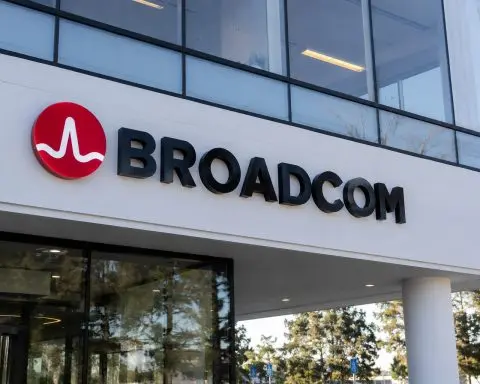

Broadcom beat Q4 estimates, lifted its dividend, and guided Q1 revenue to $19.1B as AI chip sales accelerate—yet investors sold off on margin and AI payback concerns.
Dec. 12, 2025 — Broadcom’s latest earnings were supposed to be a clear win for the AI infrastructure trade: record quarterly revenue, a stronger-than-expected outlook, and a fast-growing pipeline of custom AI chips and networking gear powering hyperscale data centers. Instead, the company’s shares fell sharply on Friday as Wall Street fixed on one uncomfortable detail— profitability may be getting squeezed as AI becomes a bigger piece of the business .
The whiplash response captured a broader shift underway in markets this week: investors are increasingly demanding not just “AI growth,” but AI growth with sustainable margins and clearer payback timelines — especially after massive spending plans from Big Tech and cloud players reignited bubble fears.Reuters+ 2Reuters+ 2
Broadcom’s Q4 results: record revenue, big AI momentum, higher dividend
Broadcom said fourth-quarter revenue rose 28% year over year to $18.015 billion , with GAAP net income of $8.518 billion and non-GAAP diluted EPS of $1.95 . The company also reported adjusted EBITDA of $12.218 billion (68% of revenue) and free cash flow of $7.466 billion (41% of revenue) —numbers that underscore how much cash Broadcom is throwing off even while investing heavily in AI-related capacity.
It also raised its shareholder payout: Broadcom increased its quarterly dividend by 10% to $0.65 per share , citing stronger cash flows.
Behind the headline beat was a familiar AI story: data centers are scaling fast, and customers are increasingly buying more than just chips—they’re buying entire platforms of accelerators, networking, optical components, and system-level infrastructure .
Segment snapshot: semiconductors and both software grew
Broadcom’s earnings release showed continued strength across its two main segments:
- Semiconductor solutions: $11.072 billion in Q4 revenue
- Software infrastructure: $6.943 billion in Q4 revenuePR Newswire
While Broadcom’s AI narrative is dominated by chips and networking, its infrastructure software portfolio—boosted by VMware—remains a major contributor to revenue and margins.
The forecast that should have cheered investors—$19.1B next quarter
Broadcom guided first-quarter fiscal 2026 revenue to approximately $19.1 billion , ahead of the consensus estimates cited by major market coverage, and projected adjusted EBITDA at about 67% of revenue .
Crucially, CEO Hock Tan said Broadcom expects AI semiconductor revenue to double year over year to $8.2 billion in Q1 , driven by custom AI accelerators and Ethernet AI switches —two areas where Broadcom has become one of the most important suppliers outside of Nvidia’s ecosystem.
So why wasn’t that enough?
Why Broadcom stock fell on Dec. 12: margins, mix shift, and “AI payoff” anxiety
Even with a beat-and-raise quarter, Broadcom’s shares dropped steeply on Friday—reported as down roughly high single-digits in shares of the session, and more than 11% at one point in trading—dragging other AI-linked hardware names with it.
The core issue: Broadcom warned that margins are likely to decline as AI becomes a larger share of sales .
CFO Kirsten Spears said the company expects first-quarter consolidated gross margin to fall by about 100 basis points sequentially , “primarily reflecting a higher mix of AI revenue.”Reuters+ 1
That matters because the market has increasingly treated Broadcom like a premium “AI infrastructure” compounder. When a premium stock signals that its fastest-growing revenue stream may carry lower margins—especially as it expands into system-level sales —investors tend to reprice risk quickly.
System sales: bigger ticket, lower gross margin
Analysts and Broadcom’s own commentary have pointed to a key mix change: a growing portion of AI revenue is expected to come from systems (think racks and broader configurations), not only chips. These system sales can include substantial pass-through components, which typically compress gross margins even when overall profit dollars rise.
Reuters reported analyst concerns that Broadcom’s AI backlog and customer concentration, combined with future lower margins for AI system sales , helped drive the selloff.
The earnings-call transcript also reflected this tension: executives indicated gross margins may deteriorate as more system shipments ramp, while operating leverage could still support operating profit growth.
“Great numbers, but not enough visibility”
Another theme emerged in Friday’s post-earnings commentary: expectations were extremely high , and some investors wanted more long-range clarity on AI revenue beyond the next quarter.
Business Insider reported that some investors were underwhelmed by Broadcom’s $73 billion AI backlog and by what they viewed as limited full-year AI revenue guidance.
Investopedia also framed Friday’s move as part of a broader “AI trade” pullback, where even strong results aren’t automatically rewarded as investors worry about overstretched positioning and bubble risk.Investopedia
The $73B AI backlog: what it is—and what it isn’t
Broadcom has increasingly become the “go-to” partner for hyperscalers building custom AI chips (often called ASICs) and the high-throughput networking needed to connect massive AI clusters.
The company said it has about $73 billion of AI-related backlog expected to be delivered over the next 18 months , a figure frequently cited across Dec. 12 coverage.
Importantly, executives also cautioned that backlog is a snapshot , and they expect additional orders to come in over time—meaning the $73B figure isn’t necessarily a ceiling on near-term opportunity.
Still, Reuters noted that investors and analysts highlighted customer concentration —with the AI backlog tied to a small number of customers—as a risk factor in how the market is valuing the business.
Broadcom’s AI engine: custom accelerators plus networking at scale
Broadcom’s AI position is often misunderstood as “just chips.” In reality, the company sits at a strategic intersection:
- Custom AI accelerators (ASICs / XPUs): chips designed for specific customers’ models and workloads
- AI networking: high-speed Ethernet switching silicon and related connectivity components
On the earnings call, Broadcom leadership described strong demand not only for custom accelerators but also for data-center networking and optical components tied to AI cluster buildouts.
Anthropic and Google TPUs: a high-profile example of demand
One of the most closely watched customer threads involves Google’s TPU ecosystem and large AI labs that buy TPU capacity.
Reuters reported Broadcom secured massive contracts including $21 billion from Anthropic over the past two quarters tied to Google’s custom “Ironwood” chips—highlighting just how large custom silicon commitments have become.Reuters
That kind of scale helps explain why Broadcom is viewed as an increasingly central player in the AI supply chain—even as investors debate how much profit the company will ultimately retain per incremental AI dollar.
OpenAI, timelines, and the market’s growing sensitivity to “when” revenue arrives
Broadcom’s relationship to OpenAI has been in the spotlight for months, and it resurfaced again in Dec. 12 coverage—partly because investors are voting the funding and payoff timelines behind AI infrastructure spending.
The 10-gigawatt OpenAI–Broadcom partnership
In October, OpenAI and Broadcom announced a strategic collaboration to deploy 10 gigawatts of OpenAI-designed AI accelerators , with deployments targeted to begin in the second half of 2026 and run through end of 2029 .
What spooked investors this week: near-term payback expectations
According to Investing.com’s coverage of the earnings call, Tan suggested Broadcom does not expect the OpenAI contract to yield much in 2026, with the bulk of returns more weighted to 2027–2029 .
That nuance matters in today’s market. With investors already unsettled by signs of ballooning AI capex across the ecosystem, anything that pushes meaningful revenue further out can trigger skepticism—especially when “AI infrastructure” trades are priced for near-term acceleration.Reuters+ 1
The broader market backdrop on Dec. 12: AI bubble nerves and rotation away from mega-cap tech
Broadcom’s stock drop didn’t happen in isolation. Reuters reported the S&P 500 and Nasdaq slipped Friday as Broadcom added to concerns about AI-fueled market excess, even as other parts of the market held up better—consistent with a rotation into value and away from the most crowded AI trades.
Investopedia similarly noted that several AI hardware-linked names moved lower alongside Broadcom, reflecting a “risk-off” mood around AI positioning rather than a single-company miss.Investopedia
What to watch next for Broadcom and the AI chip market
Broadcom’s Dec. 12 storyline is less about demand—demand appears robust—and more about the shape of that demand and what it means for profitability and valuation.
Key themes to watch in coming quarters:
- Gross margin trajectory: investors will look for evidence that margin compression is controlled, even as AI mix rises.
- System sales ramp: as more AI revenue shifts from chips into systems, the market will judge whether operating profit scales fast enough to offset gross margin dilution.
- Customer concentration vs. diversification: Broadcom’s AI backlog has been linked to a relatively small set of customers; incremental wins could reduce perceived risk.
- OpenAI revenue timing: with deployment targeted for 2026–2029, investors will watch for concrete milestones that support the longer-dated payoff narrative.
- Broader “AI capex” sentiment: macro and sector mood can overwhelm company-specific results—especially when investors are debating whether AI infrastructure spending is sustainable.Reuters+ 1
Bottom line
Broadcom delivered the kind of quarter that, on paper, checks nearly every box: record revenue, a strong outlook, accelerating AI semiconductor sales, and a higher dividend.
But on Dec. 12, 2025, the market delivered a different verdict: in the current phase of the AI cycle, growth alone isn’t the headline—margins, mix, and timing are. And until investors get comfortable that Broadcom’s AI surge will translate into sustainable profitability (not just bigger revenue), volatility is likely to remain part of the story.
Related articles: NASDAQ:AVGO