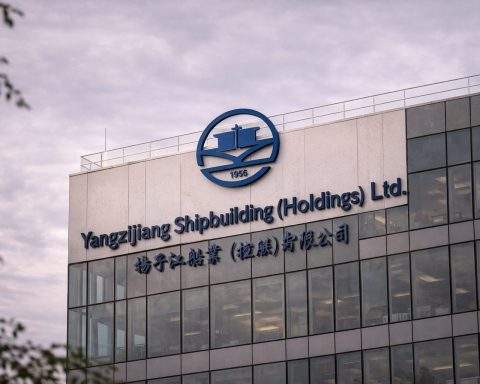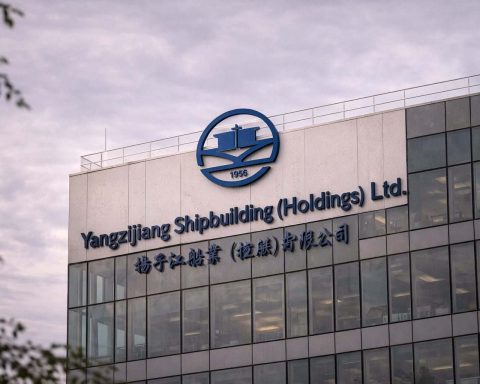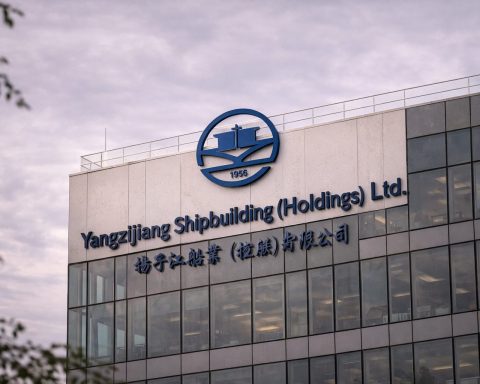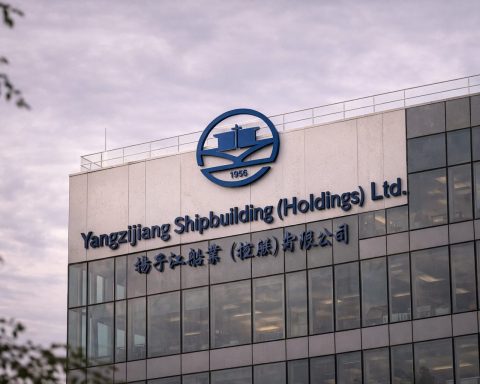

SINGAPORE — Dec. 13, 2025 — Yangzijiang Shipbuilding (Holdings) Ltd. has become a classic “industrial reality vs. geopolitical narrative” stock: investors are weighing a massive, multi-year orderbook and robust margins against policy shocks, sanctions-related contract risks, and a shipping-demand cycle that can turn on a dime.
As of the latest available close (Dec. 12, 2025), Yangzijiang Shipbuilding stock SGX:BS6 finished at S$3.49, up 0.29% on the day.
What follows is a roundup of the latest company news, macro developments, and analyst forecasts relevant to Yangzijiang Shipbuilding as of Dec. 13, 2025—and why the next leg for the stock may hinge less on “whether ships will be built” and more on which ships, for whom, and under what rules.
Where Yangzijiang Shipbuilding stock stands today
At S$3.49 (Dec. 12 close), the stock is trading in a zone where the market is no longer pricing “panic,” but also not granting a full premium for long-duration earnings visibility. SG Investors+1
That middle ground makes sense given 2025’s storyline: earlier in the year, Yangzijiang’s share price was caught in the crossfire of U.S. policy proposals aimed at China-linked shipping and shipbuilding. A Singapore Business Times column noted the stock had slid sharply after the U.S. proposed port-fee measures in February, underscoring how quickly sentiment can swing even when a yard’s production line stays full.
The biggest company driver: a US$22.8 billion orderbook (and it’s increasingly “green”)
The most important fundamental anchor is still the orderbook.
In its Nov. 17, 2025 business update, Yangzijiang reported year-to-date order wins of about US$2.2 billion, while its outstanding orderbook stood at about US$22.8 billion across 245 vessels. Crucially, green vessels accounted for 71% of total orderbook value, and container ships dominated the mix (reported at US$16.2 billion across 126 vessels).
That same update also said the group had delivered 46 vessels year-to-date, against a full-year target of 56.
Seatrade Maritime’s late-November coverage similarly framed the orderbook as a multi-year visibility engine—highlighting US$2.17 billion of new orders in 2025 (as of the update), and noting deliveries stretching through to 2030.
Why this matters for the stock: in shipbuilding, the orderbook isn’t just “future revenue.” It’s also negotiating leverage with suppliers, workforce planning stability, and—if execution stays tight—margin durability across cycles. The market tends to pay up when it believes those earnings are “locked,” and discount when it suspects delays, renegotiations, or cancellations.
The 2025 curveball: U.S. port-fee pressure… and then a one-year suspension
If 2025 had a single word, it might be “policy.”
Earlier concerns about U.S. port-fee measures targeting China-linked vessels were widely seen as a potential demand shock for Chinese yards, because shipowners could pivot ordering toward Korean or Japanese yards to reduce future route constraints or fee exposure. Seatrade reported that Yangzijiang’s orders were hit amid uncertainty tied to the U.S. Trade Representative’s (USTR) proposed port fees, before orders improved later in the year.
Then came a major reversal: the USTR formally announced a one-year suspension of the Section 301 action related to China’s maritime/logistics/shipbuilding dominance—effective Nov. 10, 2025. United States Trade Representative
The White House fact sheet on the U.S.–China deal also states the U.S. would suspend for one year (starting Nov. 10, 2025) the responsive actions taken pursuant to that Section 301 investigation while negotiations proceed. The White House
Reuters reporting around the deal and the pause reinforced that this created a 12‑month reprieve on the port-fee dispute that had disrupted trade and freight markets.
Implication for Yangzijiang (and for BS6 shareholders): the suspension doesn’t erase geopolitics—nothing ever truly does—but it does reduce the probability of an immediate “order drought” driven purely by U.S. port-fee avoidance behavior. In other words: the market’s worst-case scenario got shoved one year further into the future, and that time is valuable in shipbuilding because berths and delivery slots are planned years out.
Recent contract headlines: more orders, but also a sanctions-linked cancellation
Orders rebounded after mid-year weakness
A key datapoint from Seatrade’s Sept. 29 coverage: Yangzijiang said it had booked US$1.9 billion in new orders so far in 2025 at that point (44 newbuildings), a sharp rebound compared with the much weaker order pace reported earlier in the year when policy uncertainty was peaking.
But contract quality and compliance risk stayed in focus
The same day, Seatrade also reported Yangzijiang cancelled four MR product tanker contracts after allegations emerged that the buyer’s shareholder was involved in a sanctions-circumvention scheme. The contracts were associated with US$180 million in value; Yangzijiang indicated it had received deposits and stated the termination was not expected to have a material impact, with no revenue/profit recognized from them in 1H 2025.
For equity investors, this matters less for the direct financial hit (which was framed as immaterial) and more for what it signals: shipbuilding is increasingly shaped by customer screening, sanctions exposure, and financing pathways—and those risks can create headline volatility even in a strong market.
Ownership and flow: BlackRock’s substantial-shareholder exit was a notable 2025 event
Another stock-specific headline that investors watched closely: BlackRock sold about 37.8 million shares in late October 2025, and the sale meant it ceased to be a substantial shareholder, according to a Business Times report published Nov. 5, 2025. The stock fell on the news, before paring losses.
This type of event can matter even if fundamentals are unchanged, because large-holder selling can temporarily change supply/demand dynamics, amplify volatility, and influence how other institutions time entries.
Analyst forecasts as of Dec. 13, 2025: targets cluster above the current price
Analyst outlooks in late 2025 generally leaned constructive—with the fine print that execution and policy stability still matter.
UOB Kay Hian: Buy, target S$4.10; focus on 2026 order potential and margin resilience
An excerpt of UOB Kay Hian Research (Nov. 19, 2025) circulated by SGinvestors maintained a BUY with a higher target price of S$4.10. The note highlighted management commentary around:
- confidence in potential ~US$4.5b of new orders for 2026,
- 2026 shipbuilding margins expected to be comparable to 2025 (with margin drivers including FX, steel prices, and earlier-secured equipment),
- and the idea that enquiries returned in 2H 2025 as U.S. port-fee pressure eased.
It also flagged catalysts (execution, sustaining >30% margins, higher-margin vessel wins) and risks (yard issues, trade-war resumption, steel volatility).
Broker target-price range shown publicly: S$3.80 to S$4.10 (and higher elsewhere)
SGinvestors’ compiled target-price page for BS6 shows, among recent entries:
- DBS Research (Oct. 2, 2025): BUY, S$3.80, and
- UOB Kay Hian (Nov. 19, 2025): BUY, S$4.10.
Other market-distributed summaries (including syndication platforms) cited higher targets (for example, CGS figures reported elsewhere), but investors should always confirm the underlying report assumptions and date, because shipbuilding valuation is extremely sensitive to margin and order-price assumptions.
Consensus-style snapshot: TipRanks shows Buy-heavy ratings with ~S$3.92 average target
TipRanks’ tracking for SG:BS6 shows the stock receiving Buy ratings in the current month and an average price target around S$3.92 (as presented on its platform).
What that means numerically:
Using the S$3.49 last close (Dec. 12), a S$3.92 target implies about 12% upside, while a S$4.10 target implies about 17% upside, and a S$4.51 target implies roughly 29% upside—before considering dividends, and assuming the target horizon and assumptions hold.
The business logic behind bullish forecasts: “margin + slots” beats “volume at any price”
One of the more interesting late-2025 themes in analyst commentary is that Yangzijiang appears intent on protecting profitability rather than chasing lower-priced volume.
UOB Kay Hian’s excerpted note described:
- softened containership newbuild prices (citing ~10% easing year-to-date),
- but also highlighted management’s emphasis on maintaining profitability, with many steel requirements locked in for 2026 (supporting medium-term margins).
This matters because shipbuilding booms often end the same way: too many yards chase too many orders at too-low margins. A yard that stays disciplined can look “slower” in the short term—but can also avoid the nasty earnings hangover later.
Macro watch: shipping demand signals are mixed heading into 2026
Even with policy pressure reduced, the global shipping cycle still matters because it drives shipowner confidence and financing appetite.
A Reuters report on Dec. 9, 2025 said U.S. container imports fell 7.8% in November year-on-year, and imports from China fell sharply—reflecting softer demand and importer caution amid a dynamic tariff backdrop.
For shipbuilders, the key isn’t one monthly datapoint—it’s whether shipowners start to believe the next 24–36 months require more capacity (new orders) or less (wait, defer, charter existing tonnage). That’s why Yangzijiang’s order pace and pricing in early 2026 will likely be watched just as closely as its delivered profits.
Corporate structure headlines: Yangzijiang’s “third listing” adds narrative complexity (but also optionality)
A related group-development that turned heads: Yangzijiang Maritime Development debuted on the Singapore Exchange in November 2025. Seatrade described it as a maritime-focused investment company (asset investments, ship financing/services) and noted it was spun off from Yangzijiang Financial Holding as part of a restructuring.
This is not the same as Yangzijiang Shipbuilding (BS6), but it can influence the “Yangzijiang ecosystem” narrative in Singapore markets—especially around financing capacity, maritime services, and how investors value the shipbuilding core versus adjacent platforms.
Industry/ship-order signals: container orders continue to surface
Beyond headline corporate updates, ongoing vessel orders in the broader market help validate demand for the types of ships Yangzijiang builds.
For example, a trade publication reported that Interasia signed a contract with Jiangsu YangZiJiang Shipbuilding Group for six 2,900 TEU container vessels (with options for two more), with delivery scheduled for 2028.
Investors should treat single customer orders as supporting evidence rather than a full thesis—but this kind of flow suggests that even amid policy noise, owners are still committing to multi-year fleet plans.
Bottom line on Dec. 13, 2025: what could move BS6 next?
At today’s price level, Yangzijiang Shipbuilding stock is no longer just a “cheap cyclical.” It’s increasingly a bet on three things:
- Execution credibility — deliver vessels on time and on budget across a long pipeline.
- Margin endurance — maintain strong shipbuilding profitability as input costs, FX, and competitive pricing evolve.
- Policy temperature — the one-year U.S.–China suspension reduces immediate shock risk, but the long-term direction of maritime industrial policy remains a live wire.
If the company keeps converting a large orderbook into cash and earnings while adding “higher-quality” (often greener, more complex) orders, the logic behind above-market target prices becomes easier to defend. If geopolitics flares again—or if the shipping cycle sours sharply—Yangzijiang’s valuation can compress fast, because shipbuilding is one of the few industries where the product takes years to deliver and sentiment can change in weeks.
Related articles: SGX:BS6