
NEW YORK, Aug. 10, 2026 — Shares of Tenax Therapeutics NASDAQ:TENX tumbled around 85% ahead of Monday’s market open after the company reported that its Phase 3 LEVEL trial with oral levosimendan did not achieve its primary endpoint for exercise capacity or its main symptom endpoint.
- TENX was last at $2.08 as of 8:30 a.m. EDT, a decline of 84.5% from its previous close of $13.44 on Friday, with premarket volume at 3.67 million shares.
- The total increase in 6-minute walk distance was 3.5 meters compared to placebo (p=0.63), and the treatment difference seen on the Kansas City Cardiomyopathy Questionnaire was 0.1 point.
- A more robust outcome in a prespecified subgroup does not compensate for an unsuccessful primary analysis, as its nominal p-value lacks adjustment for multiple comparisons.
The drop wiped out approximately $425 million in core equity value during premarket trading. Tenax’s market capitalization stood at about $77.8 million, based on 37.4 million common shares disclosed as outstanding on July 28, down from nearly $503 million at Friday’s market close. Price and trading volume data are sourced from Public.com, while Reuters separately noted a preliminary opening drop of over 80%.
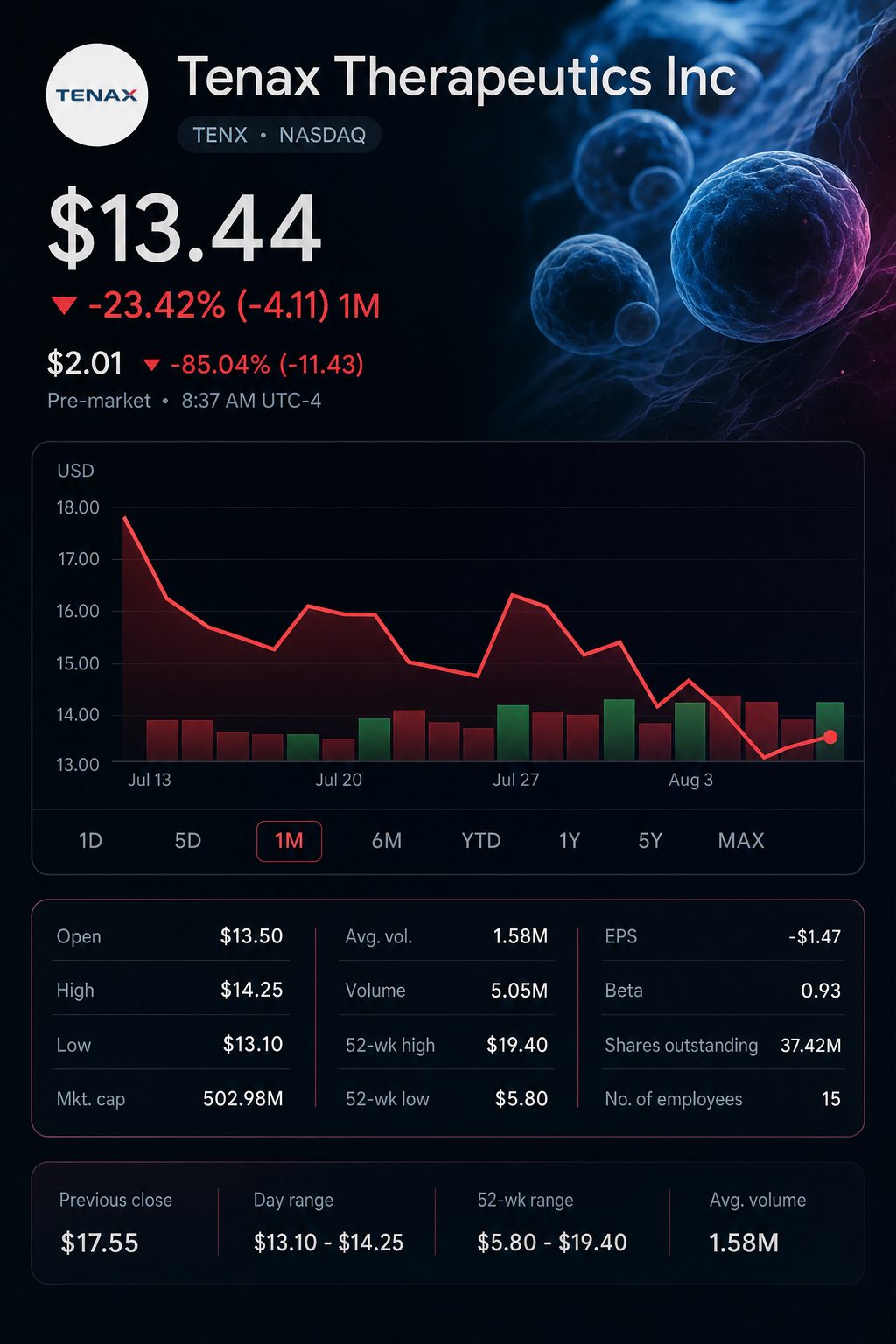
| Market measure | Before readout | Aug. 10 premarket | Change |
|---|---|---|---|
| Share price | $13.44 | $2.08 at 8:30 a.m. EDT | -84.5% |
| Basic implied market cap | About $503.0 million | About $77.8 million | About -$425.1 million |
| Trading volume | 2.09 million on Aug. 7 | 3.67 million premarket | 1.8 times the previous full session |
LEVEL enrolled 241 patients with pulmonary hypertension linked to heart failure with preserved ejection fraction (PH-HFpEF) across 41 sites in the United States and Canada. Participants were given TNX-103 or placebo for 12 weeks under double-blind conditions, the company said in an SEC filing.
For the primary endpoint, the least-squares mean rise in 6-minute walk distance reached 14.0 meters in the TNX-103 group, compared to 10.4 meters for placebo. The difference between the two groups, adjusted for placebo at 3.5 meters, did not reach statistical significance. Regarding the key secondary endpoint, both groups saw similar improvements in the Kansas City Cardiomyopathy Questionnaire total symptom score.
| LEVEL measure | TNX-103 | Placebo / comparison | Investor reading |
|---|---|---|---|
| 6-minute walk distance, overall | +14.0 meters | +10.4 meters; difference +3.5 meters, p=0.63 | Main goal not achieved |
| KCCQ total symptom score | +6.6 points | +6.5 points; difference +0.1 | Main secondary measure not met |
| Baseline walk below 333 meters | Average improvement: +26.7 meters | -2.6 meters; LS difference +26.3, nominal p=0.0112 | Subgroup signal observed, not definitive |
| NT-proBNP, overall | 49% larger decline | Ratio 0.51; nominal p<0.0001 | Sign of exploratory biomarker |
| Right-ventricular systolic pressure | -3.5 mmHg versus placebo | Nominal p=0.0045 | Sign for exploratory hemodynamics |
The most notable positive result appeared in the subgroup of 119 patients whose baseline walk distance was below the 333-meter trial median. This group saw a placebo-adjusted gain of 26.3 meters, with a 95% confidence interval ranging from 6.0 to 46.7 meters. Tenax, however, clearly stated that these subgroup and exploratory p-values are nominal, not adjusted for multiplicity, and are not sufficient to demonstrate efficacy. That caveat is key: the overall primary analysis yielded p=0.63, well above the conventional threshold for statistical significance.
Biomarker results trended positive. TNX-103 led to a 49% bigger drop in NT-proBNP compared to placebo and cut estimated right-ventricular systolic pressure by 3.5 mmHg. Safety outcomes were mixed: serious adverse events were nearly the same at 10.8% compared with 10.7%, while any adverse event was reported in 86.7% of patients on TNX-103 versus 71.9% on placebo, and treatment-related adverse events occurred in 38.3% of those receiving TNX-103 compared to 17.4% given placebo.
Tenax intends to ask for a Type C meeting with the U.S. Food and Drug Administration and will approach the European Medicines Agency for input on increasing future enrollment of patients with higher disease burden. This represents a proposal to regulatory agencies rather than an endorsement of the subgroup by regulators. The company’s claim that earlier FDA feedback might allow a single Phase 3 trial with p=0.01 does not make LEVEL’s unadjusted subgroup analysis a positive pivotal outcome.
The primary strategic focus now centers on the ongoing worldwide LEVEL-2 trial. Management faces a choice: modify the study, proceed as planned, or begin further research following regulatory input. Full LEVEL results will be presented during a late-breaking session at the European Society of Cardiology Congress in Munich on Aug. 29.
The balance sheet complicates the picture behind the headline drop. Tenax disclosed $118.0 million in cash as of June 30 and subsequently added $8.1 million from warrant exercises after the quarter closed. The company’s plan prior to the readout allowed for sufficient funding to last through the second quarter of 2028, as stated in the latest Form 10-Q.
| Financial measure | Latest reported value | Why it matters now |
|---|---|---|
| Cash at June 30 | $118.0 million | Exceeds the $77.8 million basic implied market cap |
| Post-quarter warrant proceeds | $8.1 million | Boosts liquidity, but increases number of common shares |
| H1 operating cash use | $23.5 million | Equivalent to around $3.9 million monthly on average |
| H1 net loss | $33.5 million | No product-generated revenue to offset development costs |
| Common plus near-common economic base | About 53.6 million shares | Values the company at roughly $111.5 million at $2.08 per share, bringing it much closer to cash |
Cash does not serve as a strict valuation floor. As of June 30, the company held 19.9 million pre-funded warrants, with most available for exercise at one cent, and additional exercises have since expanded the outstanding common share count. On a combined economic share basis—common plus remaining pre-funded—around 53.6 million shares, the premarket equity value stood at approximately $111.5 million, positioning it close to disclosed cash levels rather than substantially beneath them. Trial expenses, potential protocol adjustments, licensing requirements, and anticipated operational losses could reduce this cash balance.
Wall Street price targets remain outdated until analysts reassess TNX-103. According to the company's official coverage roster and rating data collected by Benzinga and MarketBeat, nine brokerages held an average pre-readout target of $37.67, with most firms positive on the stock. All of these ratings were issued before the trial failed its endpoint.
| Firm | Latest pre-readout call | Date | Price target |
|---|---|---|---|
| Piper Sandler | Overweight | June 12 | $50 |
| Guggenheim | Buy | June 22 | $40 |
| Evercore ISI | Outperform | July 22 | $39 |
| Canaccord Genuity | Buy | July 28 | $35 |
| Cantor Fitzgerald | Overweight | July 29 | $35 |
| Chardan | Buy | July 31 | $27 |
| Weiss Ratings | Sell | June 30 | Not disclosed |
Tenax is a cardiopulmonary developer without approved products generating revenue, with oral levosimendan as its main focus. The company had previously moved imatinib development down its list of priorities. This focus is the reason why the failed pivotal trial led to such a sharp plunge in shares: investors were not simply discounting a single asset in a varied portfolio, but reassessing both the likelihood and timeline of Tenax’s main commercial prospect.
Key upcoming valuation signals include management’s in-depth commentary on the readout, potential protocol decisions on LEVEL-2, minutes or feedback from FDA and EMA meetings, and the comprehensive ESC presentation. Investors are also monitoring for possible analyst target withdrawals or steep reductions after assessing the subgroup breakdown, along with any updates from Tenax regarding its cash-runway estimate should the development plan shift.
Risks: The subgroup effect might not be replicated, regulators could request an additional well-controlled study, LEVEL-2 modifications may increase both time and expenses, and the company, despite its existing cash, might still seek extra funding. On the other hand, a light but active premarket could distort price signals; broader data, endorsement of enrichment by regulators, or lasting biomarker impact may help maintain TNX-103’s value beyond what Monday’s first price suggests.
Currently, the market is clear: promising exploratory biology is not receiving the same valuation as a successful Phase 3 result. While TENX appears to have cash backing based on its basic share count, the presence of near-common warrants and a possibly extended, uncertain development timeline means the post-crash valuation may not be as inexpensive as it initially seems.