Frankfurt heads into the new week with the DAX balancing on a familiar year-end tightrope: global rate-cut optimism has improved risk appetite, but rising European bond yields and renewed debate about AI-driven equity valuations are keeping traders selective.
On Friday, 12 December 2025, Germany’s benchmark index finished at 24,186.49, ending the session lower as risk sentiment cooled into the weekend. RTTNews Even so, several weekly summaries put the DAX modestly higher on the week (around +0.7%)—a gain built on mid-week central-bank relief that was later tested by a fresh wave of “AI bubble” jitters. T. Rowe Price+2Trading Economics+2
Below is what mattered in 8–14 December 2025, and what will likely drive Germany’s stock market on 15–19 December 2025.
What moved Frankfurt markets this week (8–14 December 2025)
1) Bond yields surged — and that mattered for rate‑sensitive German sectors
The story that kept resurfacing across European trading desks was simple: yields up, valuation pressure up.
- On 8 December, Reuters highlighted that Germany’s 30-year yield rose to around 3.466%, the highest since July 2011, weighing particularly on real estate stocks.
- By 10 December, Reuters reported Germany’s 10-year Bund yield hitting about 2.87%, a nine‑month high, with markets reassessing whether the European Central Bank is truly done.
Why it matters for Frankfurt: higher long-end yields can hit the sectors the DAX tends to use as “bond proxies” (real estate, utilities) while supporting banks’ interest-rate narratives—at least until growth concerns dominate.
2) The Fed delivered a cut — but the message was not “all clear”
The global tone setter was the U.S. Federal Reserve decision on 10 December.
- The Fed set policy to a target range of 3.5%–3.75% (effective 11 December).
- Reuters described a divided decision and emphasized the signal of a likely slower path for additional cuts, with projections pointing to only one cut in 2026 (per Reuters’ reporting on the meeting and outlook).
For German equities, the near-term boost from easier U.S. financial conditions competed with two counterweights:
- a less dovish-than-hoped policy trajectory, and
- the knock-on impact on EUR/USD and European rate expectations.
A Reuters global markets wrap also noted the euro strengthened (to a multi‑week high) after the Fed decision—an issue for export-heavy indices like the DAX when currency moves accelerate.
3) AI valuation anxiety returned — and it spilled into Europe
Just as markets tried to pivot into a “rates down, risk up” narrative, the AI trade delivered another round of volatility.
Reuters reported that renewed concern about an AI-fueled rally—sparked by U.S. corporate news flow—pushed European shares lower on 12 December, with the DAX down on the day as the broader market turned risk-averse.
This matters in Frankfurt even though Europe has less mega-cap AI concentration than the U.S.: the DAX still includes globally priced growth names (and suppliers into tech capex cycles) and reacts when global risk premia shift quickly.
4) German data improved at the margin — but the “Germany is the drag” narrative didn’t disappear
Germany delivered a cluster of macro prints that were “less bad,” yet not strong enough to silence structural worries.
- Industrial production (October 2025): Destatis reported output +1.8% month-on-month, above prior momentum, with industry excluding energy and construction +1.5% m/m.
- Exports (October 2025): Destatis reported exports +0.1% m/m while imports fell -1.2% m/m (seasonally and calendar adjusted). Destatis
Reuters added that the export rise surprised forecasts, while shipments to the U.S. and China fell sharply, underscoring uneven external demand. - Inflation: Reuters reported Germany’s HICP inflation confirmed at 2.6% year-on-year in November.
Yet sentiment remained fragile:
- Reuters reported the euro zone Sentix investor morale improved slightly, but Germany’s reading weakened, and Sentix described Germany as a regional “stumbling block.” Reuters
- Separate Reuters reporting noted major German institutes warning the economy is stabilized but stuck in weak growth, with downgrades and concerns tied to structural issues and tariff risks.
Bottom line for the DAX: the tape can rally on incremental improvement, but macro disappointment risk remains high—especially if markets begin pricing an ECB that’s less supportive than hoped.
5) Stock-specific headlines that mattered in Frankfurt
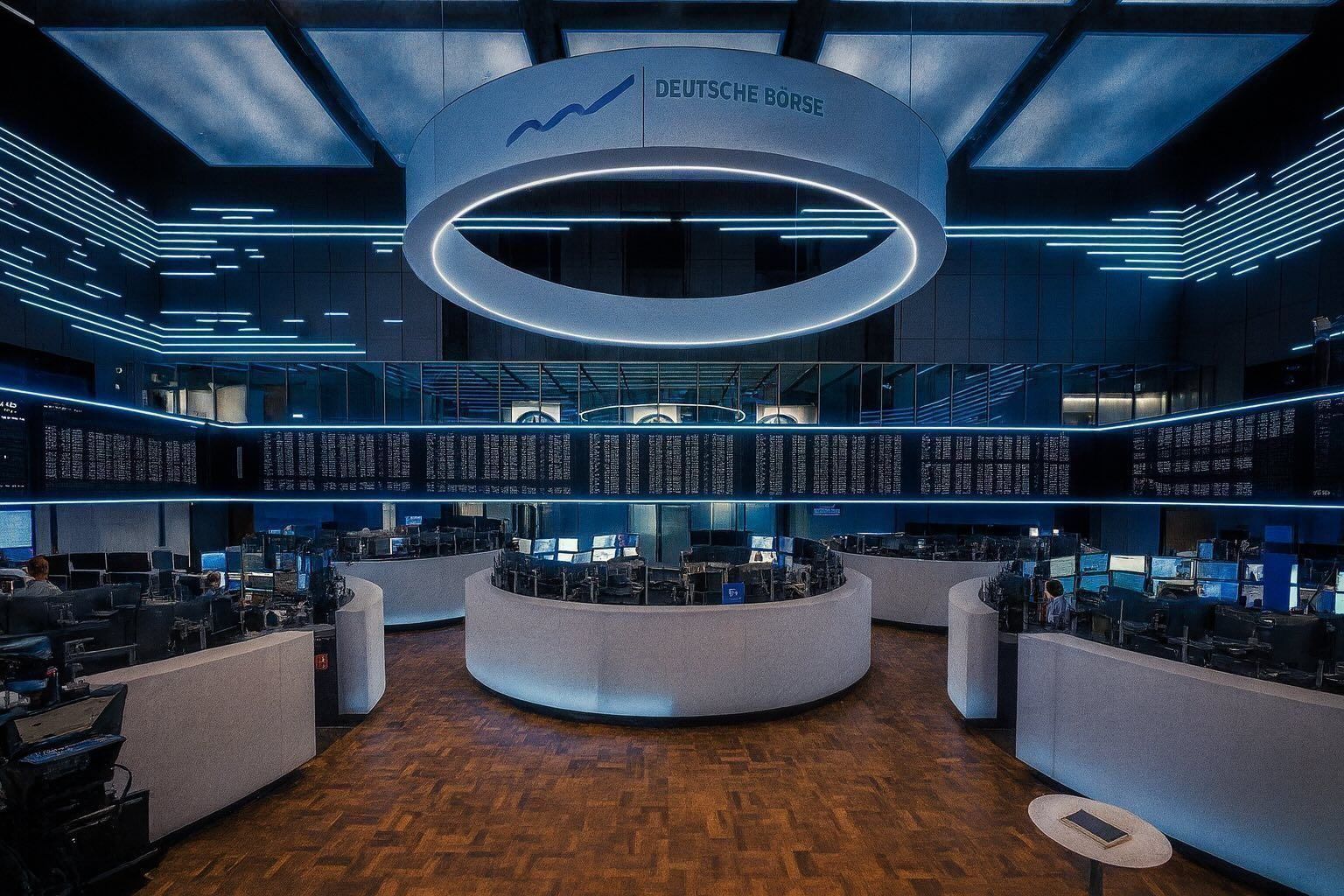
Deutsche Börse (the exchange operator itself)
Deutsche Börse laid out targets including net revenue of around €6.5 billion by 2028 and outlined a plan that included a share buyback of about €500 million in 2026, according to Reuters. Reuters
That matters for Frankfurt not just as a stock, but as a read-through on capital markets activity and European trading/clearing economics.
Defense complex strength (a major theme in German equities)
Reuters reported defense names rose on 9 December amid expectations German lawmakers would approve record procurement contracts, boosting companies including Rheinmetall and Hensoldt. Reuters
On 12 December, Reuters also flagged a supply-chain angle: Hensoldt was reported to supply radars to Rheinmetall for an air-defense system.
Thyssenkrupp pressure
Reuters reported Thyssenkrupp fell after warning of a deep net loss in 2026 (up to €800 million). Reuters
The Financial Times also described restructuring pressure around the group’s steel business and broader reset efforts.
Autos back in focus — Volkswagen headline risk into Sunday
On 14 December, the Financial Times reported Volkswagen would close its Dresden plant (described as its first factory shutdown in Germany), alongside broader job-cut and production-capacity issues. Financial Times
Autos are a core DAX exposure; large restructuring headlines can quickly influence sentiment around Germany’s industrial model and the index’s cyclical risk.
Week ahead for the Frankfurt Stock Exchange: the key catalysts (15–19 December 2025)
With no scheduled German corporate earnings flagged for the week ahead (per a Reuters/Refinitiv note), macro and policy signals are set to dominate.
1) ECB week: decision and tone will set the rate narrative for early 2026
The European Central Bank is the main event for European assets this week, with the Governing Council meeting 17–18 December 2025.
Markets are watching for whether the ECB:
- pushes back against expectations of further easing,
- leans into a “higher for longer” stance, or
- stays comfortable with its current rate level.
Key context:
- The ECB’s deposit facility rate (2.00%) and main refinancing operations rate (2.15%) reflect the levels in place since June 2025.
- Multiple previews have framed expectations around the ECB holding rates steady, including a Morningstar preview and Reuters reporting that investors saw near-zero odds of a rate change at the December meeting.
Why Frankfurt cares:
A more hawkish ECB can lift yields and strengthen the euro—often a headwind for DAX exporters and rate-sensitive sectors—while also supporting banks’ earnings narratives. A more dovish ECB can do the opposite: ease financial conditions and prop up valuations, but may also revive growth worries if it signals concern.
2) Germany’s ZEW survey: a fast read on expectations (Tuesday)
The ZEW Indicator of Economic Sentiment is scheduled for 16 December 2025 (Frankfurt time).
ZEW tends to move the market when it surprises because it’s a high-frequency gauge of expectations from financial market participants—useful for judging whether the “Germany stabilisation” story is building or fading.
3) Germany’s Ifo Business Climate: the domestic demand pulse (Wednesday)
The Ifo Business Climate Index has its next release on 17 December 2025 at 10:30 CET, per the Ifo Institute’s schedule.
For DAX positioning, Ifo is often treated as a bridge between:
- industrial reality (orders/production), and
- corporate confidence in services, construction, and trade.
4) Flash PMIs: the growth snapshot Europe will trade
S&P Global’s week-ahead preview highlighted flash PMI surveys for December as a core global data point in the coming week, including for the eurozone.
For DAX traders, the crucial question is whether PMIs confirm:
- “soft landing / gradual recovery,” or
- “stagnation with pockets of resilience,” or
- renewed contraction risk.
5) Bund yields and the equity style rotation
Last week showed how quickly higher yields can tilt the playing field—hurting rate-sensitive sectors and forcing rotations. With the ECB looming, the DAX may continue to trade like a referendum on:
- where European yields settle, and
- whether markets re-price the end point of the ECB cycle.
6) Euro strength vs exporters: watch FX as closely as stocks
A firm euro can pressure earnings expectations for Germany’s large exporters (autos, industrials, chemicals), especially into year-end when liquidity can thin. The Fed decision and ECB messaging are the two big drivers here, with Reuters noting euro strength in the wake of the Fed cut.
7) Late-week “macro plus micro” risk: Bundesbank Monthly Report (Friday)
Germany’s Bundesbank Monthly Report (December 2025 edition) is scheduled for 19 December 2025 and is set to include the Bundesbank’s forecast for Germany, according to the Bundesbank’s press calendar.
Even if the market reaction is muted, it can influence the narrative into the final trading stretch of 2025.
The DAX setup: what the price action is saying
With the DAX ending Friday near 24,186, the market is still trading close to the upper end of its recent range, but the week ended with investors re-pricing risk in global tech and rates.
Two dynamics stand out heading into Monday’s open:
- Momentum exists, but it’s fragile—late-week AI jitters showed how quickly gains can be given back.
- Macro sensitivity is high—bond yields and central-bank language are moving markets as much as company fundamentals.
Base case, bullish case, bearish case: how next week could play out in Frankfurt
Base case: range trading with ECB risk premium
The most likely path is a market that remains two-sided:
- Investors lean on the Fed’s cut as a tailwind,
- but demand clarity from the ECB, and
- stay wary of global AI/tech volatility spilling over.
Bullish case: softer ECB tone + improving German surveys
A constructive DAX outcome becomes more plausible if:
- Ifo and ZEW show clear improvement,
- PMIs confirm continued stabilization, and
- the ECB avoids reinforcing “next move could be a hike” rhetoric that has lifted yields recently. Reuters+3ifo Institut+3Zew+3
Bearish case: hawkish ECB + renewed AI selloff + stronger euro
Downside risk rises if:
- the ECB delivers a hawkish hold (or signals discomfort with market easing), pushing yields higher,
- AI concerns intensify again, dragging global sentiment, and
- EUR strength builds—tightening financial conditions for exporters.
What to watch first on Monday morning
If you follow the Frankfurt Stock Exchange closely, the first questions for the week are:
- Are Bund yields still climbing, or stabilizing after last week’s move?
- Does the market treat the ECB as a “hold and done,” or as the next source of hawkish surprise? European Central Bank+1
- Is global risk appetite holding up after the AI-driven wobble that ended the week?
- Do Germany-specific headlines (autos, industrials, defense) keep driving dispersion inside the DAX?
This article is for informational purposes only and is not investment advice.