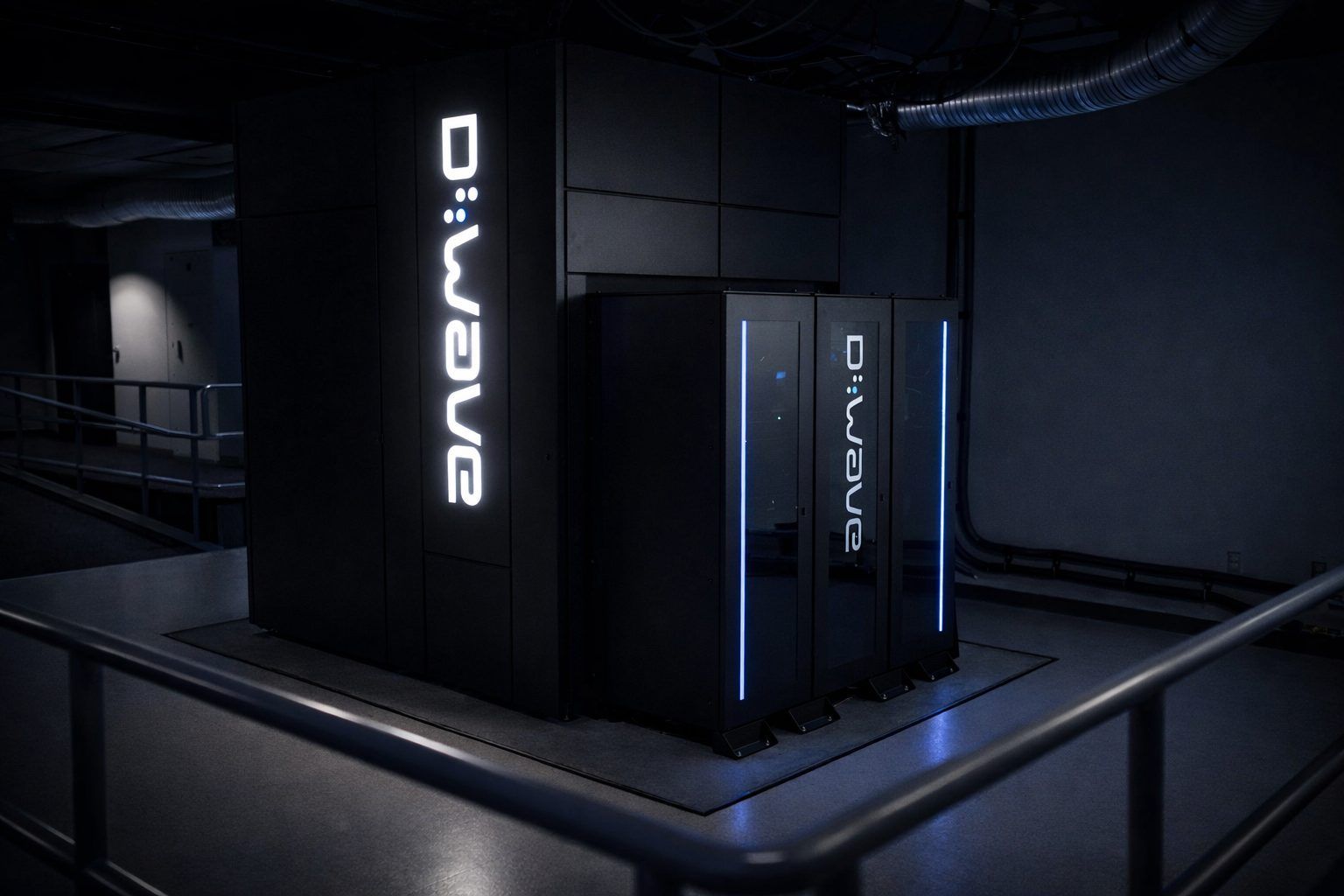
D-Wave Quantum Inc. (NYSE: QBTS) is having one of those “welcome to the frontier” trading sessions that quantum-computing investors have come to recognize: big intraday swings, heavy debate about what’s real today versus what’s possible later, and a steady drip of analyst notes and filings that can move a high-volatility stock fast.
As of Monday, Dec. 15, 2025, QBTS shares were trading around $24, down roughly 8% on the day after opening near $26.5 and touching an intraday high around $26.6.
Below is a full, publication-ready roundup of the latest QBTS stock news, the most current analyst forecasts, and the key fundamentals investors are using to argue both sides—with the most important developments clustered in the first half of December.
QBTS stock today: sharp swings, big narratives
By mid-afternoon on Dec. 15, QBTS was showing a wide trading range and a notable pullback—classic behavior for a momentum-heavy “pure play” theme stock, especially in a sector where headlines often travel faster than revenue. StockAnalysis
The bigger picture, though, is that this pullback is happening after a dramatic 2025 run. Evercore ISI’s initiation note (reported by Investor’s Business Daily) pointed out that D-Wave had surged about 206% in 2025 at the time of publication—leading the quantum cohort.
That combination—huge year-to-date gains plus sharp short-term drops—is why QBTS keeps popping up in Google Discover feeds: it’s not just a stock, it’s a live referendum on whether quantum computing is nearing practical commercial value or still mostly a long-duration bet.
What’s moving D-Wave stock now: analysts turn bullish, while filings add friction
1) Mizuho and Evercore throw gasoline on the “quantum pure play” trade
Over the past two weeks, two Wall Street events stood out:
- Mizuho initiated coverage on multiple quantum “pure plays,” including D-Wave, with an Outperform rating and a $46 price target. Barron’s+1
- Evercore ISI initiated coverage with an Outperform rating and a $44 price target, calling out D-Wave’s commercial revenue position, its full-stack approach, and a large cash position (reported around $800 million).
The Mizuho thesis—amplified in financial media—leans hard into a long-run market expansion story, with Mizuho analysts projecting the quantum computing market could grow from about $1B today to $205B by the mid-2030s.
2) Insider selling headlines (and a new Rule 144 notice today)
The other major “current” pressure point isn’t technological—it’s behavioral: insider selling and planned selling notices.
On Dec. 15, 2025, a Rule 144 filing surfaced indicating CFO John Markovich filed notice to sell 11,562 shares (a proposed sale, not necessarily completed yet), with the filing also listing several prior sales over the past three months.
Earlier in December, separate reporting summarized CFO transactions tied to option exercises and sales (including a Reuters/Refinitiv brief circulated via TradingView and summaries of Form 4 details).
Important nuance: insider sales can be pre-planned (often via 10b5-1 trading plans), and they don’t automatically mean “bad news.” But in a high-sentiment stock, they can influence the narrative, especially when investors are already debating valuation.
D-Wave’s latest corporate news: government push, Qubits 2026, and post-warrant cleanup
D-Wave itself has been active with announcements that investors interpret as “commercialization signals.”
Formation of a U.S. government-focused business unit (Dec. 2)
On Dec. 2, 2025, D-Wave announced the formation of a U.S. government business unit, led by government contracting executive Jack Sears Jr., intended to support adoption of D-Wave’s products and services in public sector and defense-related applications.
The press release also referenced D-Wave’s Advantage2 system being operational at Davidson Technologies’ Alabama headquarters, with expectations it could eventually support sensitive applications.
A separate government-technology publication also covered the Davidson angle, underscoring how D-Wave’s annealing approach is being positioned for national-security-adjacent optimization problems.
Qubits 2026 user conference (announced Dec. 8; scheduled Jan. 27–28, 2026)
On Dec. 8, 2025, D-Wave announced its annual Qubits 2026 user conference, set for Jan. 27–28, 2026 in Boca Raton, Florida, featuring customer case studies, roadmap updates across annealing and gate-model work, and discussions of hybrid-quantum solvers and “quantum AI.” D-Wave Quantum+1
For a stock like QBTS, conferences matter because they can produce:
- new customer stories (credibility),
- roadmap disclosures (expectations),
- and partnership headlines (momentum fuel).
Public warrant redemption completed (Nov. 21) — and why it still matters mid-December
D-Wave completed redemption of all outstanding public warrants in November, a capital-structure event that continues to show up in December commentary.
In its Nov. 21 release, the company said 4,746,358 warrants were exercised for about 6.9 million shares at $11.50, generating about $54.6 million in cash proceeds, and that remaining warrants were redeemed at $0.01 per warrant, leaving no public warrants outstanding after redemption.
That cash infusion helps explain why analysts emphasize liquidity—while skeptics emphasize dilution and the long path to cash-flow breakeven.
Fundamentals check: revenue is still small, but bookings and margin are drawing attention
The most recent quarterly “anchor” investors cite is D-Wave’s Q3 2025 report (released Nov. 6).
Key figures disclosed by the company included:
- Revenue:$3.7 million for Q3 2025, up from $1.9 million a year earlier
- GAAP gross margin:71.4% for Q3 2025 (up from 63.2% a year earlier)
- Bookings:$9.0 million for Q3 2025, and the company said it closed over $12 million in additional bookings after quarter end
- GAAP net loss:$140.0 million, largely driven by a non-cash warrant liability remeasurement loss of $121.9 million
- Adjusted net loss:$18.1 million (a non-GAAP figure meant to strip out certain non-cash/one-time items)
Those numbers are exactly why QBTS triggers fierce “two-truths” arguments:
- Bull view: high gross margin + bookings growth + improving “real customer” story
- Bear view: absolute revenue remains tiny relative to valuation; losses and dilution risk linger
On liquidity, multiple reports around the quarter emphasized a very large cash position (often cited in the ~$800M range), which analysts describe as a strategic advantage in a capital-intensive R&D race.
D-Wave stock forecast: analyst price targets, consensus ratings, and the spread that tells the story
Wall Street forecasts for QBTS are bullish on average—but the range of targets is doing a lot of the storytelling.
What current target compilations show (as of Dec. 15, 2025)
A widely referenced compilation shows:
- Consensus rating: “Strong Buy”
- Average price target: about $30.08
- High target:$46
- Low target:$12
That same dataset lists recent initiations and updates, including:
- Mizuho $46 (Dec. 11, 2025)
- Evercore ISI $44 (Dec. 3, 2025)
Another compilation (via Fintel coverage reporting) cited an average one-year price target around $38.25 (with a $30.30 to $50.40 range) as of mid-November.
Why the price-target spread matters more than the average
When you see targets ranging from $12 to $46+ in the same stock, that’s not just disagreement—it’s the market admitting the core variable is unknowable right now:
- How fast does quantum demand become “budget line item,” not “innovation pilot”?
- Does D-Wave’s annealing-first strategy create near-term revenue leadership… or a niche?
- Can the company scale without repeated dilution?
Those are not “next quarter” questions. They’re “next five years” questions—disguised as a one-year price target.
The bull case for QBTS: optimization now, gate-model optionality later
D-Wave’s strategic positioning is a major differentiator: the company emphasizes annealing quantum computing and hybrid-quantum solvers aimed at optimization problems that can matter in logistics, scheduling, and resource allocation.
Analysts who like the stock tend to highlight three themes:
- Commercial posture today
Evercore’s coverage argued D-Wave offers commercial revenue and a full-stack ecosystem (hardware + services + software), framing it as a “ways-to-win” setup versus earlier-stage peers. Investors.com - Government and defense demand as a catalyst
D-Wave is explicitly building a go-to-market structure for U.S. government adoption, and it’s linking its installed systems (like the Davidson deployment) to potential mission-critical problem sets. - Industry tailwinds keep stacking up
Even when company-specific news is quiet, quantum sector headlines keep arriving. For example, a Dec. 15 sector roundup highlighted developments tied to Google’s Willow chip access in the UK, Microsoft’s quantum chemistry efforts, and new partnerships aimed at scaling quantum processors—signaling that the broader ecosystem remains in acceleration mode.
The bear case: revenue reality, dilution anxiety, and the timeline problem
The skeptical case is less about whether quantum computing is real (it is), and more about when it becomes economically decisive—and who captures value.
1) Revenue is still tiny relative to valuation
Even with strong year-over-year growth, D-Wave’s quarterly revenue is measured in single-digit millions.
Markets can (and do) price far ahead of fundamentals—but the further out the horizon, the more sensitive the stock becomes to sentiment shifts.
2) Dilution and insider selling become narrative accelerants
The warrant redemption raised cash but also expanded share count via exercised warrants, and insider selling headlines (including the Dec. 15 Rule 144 notice) add friction to the bullish story during volatile periods.
Commentary outlets have been blunt that investors should be careful about chasing momentum when insiders are selling—whether planned or not—because it changes the emotional tone around the stock.
3) The “show me” metric is cash flow
A recurring theme in recent analysis is that QBTS remains a “show me” stock—where the “show me” is breakeven cash flow (or a clear path to it without repeated dilution). The Motley Fool
This is the uncomfortable truth about frontier tech: the physics might be brilliant, but cash flow is the final exam.
What to watch next: catalysts into early 2026
For investors and readers tracking QBTS into the new year, the next wave of potential catalysts is fairly clear:
- Qubits 2026 (Jan. 27–28, 2026): roadmap updates, customer stories, and partnership announcements can all move sentiment quickly.
- Government traction: any contract wins, expanded deployments, or program announcements tied to the new U.S. government unit could be meaningful.
- Bookings conversion: D-Wave said it closed over $12M in additional bookings after Q3; investors will watch how that converts to recognized revenue.
- More analyst notes: the quantum theme has Wall Street’s attention right now; new coverage or target changes can move the whole cohort.
- Insider filings: in a sentiment-driven stock, even small incremental filings can affect headlines and intraday trading behavior.
Bottom line
On Dec. 15, 2025, D-Wave Quantum stock sits at the intersection of three powerful forces:
- A hot macro theme (quantum computing as “the next compute platform”),
- Fresh Wall Street validation (big initiations with targets in the $40s), and
- A credibility stress test (small revenue base, dilution concerns, and insider selling headlines).
QBTS can absolutely keep making headlines—because the quantum sector is advancing and D-Wave has real deployments and a clear commercialization narrative. But the stock’s volatility is not a bug. It’s the market’s way of confessing that the future is still being negotiated.