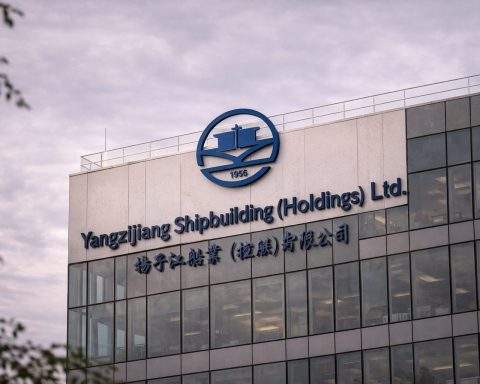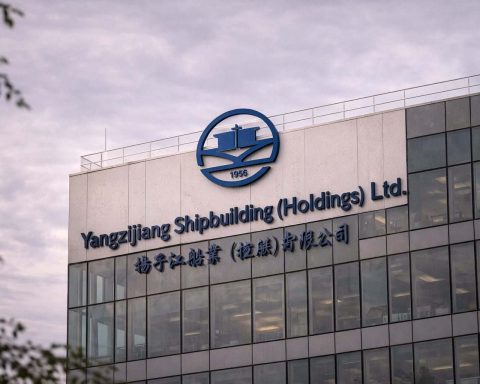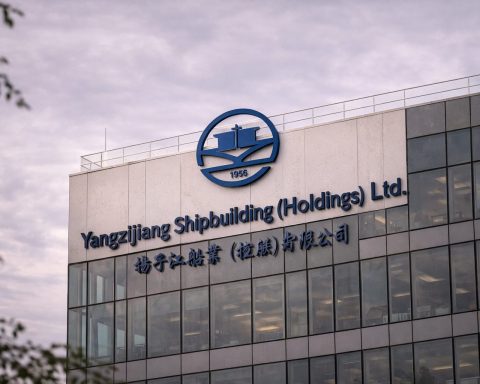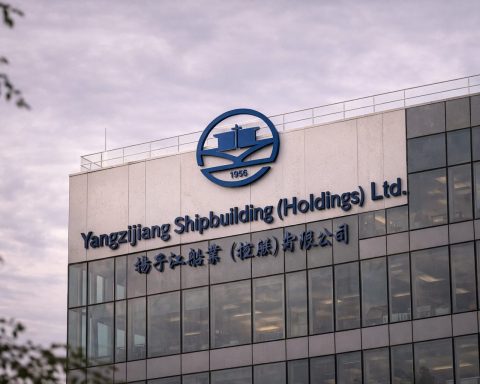

Yangzijiang Shipbuilding (Holdings) Ltd SGX:BS6 has become one of the most closely watched industrial names on the Singapore Exchange—helped by a record-high multi‑year order book, widening margins in 2025, and a global shipbuilding market being reshaped by decarbonisation and geopolitics.
As of 16 December 2025, market data platforms showed BS6 trading around S$3.49–S$3.50, keeping the stock near recent highs after a strong run through 2024–2025.
Below is a detailed roundup of the latest company developments, the key themes driving the share price, and the most recent analyst forecasts and target prices available as of 16.12.2025.
Yangzijiang Shipbuilding stock price on 16 Dec 2025: where BS6 stands now
On 16 Dec 2025, BS6 was quoted at roughly S$3.49–S$3.50 intraday (sources vary slightly due to timing and delay conventions).
For investors, it also matters that Yangzijiang Shipbuilding has a dual-currency listing on SGX:
- BS6 (primary counter in SGD)
- SO7 (secondary counter in RMB) SG Investors
This dual-counter structure can influence liquidity patterns, headline “price move” narratives, and how global investors compare valuations versus China-listed and Korea-listed shipbuilding peers.
What Yangzijiang Shipbuilding actually does—and why the market cares
Yangzijiang Shipbuilding is a Singapore-listed group with major shipbuilding operations in China. The company builds a range of commercial vessels, including containerships, tankers, bulk carriers, LNG and other gas carriers—a product mix that increasingly matters as shipowners upgrade fleets for fuel efficiency and emissions rules.
In 2025, the investment debate around BS6 has largely revolved around four questions:
- Is the record order book “real” and profitable?
- Can margins stay elevated as the cycle cools?
- Will new orders recover from 2025’s slowdown vs 2024?
- How much do geopolitics and sanctions risk affect Chinese yards and customers?
The latest news flow provides some answers—and raises a few new concerns.
Latest Yangzijiang Shipbuilding news: order momentum rebounds, but 2025 is still a comedown from 2024
1) 3Q/9M 2025 business update: US$2.17b YTD orders, US$22.8b order book
Yangzijiang’s Nov 2025 business update was the biggest recent stock-moving catalyst. The company reported about US$2.2 billion of orders secured year-to-date, versus US$11.6 billion in the same period a year earlier—highlighting how sharply the ordering cycle cooled after an exceptionally strong 2024.
At the same time, the company’s outstanding order book remained very large:
- ~US$22.8 billion
- 245 vessels
- “Green vessels” ~71% of order book value
- Containerships still dominant, at ~US$16.2 billion across 126 vessels The Business Times+1
DBS Research described the pattern as an order rebound concentrated in recent months, noting YTD order wins of US$2.17b with ~75% secured in the past three months (as of its Nov 18, 2025 report).
Why this matters for the stock:
Even though new order intake in 2025 is far lower than 2024, Yangzijiang’s existing backlog still provides long revenue visibility—so investors have been focusing less on “this quarter’s orders” and more on pricing quality, margin sustainability, and customer risk.
2) Delivery progress: on track for FY2025 target (so far)
Operational execution is critical in shipbuilding because cash flow, milestone payments, and final profitability depend on on-time delivery.
In its update, Yangzijiang said it delivered 46 vessels year-to-date against a full-year target of 56.
DBS also highlighted deliveries at 82% of FY2025 target in the same period.
3) Management tone: backlog is high, delivery slots are tight
A key takeaway from the November update was the CEO’s framing of what comes next: a market where shipowners and shipyards are cautious because capacity is tight and lead times are long.
According to The Business Times, CEO Ren Letian cautioned that the industry-wide backlog remains at historical highs, with lead times stretching close to five years and limited delivery slots for large vessels at “tier-one” shipyards. The Business Times
That’s a double-edged sword for BS6 investors:
- It can support pricing discipline and protect margins.
- But it may also constrain how much additional work Yangzijiang can accept for 2028–2030 delivery windows.
Financial performance: margin expansion and a strong cash position in 1H2025
While the Nov 2025 update was mainly operational, the company’s 1H2025 results (released earlier in 2025) remain central to valuation arguments.
Key points from the 1H2025 press release include:
- Revenue of about RMB12.9 billion (slightly lower year-on-year)
- Gross profit up strongly (margin expansion attributed to lower steel costs, improved pricing on secured contracts, and smooth delivery execution on larger dual-fuel containerships)
- Net profit attributable to equity holders up 36.7% to about RMB4.2 billion
- A net cash position of about RMB18.3 billion (as of 30 June 2025)
- New orders of about US$537.2 million for 14 vessels, bringing outstanding order book to about US$23.2 billion at the time (extending revenue visibility well beyond the near term) SGX Links
The same release also pointed to a more uncertain macro environment—important context for why global shipbuilding order intake cooled in 2025.
Risk event investors shouldn’t ignore: termination of US$180m tanker contracts tied to sanctions allegations
One of the most important “risk management” headlines for BS6 in 2025 was the termination of shipbuilding contracts for four 50,000 DWT MR oil tankers with an aggregate contract value of ~US$180 million.
In its SGX announcement, Yangzijiang said termination followed critical information disclosed by the buyer, including allegations the buyer’s sole shareholder was involved in a scheme to circumvent U.S. sanctions laws and regulations.
Notable details disclosed:
- No revenue/profit had been recognised for the contracts up to 30 June 2025
- A 10% deposit (US$18m) had been received at signing
- Construction had begun for one vessel, and an additional instalment of US$4.48m was collected
- The company stated the termination was not expected to have a material impact on NTA or EPS for FY2025 SGX Links+1
Why this matters for the stock (beyond the dollar amount):
This is a real-world example of how sanctions compliance and counterparty risk can affect shipbuilders—especially those building globally traded assets in a politically sensitive period.
Analyst forecasts and target prices for Yangzijiang Shipbuilding stock (BS6)
As of mid‑December 2025, sell-side commentary on BS6 is broadly constructive, but the details differ—especially around how many new orders the company can realistically secure and at what profitability.
DBS Research: BUY, TP S$3.80 (Nov 2025)
DBS reiterated BUY with a target price of S$3.80, highlighting:
- YTD order wins of US$2.17b
- US$22.8b order book (green vessels ~71% of value)
- Deliveries on track (46 vessels YTD)
- Ongoing capex commitments including the Hongyuan new yard and LNG terminal/storage (both referenced as scheduled for completion in 1H27), with potential revenue contribution from the new yard from 2H26 DBS Bank+1
DBS also flagged potential re‑rating catalysts such as fresh large-vessel wins, stronger pricing for methanol/LNG dual-fuel units, and evidence of sustained margin expansion.
UOB Kay Hian: TP raised to S$4.10 (reported by The Edge, Nov 2025)
The Edge reported that UOB Kay Hian’s analyst turned more bullish, raising target price to S$4.10 from S$3.90, citing:
- Active negotiations that could close by year-end
- Management confidence in securing ~US$4.5b in new orders for 2026 (as stated in the report)
- Margin expectations supported by USD/RMB stability, steel price ranges, and earlier-secured equipment costs
- Potential margin softness during integration of the Hongyuan yard, but management confidence in robust margins post-integration The Edge Singapore
CGS International: “Add”, TP raised to S$4.51 (reported by The Edge, Nov 2025)
The same Edge piece reported CGS International reiterated “add” and raised target price to S$4.51, while noting:
- Stiffer competition from expanded capacity at second-tier Chinese yards
- Clarksons data observations: about 40% of newbuild orders secured by Chinese yards in 2H2025 were for 2026–2027 delivery
- Yangzijiang’s delivery slots: filled for 2028 with limited small-vessel capacity; 2029 largely filled with ~25% capacity left (as described in the report)
- CGS reduced order expectations to US$3.0b for FY2025 and US$3.5b for FY2026, arguing yard availability increases uncertainty The Edge Singapore
Consensus ranges: roughly S$3.8–S$3.9 average, but wide dispersion
Several market/estimate aggregators also pointed to an average target in the high‑S$3 range, with a wide range between bearish and bullish scenarios:
- Fintel: average one‑year target ~S$3.86 (range S$1.62–S$4.74) Fintel
- Another estimates summary page similarly showed ~S$3.86 average and “BUY” skew across analysts Value Investing
- Stockopedia: analyst consensus target ~S$3.78 vs last close around S$3.49 Stockopedia
- MarketScreener: mean consensus BUY, with an average target implying high‑single‑digit upside (as presented on its platform) MarketScreener
How to read these forecasts:
Targets are not guarantees. What matters is the underlying driver set: order cadence, vessel mix (especially “green” vessels), margin durability, and execution risk.
The broader backdrop: decarbonisation tailwind meets trade-policy headwinds
Decarbonisation supports multi-year replacement demand
Yangzijiang itself has pointed to structural demand from the industry’s transition toward decarbonisation and emissions regulation frameworks.
This theme supports the investment case for yards with credible capability in:
- dual-fuel containerships,
- LNG/LPG/gas carrier specialisation,
- and complex, higher-value construction.
Trade tensions and industrial policy are reshaping competitive dynamics
At the same time, shipbuilding has become increasingly strategic. A Wall Street Journal report described China’s efforts to consolidate shipbuilding capacity and highlighted the scale advantage of Chinese shipbuilders—part of a broader U.S.–China industrial rivalry.
Meanwhile, Reuters reported that CMA CGM ordered container ships from an Indian shipyard as part of a push to expand India-flagged capacity—one signal that shipowners may diversify sourcing in a more fragmented geopolitical environment.
For Yangzijiang investors, the takeaway is practical:
- The company’s existing backlog reduces near-term demand risk.
- But new order competition (and where shipowners place incremental orders for 2027–2029 delivery) is likely to be increasingly influenced by policy, compliance, and supply-chain considerations, not just price.
What to watch next for Yangzijiang Shipbuilding stock in 2026
If you follow BS6, these are the most “market-moving” checkpoints as of mid‑December 2025:
- New contract announcements
Especially any larger, higher-margin “green vessel” contracts that extend beyond already tight 2028–2029 slots. The Business Times+1 - Margins and cost assumptions
Analysts are explicitly watching USD/RMB, steel price bands, and equipment cost advantages locked in earlier. - Counterparty / sanctions compliance risk
The US$180m tanker termination shows how quickly a headline can shift sentiment, even if financial impact is described as non-material. - Capex execution and capacity expansion timeline
Updates on the Hongyuan yard and LNG infrastructure matter because they influence the next leg of earnings power—both through potential capacity and any integration “dip” in profitability. DBS Bank+1 - Dividends and capital management
Income investors continue to track the dividend profile and payout sustainability alongside buyback capacity.
Bottom line: why BS6 remains on investors’ radar
As of 16 December 2025, Yangzijiang Shipbuilding’s stock narrative is neither a simple “order boom” nor a straightforward “cycle peak” story.
Instead, BS6 sits at the intersection of:
- a still-massive US$22.8b order book with a high share of “green vessels,” The Business Times+1
- a 2025 environment where new orders are far below 2024, but have shown signs of rebound, The Business Times+1
- and a market debate over how much 2026 order intake is achievable amid tight yard slots and intensifying competition.
For readers searching “Yangzijiang Shipbuilding stock forecast” or “BS6 target price”, the clearest message from current research is this: analysts generally see moderate upside from mid‑December price levels, but they disagree on how quickly (and how profitably) new orders can scale as the global shipbuilding cycle normalises. DBS Bank+2The Edge Singapore+2
Related articles: SGX:BS6