
SATS Ltd shares are back in the spotlight on 16 December 2025, as investors weigh a mix of near-term market momentum and company-specific catalysts—most notably strong cargo-led earnings, a higher interim dividend, and ongoing share buybacks, alongside operational and commercial updates at Worldwide Flight Services (WFS), SATS’ global cargo handling arm.
By late morning, SATS’ Singapore-listed shares were quoted around the mid-S$3.60s, with the company’s own stock information page showing S$3.64 as the last price and an intraday range of S$3.58 to S$3.66. SATS Corporate
A separate market snapshot showed SATS at S$3.63 (+0.83%) around mid-afternoon Singapore time.
What does SATS do, and why the market cares
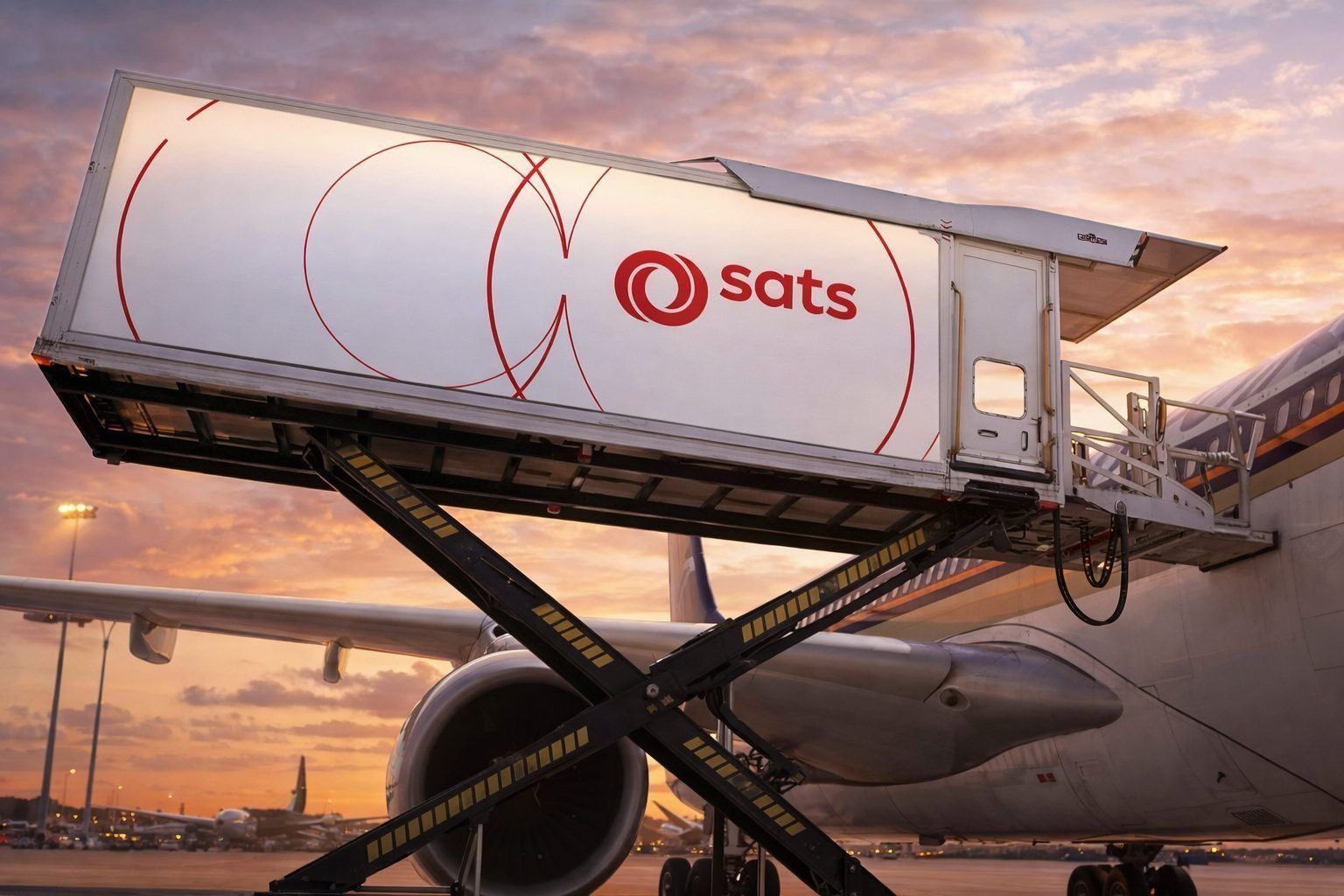
SATS is a key Singapore aviation and logistics name, spanning air cargo handling, ground handling, and airline catering—business lines that tend to move with global trade flows and air travel activity. On its corporate site, SATS describes itself as the world’s largest air cargo handler and Asia’s leading airline caterer.
That positioning matters because, coming into year-end 2025, the market narrative around SATS is increasingly tied to two themes:
- Cargo resilience and network scale (especially with WFS in the group), and
- Operational leverage—how much profit SATS can generate from incremental volume as efficiencies improve.
SATS share price on 16 Dec 2025: where it’s trading
As of 16 Dec, the stock action suggests SATS is firmly “in play” for traders and longer-term investors alike:
- SATS’ investor page showed S$3.64 last, S$3.66 high, S$3.58 low (time-stamped during the session).
- Historical pricing data listed S$3.60 open, S$3.66 high, S$3.58 low, S$3.62 close, with volume near 3.877 million shares for Dec 16.
- The day before, SATS saw unusually heavy trading volume, with historical data showing 11.8 million shares for Dec 15.
It’s also worth noting that in the prior session (Dec 15), SATS was cited as the top gainer on Singapore’s STI, rising 3.5% to S$3.60, in a broader market wrap.
The fundamentals driving attention: profit growth, margin expansion, higher dividend
The most concrete “why now” catalyst remains SATS’ latest reported financial performance (released in November, but still shaping price discovery in mid-December).
2Q FY26 highlights: profits and margins moved higher
In its 2Q FY26 update (three months ended 30 September 2025), SATS reported:
- Revenue:S$1,572.1 million (up 8.4% YoY)
- EBITDA:S$307.4 million (up 15.7% YoY) with EBITDA margin 19.6% (vs 18.3% a year earlier)
- Operating profit (EBIT):S$157.4 million
- Profit attributable to owners (PATMI):S$78.9 million (up 13.3% YoY) SATS Corporate+1
SATS directly tied the quarter’s strength to cargo volume growth across multiple regions, while also flagging operational efficiency improvements as a contributor to margin expansion.
A contemporaneous report also highlighted management’s nuance on the cargo tailwind—saying that while volumes were strong, part of the quarter benefited from front-loading ahead of tariff changes, with the company “actively managing” capacity and resources as demand patterns evolve. The Business Times
1H FY26 snapshot: steady growth continues
For 1H FY26 (six months ended 30 Sep 2025), SATS reported:
- Revenue:S$3,078.5 million
- EBITDA:S$581.2 million
- Operating profit (EBIT):S$282.6 million
- PATMI:S$149.8 million SATS Corporate+1
Interim dividend: a higher payout signal
SATS declared an interim dividend of 2 Singapore cents per share, payable 5 December 2025, with a stated book closure date of 24 November 2025. SATS Corporate
Exchange listings of corporate action details also reflected an ex-date of 20 Nov 2025 and payment on 5 Dec 2025 for the S$0.02 dividend.
Dividend increases aren’t the only reason investors care—rather, the market often reads them as a management “confidence signal,” especially when paired with buybacks.
Share buybacks: SATS has been active in the market
SATS’ December SGX filings show on-market share repurchases executed on multiple days. The details matter because they provide a transparent look at price levels where the company has been willing to step in.
From SGX daily buyback notices:
- 11 Dec 2025: SATS bought 300,000 shares at S$3.42 per share, for total consideration of about S$1.027 million. Cumulative buybacks under the mandate were reported at 6,321,200 shares (0.4232%).
- 9 Dec 2025: SATS bought 101,200 shares at S$3.41 per share, for total consideration of about S$345,506. Cumulative buybacks were 6,021,200 shares (0.4032%).
- 8 Dec 2025: SATS bought 419,700 shares, with a disclosed price range of S$3.40 to S$3.42, for total consideration of about S$1.435 million.
These purchases were carried out under a mandate that (per filings) began 25 July 2025, with a maximum authorised buyback quantity of 29,870,031 shares.
WFS developments: why SATS’ cargo “engine” keeps getting attention
For SATS, WFS isn’t just a subsidiary headline—it’s central to the investment case because cargo handling scale can drive both revenue durability and margin potential.
Two notable WFS-related storylines circulating into mid-December:
1) Saudia Cargo handling partnership extended across key gateways
Industry reports on 15 December 2025 said Saudia Cargo renewed/extended its cargo handling partnership with SATS-owned WFS across eight gateways in Europe and the US, including London Heathrow, Manchester, Amsterdam Schiphol, Brussels, Frankfurt, Paris CDG, New York JFK and Washington Dulles.
For investors, contract continuity on major lanes can help reinforce the “sticky customer” narrative in cargo handling—where service quality, operating reliability, and airport footprint are hard to replicate quickly.
2) WFS pushes further into data-driven cargo forecasting
Separately, WFS announced (8 Dec 2025) a machine-learning forecasting tool designed to improve air cargo volume prediction and align workforce resourcing more accurately. WFS said the tool uses machine learning trained on 10 years of operational data, including processing over 3 million air waybills plus historical flight and truck movement records.
WFS also described scale of deployment and usage, stating the platform is deployed across 75 warehouses in 13 countries and generates weekly forecasts covering 9,842 flights and 6,216 truck movements.
From a stock perspective, this matters because labour planning is a major cost driver in cargo operations. Better forecasting can support service levels while reducing inefficiencies—one route to sustained margin improvement if execution holds.
SATS management outlook: resilience, but with tariff-driven volatility flagged
In its results materials, SATS framed its second quarter as “resilient” amid evolving market conditions and said Gateway Services continued to demonstrate strength, while Food Solutions was positioned to capture stable regional meal demand. SATS Corporate
At the same time, SATS signalled the cargo environment is not linear: it noted that recent quarters included elements of accelerated shipments ahead of tariff implementations, and said it remains focused on adapting operations across its network to manage shifts while maintaining operational discipline.
This is an important nuance for anyone tracking SATS stock into 2026: “strong cargo” can be supportive, but the shape of demand (and the timing of peaks and troughs) still matters.
Analyst forecasts and target prices for SATS stock
While individual broker notes vary, multiple consensus trackers point to analyst target prices clustering above the mid-S$3.60 level seen on Dec 16.
Consensus targets clustered around ~S$4.0
- One 12‑month forecast compilation (based on 8 analysts) showed an average target price around S$4.02, with a high of S$4.25 and low of S$3.66, and the consensus rating tagged as “Strong Buy.” Investing.com
- Another consensus snapshot similarly reported an average target around S$4.021, also citing 8 analysts and a similar S$3.66–S$4.25 range.
Local broker calls (as reflected by public roundups)
A local compilation of analyst coverage listed several “Buy”-leaning targets, including DBS (Buy, S$3.80), OCBC (Buy, S$3.73) and UOB Kay Hian (Buy, S$3.86), reflecting earlier 2025 notes but still widely referenced by market participants. SG Investors+1
A slightly lower consensus also circulates
Another Singapore-focused estimate put a consensus target price around S$3.815 as of 16 Dec 2025, implying more modest upside from the prevailing price area.
Why the gap? Different platforms use different analyst sets, refresh schedules, and aggregation methods. For readers, the actionable takeaway is less about one “right” number—and more about where the cluster of expectations sits (roughly high‑S$3s to low‑S$4s in the widely cited sources above).
Bull case vs bear case for SATS Ltd stock
Here’s how the current mix of news and forecasts tends to map into the two-sided debate investors are having around SATS SGX:S58 in December 2025:
Bull case: operational leverage + global cargo scale
- Earnings momentum supported by cargo growth and margin expansion, as shown in 2Q/1H FY26 results.
- Shareholder returns supported by both dividends and active buybacks.
- WFS contract continuity and digital operational improvements may strengthen service reliability and workforce efficiency over time.
Bear case: cargo volatility and “pull-forward” risk
- Management itself acknowledged part of the cargo strength was influenced by front-loading ahead of tariff changes, which can reverse in later quarters.
- Global trade and aviation remain sensitive to policy, geopolitics, and macro conditions—meaning volumes and yields can change quickly even for scaled operators. (This is consistent with SATS’ own caution around evolving trade patterns.
What to watch next for SATS SGX:S58
As the market digests December’s price action, the next catalysts that are likely to matter most for SATS stock are:
- Cargo volume trajectory after any tariff-driven pull-forward (does demand normalize smoothly, or dip sharply?) The Business Times
- Margin sustainability—whether operational efficiencies continue to show up in EBITDA and EBIT expansion.
- Pace and pricing of buybacks—investors often watch whether buybacks continue when the stock moves higher versus only when it dips.
- WFS commercial traction and execution—contract wins/renewals and operational rollouts that can translate scale into earnings quality.
Related articles: Share Buybacks