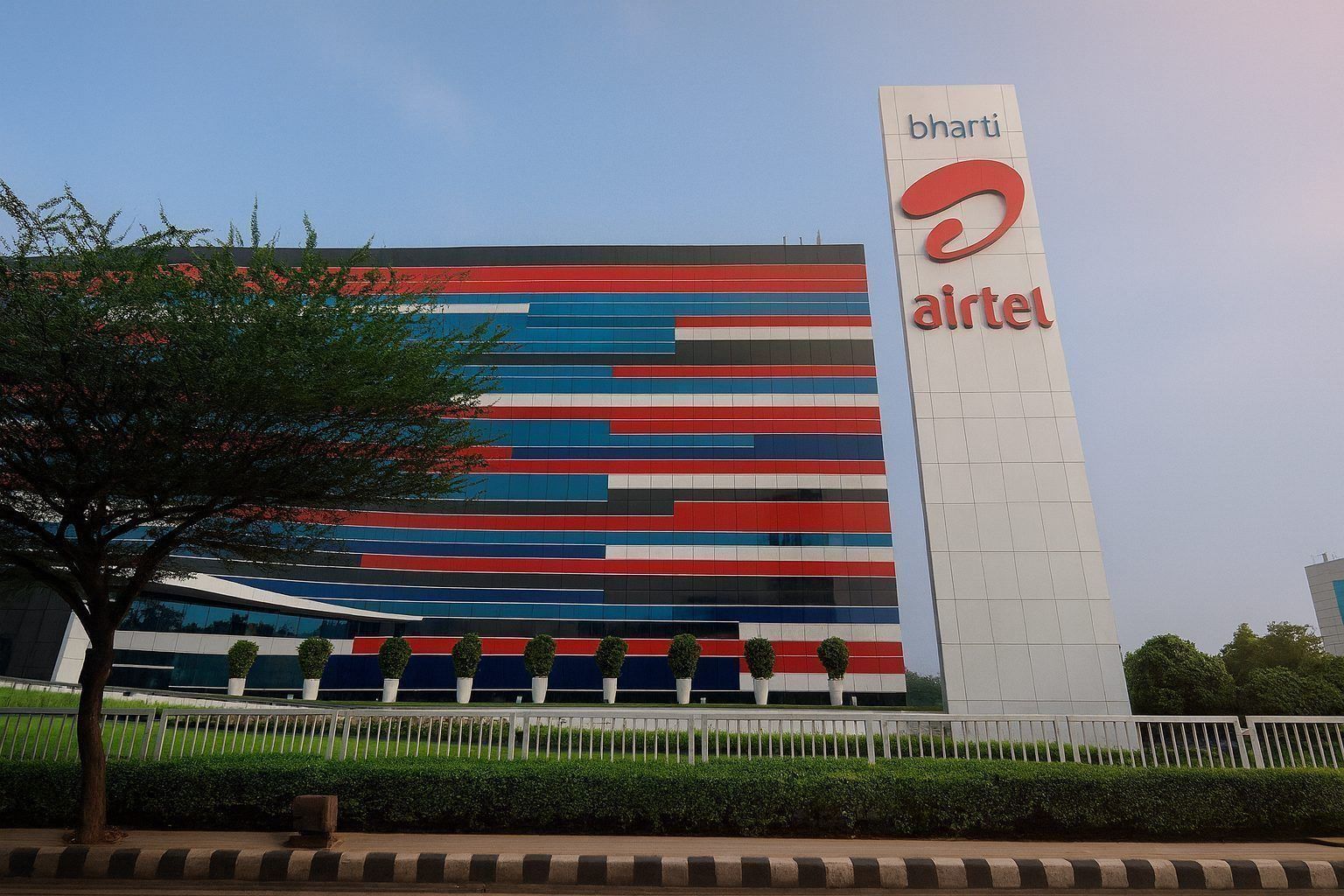
Bharti Airtel Ltd (NSE: BHARTIARTL, BSE: 532454) was firmly in the spotlight on Tuesday, December 16, 2025, after a fresh bullish brokerage note helped lift sentiment around the telecom major. In early trade, Airtel shares rose close to 2% after Morgan Stanley increased its price target and reiterated an “Overweight” stance, with the brokerage explicitly pointing to a potential tariff hike in Q1 FY27 as a key near-term catalyst. Moneycontrol+1
The move comes at a time when investors are weighing two big, competing narratives around Airtel stock: (1) a multi-quarter ARPU and EBITDA compounding story powered by premiumization and disciplined capex, and (2) policy and rollout uncertainty around satellite broadband (satcom)—a long-term optionality theme that faces fresh delays due to ongoing regulatory tussles.
Bharti Airtel share price today (16 Dec 2025): what the market is pricing in
Intraday data across market trackers showed Airtel trading higher versus the prior close, with quotes around the ₹2,090–₹2,100 zone during the morning session. Live market pages also highlighted an intraday trading range roughly spanning the low ₹2,070s to around ₹2,103 during the session—consistent with Airtel being cited among notable gainers at different points in the day.
Several widely-followed market pages also reinforced the broader setup Airtel bulls have been leaning on through 2025:
- 52-week range: roughly ₹1,561 to ₹2,174.70 (depending on the data snapshot)
- Broker sentiment: “Buy”-leaning coverage across a sizeable analyst set
- Valuation (data-provider dependent): TTM P/E readings in the high-20s range were shown on at least one market stats page
The key takeaway for readers tracking Bharti Airtel share price today: the stock’s positive move wasn’t driven by an earnings release or corporate filing on December 16—it was largely research-note-led momentum, with the market quickly reacting to the combination of higher target price + explicit tariff hike timing in a heavyweight brokerage call.
The headline driver: Morgan Stanley turns more bullish on Airtel stock
The most market-moving development on 16 Dec 2025 was Morgan Stanley’s updated stance on Bharti Airtel. In coverage cited by market outlets, the brokerage:
- Raised its target price by 20% to ₹2,435 (from ₹2,035)
- Kept an “Overweight” view, with commentary suggesting the stock could “start to reflect” the next tariff hike ahead of time
- Flagged expectations of a tariff hike in Q1 FY27 as a meaningful catalyst
Why the “tariff hike” signal matters for Airtel investors
In telecom, tariff hikes can change the tone of the entire investment case because they directly influence ARPU, and ARPU improvements typically flow through to EBITDA with strong operating leverage (particularly when capex intensity is stabilizing).
Morgan Stanley’s thesis, as summarized in reporting, leaned on multiple “levers” for medium-term ARPU growth (even beyond tariff), which it believes can sustain double-digit India EBITDA growth. It also referenced a pathway to 20%+ return ratio improvement—language that often resonates with investors looking for “quality compounder” characteristics in a large-cap stock. Moneycontrol+1
Beyond tariffs: what else Morgan Stanley highlighted
Reporting of the note also points to additional drivers Morgan Stanley sees behind Airtel’s longer runway:
- Better data monetisation
- Mix shift toward postpaid
- Value-added services (international roaming was referenced)
- A view that capex could remain below prior peak levels, with Airtel in a “monetisation phase” Business Today
For investors, the practical implication is straightforward: Morgan Stanley’s upgrade isn’t only a short-term “tariff hype” call—it’s presenting Airtel as a business with improving returns and still-manageable investment intensity.
Analyst targets and forecasts: what the Street expects as of 16 Dec 2025
Broker “forecasts” for Bharti Airtel stock aren’t a single number—investors typically see a range of target prices and scenario-based expectations. Still, today’s coverage and consensus trackers provide a useful snapshot of where expectations sit.
1) Consensus target price: mid-to-high ₹2,200s on many trackers
One consensus research compilation showed Bharti Airtel’s average target price around ₹2,293, implying high single-digit upside from prices around the low ₹2,090s (at the time of that snapshot).
2) Analyst rating mix: “Buy” still dominates coverage
A widely-followed market stats page listed 30 analysts covering the stock, with most in the Strong Buy / Buy buckets, alongside a smaller number of Hold/Sell ratings.
3) Recent “named” brokerage calls in circulation
In addition to Morgan Stanley’s ₹2,435 target on Dec 16, a separate analyst note summary from November cited Goldman Sachs raising its target price to ₹2,150 while keeping a Buy rating, referencing a strong outlook tied to financial performance and cash flow expectations (as reported by a markets outlet).
How to read these targets: Target prices are not guarantees; they’re best treated as conditional estimates based on assumptions about ARPU, subscriber mix, competitive intensity, regulatory constraints, and capex. When a large broker explicitly anchors the next tariff event (like Q1 FY27), it can pull the “market-implied” narrative toward a higher probability of ARPU/EBITDA upgrades—at least until new data contradicts it. Business Today+1
Fundamentals recap: what Airtel’s latest quarterly numbers say
While today’s move is research-driven, the foundation for the bullish narrative is Airtel’s recent operating performance.
In its Q2 FY26 media release (quarter ended September 30, 2025), Bharti Airtel reported:
- Consolidated revenue:₹52,145 crore (up 25.7% YoY)
- Consolidated EBITDA:₹29,919 crore with 57.4% margin
- Net income (before exceptional items): ₹6,792 crore
- India Mobile ARPU:₹256 (vs ₹233 in Q2 FY25)
- Customer base: ~624 million across geographies; India customer base ~450 million
A Reuters report covering the same results highlighted the drivers behind the profit jump, pointing to rising subscriptions to higher-margin plans and ARPU expansion alongside continued migration toward 4G/5G.
These numbers matter for today’s “tariff hike” debate because they show Airtel has already been improving monetisation even without a constant stream of large headline tariff increases—supporting the argument that Airtel has multiple paths to ARPU improvement (pricing, mix, premiumization, bundling, value-added services). Airtel Assets+1
When is the next earnings catalyst?
Airtel’s investor calendar lists the Q3 (quarter ended Dec 2025) result announcement date as February 05, 2026—a key upcoming event for investors tracking ARPU trajectory and management commentary on tariffs and capex.
Policy and industry watch: satcom delays add friction to a long-term optionality theme
A separate—but strategically important—Airtel narrative revolves around satellite broadband.
On Dec 16, 2025, reporting pointed to further delays in the rollout of satellite-based internet services in India, citing ongoing friction between the telecom regulator and the Department of Telecommunications over spectrum pricing and related rules.
A detailed report described a potential additional 3–6 month timeline slippage due to the policy pipeline required for approvals (committee review, commission sign-off, consultation process) and the broader regulatory framework still being finalised.
Why this matters for Bharti Airtel stock
From an equity-market perspective, satellite internet is not (yet) the core earnings driver for Airtel. But it can be seen as:
- A growth option for coverage expansion and new broadband demand pockets
- A competitive dynamic that could reshape connectivity over time
- A regulatory risk if the framework creates uncertainty or delays commercial traction
Airtel has already signaled interest in the space: it announced in March 2025 an agreement with SpaceX to bring Starlink high-speed internet services to its customers in India (subject to applicable approvals). That makes the pace of satcom policy decisions directly relevant to how quickly this optionality can turn into real distribution and revenue.
Technical and trader view (16 Dec 2025): levels the market is watching
While long-term investors usually anchor on ARPU, EBITDA, and capex, Airtel’s short-term price action is also shaped by technical positioning.
A technical dashboard snapshot on Dec 16 showed:
- Intraday day range roughly ₹2,070–₹2,103
- A set of moving average readings and momentum indicators (e.g., RSI in the low-50s zone in one snapshot), often interpreted as neither overheated nor washed out
- Widely referenced pivot/support/resistance calculations around the ₹2,070 pivot region and nearby bands
Important: Technical indicators can shift quickly and do not predict regulatory decisions, tariff timing, or earnings outcomes. But for Discover/News readers following “Bharti Airtel share price today,” these levels often explain why the stock pauses, breaks out, or consolidates after a headline catalyst. Moneycontrol
Key risks to watch (even with a bullish target upgrade)
Even the most bullish broker notes typically rely on assumptions that can break. For Airtel stock, the main risk buckets investors are watching include:
- Tariff hike timing risk: If the industry does not execute a meaningful tariff hike in the expected window, ARPU/EBITDA upgrade cycles may shift out.
- Competitive intensity: Airtel’s ability to sustain premiumization depends on how aggressively competitors price and bundle services.
- Regulatory uncertainty: Satcom timelines and spectrum pricing debates can create uncertainty for long-dated growth narratives.
- Capex/monetisation balance: If capex rises meaningfully above expectations, the market can re-rate the stock’s cash-flow profile.
- Execution across segments: Homes, business services, and Africa performance are increasingly important to the consolidated story—not just India mobile.
Bottom line: why Bharti Airtel stock is trending on 16 Dec 2025
Bharti Airtel shares are trending today primarily because Morgan Stanley turned more constructive, lifted its target price to ₹2,435, and tied the bull case to a concrete catalyst: a potential tariff hike in Q1 FY27.
Under the hood, Airtel’s recent fundamentals—ARPU at ₹256, strong consolidated revenue/EBITDA growth, and improving profitability—give investors a data-backed reason to take tariff-led upside scenarios seriously.
At the same time, policy-driven themes like satellite broadband remain a “watch this space” factor rather than a near-term earnings engine, with fresh reporting suggesting additional delays to commercial rollout amid spectrum pricing disagreements. The Economic Times+1