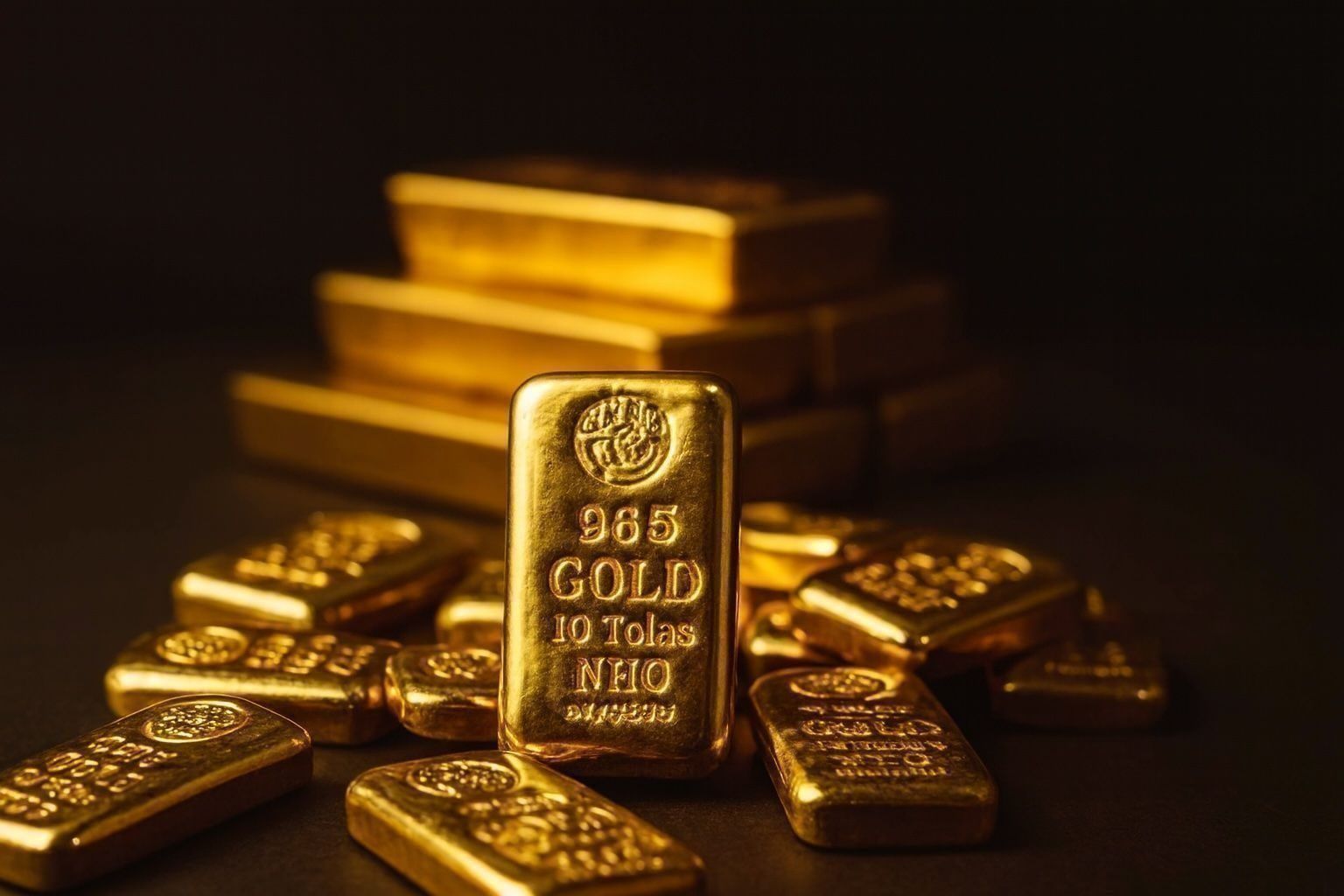
Gold Prices Soar to Historic Levels in Late 2025
As of December 16, 2025, gold prices are hovering near record highs around $4,350 per ounce, just shy of the all-time peak of $4,383 set in Octoberdailyforex.com. This caps a historic year for the yellow metal, which has surged roughly 60-66% since Januarydailyforex.com – one of its strongest annual rallies in decades. The metal swung between $4,285 and $4,351 last week before steadying near $4,304timesofindia.indiatimes.com, buoyed by supportive economic news and policy shifts. Gold’s sister metal, silver, has also skyrocketed, touching a record high above $59/oz this monthreuters.com and nearly doubling in price year-to-datereuters.com. The broad-based strength in precious metals underscores investors’ robust appetite for safe-haven assets as 2025 draws to a close.
Despite some mid-year volatility – including a sharp October correction from record levelsscmp.com – gold’s uptrend remains firmly intact. The metal posted consecutive weekly gains in December and is up over 50% for the year amid a “cocktail of bullish forces,” from central bank buying to geopolitical tensionsreuters.com. Its resilience and momentum heading into 2026 have market participants asking: will the rally continue, or is a pullback overdue? So far, the bulls remain in control, setting the stage for an optimistic outlook going forward.
Fed Easing and Economic Signals Support Gold
A major catalyst behind gold’s 2025 surge has been the U.S. Federal Reserve’s pivot toward easier monetary policy. At its December meeting, the Fed delivered its third and final quarter-point rate cut of the year, lowering the benchmark interest rate by 25 basis points to a range of 3.50%–3.75%. This marked a decisive end to the prior tightening cycle. The Fed also quietly introduced liquidity measures reminiscent of quantitative easing – purchasing around $40 billion in Treasury bills per month – as part of efforts to support financial marketstimesofindia.indiatimes.com. The mere expectation of these rate cuts had weakened the U.S. dollar throughout the fall (the Dollar Index is down roughly 9% in 2025)dailyforex.com, making gold cheaper for overseas buyers and more attractive as an alternative asset.
Key economic indicators gave the Fed cover to turn dovish. Inflation has moderated closer to target: the core Personal Consumption Expenditures (PCE) index rose just 0.3% in September, with the annual pace easing to 2.8% (down from 2.9% in August). At the same time, the labor market has shown signs of cooling – initial jobless claims jumped to their highest level in nearly five years in early Decemberdailyforex.com, and private payrolls saw an unusually sharp decline last monthreuters.com. This softening data, alongside dovish commentary from several Fed officials, fueled expectations that monetary policy would ease.
Lower interest rates are a classic boon for gold. As borrowing costs fall, the opportunity cost of holding non-yielding gold diminishes, which supports higher pricesfxstreet.com. “The market is increasingly confident that the central bank is going to cut rates, and in response we’ve seen the U.S. dollar weaken – that’s accretive for gold,” noted Bart Melek, global head of commodity strategy at TD Securitiesreuters.com. While some Fed officials voiced caution about easing too quicklyfxstreet.com, futures markets are now pricing in a pause at the next Fed meeting and potentially further cuts later in 2026fxstreet.com. In short, the current interest rate outlook remains gold-friendly, removing a key headwind that had weighed on bullion in previous years.
Geopolitical Uncertainty Fuels Safe-Haven Demand
Beyond Fed policy, persistent global uncertainties in 2025 have enhanced gold’s appeal as a safe-haven asset. Foremost is the continued conflict in Ukraine, which, despite some recent diplomatic overtures, still injects caution into the global outlook. In the Middle East, simmering tensions and security concerns have further added to investors’ anxiety. Meanwhile, trade frictions have re-emerged: the U.S. administration’s renewed use of tariffs and other “unorthodox macro policies” has created trade uncertainty that helped drive gold’s record-setting rallybusinessinsider.com. Investors are also warily eyeing the economic fallout of growing U.S. fiscal deficits and heavy government spendingbusinessinsider.com, which raise long-term questions about debt and currency stability.
These geopolitical and fiscal concerns have driven a “flight to safety” into gold throughout the year. Market watchers note that demand for safe-haven assets surged as investors sought hedges against both political turmoil and economic slowdown fearsbusinessinsider.com. “Overall growth in demand outpaces supply,” observed Deutsche Bank analyst Michael Hsueh, pointing to a continued bid for gold amid global tensionsscmp.com. Indeed, concerns over the long-term stability of the U.S. dollar – partly due to high debt and deficit levels – have spurred central banks and investors alike to diversify into goldscmp.com. The combination of stubborn inflation earlier in the year, recession worries, and geopolitical flare-ups created a perfect storm that kept risk appetites in check and supported gold prices at elevated levelsreuters.com. Even as equities and other risk assets saw periods of strength in 2025, many investors maintained positions in gold as a form of insurance. This broad-based sentiment that “something could go wrong” in the world economy or geopolitics has been a key pillar sustaining gold’s safe-haven bid.
Central Banks and Investors Pile Into Gold
One of the defining features of this year’s gold market has been exceptional demand from both central banks and private investors. Around the world, central banks continued a multi-year buying spree of gold reserves, providing a sturdy floor under the market. Analysts estimate that official sector purchases will average on the order of 80 metric tons in 2025 and remain high in 2026reuters.com. Goldman Sachs notes that emerging-market central banks are likely to keep diversifying their reserves into gold, a structural trend that has bolstered demandreuters.com. These consistent inflows – following 2022 and 2023’s record central bank buying – send a strong signal of long-term support. “We see the risks to our upgraded gold price forecast as still skewed to the upside on net, because private sector diversification into the relatively small gold market may boost ETF holdings above our…estimate,” Goldman said in a recent outlookreuters.com, highlighting how even modest shifts by large investors can have an outsized effect on prices.
Private investment has indeed surged in parallel. Gold-backed exchange-traded funds (ETFs) have seen robust inflows, especially in the second half of the year. By mid-December, total known global gold ETF holdings climbed to about 98.3 million ounces – the highest level since late October – after rising for three consecutive weekstimesofindia.indiatimes.com. Holdings are up nearly 19% year-to-date (equivalent to roughly 482 tons added)timesofindia.indiatimes.com, reflecting renewed accumulation by both institutional and retail investors. Western ETFs in particular experienced strong demand this fall as the Fed’s stance turned more accommodativereuters.com. According to Reuters, gold’s 51% annual climb has been driven in large part by “strong central bank buying, increased demand for gold-backed ETFs, a weaker dollar and growing interest from retail investors” seeking a hedgereuters.com. In other words, both official and private buyers have been lining up for gold in 2025, creating a broad base of support.
Physical buying trends present a mixed picture: in key consumer markets like India and China, jewelry demand has cooled at these high price levels – many buyers are waiting for price dipsreuters.com. However, any slack in jewelry/offtake demand has been more than offset by investment flows. COMEX gold futures data also show robust interest; although some inventories have been drawn down as investors opt for physical delivery, registered stockpiles remain historically elevatedtimesofindia.indiatimes.com. Overall, demand growth has outpaced supply this year, contributing to tighter market conditions. This fundamental backdrop of strong structural demand – from central banks securing reserves to investors building hedge positions – has underpinned gold’s ascent and could continue to do so into next year.
Expert Forecasts Point to More Upside in 2026
Looking ahead, market experts and forecasters largely anticipate that gold’s bull run will extend into 2026, albeit with some potential volatility along the way. Many top Wall Street banks have recently raised their gold price targets for the next 12-18 months, citing the same supportive factors seen in 2025 – namely, dovish monetary policy, strong official-sector buying, and persistent geopolitical risks.
Bank of America analysts, for example, believe gold could test $5,000 per ounce in 2026, which would represent roughly 19% upside from current levelsbusinessinsider.com. Goldman Sachs is forecasting around $4,900 by the end of 2026businessinsider.com and sees “significant upside” potential to that figure if private investor demand accelerates further. Deutsche Bank recently raised its 2026 average price forecast to $4,450 (from $4,000 prior), with a projected trading range between $3,950 and $4,950 over the yearscmp.com. Their analysts cite a “positive structural picture” driven by central-bank buying and ETF inflows, and argue that about $3,900/oz will act as a firm floor barring a major change in fundamentalsphysicalgold.com. Even more bullish, J.P. Morgan Research now projects gold prices could average around $5,050 by the fourth quarter of 2026, making it one of the highest forecasts among major institutionsphysicalgold.com. On the cautious end of the spectrum, HSBC still envisions gold trading in a historically high range of $3,600–$4,400 in 2026businessinsider.com, underscoring that virtually all mainstream forecasts expect prices to remain elevated.
Market commentators note that these upbeat predictions rest on familiar pillars. Continued central bank accumulation, further U.S. dollar weakness, and the prospect of additional Fed rate cuts in 2026 are frequently cited as reasons to expect new highsbusinessinsider.com. Many banks also highlight expanding U.S. fiscal deficits and debt as a long-term bullish factor for gold, as investors seek hard assets to hedge against potential currency debasementphysicalgold.com. “Gold prices [will] stop pushing higher only once the underlying drivers change,” one analyst remarked, referring to the enduring mix of loose monetary policy and geopolitical uncertaintybusinessinsider.com. For now, those drivers appear likely to persist.
Of course, seasoned investors acknowledge that no rally is without risks. Gold has already enjoyed an exceptional run – over 50 all-time highs were notched in 2025 alonegold.org – and periodic corrections are possible if, for instance, economic data surprise to the upside or central banks adopt a more hawkish stance than expected. A faster global growth rebound or a resolution of major geopolitical conflicts could also cool safe-haven demand. Nonetheless, the prevailing sentiment among analysts is optimistic: barring a dramatic shift in conditions, gold is positioned to “push ahead” in 2026 rather than pull backgold.org.
Conclusion: Shining Outlook for the Yellow Metal
In summary, gold is ending 2025 not just with a glittering price tag near record highs, but with a widespread conviction in the market that its fundamentals remain strong. The combination of a more accommodative Fed, robust physical and investment demand, and a backdrop of global uncertainty has created a potent brew that propelled gold to historic heights this year. As we enter 2026, the yellow metal’s role as a portfolio safe haven and inflation hedge is as prominent as everfxstreet.comfxstreet.com. While investors should stay vigilant to changing conditions, the current outlook from many experts suggests that gold’s rally “could continue to act as an effective store of value during a period of elevated macro uncertainty”physicalgold.com. For general investors, traders, and anyone watching the gold market, the message is clear: gold’s luster looks set to shine on into the new year, backed by the same forces that made 2025 a historic year for the precious metal.
Sources: Gold market analyses and forecasts from Reuters, Kitco News, Times of India, DailyForex, FXStreet, Business Insider, and other financial research outletsreuters.comreuters.combusinessinsider.comscmp.com. All information is current as of December 16, 2025.