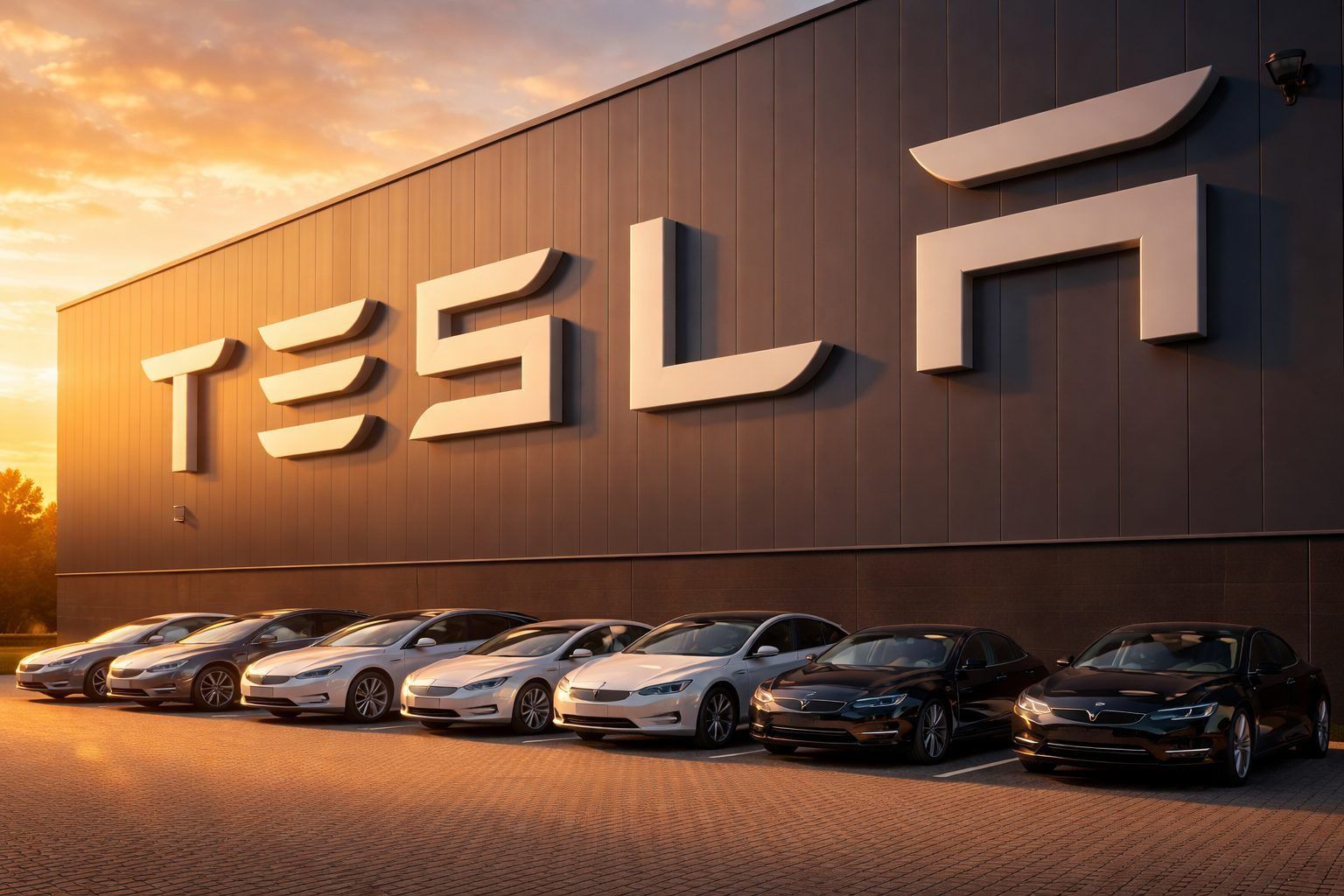

December 16, 2025 — Tesla, Inc. NASDAQ:TSLA is back in the spotlight after a burst of autonomy-related headlines helped push the stock to the edge of record territory, reviving the long-running debate over whether investors are valuing Tesla primarily as an automaker — or as an AI-and-robotics platform.
Shares finished Monday, December 15, at $475.31, after trading between roughly $467.66 and $481.77 on heavy volume. Yahoo Finance That close leaves TSLA within striking distance of its prior record markers, with market attention now centered on one question: how quickly Tesla can turn robotaxi testing into scalable, revenue-generating operations.
What’s driving Tesla stock on December 16, 2025: robotaxi testing without safety monitors
The immediate catalyst behind the latest move is Tesla’s progress — and messaging — around unsupervised robotaxi testing in Austin.
Reuters reported that CEO Elon Musk said Tesla was testing robotaxis without safety monitors in the front passenger seat, and that the shares rose as much as about 4.9% in response. Reuters Musk wrote that “Testing is underway with no occupants in the car,” according to Reuters. Reuters
TechCrunch added key operational color: roughly six months after Tesla began testing a limited robotaxi service in Austin, the company is now letting those vehicles drive around the city with no safety monitor onboard — a step that intensifies scrutiny and raises the stakes for safety, transparency, and regulatory response.
The Verge separately reported that Tesla robotaxis were spotted operating unsupervised in Austin over the weekend, and emphasized that Tesla previously relied on human monitors (with a kill switch) in both Austin and the Bay Area.
Why investors care: Wall Street has increasingly treated robotaxis and autonomy software as the “unlock” for Tesla’s next valuation leg — and these sightings/confirmations are being read as proof of forward momentum, even while the service remains limited in scope.
The competitive reality check: Waymo’s scale, safety data, and the “proof gap”
Tesla’s autonomy headlines also re-ignite comparisons to Alphabet-owned Waymo, which is widely viewed as the current U.S. leader in commercial robotaxi deployments.
- Reuters noted Waymo had more than 2,500 commercial robotaxis across major U.S. cities (as of November) and cited a report that Waymo was doing about 450,000 paid rides per week.
- The Verge reported Waymo disclosed over 14 million paid rides in 2025 and plans to expand to 20 new cities in the coming year.
Meanwhile, TechCrunch pointed out that Tesla’s small Austin test fleet has been involved in at least seven crashes since June, and described limited public detail around incidents due to redactions in reports to the National Highway Traffic Safety Administration.
This dynamic helps explain the split on TSLA: the market is rewarding progress signals, but many analysts remain cautious until Tesla can provide repeatable performance evidence, broader access, and a clearer regulatory runway.
The big bullish forecasts: Wedbush’s “$3 trillion” narrative returns
Few voices moved faster to frame this week’s robotaxi developments as a major valuation inflection than Wedbush analyst Daniel Ives.
Multiple outlets summarized Ives’ view that Tesla could reach a $2 trillion market cap in 2026, with a bull-case $3 trillion by end of 2026 as autonomous and robotics initiatives ramp.
In a separate Investing.com roundup, Ives argued that robotaxis could expand to more than 30 U.S. cities in 2026, that FSD adoption could exceed 50%, and that in a bull scenario the stock could reach $800 over the next 12–18 months.
It’s important to note: these are analyst projections, not company guidance — and they rest on aggressive assumptions about timeline, scale, and regulatory environment. Still, the “Tesla as AI platform” thesis remains a powerful narrative force whenever autonomy milestones appear to be accelerating.
A major near-term upgrade: Mizuho raises Tesla price target to $530
Beyond the headline-grabbing long-term bulls, Tesla also received notable sell-side target support heading into December 16.
TipRanks’ coverage of TheFly reported that Mizuho raised its Tesla price target to $530 from $475, keeping an Outperform rating, and cited improving investor sentiment on robotaxis as a key factor behind the increase.
Barron’s also reported Mizuho’s increased target and noted that Tesla slipped modestly Tuesday as some investors took profits after Monday’s strength.
The bear and “hold” camp hasn’t disappeared — and the consensus target is far lower
Despite the high-profile bulls, the broader analyst picture remains mixed.
A 24/7 Wall St. roundup published December 16 said Tesla had a median one-year price target around $386.42 and a consensus Hold rating split among Buy/Hold/Sell calls.
MarketBeat’s analyst compilation similarly pegged the average target near $399.33, with an unusually wide spread between the highest and lowest published targets.
TipRanks’ forecast page echoed the same broad message: average targets well below the current price and a Hold-leaning consensus.
Barron’s highlighted that Barclays remains cautious and cited a $350 target alongside its concerns about regulatory challenges — a reminder that for many analysts, the autonomy upside must be weighed against execution and approval risk.
Bottom line: even as TSLA trades near record levels, the “average Street target” still clusters closer to ~$400 than ~$600+, reflecting skepticism that robotaxi economics will arrive quickly enough to justify today’s valuation.
Morgan Stanley’s recent downgrade: “great company, priced-in catalysts”
One of the most widely discussed caution flags earlier this month was Morgan Stanley’s rating change.
Investing.com reported the firm moved Tesla to Equal Weight (from Overweight), set a $425 price target, and argued that non-auto catalysts appeared largely priced in at current valuation levels.
Investopedia’s summary of the Morgan Stanley note also underscored near-term risk factors tied to the EV business, while laying out how the bank conceptually values Tesla’s pieces — including “mobility” (robotaxis), “network services” (including self-driving software), energy, and humanoids. investopedia.com
Cathie Wood trims TSLA again — but keeps Tesla as a cornerstone bet
Tesla’s rally also triggered more portfolio moves from one of TSLA’s most famous long-term champions: Cathie Wood’s ARK Invest.
Investor’s Business Daily reported that ARK sold 124,867 shares worth about $59.35 million, following another sale of nearly 88,000 shares days earlier, while still keeping Tesla as a top holding and reiterating a long-term thesis tied to robotaxis.
Barron’s likewise framed ARK’s sales as routine rebalancing rather than a major sentiment shift and noted ARK’s continued $2,600 by 2029 projection.
For TSLA watchers, ARK’s activity matters less as a “signal” and more as confirmation of the current regime: Tesla rallies tend to attract both profit-taking and renewed long-duration forecasts at the same time.
Tesla’s fundamentals: falling U.S. sales in November vs. autonomy-led valuation
A key tension in Tesla’s story right now is that autonomy excitement is rising even as core auto demand shows strain.
Reuters reported U.S. Tesla sales fell nearly 23% year over year in November to 39,800 vehicles, the lowest since January 2022, despite the rollout of cheaper “Standard” variants — and also noted broader U.S. EV sales fell more than 41% in November after the end of the $7,500 federal tax credits in September. Reuters
At the same time, Reuters emphasized that despite the market’s focus on robotaxis and humanoids, the bulk of Tesla’s current revenue and profit still comes from selling vehicles.
This mismatch is why TSLA can feel like two stocks in one:
- An automaker navigating demand, pricing, incentives, and competition
- A high-multiple “future autonomy” platform trading on milestones, data, and regulatory momentum
Tesla expands the “more than cars” narrative with a European Megapack framework deal
Another notable development near the same news cycle is in Tesla’s energy business.
SPIE announced on December 15 that it signed a European framework agreement with Tesla covering the deployment of battery energy storage system (BESS) projects, structured as a renewable three-year agreement across SPIE subsidiaries with relevant expertise.
While the announcement is not an “earnings event,” it reinforces an important valuation-supporting theme: Tesla’s energy segment (including Megapack deployments) is increasingly cited as a durable growth vector alongside autonomy.
Business Insider also noted Tesla generated over $10 billion last year from selling batteries that support the grid and home energy use — a data point frequently used to argue Tesla already has meaningful scale outside autos.
Governance headline investors are watching: Reuters reports board stock award windfalls
A separate Reuters investigation published December 15 put Tesla governance back on the radar, reporting that Tesla directors earned more than $3 billion through stock awards whose gains outpaced peers at major U.S. tech firms, citing an analysis by compensation and governance specialist Equilar.
Reuters added that Tesla’s board suspended director compensation starting in 2021 to settle a shareholder lawsuit alleging excessive board-member pay, and provided historical comparisons on director compensation levels.
For TSLA stock, governance coverage tends to matter most when it intersects with broader market confidence — especially in periods where the share price is being driven by longer-dated expectations rather than near-term earnings.
Technical setup: breakout chatter grows as TSLA hovers near key levels
Technical analysts are also engaged, largely because Tesla is trading close to breakout territory.
Investor’s Business Daily reported TSLA cleared a cup-base buy point near $474.07 and described support near the 50-day moving average, alongside broader “breakout” framing tied to the robotaxi news flow. Investors.com+1
Even for investors who don’t follow technicals closely, the practical implication is simple: a stock near record levels tends to amplify reactions — both to good news (breakouts) and to disappointments (sharp pullbacks when expectations are crowded).
What could move Tesla stock next: the December 2025 checklist
With TSLA trading on a blend of autonomy headlines and high expectations, investors will likely focus on:
- Robotaxi expansion pace: fleet size, new geographies, and whether Tesla begins to provide more measurable performance/safety detail (or faces regulatory friction).
- Competition benchmarks: Waymo’s continued expansion and disclosed ride volume will remain a direct comparator.
- 2026 timeline credibility: Wall Street’s bull cases are increasingly anchored to 2026 as the year autonomy and robotics become material.
- Auto demand and deliveries: recent U.S. sales weakness is a reminder that the “legacy” revenue engine is still critical. Reuters
- Energy storage growth: large-scale Megapack partnerships in Europe and elsewhere can strengthen the “Tesla is diversified” narrative. SPIE+1
- Analyst target dispersion: with targets ranging from the mid-$300s to $600+ and beyond, Tesla remains unusually sensitive to upgrades/downgrades.
The takeaway for TSLA on December 16, 2025
Tesla stock’s latest surge is a textbook example of how TSLA trades when autonomy momentum appears to accelerate: the market rapidly re-prices the long-term robotaxi opportunity, while skeptics emphasize the absence of widely published safety metrics, competitive pressure from Waymo, and the reality that Tesla’s near-term financials still depend on vehicle sales.
As of today, investors are effectively voting on a timeline — and the next phase of robotaxi testing in Austin is pushing more of the market to believe that timeline is shortening.
Related articles: NASDAQ:TSLA