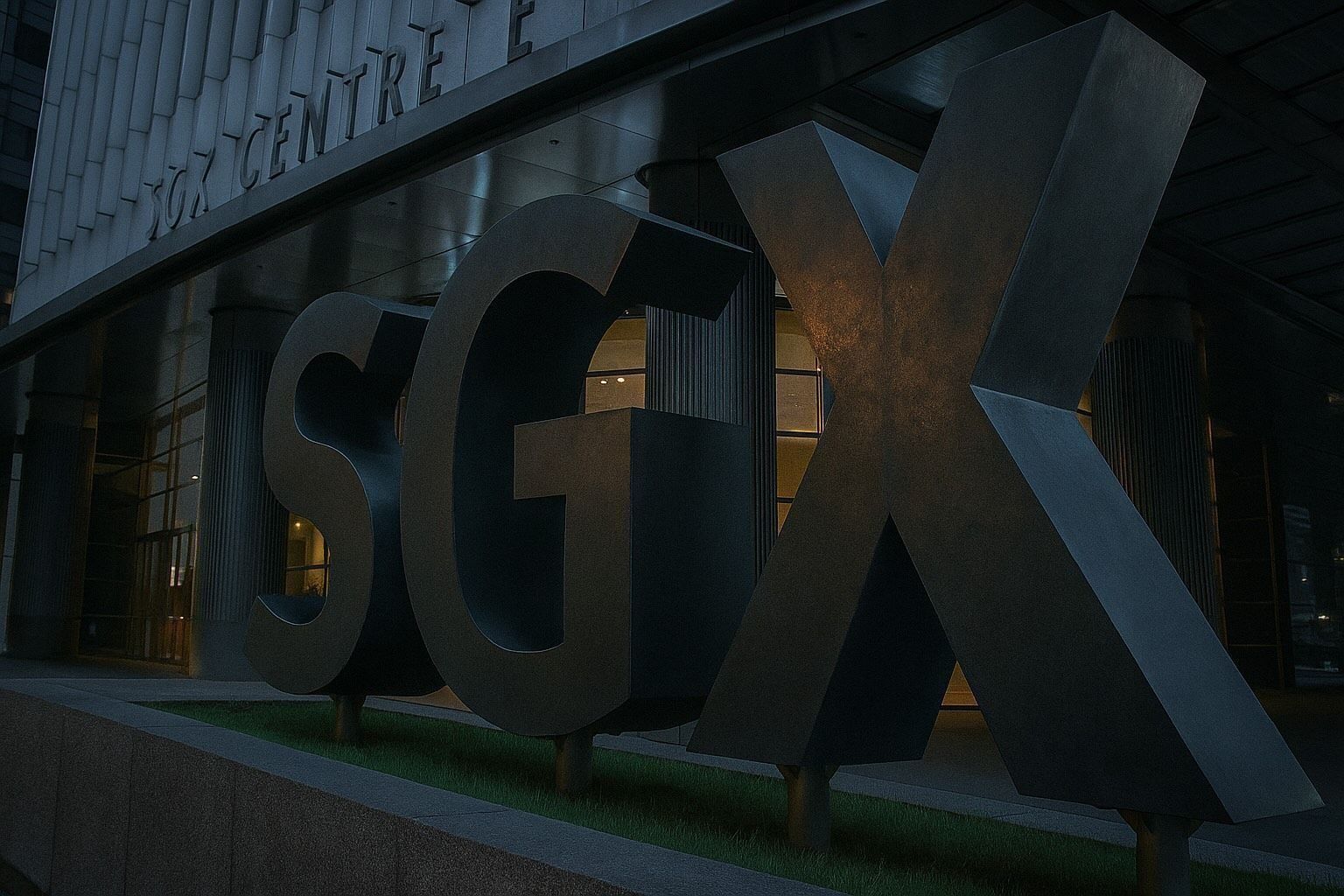
SINGAPORE, Dec 17, 2025 — Singapore shares were softer on Wednesday, with the benchmark Straits Times Index (STI) easing as investors balanced upbeat domestic data against a cautious global backdrop shaped by shifting interest-rate expectations, oil’s rebound, and a busy central-bank calendar. The STI was last hovering around 4,566, after opening at 4,555.67 and trading in a 4,545.77–4,575.13 range, with volume reported at about 88.4 million.
The muted tone came even as Singapore posted a stronger-than-expected jump in November exports and economists upgraded GDP expectations in the latest Monetary Authority of Singapore (MAS) survey — data that would typically support risk appetite.
Meanwhile, several Singapore blue chips and REIT-related counters drew attention after fresh corporate developments: property tycoon Gordon Tang’s move to acquire Suntec REIT’s manager, Keppel’s planned sale of data-centre stakes to Keppel DC REIT, and a CapitaLand-UOL consortium’s top bid for a major Hougang Central mixed-use site.
STI performance: A cautious dip despite supportive domestic headlines
Singapore’s equity barometer started the session at 4,555.67 and stayed rangebound through the day, reflecting a market that is neither fully risk-on nor decisively defensive. Trading levels reported for the session put the day’s range at 4,545.77 to 4,575.13, with the index sitting around the mid-4,500s.
From a market narrative standpoint, the message was clear: Singapore’s macro prints improved, but global positioning and rates still have a strong grip on Asian equity performance — especially for markets like Singapore where banks and yield-oriented stocks remain central to index direction.
For context, Singapore stocks had finished the prior session (Dec 16) slightly lower, with the STI down 0.2% to 4,579.73, as markets braced for key U.S. data that could reset rate expectations.
Singapore macro today: Exports beat forecasts; economists lift growth outlook
Exports surprise on the upside
Singapore’s non-oil domestic exports (NODX) rose 11.6% year-on-year in November, beating a Reuters-polled forecast of 7.0%, following a revised 21.7% increase in October. The growth was led mainly by pharmaceuticals, with support from electronics such as integrated circuits and PCs, underscoring that parts of the tech and AI-linked cycle remain constructive into year-end.
Enterprise Singapore also narrowed its full-year 2025 NODX growth forecast to “around 2.5%” (from a prior 1% to 3% range), citing expectations that AI-related demand and high gold prices could provide some support through the fourth quarter. Reuters
MAS survey: 2025 growth upgraded, 2026 seen moderating
A separate macro signal came via MAS’ quarterly survey of professional forecasters. Economists’ median forecast for Singapore’s 2025 growth was raised to 4.1% (from 2.4% previously), while 2026 growth was seen easing to 2.3%.
Inflation expectations stayed relatively contained for 2025 (core and headline forecasts around 0.7% and 0.9%, respectively), with both expected to pick up in 2026.
Crucially for markets, the survey pointed to policy continuity: economists broadly expected MAS to keep policy unchanged at the upcoming January review, with most also expecting no change by April.
Why this matters for SGX investors:
- Better growth and stronger exports can support cyclical earnings expectations (industry, transport/logistics, selected tech exposure).
- A steady MAS stance can help keep financing and currency conditions relatively predictable — important for REITs and dividend-heavy strategies.
- But improved growth does not automatically translate into higher equity prices if global risk sentiment is fragile.
Global backdrop: Rates, oil, and central banks set the tone for Asia — including Singapore
Singapore equities rarely trade in isolation, and Wednesday’s mood across Asia leaned cautious.
U.S. jobs data: noise, but enough to keep investors hesitant
In global markets, investors weighed a U.S. jobs report that showed job growth rebounding but with the unemployment rate rising to 4.6%, while data quality was clouded by disruptions linked to a record 43-day government shutdown.
Market participants largely treated the data as not decisive enough to force a major repricing of the rate outlook, but it contributed to a “wait-and-see” posture. Reuters
Oil jumps on Venezuela blockade headlines
Oil prices rebounded after U.S. President Donald Trump ordered a blockade of sanctioned oil tankers entering and leaving Venezuela, adding a new geopolitical variable to markets already sensitive to growth and inflation signals. Reuters reported U.S. crude futures rising to around $55.97 and Brent to $59.60 in the wake of the news.
For Singapore, higher oil can cut both ways: it may support parts of the offshore/marine and services ecosystem, but it also raises broader inflation and cost concerns — especially if the move becomes sustained.
Central bank watch: BOE/ECB/BOJ and U.S. inflation next
Asian trading also reflected anticipation of major central bank decisions and near-term inflation prints. Reuters flagged that investors were watching upcoming rate decisions from the Bank of England, European Central Bank, and Bank of Japan, alongside fresh U.S. inflation data for the next cue.
The Business Times similarly noted that mixed U.S. jobs data did little to revive aggressive near-term rate-cut expectations, contributing to subdued sentiment across regional markets — with Singapore among the markets in the red on the day.
Stocks in focus on SGX today: Suntec REIT, Keppel DC REIT, and the Hougang mega project
Corporate developments — especially those tied to capital allocation and “value unlocking” — have become central to the Singapore equities story. Today’s headlines reinforced that theme.
Suntec REIT: Gordon Tang moves to acquire the REIT manager
One of the most closely watched Singapore REIT developments this morning: Acrophyte Asset Management, controlled by billionaire Gordon Tang, issued a disclosure of interest notification to acquire ESR Trust Management (Suntec), the manager of Suntec REIT. Acrophyte planned to enter a conditional sale and purchase agreement with ESR subsidiaries to acquire ESR’s 100% indirect interest in the manager, according to the disclosure referenced by Suntec’s manager.
Tang was reported to own about 35.7% of Suntec REIT (around one billion units), while ESR owned about 10.8%. Tang described the move as an extension of his long-term commitment and said he wanted to work with the board and management on further value-adding initiatives.
This matters because manager control can influence:
- capital management decisions (asset recycling, leverage, refinancing),
- distribution policy and strategy,
- portfolio direction in a still-rate-sensitive REIT landscape.
Keppel and Keppel DC REIT: data-centre stakes deal (S$50.5 million)
In another data-centre-linked headline, Keppel’s connectivity division agreed to sell its stakes in two data centres to Keppel DC REIT for S$50.5 million in cash. The remaining interests involve a 10% stake in Keppel DC Singapore 3 and a 1% stake in Keppel DC Singapore 4, with transactions expected by Q1 2026.
Keppel shares had closed 0.4% lower at S$10.06 in the prior session, while Keppel DC REIT units closed 1.8% lower at S$2.20 ahead of the news, according to The Business Times.
The broader read-through: Singapore’s data-centre theme remains active, and intra-group portfolio reshaping continues — a point of focus for investors tracking long-duration digital infrastructure cash flows.
CapitaLand-UOL-CICT: top bid for Hougang Central at S$1.5 billion
Property-linked counters were also in the spotlight after a consortium involving CapitaLand Development, UOL, Singapore Land, Kheng Leong, and a CapitaLand Integrated Commercial Trust (CICT) vehicle put in the top bid of S$1.5 billion (about S$1,179 psf ppr) for a Hougang Central mixed-use mega project.
The bids came in above analysts’ expectations (reported as around S$800 to S$1,000 psf ppr), and analysts cited in The Business Times expected the new homes in the project to be priced around S$2,500 to S$2,600 psf.
This is significant because it ties together:
- residential development economics (UOL/CapitaLand/SingLand),
- long-term commercial asset exposure (CICT),
- and the demand outlook for integrated transport-and-retail nodes.
Forecasts and market outlook: “New highs” thesis meets near-term caution
While day-to-day trading is being shaped by rates and global cues, 2026 outlook notes are increasingly shaping how institutions frame Singapore.
JPMorgan’s 2026 view: Singapore equities still have room to run
JPMorgan analysts said Singapore equities could reach “new highs” in 2026, citing value-unlocking initiatives, a surge of capital inflows, and a solid fiscal buffer. The bank argued that Singapore equities have “a long way to go” as official measures are implemented to lift listings and trading activity over the longer term. The Edge Singapore
JPMorgan’s analysis also pointed to potential improvements in corporate efficiency and valuation: it highlighted expectations that return on equity could rise toward 12% (versus “current 10%” cited in the report), and that price-to-book valuations could move closer to Asia’s average near 2x (against the STI’s cited 1.6x). The Edge Singapore
What this means for today’s tape: Even when the index is down on a given session, investors are increasingly scanning for events that fit the “value unlock” storyline — corporate actions, restructuring, manager changes, asset recycling, or transactions that can re-rate balance sheets and improve shareholder returns.
What to watch next for Singapore stocks
With Singapore’s domestic data improving, the short-term question is whether global macro volatility will allow that good news to translate into stronger equity momentum.
Key catalysts investors are tracking:
- Global inflation and rates: the next U.S. inflation data print and how it influences the path of global yields (a major driver for banks, REITs, and valuation multiples).
- Central bank decisions: BOE/ECB/BOJ outcomes and messaging, especially where they influence FX and regional risk appetite.
- Singapore policy expectations: MAS survey signals still point to policy on hold near term, but markets will watch January’s review closely for confirmation.
- SGX “value unlock” style corporate developments: REIT manager changes, asset deals, and major property bids can act as catalysts even when the benchmark drifts. The Straits Times+2The Business Times+2
Bottom line: Singapore’s fundamentals improved today — but global markets still call the shots
On Dec 17, the Singapore stock market delivered a familiar late-cycle mix: strong domestic macro surprises (exports, growth forecasts) alongside global uncertainty (rates, oil geopolitics, and central-bank risk).
The STI’s modest dip around the 4,566 area suggests investors are not rejecting the Singapore story — they are simply not yet ready to price it aggressively higher until global rate signals and risk sentiment become clearer.
At the same time, today’s corporate headlines — especially around Suntec REIT’s manager, Keppel’s data-centre stake sale to Keppel DC REIT, and the CapitaLand-UOL-CICT Hougang bid — underline that deal flow and value unlocking are likely to remain key drivers of Singapore equity narratives into 2026.