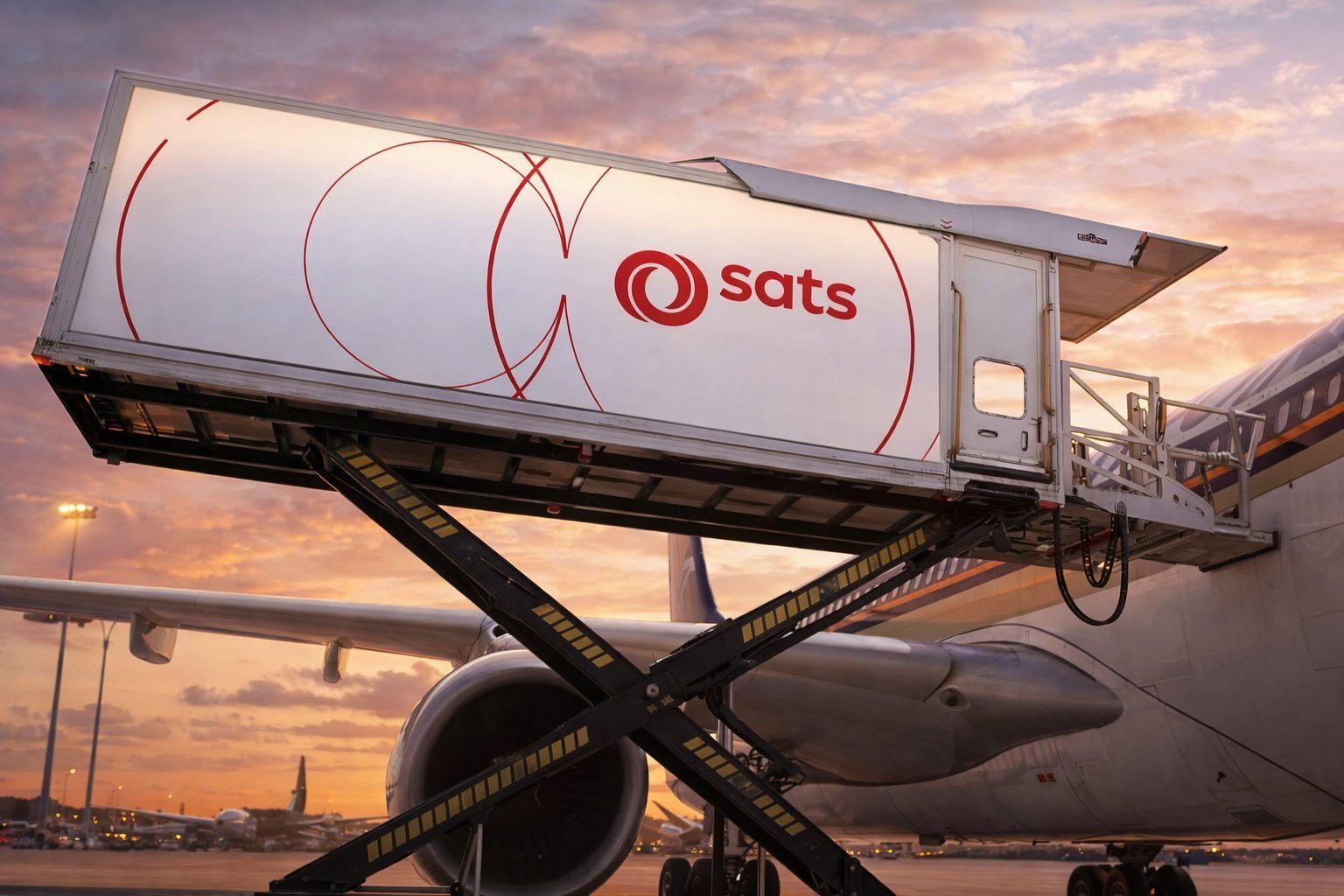
SINGAPORE — December 17, 2025 — SATS Ltd stock (SGX: S58) was firmly in focus on Wednesday as shares traded around S$3.72–S$3.73, extending a strong multi-day climb. Investors have been weighing three themes at once: an active share buyback programme, fresh operational momentum at cargo unit Worldwide Flight Services (WFS), and a cluster of broker target prices that mostly sit above the current trading level.
This article refers to SATS Ltd listed in Singapore (SGX: S58 / S58.SI)—not other similarly named tickers in overseas markets.
SATS Share Price Today: What the Market Is Saying on 17.12.2025
By mid-day Singapore time, SATS shares were quoted at S$3.73, up S$0.08 (+2.19%) on the session, according to SG-focused market tracking. SG Investors
End-of-day reporting from market data services showed SATS at S$3.72 (+1.92%) with about 6.54 million shares traded—also notable because it places the stock at the top end of its recent range.
Zooming out slightly, the move is part of a broader short-term upswing: SATS’ one-week change was shown at roughly +8.77%, reflecting a burst of momentum that has been hard for the market to ignore.
The Most “Real” Near-Term Support: SATS’ Share Buyback Activity
One of the cleanest, most concrete signals behind the recent firmness is the company’s ongoing on-market share buybacks, disclosed through SGX filings.
In the latest available Daily Share Buy-Back Notice (broadcast December 16, 2025), SATS reported it bought back 235,100 shares on 16/12/2025 at prices between S$3.59 and S$3.64, for a total consideration of S$851,776.44. The shares were held as treasury shares (not cancelled).
The same filing also showed cumulative progress since the buyback mandate began:
- Cumulative shares bought back to date:6,556,300
- Cumulative buyback percentage:0.439% of issued shares (excluding treasury shares, per the disclosure)
- Treasury shares after the purchase:8,024,605
Buybacks aren’t magic, but they do two practical things that markets often like:
- they can provide a steady source of demand in the open market, and
- they broadcast management’s confidence in the company’s capital position and medium-term earnings power—especially when paired with dividends.
WFS News: Saudia Cargo Renews a Multi-Station Handling Deal Across Europe and the US
If buybacks are the “financial engineering” angle, WFS is the “operating engine” angle.
This week’s standout operating headline is a WFS announcement dated 16/12/25 (with the release referencing December 15, 2025) that Saudia Cargo has renewed and extended its cargo handling partnership with WFS (a SATS company).
The contract coverage is meaningful because it spans eight major international gateways:
- Europe: Amsterdam Schiphol, Brussels, Frankfurt, Paris CDG, London Heathrow, Manchester
- United States: New York JFK, Washington Dulles
WFS also noted it provides Saudia Cargo handling at other stations beyond those eight (including locations such as Liege, Bengaluru, Bangkok, Johannesburg and Los Angeles), underlining that the relationship is part of a broader global network rather than a single-station win.
Industry trade coverage mirrored the announcement, highlighting the same multi-station footprint and positioning it as a reinforcement of service continuity at key cargo hubs.
Why this matters for SATS stock: SATS’ long-term bull case increasingly leans on cargo scale + network economics after the WFS acquisition. Multi-station contracts tend to be strategically valuable because they can:
- raise switching costs for customers (harder to replace across many airports at once), and
- improve utilisation and planning across a network (labour, warehouse capacity, equipment).
The market doesn’t always re-rate a stock on a single contract renewal, but a steady drumbeat of global cargo activity helps reinforce the idea that WFS is not just “integrated,” but actively commercial.
WFS and the Efficiency Story: Machine Learning Forecasting for Cargo Volumes
The other WFS development investors have been chewing on is less flashy than a contract win—but arguably more important to margins.
In a 08/12/25 press release, WFS described a machine-learning forecasting tool built on 10 years of operational data, aimed at improving the accuracy of cargo volume forecasts (by flight, truck and day) so warehouses can plan labour and resources more precisely.
Key operational details from WFS’ release included:
- Models trained on over 3 million air waybills, incorporating seasonality, holidays and cargo types
- Coverage across 75 warehouses in 13 countries
- Forecast output spanning 9,842 flights and 6,216 truck movements per week
- Reported forecast accuracy in a 92–98% range (per WFS’ data)
For investors, this lands right on the pressure point for airport services businesses: labour is a big cost line, and cargo volumes can be volatile. Better forecasting can reduce overtime spikes and service-level breaches—both of which can quietly chew through operating leverage.
The Earnings Base: SATS’ Q2 FY2026 Profit Growth and Higher Interim Dividend
The current “December tape” for SATS stock is also anchored by the company’s most recent half-year performance update.
SATS reported Q2 FY2026 net profit of S$78.9 million, up 13.3% year-on-year, with quarterly revenue rising 8.4% to about S$1.6 billion (for the three months ended Sep 30).
Management commentary pointed to strong cargo performance and noted that the quarter’s demand benefited partly from customers front-loading orders ahead of tariff changes, while the company managed capacity and resources as patterns evolved.
SATS also declared an interim dividend of S$0.02 per share, payable on Dec 5, higher than the prior year’s interim payout noted in the same report.
From an investor attention standpoint, that dividend matters because it feeds directly into the “returns story” that is now running alongside buybacks.
Separately, independent investor commentary in Singapore has emphasised improving cash generation and the post-pandemic recovery arc—while also flagging the balance-sheet trade-offs that came with building a global platform.
Food Solutions Growth Angle: A Turkish Airlines Catering Contract in Japan
SATS isn’t only a cargo story; the company also has a large Food Solutions segment. One recent, clearly disclosed commercial win came through SATS’ subsidiary in Japan.
In a SATS release dated Nov 21, 2025, the company said TFK Corporation (SATS TFK) secured a multi-year inflight catering contract with Turkish Airlines, providing daily meal services for flights from Tokyo Narita (NRT) and Tokyo Haneda (HND) to Istanbul (IST), prepared to halal standards at SATS TFK’s certified facilities.
This is the kind of contract that tends to be strategically useful for two reasons:
- it strengthens airline relationships in a major hub market (Tokyo), and
- it supports the idea that SATS can cross-sell and scale food capabilities beyond Singapore.
SATS Stock Forecasts and Analyst Targets: Where Street Numbers Sit in December 2025
Forecasts and analyst views aren’t guarantees (markets love humiliating certainty), but they matter because they shape institutional positioning and narrative gravity.
Broker target prices in circulation
A Singapore market compilation of broker calls listed the following target prices and ratings for SATS (dates shown as published in 2025):
- UOB Kay Hian (Nov 17):Buy, target S$4.20 (prev S$3.52)
- DBS Research (Aug 22):Buy, target S$3.80 (prev S$3.50)
- OCBC Investment (Aug 21):Buy, target S$3.73
- Phillip Securities (Aug 22):Accumulate, target S$3.66 (prev S$3.58)
With SATS trading around S$3.72, that set of targets spans “roughly fairly valued” (around S$3.66–S$3.73) to “meaningful upside” (S$3.80 and S$4.20). SG Investors+1
Nomura’s target price adjustment
Market data also pointed to a Nomura adjustment on Nov 18, showing a target price reset to S$4.04 from S$4.56, while maintaining a Buy stance.
Valuation snapshots investors are seeing
Market-based valuation snapshots (which rely on forward estimates) indicated SATS trading at around 19.6x estimated P/E for 2026, with an estimated forward dividend yield around 1.76% (again, estimate-based).
Meanwhile, one independent analysis piece published Dec 16, 2025 framed the recent share-price strength around profit growth, a higher interim dividend, and buybacks—while warning that capital needs and refinancing considerations remain central to the longer-term debate.
Practical takeaway: Into year-end 2025, the “forecast zone” around SATS isn’t a single number. It’s a range—bounded by execution on margins and cash flow on one side, and debt/cycle risk on the other.
The Investment Narrative on 17 Dec 2025: What Bulls and Bears Are Really Arguing About
Under the day-to-day headlines, SATS stock is basically a debate between two stories:
The bull case (why the stock can keep working)
- Aviation and cargo recovery continues to normalise volumes and raise utilisation.
- WFS shows evidence of commercial traction via multi-station contract renewals, supporting network scale.
- Operational improvement efforts (like forecasting tech) suggest a path to better labour efficiency and service reliability, which can lift margins without needing perfect macro conditions.
- Capital returns (dividends + buybacks) signal confidence and can support price levels in choppy markets.
The bear case (what can break the story)
- The post-acquisition structure comes with leverage and refinancing sensitivity—a risk repeatedly flagged in market commentary.
- Air cargo is cyclical; volumes can swing with global growth, trade policy shifts and inventory cycles.
- Integration isn’t a one-time event; it’s a long, operational slog where execution mistakes show up as margin disappointment.
In other words: SATS is increasingly a “global platform + operational excellence” stock—still cyclical, but trying to be less fragile through scale and process.
What to Watch Next: Near-Term Catalysts and Key Dates
A few items are likely to stay on investors’ dashboards after December 17:
- Next results checkpoint: market calendars have pointed to a projected Q3 FY2026 earnings release around Feb 17, 2026.
- Further SGX buyback disclosures: if buybacks continue at a steady clip, the market will see it in recurring daily notices.
- Additional WFS contract updates: multi-station renewals and operational tech rollouts can compound into a clearer margin story over time.
- New Food Solutions wins: contracts like Turkish Airlines in Japan are small individually, but strategically important if they signal scalable international catering growth.
Bottom Line on SATS Ltd Stock on 17.12.2025
SATS stock’s strength on December 17, 2025 looks less like a random spike and more like a market re-pricing around a coherent bundle of signals: active buybacks, visible cargo network momentum via WFS, and a forecast/target-price backdrop that still leaves room (at least on paper) for upside—particularly if operational efficiency translates into durable margin gains.
At the same time, the company’s valuation debate is inseparable from its capital structure and the reality that aviation and cargo don’t move in straight lines. The next few quarters—especially the tone around cash flow, debt management and WFS execution—will likely determine whether this December rally becomes a new baseline, or just a festive seasonal mood swing.