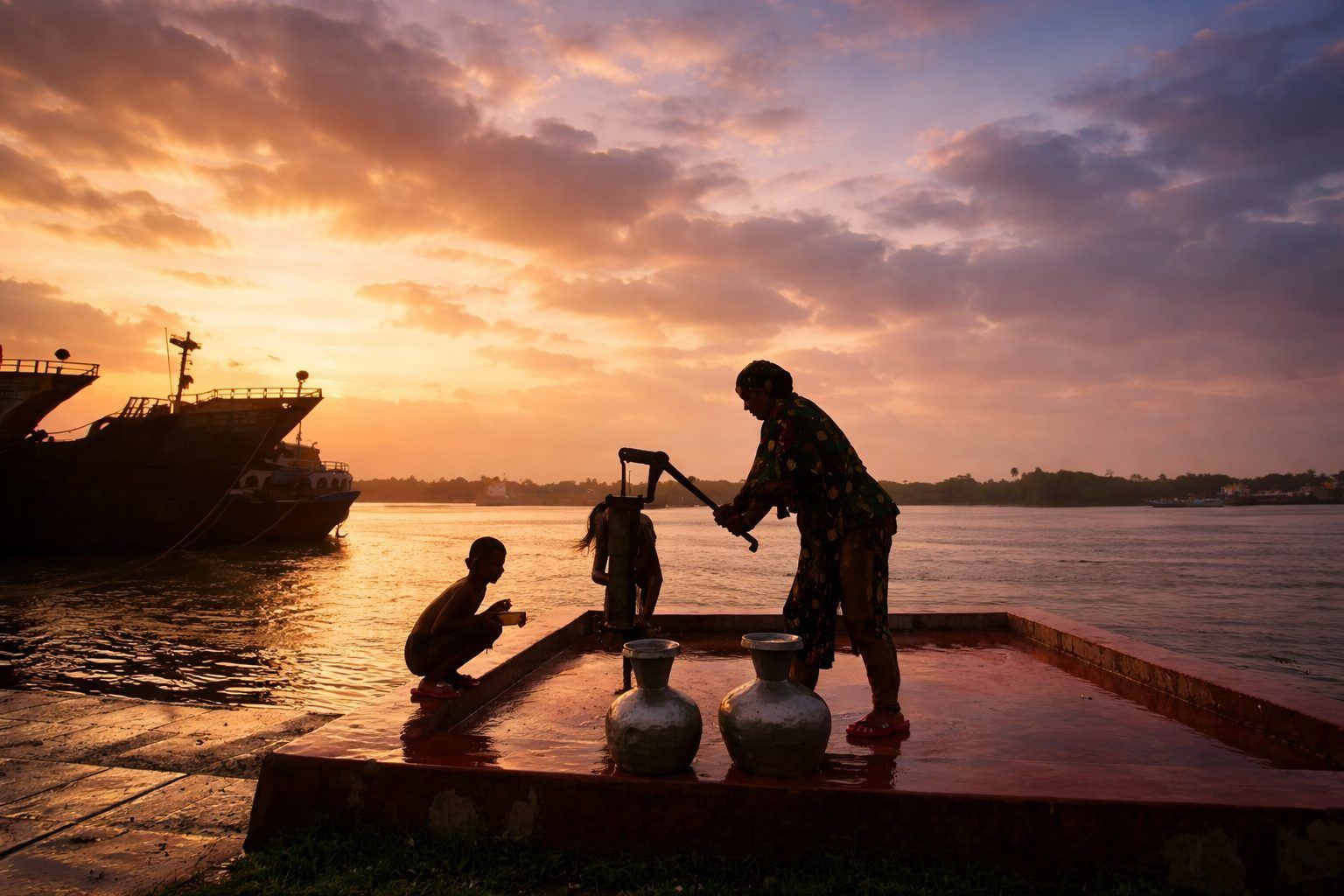

DHAKA/RAJSHAHI, Dec. 17, 2025 — Bangladesh’s water story is entering a new and more complicated phase: it’s no longer only about water pollution, or only about drought and scarcity. It’s about both — at the same time — and the consequences are landing on public health, agriculture, and the economy from Dhaka’s riverbanks to the parched Barind tract.
On December 17, fresh developments highlighted how fast the crisis is converging. In the northwest, the government has moved to formally recognize the severity of water stress in the Barind region, including restrictions on groundwater extraction beyond drinking water. In parallel, enforcement agencies are intensifying action against polluters and noncompliant industrial operations. And while national policy discussions focus on monitoring systems and regulation, grassroots innovation is also emerging — including farmer-led seed research designed to keep crops alive when irrigation fails.
Barind water crisis: 4,911 villages declared “water‑stressed” — and groundwater restrictions tighten
The Barind tract — spanning parts of Rajshahi, Naogaon, and Chapainawabganj — has long been one of Bangladesh’s most drought-prone zones. But this week, officials and experts put new legal and policy weight behind that reality.
According to a Bangladesh Sangbad Sangstha (BSS) report from Rajshahi, a gazette has recently been published declaring 4,911 villages across 25 upazilas in the three districts as water-stressed, following decisions connected to the National Water Resources Council. The designation is set for 10 years, and it comes with a major implication: restrictions on extracting underground water for purposes other than drinking — specifically stating that extracted groundwater should not be used for irrigation or industrial use in the restricted area.
The announcement surfaced during a meeting between officials of the Water Resources Planning Organization (WARPO) and the Barind Multipurpose Development Authority (BMDA), where speakers emphasized that sustainable water management in Barind will require strong coordination across agencies and “realistic decisions,” especially under climate pressure. BSS
Why the Barind decision matters beyond Barind
The Barind region is not just another drought hotspot — it is also a major food-production belt. That means that groundwater rules, irrigation planning, and crop choices in Barind can ripple into national food supply and pricing.
At the same meeting, BMDA outlined the scale of its intervention in the region — a reminder that Barind’s agricultural gains in recent decades were built on infrastructure and intensive water management. In the 2024–25 fiscal year, BMDA said it re-excavated 122 km of canals and 56 ponds, built 22 cross-dams, and installed solar-powered irrigation machines and other equipment. BMDA also cited the installation of deep tube wells and underground pipelines, farmer training, and seed production.
That history creates today’s policy dilemma: deep tube wells helped transform farming capacity — but overreliance on groundwater is now colliding with long-term sustainability and a changing climate.
Dry weather on Dec. 17 adds near-term pressure to long-term scarcity
Bangladesh’s immediate weather outlook is also reinforcing the urgency around water availability.
The Bangladesh Meteorological Department forecast that most parts of the country would experience generally dry weather over the following 24 hours from the morning of December 17, with the possibility of light fog in some areas and temperatures staying nearly unchanged.
A dry spell does not automatically translate into drought — but in water-stressed regions such as Barind, short rain gaps can quickly amplify irrigation demand and stress local water sources, especially when farmers are already adapting to tighter extraction limits.
Pollution enforcement intensifies — including action against noncompliant dyeing factories
Water scarcity is only half the national challenge. The other half is water quality — and the link between industrial operations and pollution is drawing renewed enforcement attention.
BSS reported that the Department of Environment (DoE) carried out a nationwide drive in coordinated operations with district and upazila administrations, targeting pollution sources including illegal brick kilns, banned polythene use, and industries operating without government approval. The drive resulted in fines, shutdowns, destruction of a large number of bricks, and utility disconnections for noncompliant facilities.
Notably for water pollution monitoring and enforcement, BSS said environmental regulators in Narsingdi disconnected electricity, gas, and water from three dyeing factories and a battery manufacturing plant that allegedly lacked environmental clearance.
While this particular operation focused broadly on environmental compliance (including air pollution and solid waste issues), the inclusion of dyeing factories underscores a central fact in Bangladesh’s pollution debate: industrial clusters can drive multi-layered environmental harm — affecting rivers and groundwater as well as air quality and surrounding communities.
Dhaka’s rivers: Bangladesh moves toward automated, “science-based” water quality monitoring
Enforcement is one tool. But officials are also pushing toward a more systematic strategy: continuous monitoring backed by standardized sampling and data sharing.
Earlier this month, BSS reported that the government is set to introduce an automated and science-based system to monitor water quality for rivers surrounding Dhaka, with technical support from South Korea-based Green Transition Initiative (GTI). The project involves GIS-based pollution source identification and developing scientific sampling guidelines (including depth, monitoring points, and schedules). A full proposal is expected under GTI’s 2026 assistance program, with an implementation timeline mentioned for 2027–2030, alongside training and capacity-building activities scheduled for December.
A Dhaka Tribune report describing the same initiative also emphasized the aim of building stronger water-quality governance to protect communities living along polluted riverbanks, and discussed possible longer-term steps like a national monitoring system and river health tools.
Why monitoring matters in Bangladesh’s water pollution fight
For years, Bangladesh’s river pollution conversation has often stalled between blame and enforcement. Monitoring systems can change that — not by replacing enforcement, but by strengthening it:
- Real-time or routine data makes it harder for chronic polluters to hide behind irregular inspections.
- Standardized sampling protocols reduce disputes over measurements and improve legal defensibility.
- GIS mapping of pollution sources helps focus resources where they can have the highest impact.
The pollution engine: textile dye production, export pressure, and river vulnerability
Bangladesh’s water pollution challenge is not abstract — it is shaped by industrial geography.
A United Nations University summary of a peer-reviewed study published in August 2025 reported that water and chemical use in textile dye production is exacerbating water pollution and extraction across Dhaka, Narayanganj, and Gazipur — areas where textile activity is concentrated. The study maps clusters of textile dyeing alongside river pollution and water insecurity, and identifies rivers including the Shitalakhya, Turag–Tongi Khal, Buriganga, and Balu as highly polluted with key water-quality indicators exceeding safe limits.
This intersects with a reality that global consumers often overlook: Bangladesh’s apparel supply chains are deeply connected to water systems.
A BBC StoryWorks feature (paid content presented by Aldi) notes that Bangladesh’s garment industry accounts for a major share of exports and “plays no small part” in river pollution, including discharge of wastewater from dyeing processes — even as buyer pressure is pushing some improvements in handling and disposal practices. bbc.com
Public health stakes: arsenic, sewage, and the cost of unsafe water
Beyond rivers and irrigation, Bangladesh’s water crisis is a health crisis — especially where drinking water sources are unsafe or hard to access.
UNICEF Bangladesh warns that while access to basic drinking water is widespread, water quality is compromised by bacteriological contamination from poor sanitary practices, chemical contamination including arsenic (with UNICEF noting over 10% of sources contaminated), and seawater intrusion in climate-vulnerable areas. UNICEF also highlights that unregulated sewage disposal without treatment threatens scarce freshwater resources and contributes to disease spread — and that the burden of water collection falls overwhelmingly on women and girls.
New scientific findings are sharpening the message that reducing toxic exposure saves lives — even after years of harm.
On December 16, the U.S. National Institutes of Health summarized a long-term Bangladesh study tracking arsenic exposure reductions and mortality. NIH reported that decreased arsenic exposure was linked to lower deaths from chronic disease, with findings suggesting that reducing exposure can improve health outcomes even after prolonged contamination. The report describes well-water arsenic levels in the study communities ranging widely and cites interventions like labeling unsafe wells and installing low-arsenic community wells.
The takeaway for Bangladesh’s policy debate is blunt: water quality interventions are not only preventative; they can also be restorative, lowering long-term mortality risk for communities already affected.
Food security adaptation: Noor Mohammad and the “Noor Rice One” response to drought
While regulation, monitoring, and enforcement operate at the national level, the Barind region is also generating its own response — rooted in lived experience.
A recent Daily Star feature profiles Noor Mohammad, a resident of Tanore upazila in Rajshahi, who converted a mud home into a makeshift laboratory during the pandemic and pursued hands-on agricultural research despite having only formal schooling through grade 10. The report says he learned by observing scientists in rice research fields and received mentorship from researchers and specialists, eventually mastering hybridisation and working with genetic lines.
His flagship result is a rice variety he calls “Noor Rice One.” According to the Daily Star, Noor describes it as drought-tolerant — capable of withstanding 15 to 20 days without irrigation or rain during the reproductive stage while still producing a good yield — and short-duration, which can help farmers harvest earlier and reduce disaster risk. The feature also describes his personal seed bank to conserve and improve indigenous varieties and distribute seeds through farmer-to-farmer sharing. The Daily Star
In a region now facing tighter restrictions on non-drinking groundwater extraction, innovations like drought-tolerant and short-duration crops become more than inspiring stories — they become part of the national adaptation toolbox.
From rivers to the sea: plastic pollution and Bangladesh’s “blue economy” warning
Water pollution in Bangladesh is not confined to inland rivers. What flows downstream increasingly shapes marine ecosystems and coastal livelihoods.
A Business Standard feature warns that the Bay of Bengal faces escalating risk from plastic pollution and ocean acidification, framing it as a direct threat to Bangladesh’s blue economy and food systems. The article cites a reported drop in marine fish harvest to a nine-year low in FY 2023–24 and argues that declining catches undermine nutrition, jobs, and coastal stability. It also emphasizes that rivers feeding the bay — including major transboundary river systems — can carry plastic waste into marine environments.
Whether through sewage, industrial discharge, or plastics, the underlying message is consistent: Bangladesh’s water pollution challenge is becoming a linked watershed-to-ocean problem, and solutions must travel the same path — from upstream monitoring and enforcement to coastal waste management and ecosystem protection.
What to watch next: the policy choices that could determine whether Bangladesh bends the curve
As of December 17, the headlines point to a country moving on multiple fronts — but still facing hard trade-offs. Based on current developments, several near-term decisions will matter most:
1) How groundwater restrictions reshape agriculture in Barind
Declaring thousands of villages water-stressed and restricting groundwater use outside drinking water sets a new baseline. The next question is whether surface water restoration, crop diversification, and irrigation reform can scale fast enough to protect both farmers and aquifers.
2) Whether enforcement becomes consistent — not episodic
The DoE’s nationwide drive signals momentum. Maintaining credibility will depend on repeat enforcement, transparent compliance processes, and follow-through in high-impact sectors, including dyeing and industrial clusters.
3) Whether automated monitoring moves from proposal to daily governance
Bangladesh’s push toward automated river monitoring around Dhaka could be a turning point if it becomes integrated into enforcement and public accountability — not just a technical pilot.
4) Whether public health solutions accelerate for arsenic and sewage
Arsenic exposure reduction is now backed by stronger long-term evidence on mortality. Scaling safe wells, better sanitation management, and WASH infrastructure remains essential — especially for women and girls who bear the burden of water collection when systems fail.
5) Whether local innovation is treated as a national asset
Stories like Noor Mohammad’s matter not because they are exceptional, but because they show how adaptation can be rooted in local reality. The challenge is building pathways for farmer-led innovation to be tested, validated, and scaled responsibly.
Bangladesh has spent years discussing water pollution as an environmental issue and drought as a climate issue. December 2025 is making clear that they are the same issue — experienced through different taps, canals, rivers, and harvests. The question now is whether coordinated planning, modern monitoring, and strict enforcement can match the speed of the crisis — and whether the country can protect both its water and the people who depend on it.
Related articles: Stock Market