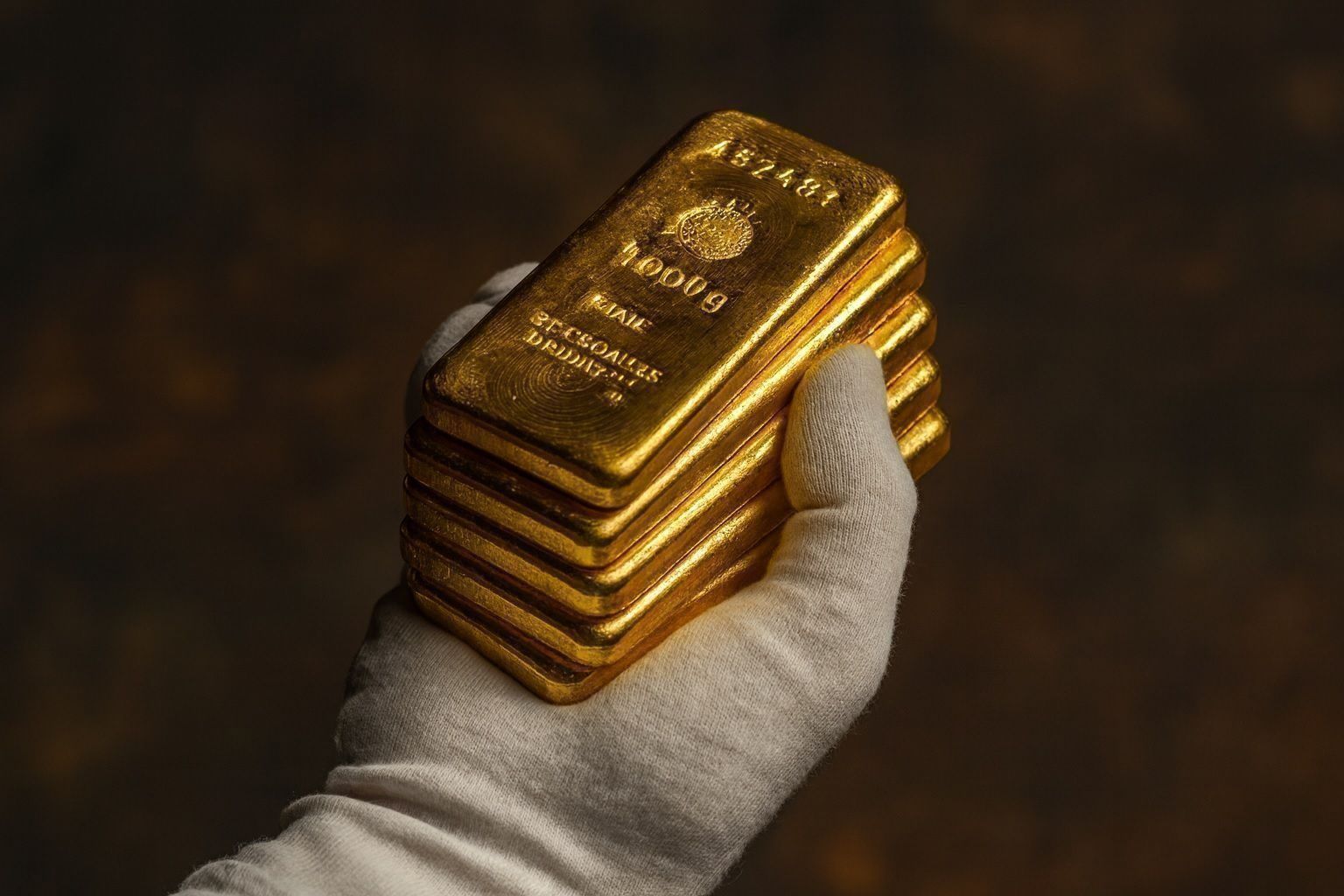
December 17, 2025 — Gold is holding firm in the low-$4,300s on Wednesday, staying close to recent highs as investors weigh a cooling U.S. labor market, a softer dollar backdrop, and a fresh round of geopolitical tension—all while bracing for U.S. inflation data that could set the tone into year-end.
In the latest session, spot gold rose 0.4% to $4,318.99 per ounce by 10:15 GMT, while U.S. gold futures gained 0.4% to $4,348.10. Gold is now up about 65% year-to-date, one of its strongest annual performances in decades.
Gold price today: what’s happening right now
Gold’s price action on Dec. 17 is best described as resilient and headline-driven: the metal is not exploding higher in a straight line, but it’s also refusing to break down—because the macro and geopolitical cross-currents still tilt supportive.
The big picture from today’s market tape:
- Rates narrative remains gold-friendly. Softer economic signals are keeping rate-cut expectations alive, which tends to support non-yielding assets like gold.
- The U.S. dollar is still under pressure overall. Even with minor bounces, the greenback is hovering near multi-month lows in broader trading, which can make dollar-priced gold more attractive to non-U.S. buyers.
- Geopolitics is back in the driver’s seat. A rise in geopolitical tension is adding a “safe-haven bid” under precious metals. Reuters+1
- Silver’s blowout rally is lifting the whole complex. With silver hitting record territory above $65/oz, the precious-metals space is drawing extra attention—and that often spills into gold positioning as well.
The key catalyst: U.S. jobs data and the Fed-cut debate
One of the main supports for gold today is the market’s read-through from U.S. employment data. Reuters reported that nonfarm payrolls increased by 64,000, while the unemployment rate rose to 4.6%, the highest since September 2021—an outcome investors interpreted as a sign of cooling labor conditions.
That matters for gold because:
- A softer labor market can reinforce expectations that the Federal Reserve will keep easing—or at least won’t need to stay restrictive for long.
- Gold typically performs better when real yields fall or when investors expect lower policy rates ahead.
Reuters also noted that the Fed delivered its third quarter-point cut of the year last week, and traders are pricing in two additional 25-basis-point cuts in 2026.
At the same time, there’s still a gap between market pricing and central bank guidance, which is why every major data release—especially inflation—has the potential to jolt gold sharply in either direction.
Dollar, yields, and why gold bulls care about Thursday’s CPI
Currency and rates markets are setting up for a potentially volatile 24–48 hours.
Reuters reported the dollar index was near its lowest since early October and remains down about 9.5% for the year, one of the steepest annual drops in years.
Meanwhile, investors are watching yields and inflation expectations closely:
- Reuters flagged the next major macro waypoint: U.S. CPI due Thursday, followed by PCE inflation on Friday.
- Bond markets are cautious into the CPI release, with Reuters noting benchmark 10-year U.S. Treasury yields around the mid-4% area in Europe.
If CPI surprises to the upside, yields and the dollar could pop—creating a near-term headwind for gold. If CPI comes in soft, it can reinforce the “Fed has room to cut” narrative that has supported gold’s 2025 surge.
Geopolitics returns: Venezuela shock boosts risk premium
Gold’s safe-haven demand also got a lift from rising geopolitical tension. Reuters reported that U.S. President Donald Trump ordered a “blockade” of all sanctioned oil tankers entering and leaving Venezuela, pushing oil higher and increasing global risk sensitivity. Reuters+1
In markets like this, gold can benefit even if equities are steady—because investors use it as portfolio insurance against tail risks, not just as a day-to-day risk-off trade.
Central banks this week: BoE, ECB, and BoJ in the spotlight
Gold doesn’t trade only on the Fed. This week’s global central-bank calendar matters because it shapes the global rate environment—and currency moves often feed back into gold.
Reuters reported:
- Bank of England decision Thursday (with growing expectations of a cut in the U.K.).
- European Central Bank decision Thursday (expected to hold).
- Bank of Japan decision Friday (markets watching for a hike).
A BOJ hike, for example, can ripple into global yields and FX markets, which can indirectly affect dollar dynamics and gold positioning.
Technical view: $4,300 is the level traders won’t stop talking about
A lot of today’s gold commentary—across macro desks and technical analysts—clusters around one psychological threshold: $4,300.
An Investing.com technical analysis described gold consolidating around the $4,315 area, with support near $4,300 and near-term resistance around $4,345, framing the current move as consolidation rather than reversal ahead of CPI.
FXEmpire’s short-term outlook similarly emphasized a bullish bias while gold holds above $4,300, with near-term targets in the $4,350–$4,390 zone, and potential pullback buyers watching $4,260–$4,300.
What that means in plain English: gold is at a point where macro data (especially CPI) could be the trigger that either (1) breaks it higher into fresh year-end highs, or (2) forces a reset lower—without necessarily breaking the longer-term uptrend.
The deeper demand story: ETFs and central-bank buying still matter
Gold’s 2025 rally wasn’t powered by one headline—it was built on persistent structural demand, and that demand is still in focus heading into 2026.
The World Gold Council reported that global physically backed gold ETFs recorded inflows for six months in a row, adding $5.2 billion in November, with total gold ETF assets under management at $530 billion and holdings at 3,932 tonnes, the highest month-end level in history.
In India, the World Gold Council’s Dec. 17 update also pointed to gold’s uptrend being supported by a weakening U.S. dollar and investment flows, while noting that jewelry demand volumes have been pressured by higher prices even as investment demand holds up.
This distinction matters: investment demand and institutional flows can keep gold elevated even when consumer jewelry demand softens—especially late in a cycle when investors are focused on macro hedging.
Gold price forecast and outlook: where major strategists see gold in 2026
Gold’s explosive run in 2025 has forced banks and asset managers to update their roadmaps. While forecasts vary, a striking number of credible outlooks now cluster between $4,500 and $5,000 in bullish scenarios.
Here are some of the most-cited calls shaping market expectations:
UBS: $4,500 by mid-2026, upside case $4,900
UBS raised its forecast and now sees gold reaching $4,500 per ounce by June 2026, arguing the drivers behind 2025’s surge remain in place. UBS also discussed the potential for a rebound in ETF inflows and continued central-bank demand, and outlined an upside case as high as $4,900.
Deutsche Bank: 2026 average $4,450, range $3,950–$4,950
Deutsche Bank, in a widely circulated outlook, said it expects gold to average $4,450/oz in 2026, with a projected trading range of $3,950–$4,950, citing resilient investor demand, strong central-bank buying, and limited supply response.
Morgan Stanley: $4,500 by mid-2026
Morgan Stanley also flagged potential for gold to climb to $4,500 per ounce by mid-2026, highlighting ETF and central-bank demand as key supports.
State Street Global Advisors: bull case $4,500–$5,000
State Street Global Advisors outlined a bullish skew and described a 30% probability scenario where gold could reach $4,500–$5,000, depending on ETF flows, central-bank demand, and broader macro stress.
World Gold Council: 2026 could be rangebound—or surprise again
The World Gold Council’s 2026 outlook framed a base case where gold may remain broadly rangebound if current macro conditions persist, but noted gold could see moderate gains if growth slows and rates fall further, and stronger performance in a more severe downturn.
Takeaway: Even among bullish forecasters, the path matters. Many outlooks assume periods of consolidation and sharp pullbacks—but still see structural demand and policy uncertainty keeping gold supported.
Gold price in India today: IBJA benchmark rates (Dec. 17, 2025)
For readers tracking gold in India, the India Bullion and Jewellers Association (IBJA) published its Daily Bullion Physical Market Report dated 17th December 2025, listing spot market benchmark rates (exclusive of GST).
Key IBJA rates shown:
- Gold (999): 132,136 (AM) and 131,777 (PM) Rs/10 gm
- Gold (916): 121,037 (AM) and 120,708 (PM) Rs/10 gm
- Silver (999): 191,971 (AM) and 191,975 (PM) Rs/kg
IBJA also highlighted the day’s macro watch list, including scheduled remarks from FOMC members (Waller, Williams, Bostic)—the kind of event risk that can quickly move both international gold and domestic pricing.
Bottom line: gold’s year-end test is inflation
Gold is ending 2025 on a powerful footing, holding above $4,300 with a strong mix of supports: rate-cut expectations, a weaker dollar trend, persistent ETF/central bank demand, and geopolitical risk.
But the next directional move may depend on whether Thursday’s U.S. CPI report confirms the market’s disinflation narrative—or challenges it.
- If inflation softens: the market may lean harder into 2026 cuts, potentially opening the door for gold to press higher from its current consolidation range.
- If inflation runs hot: gold could see a pullback toward key support near $4,300, especially if yields and the dollar rebound.
Either way, with bullion already up roughly 65% year-to-date, the final stretch of 2025 is shaping up as a high-stakes “macro checkpoint” for the world’s most closely watched safe-haven asset. Reuters