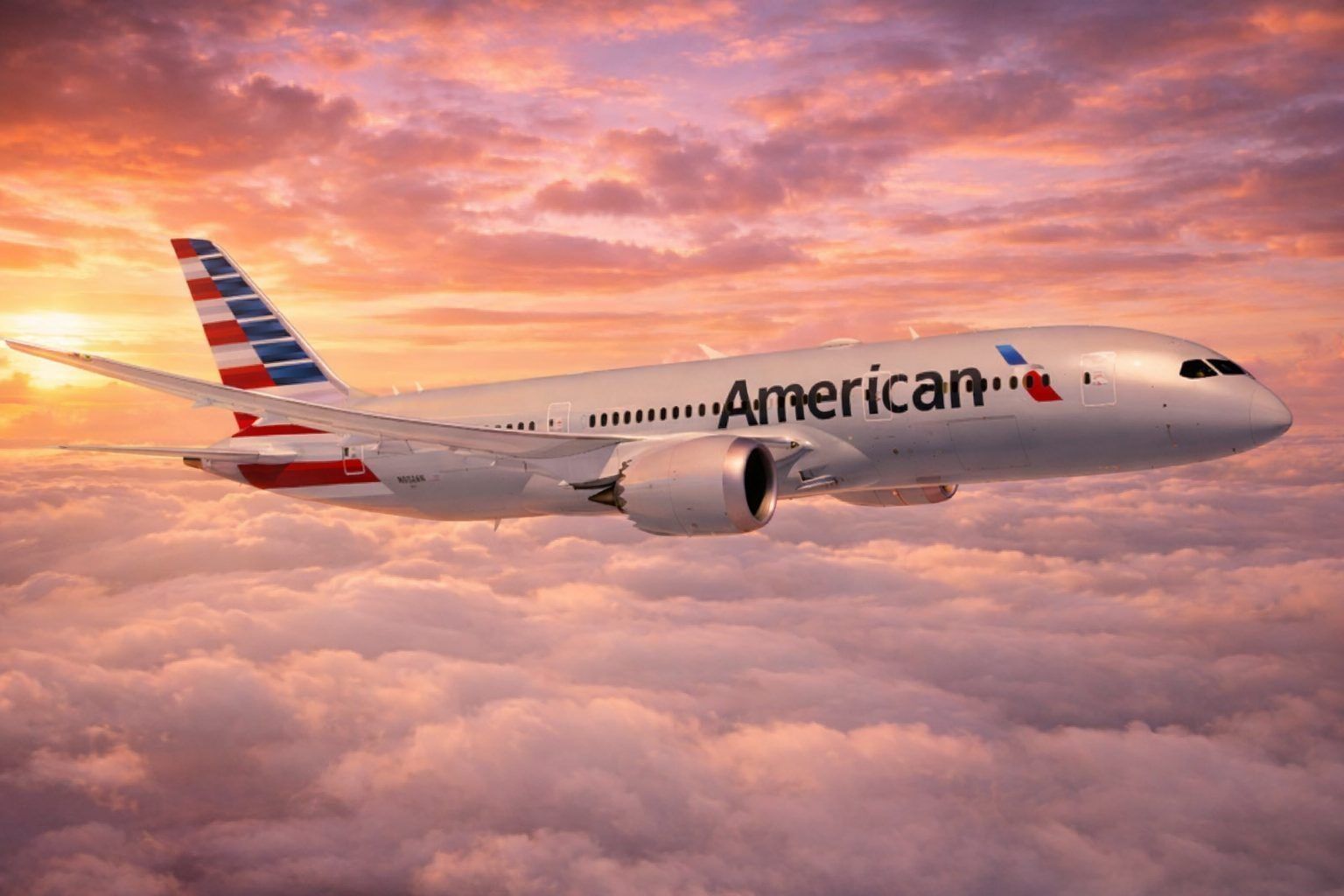
American Airlines Group Inc. NASDAQ:AAL is back in the spotlight on Wednesday, December 17, 2025—not because of a surprise earnings report, but because the airline is making a very loud statement about where it thinks airline profits are going next: upmarket.
Shares were recently around $15.99 in U.S. trading on Dec. 17, according to the latest available quote. That price level matters because it’s sitting right at the center of a debate investors have been having all year: Is American’s turnaround a real margin story—or just a nicer cabin wrapped around the same old leverage and execution risk?
Below is what’s driving AAL today, the most important forecasts and analyst calls shaping sentiment, and the concrete catalysts investors are tracking into 2026.
AAL stock price check: where shares stand heading into mid-December
American Airlines stock closed at $15.99 on Dec. 16, up 4.31% on the day, after trading between roughly $15.27 and $16.08, with reported volume near 98.40 million shares.
That kind of volume is a reminder that AAL remains a “high beta” airline name: it can move fast when investors feel the story is changing—especially when the story involves premium revenue and structural margin improvement, two phrases that reliably make Wall Street sit up straighter.
The big headline on Dec. 17: American doubles down on “premium” to chase Delta and United
The main piece of market-moving news today is a Reuters report detailing American’s strategy shift toward a full-scale premium makeover—what company executives have called a “customer reimagination” plan. Reuters
The gist is simple, and very 2025:
- More lie-flat seats and privacy doors
- Higher-end onboard products (yes, the “Bollinger champagne and Lavazza coffee” detail is doing a lot of PR work here)
- Better onboard connectivity, plus richer loyalty and credit card perks
- A willingness to invest after years of cost-focused playbooks
Why it matters to the stock: premium seats and loyalty revenue are where the highest-margin dollars live. American’s rivals have been pressing that advantage for years, and American is now trying to close the gap with a more aggressive product and network strategy.
The aircraft at the center of the story: A321XLR and the premium “Flagship Suite” rollout
A big part of the premium narrative is physical: new planes with premium-heavy layouts.
The A321XLR debut (Dec. 18) is a near-term catalyst
American is set to debut its Airbus A321XLR on the ultra-competitive New York (JFK)–Los Angeles (LAX) route on Dec. 18, positioning it as a flagship moment for the premium strategy.
American’s newsroom announcement emphasizes that it’s the first U.S. airline to debut the A321XLR, and that the inaugural flight is designed to showcase its premium “Flagship Suite” experience. news.aa.com
What’s actually on the plane?
American says each A321XLR will include:
- 20 Flagship Suite seats
- 12 Premium Economy seats
- 123 Main Cabin seats
The airline also frames the aircraft as a bridge between premium transcontinental flying now and new long-range international opportunities later—an argument that matters because right-sizing capacity to “thin” long-haul markets is one of the most compelling use-cases for the XLR category. Reuters+1
The strategic “why”: American wants premium and loyalty to do the heavy lifting in 2026
Reuters reports that American’s leadership expects meaningful revenue improvement starting in 2026 as the premium product and commercial changes scale.
That timeline—not 2025, but 2026—is important for investors. It subtly reframes AAL as a “next year (and the year after) story,” which can be bullish if the market believes:
- Corporate travel continues to normalize (or re-accelerate), and
- Premium cabin supply stays disciplined across the industry, and
- American’s reliability and customer scores improve enough to justify higher yields
This is also where American’s loyalty economics come in. Reuters notes American expects an exclusive Citi credit card partnership beginning next year, which is tied to high-margin loyalty revenue.
Separately, American and Citi have already been launching new co-branded card products—an example being the Citi / AAdvantage Globe Mastercard introduced earlier in 2025, positioned as a mid-tier card with lounge passes and loyalty-point earning features.
The uncomfortable truth in the Reuters report: American’s margin gap is still the main villain
The Reuters piece doesn’t sugarcoat why investors have been skeptical.
Profitability comparisons are stark
Reuters reports that:
- American’s stock was down 11% this year at the time of reporting
- While Delta was up 18% and United was up 14%
- Through the first nine months, American earned about $12 million, versus $3.8 billion for Delta and $2.3 billion for United
The margin forecast investors keep circling
Analysts cited by Reuters expect American’s EBITDA margin to rise to about 9% in 2026, up from 7.3% this year—but still well below Delta’s estimated 15% and United’s 14% (per LSEG data referenced by Reuters).
In plain English: even if the plan works, the street isn’t assuming American suddenly becomes Delta. The market is pricing a slow climb, not a teleport.
Execution risk: delays, retrofits, reliability, and labor tension
Premium strategies aren’t just “buy nicer champagne.” They’re supply-chain, certification, and operational-grit problems.
Reuters highlights several friction points:
- Aircraft delivery delays, including A321XLR timing slipping from earlier expectations
- Retrofit delays for older widebodies (including Boeing 777 cabin conversions) due to seat and interior component shortages
- Operational reliability challenges, with American still trailing peers in punctuality and ranking near the bottom of a recent J.D. Power satisfaction survey referenced by Reuters
And then there’s labor.
Labor pressure is not background noise anymore
Reuters reports rising tension with unions, including frustration tied to profit-sharing levels (with pilots projected to receive 0.6% vs 10% at Delta and 7.6% at United, per a union memo cited by Reuters).
Even if you don’t model labor sentiment into EPS, it matters because:
- Reliability is partly a people-and-process outcome
- Turnarounds fail when frontline execution and leadership trust break down
- Airlines are operationally complex enough without internal cold wars
Analyst forecasts and price targets: what Wall Street is modeling now
Here’s the current analyst landscape that investors are using as a reference point.
Broad consensus: “Hold,” with a mid-teens target
MarketBeat’s consensus view (based on 18 analyst ratings over the last 12 months) pegs AAL as a “Hold” with:
- An average 12-month price target of $16.42
- A high target of $24
- A low target of $10
At around $15.99, that consensus implies only modest upside on average—suggesting the street sees the turnaround as plausible but not yet “proven enough” to pay up for.
UBS: upgrade to Buy, $20 target, emphasizing profit expansion
UBS upgraded American to Buy and lifted its price target to $20 (from $14), arguing the market may be underappreciating American’s multi-year profit expansion opportunity as corporate revenues recover and loyalty economics expand. UBS also published EPS estimates of $1.92 for 2026 and $2.82 for 2027 in the same report.
This is the more bullish framing: AAL doesn’t need to become the “best airline,” it just needs to close part of the gap while operating leverage and earnings growth do the rest.
Citi: initiated with Buy and a $19 price target, leaning on a 2026 “mid-cycle” view
Citi initiated coverage with a Buy rating and a $19 price target, describing a positive setup for airlines with an “elongated mid-cycle” beginning in 2026—and calling the “supermajors” (big network carriers) the likely largest beneficiaries. TipRanks
In other words: Citi’s thesis is less “American is perfect now,” and more “the industry tape may be favorable, and big networks usually win when the cycle is supportive.”
BMO: Market Perform, $16.75 target, still cautious on leverage and unit revenue
BMO initiated coverage with Market Perform and a $16.75 price target, noting that while American’s cost performance can be strong, unit revenue has lagged—partly due to distribution shifts and network exposure to domestic capacity dynamics. BMO also flagged leverage as still elevated, implying the story needs clearer margin expansion to justify more optimism.
This is the “show me” camp: credible improvements are happening, but the balance sheet and revenue quality still demand skepticism.
Company guidance context: American lifted its 2025 profit outlook earlier this year
While today’s headline is about the premium strategy, investors also anchor to the most recent major guidance update.
In October, Reuters reported American raised its 2025 profit forecast, expecting full-year adjusted profit per share of $0.65 to $0.95, citing improved pricing power after capacity cuts and resilience in premium offerings.
That guidance range has become part of the “floor vs. ceiling” debate for AAL:
- If premium demand holds and execution improves, investors look past 2025 into 2026 margins.
- If the domestic market softens or costs bite harder, the market’s patience for “premium reinvention” can shrink fast.
Another storyline investors are tracking: the in-flight Wi‑Fi arms race
AAL’s premium push isn’t only about seats. Connectivity is increasingly part of the premium promise.
A Dallas Morning News report (from Bloomberg Wire) said American has held discussions with Amazon about using Amazon’s Leo satellite-based internet for in-flight Wi‑Fi, with CEO Robert Isom indicating the airline is keeping options open as competitors sign LEO satellite deals.
The same report notes American has been focusing on offering free Wi‑Fi to loyalty program members starting in January, via a partnership with AT&T, while also working with existing providers such as Viasat.
For investors, better Wi‑Fi is not just a customer perk—it’s a yield defense tool on business-heavy routes, and another mechanism to make loyalty stickier.
Sector backdrop: low-cost carrier consolidation talk highlights competitive pressure
Even when the news isn’t directly about American, airline investors watch competitive structure like hawks watching mice.
Reuters reported that bankrupt Spirit and Frontier have been in discussions about a potential merger, noting ultra-low-cost carriers face higher operating costs and stronger competitive pressure from large U.S. airlines that can match fares and use loyalty programs to defend share.
If consolidation reduces fare pressure at the low end, network carriers can sometimes benefit indirectly—especially on overlapping routes where pricing discipline improves. That’s not guaranteed (and regulators exist), but it’s part of the “industry setup” investors weigh alongside company-specific execution.
What investors are watching next: the “catalyst checklist” into 2026
Here are the near-term markers that matter for AAL stock after today’s headlines:
- Dec. 18 A321XLR launch on JFK–LAX
The first high-visibility “proof point” of the premium narrative. news.aa.com+1 - Premium retrofit pace (especially widebodies)
Reuters notes retrofit progress has been constrained by component shortages—investors will track whether that bottleneck eases. - Operational reliability improvements
Premium product only converts into pricing power if the operation stops stepping on rakes. - Loyalty economics and co-brand momentum
American’s Citi partnership and new card initiatives are closely watched because loyalty revenue can be high margin and more stable than ticket revenue. - 2026 route expansion enabled by the A321XLR
American has already laid out international plans like seasonal JFK–Edinburgh starting March 8, 2026, and positioned the A321XLR as a key tool for transatlantic growth.
Bottom line for AAL stock on Dec. 17, 2025: a real turnaround attempt, priced with skepticism
American Airlines is making a serious pivot: fewer apologies about being “behind,” more capital and attention directed toward premium cabins, loyalty, connectivity, and product consistency. Today’s Reuters report puts that strategy into sharp focus—and explains why 2026, not 2025, is where management believes the payoff begins. Reuters
Wall Street’s forecasts reflect a split personality:
- The bull case says margin expansion plus loyalty economics can re-rate the stock (UBS’s $20 target is the cleanest expression of that).
- The base case says incremental improvement is likely, but not enough to justify a big multiple expansion yet (MarketBeat’s “Hold” consensus around the mid‑$16s fits here). MarketBeat
- The bear case is still alive: execution delays, reliability issues, and labor tension could keep American structurally behind the leaders even as it spends more to catch up.