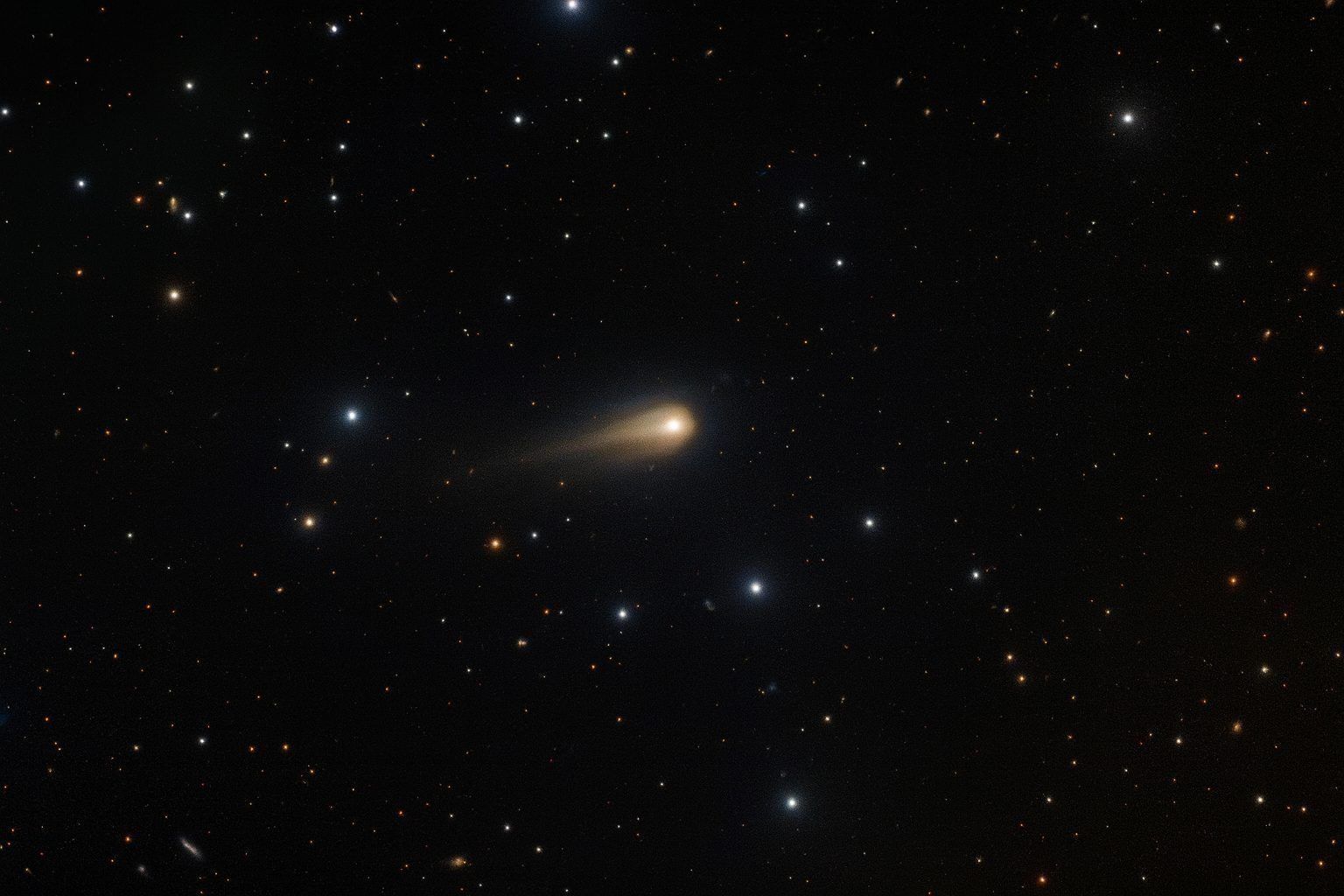
Updated Wednesday, Dec. 17, 2025 — Interstellar comet 3I/ATLAS (also referenced as C/2025 N1 (ATLAS)) is now just two days from its closest approach to Earth, and today’s coverage spans everything from practical skywatching advice to fresh scientific analysis of the comet’s “non‑gravitational” motion. Space+1
On Friday, Dec. 19, 2025, 3I/ATLAS will reach its minimum distance from Earth — but don’t let the phrase “closest approach” fool you. NASA says the comet will still be about 1.8 astronomical units away (roughly 170 million miles / 270 million kilometers), nearly twice Earth’s distance from the Sun — a wide, safe margin that puts any impact fears firmly to rest. NASA Science+1
So why the excitement? Because 3I/ATLAS is only the third confirmed interstellar object ever seen passing through our solar system, following 1I/‘Oumuamua (2017) and 2I/Borisov (2019) — and every hour of observing time is precious before it continues outward for good.
What’s new today: a rare flyby, a clearer “comet not spacecraft” case, and a rush to observe
News and explainer coverage on Dec. 17, 2025 has converged on three big themes:
- A final “best window” for observers: With the comet nearing its closest approach, astronomers and outlets are emphasizing that this week is the most favorable time to collect data and attempt backyard sightings — even though it remains distant and faint. Space+1
- More focus on normal comet physics: Today’s reporting highlights new analysis explaining that small deviations in the comet’s path can be explained by outgassing (gas and dust escaping as sunlight warms the nucleus) — a standard comet behavior, not evidence of propulsion.
- Human story behind the discovery: A prominent piece today also pulls back the curtain on how survey telescopes and software flag moving “points of light,” and how a human still has to make the call before an object becomes “real” science. Space
What is Comet 3I/ATLAS, and why “3I” matters
3I/ATLAS is officially categorized as a comet — meaning it’s active, with an icy nucleus producing a coma (a cloud of gas and dust). NASA explains that its orbit is hyperbolic, which is the key clue: it’s moving too fast to be gravitationally bound to the Sun and is therefore just passing through, not looping around on a closed orbit like typical comets.
NASA’s ATLAS program — short for Asteroid Terrestrial-impact Last Alert System — first reported observations of the object to the Minor Planet Center on July 1, 2025, from Río Hurtado, Chile. After the initial alert, astronomers pulled in earlier “precovery” observations from multiple ATLAS sites and Caltech’s Zwicky Transient Facility to refine the orbit and confirm it truly came from beyond our solar system. NASA Science
NASA’s FAQ adds another detail that’s become part of the comet’s identity: 3I/ATLAS approached from the general direction of Sagittarius, near the line of sight toward the Milky Way’s central region — though that does not mean astronomers can confidently trace it back to a specific star system.
Closest approach on Dec. 19, 2025: what will actually happen
The headline event is simple: 3I/ATLAS reaches its closest point to Earth on Dec. 19 — a moment that optimizes viewing geometry and can make faint features easier to study with powerful telescopes.
But it’s not a cinematic “comet streaking overhead” moment.
NASA says the comet will remain about 170 million miles (270 million km) away at closest approach. BBC Sky at Night Magazine underscores that expectations of crisp, close-up imagery are misplaced: even at “closest approach,” it’s still far beyond Mars’ orbit, and it will not suddenly transform into a naked-eye spectacle for most people. NASA Science+1
How to see Comet 3I/ATLAS: best timing, where to look, and what gear you’ll need
Start with the key reality check: no naked-eye view
3I/ATLAS is too faint to see with the naked eye, according to today’s practical observing guidance, and phone cameras alone are not expected to capture it meaningfully.
When to look: pre-dawn hours (and a livestream option)
NASA’s December skywatching guidance points observers to the early pre-dawn morning for the best chance, looking east to northeast.
If you can’t get clear skies (or don’t have the gear), there’s also a widely shared remote-viewing option: the Virtual Telescope Project has scheduled an online broadcast for the close-approach date, starting 04:00 UTC on Dec. 19, 2025(which corresponds to 11:00 p.m. EST on Dec. 18).
Where in the sky: near Leo and Regulus this week
NASA says skywatchers may spot the comet near Regulus, the bright star marking the heart of Leo, in the pre-dawn sky. NASA Science
BBC Sky at Night Magazine similarly notes the comet has shifted from Virgo toward Leo, and places it near Regulus and the “Sickle” pattern around the time of closest approach. Sky at Night Magazine
A real-time sky position tracker also charts the comet in Leo on Dec. 17, 2025, aligning with today’s “look near Leo” guidance. The Sky Live
What equipment is recommended
Here’s the most conservative (and official) recommendation: NASA says you’ll need a telescope with an aperture of at least 30 centimeters and suggests checking with local observatories and organized skywatching events.
More enthusiast-oriented guidance today notes that computer-assisted GoTo telescopes or smart telescopes can simplify the hunt, while manual observers may need careful star-hopping and an astronomy app to confirm they’re not looking at a faint galaxy.
What should you expect visually? In smaller telescopes, observers often describe it as a small, fuzzy smudge or an out-of-focus star-like glow rather than a dramatic tailed object.
The science payoff: what researchers hope to learn during the flyby window
Even at a large distance, the timing matters because closer geometry generally means better signal for spectroscopy and imaging — especially for faint emissions in the coma and tail.
NASA says 3I/ATLAS is scientifically important because differences from solar-system comets could offer insight into the composition of other planetary systems.
NASA’s broader overview also lists a long roster of observing assets — from flagship space telescopes to spacecraft around Mars — underscoring how rare it is to have an interstellar object available for coordinated study.
That matters because comets are essentially moving “sample capsules” — mixtures of ice, dust, and volatiles shaped by the environment where they formed. In November, NASA officials and outside experts said 3I/ATLAS shows the classic signatures of comet activity (coma and dust tail), and discussed detections of common comet molecules and some intriguing chemistry differences, consistent with formation in a different system. Reuters
The “spaceship” rumors, the anti-tail chatter, and what the evidence supports
NASA: it’s a comet — and there are no “technosignatures”
Speculation that 3I/ATLAS might be artificial has surged online since discovery. NASA has directly addressed that narrative before, stating that 3I/ATLAS “looks and behaves like a comet,” and that the agency has not seen evidence suggesting otherwise. Reuters+1
Today’s key scientific detail: “non-gravitational acceleration” is normal for comets
One of the most misunderstood phrases in the 3I/ATLAS discussion is non‑gravitational acceleration — tiny changes in motion that don’t come from gravity alone.
NASA’s own FAQ explains the straightforward mechanism: as comets warm, they sublimate and release jets of gas and dust, and that outflow can slightly nudge their trajectories. NASA notes that the perturbations observed for 3I/ATLAS are small and compatible with this process.
Today’s reporting builds on that point by highlighting research that measured these effects using long‑baseline observations — including spacecraft positioned far from Earth — reinforcing the “ordinary comet physics” interpretation. IFLScience+1
What about the “anti-tail” being discussed today?
Another topic making the rounds in today’s coverage is an apparent “anti-tail” — a tail-like feature that can appear to point sunward. Some commentary frames this as bizarre, but in comet science, antitails can occur due to viewing geometry and dust distribution along the comet’s orbital plane.
Reports today emphasize that the feature is being closely watched and debated, and it’s part of why astronomers are eager to collect more data during the Dec. 19 window rather than jump to conclusions.
What happens after Dec. 19: the comet heads out, but the story continues
After the close approach, 3I/ATLAS will continue outward on its escape trajectory.
NASA says the comet is now observable again from Earth after it passed behind the Sun earlier in the fall, and it should remain observable (with appropriate equipment) until spring 2026. NASA Science
NASA also notes that spacecraft and telescopes will continue to follow it as it moves outward through the solar system, including beyond the region of the giant planets.
The bottom line: Dec. 19 isn’t the end of the science — but it is a peak moment for coordinated observing while the comet is still relatively “near” by interstellar standards.
Why 3I/ATLAS is a big deal — even from 170 million miles away
Interstellar visitors are inherently fleeting. They arrive without warning, move fast, and leave.
As of today, 3I/ATLAS remains a once-in-a-generation observing target: a natural object that formed around another star, wandered interstellar space for an unknown span of time, and is now giving scientists — and well-equipped amateurs — a brief opportunity to study material that didn’t originate here.
If skies cooperate where you are, the best advice is simple: set expectations realistically, seek out a local observatory or club event if possible, and treat the Dec. 19 flyby as what it truly is — a rare scientific window on a traveler from beyond the solar system.