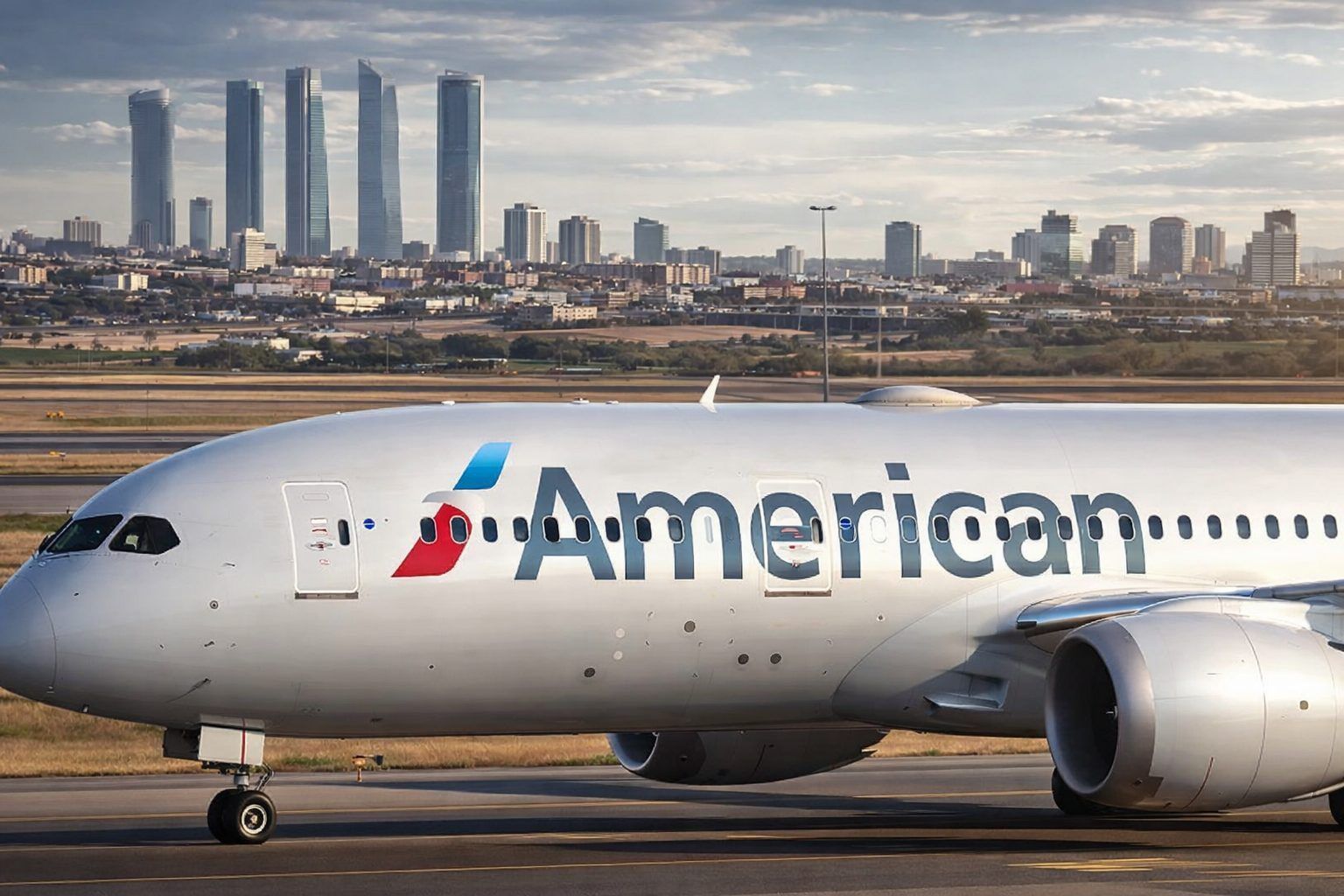

American Airlines Group Inc. (NASDAQ: AAL) is back in the market spotlight on Thursday, December 18, 2025—not because the airline business suddenly became simple (it never will), but because several threads hit at once: a fresh Wall Street initiation, a high-profile safety-and-liability update tied to a fatal crash, and a very visible push into premium cabins that management is betting can lift revenue and margins in 2026.
As of early Thursday in New York, AAL was around $15.51, with pre-market trading near $15.65, after a prior close of $15.99. The stock’s 52-week range has been wide—roughly $8.50 to $19.10—a reminder that airline equities remain among the market’s most macro-sensitive, headline-prone trades.
Below is what’s driving coverage today, what analysts are forecasting, and the concrete catalysts investors are watching into early 2026.
Why American Airlines stock is in focus on Dec. 18, 2025
1) Wells Fargo starts coverage: “Equal Weight” with a $17 target
One of the most immediate “today” items for AAL is a new initiation from Wells Fargo, which started coverage with an Equal Weight rating and a $17.00 price target. Investing.com
Wells Fargo’s framing (as summarized by Investing.com) is basically: there are real levers for improvement, but they’re competing with real balance-sheet gravity. The firm pointed to improving main cabin economics and a new co-branded card agreement as positives, while flagging elevated debt levels and the need to keep upgrading premium service to close the gap versus best-in-class rivals.
That debt point isn’t abstract. American’s own recent reporting put total debt at $36.8 billion at the end of Q3 2025, with a stated goal to bring total debt below $35 billion by the end of 2027.
2) The U.S. government admits liability in the fatal Reagan National collision case
Another major headline: the U.S. Justice Department acknowledged the federal government’s liability tied to the January 29 collision involving an Army Black Hawk helicopter and an American Airlines regional jet near Reagan Washington National Airport, which killed 67 people. Reuters reported the government said it breached its duty of care, pointing to failures by the Army helicopter pilots and an FAA air traffic controller, while also noting multiple factors contributed.
American Airlines, for its part, has sought dismissal from the lawsuit—arguing the proper recourse is against the U.S. government.
For investors, the key isn’t the tragedy’s scale (which is enormous), but the direction of legal liability and the potential for this to reduce uncertainty around how damages might ultimately be allocated. That said, these cases can take time, and nothing about litigation is ever truly “clean.”
3) A premium “reimagination” goes from strategy deck to showroom floor
American’s commercial strategy has been under a microscope all year, and Reuters’ reporting this week puts a sharper edge on the story: American is leaning hard into a premium overhaul—upgraded cabins, loyalty perks, and amenities—aimed at winning back high-yield travelers and narrowing profitability gaps versus Delta and United.
Reuters describes a pivot away from years of cost-cutting toward a more premium-forward product mix (think lie-flat seats, privacy doors, upgraded onboard food and beverage, and improved Wi‑Fi).
And today is symbolically important for that strategy because American’s Airbus A321XLR premium product is scheduled to debut on the New York (JFK)–Los Angeles (LAX) route on Dec. 18, per the company.
American has said it is the first U.S. airline to debut the A321XLR, and that the aircraft is configured with 20 Flagship Suite seats, 12 Premium Economy seats, and 123 Main Cabin seats—an unusually premium-heavy single-aisle setup by U.S. standards.
The latest AAL stock forecast: what analysts are signaling now
Airline stocks don’t move on one metric; they move on a messy cocktail of demand, unit revenues (how much you earn per seat-mile), costs, fuel, and balance-sheet risk. Still, analyst targets and thesis updates matter because AAL is a heavily covered name—and December has brought a cluster of fresh calls.
Today’s call: Wells Fargo’s $17 target
As noted above, Wells Fargo’s initiation sets a $17 price objective, with a balanced stance (Equal Weight) reflecting upside from commercial and loyalty initiatives versus leverage and execution risk.
The recent upgrade wave: UBS and Citi get constructive; BMO stays cautious
In the past two weeks:
- UBS upgraded AAL to Buy and raised its price target to $20 from $14, arguing the market may be underestimating American’s profit expansion potential as corporate revenue recovers and loyalty income expands. Investing.com+1
UBS also published forward-looking EPS estimates (as summarized by Investing.com) of $1.92 for 2026 and $2.82 for 2027. - Citi initiated coverage at Buy with a $19 price target, describing a favorable setup heading into an “elongated mid-cycle” starting in 2026 and positioning “supermajors” as key beneficiaries. TipRanks
- BMO Capital initiated coverage at Market Perform with a $16.75 target, acknowledging improving conditions but emphasizing that American’s EBIT remains below 2019 levels and that leverage still needs margin expansion to sustainably improve.
Consensus targets: modest upside… but not a slam dunk
Consensus numbers vary by data provider, but one widely followed snapshot (MarketBeat) recently showed:
- Consensus rating: Hold
- Average 12-month price target: $16.46
- High/low target range: $24 / $10 MarketBeat
The picture this paints is important: there’s upside on paper, but it’s not the kind of consensus that screams “easy trade.” The Street is effectively saying: execution matters more than sentiment right now.
American Airlines fundamentals: what the company last told investors
The most recent detailed company update (Q3 2025 results, released Oct. 23, 2025) matters because it anchors the debate about whether a premium-led turnaround is financially feasible.
Key datapoints from American’s Q3 2025 report:
- Revenue: $13.7 billion (record third quarter) American Airlines Newsroom
- GAAP net result: net loss of $114 million (‑$0.17 per share) American Airlines Newsroom
- Guidance: Q4 2025 adjusted EPS expected $0.45–$0.75, and full‑year adjusted EPS $0.65–$0.95 American Airlines Newsroom
- Free cash flow: expected to be over $1 billion for full-year 2025 American Airlines Newsroom
- Balance sheet:$36.8 billion total debt and $10.3 billion liquidity at quarter end American Airlines Newsroom
- Revenue mix commentary: premium unit revenue growth continued to outperform main cabin, per management.
That combination—positive free cash flow guidance but high absolute debt—is exactly why AAL can feel like a coiled spring to bulls and a tightrope to bears.
The strategic bet: premium cabins + loyalty economics
Premium cabins are no longer optional in U.S. network airlines
Reuters’ reporting is blunt about the competitive reality: Delta and United have outperformed on profitability and customer satisfaction, and premium travelers are driving margins. American’s response is to “premiumize” aggressively, using new aircraft like the Boeing 787‑9 and the Airbus A321XLR and refreshing products from lounges to onboard amenities. Reuters
American’s own communications reinforce the same direction: it has highlighted Flagship Suite seats, expanded lounge plans, and partnerships like Lavazza coffee and Champagne Bollinger as part of a broader customer experience push.
The A321XLR is a very specific weapon
For investors, the A321XLR isn’t just a “new plane story.” It’s a capacity-and-revenue tool:
- premium-heavy configuration,
- long-range capability for “long and thin” routes,
- and a way to sell higher-yield seats on routes that don’t justify a widebody.
American says the A321XLR launches on JFK–LAX starting Dec. 18 and will later expand to international flying, with the company already pointing to transatlantic plans as deliveries ramp.
Loyalty is the quiet cash machine (when executed well)
One of the recurring bullish arguments for U.S. airlines is that loyalty programs can produce high-margin economics through credit card partnerships and mileage sales.
American has emphasized strong AAdvantage engagement and said its expanded, exclusive partnership with Citi is expected to start in January 2026. American Airlines Newsroom
That timeline matters because the market tends to reward airlines when loyalty revenue becomes more predictable—especially when the core flying business is volatile.
Regulatory and legal headlines investors are tracking
DOT disability-related penalty gets redirected into mandated improvements
A big “service quality and compliance” story hanging over American this month comes from the U.S. Department of Transportation.
DOT said it amended an earlier order that assessed a $50 million civil penalty against American (related to disability services), and that instead of paying remaining Treasury installments (about $16.7 million), American is required to spend $16.8 million to benefit passengers with disabilities—primarily $16.1 million on equipment and systems improving wheelchair handling beyond baseline requirements. DOT also credited American $700,000 for compensation provided in 2024 and 2025.
This kind of regulatory action can be a double-edged sword for the stock:
- short-term: costs, operational focus, reputational pressure
- long-term: if executed well, fewer incidents and fewer headline risks
The Reagan National crash liability development
As covered above, Reuters’ report that the federal government admitted liability is significant because it changes the legal posture around one of the most severe aviation incidents tied to the carrier this year.
Other moves around American that may matter (even if they’re not “the main plot”)
Talks with Amazon for next-gen in-flight Wi‑Fi
American has been reported to be in discussions with Amazon about using its low-Earth-orbit satellite network—referred to as Amazon Leo—for inflight Wi‑Fi, as airlines compete to meet rising passenger expectations for fast connectivity.
Even if no deal is finalized soon, this is relevant to the premium strategy: connectivity has become part of the product, not a “nice-to-have.”
Monitoring other airlines’ restructurings and assets: Spirit and Azul
American has also appeared in bankruptcy-related headlines:
- Reuters reported American filed a notice of appearance in Spirit Aviation’s bankruptcy proceedings, requesting future court documents. The filing was tied to an airport-specific agreement, though details were limited.
- Separately, Reuters reported a bankruptcy judge approved Azul’s restructuring, and American (along with United) agreed to invest in Azul equity as part of the plan.
These aren’t “American is buying X” signals on their own—but investors watch them because they can affect competitive dynamics, gate/slot access, and partnership networks.
The bull case vs. bear case for AAL stock heading into 2026
The bull case (what has to go right)
- Premium strategy translates into higher unit revenue and better margins as new products roll out and “gel” in 2026 (management and analysts have pointed to that timing). Reuters
- Loyalty economics strengthen as the Citi partnership expands in January 2026.
- Corporate travel continues recovering, supporting the UBS/Citi-style thesis of multi-year profit expansion.
- Debt reduction continues—because with airlines, leverage is the volume knob on both gains and pain.
The bear case (what can break)
- Execution risk: Reuters highlighted that retrofits and deliveries have faced bottlenecks, and that operational reliability has been a weak spot versus peers.
- Balance-sheet risk: American’s debt load remains high, and multiple analysts have emphasized leverage as a limiting factor even when revenue improves.
- Labor relations and cost pressures: Reuters noted rising tensions with unions and that the turnaround may be slow and expensive.
- Macro whiplash: airlines are famously exposed to demand shocks and fuel volatility—meaning investors can be “right” on strategy and still be early or wrong on timing.
What to watch next for American Airlines stock
Over the next several weeks, AAL investors will likely focus on:
- A321XLR performance and deployment on the flagship JFK–LAX route and any new route announcements American Airlines Newsroom+1
- Updates on premium cabin retrofits and supply-chain constraints (a key risk cited in recent reporting) Reuters
- Any additional clarity on the Citi partnership ramp in January 2026 and loyalty revenue expectations American Airlines Newsroom
- Litigation developments tied to the Reagan National collision case and whether American is dismissed as it seeks Reuters
- Progress on debt and liquidity metrics as the market weighs whether free cash flow can steadily translate into deleveraging American Airlines Newsroom
Related articles: NYSE:WFC