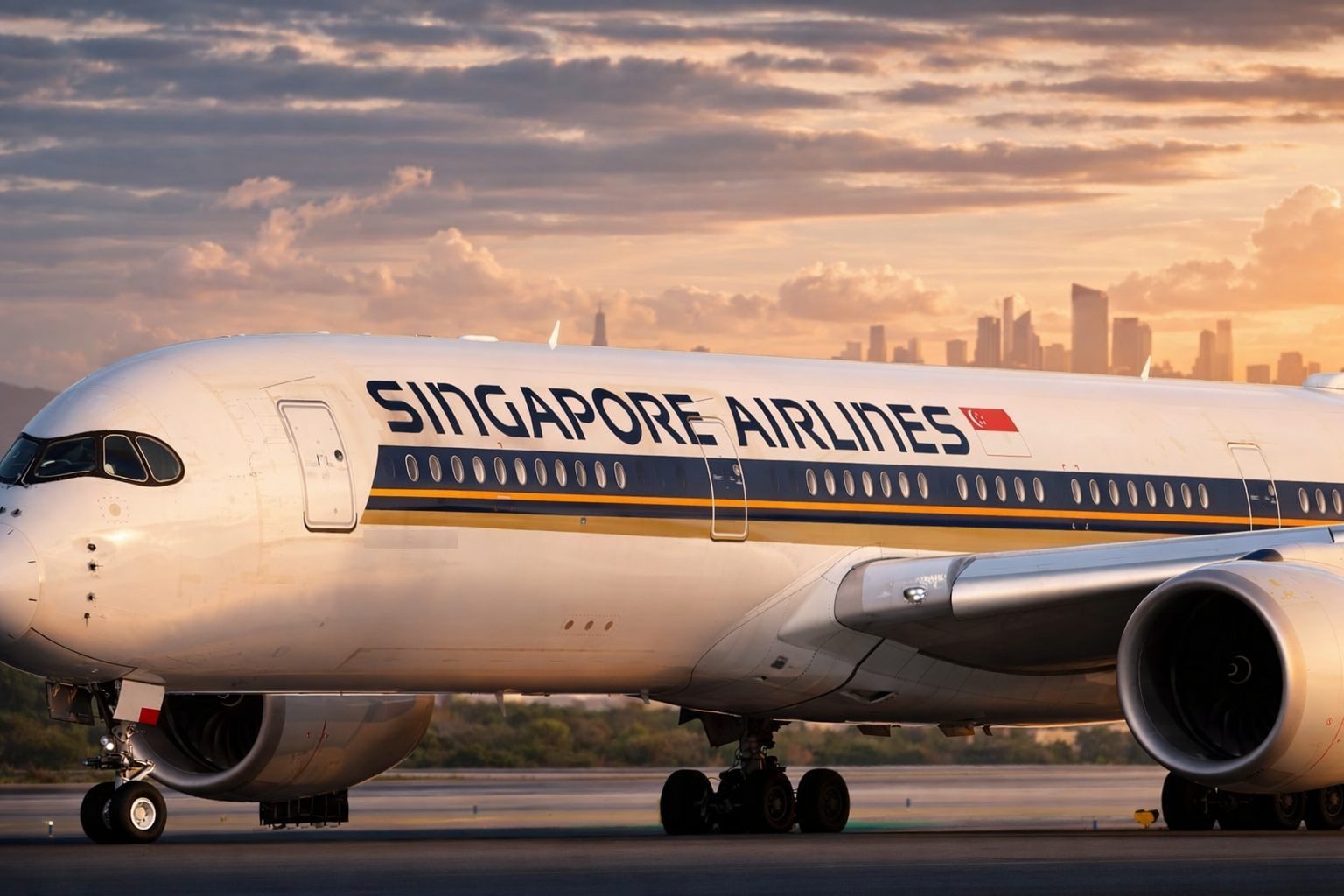
Singapore Airlines Ltd (SIA) shares ended the latest trading session at S$6.32 (Dec. 19 close), leaving investors to weigh a familiar airline-stock tug-of-war: solid travel demand and healthy load factors versus softening yields, rising non-fuel costs, and ongoing uncertainty around Air India.
With markets closed on Dec. 20 (a Saturday), the newest “fresh” catalysts for SGX:C6L are the November 2025 operating update, the upcoming cash dividend payment on Dec. 23, and the continuing debate about how much Air India’s turnaround could cost (and how visible that bill will be). SGX Links+2Singapore Airlines+2
Key developments investors are tracking right now
Here’s the tight, news-driven map of what’s moving the Singapore Airlines stock narrative into year-end:
- Dec. 15, 2025: SIA Group reported November 2025 operating results—passenger traffic +2.6% YoY, cargo carriage +12.4% YoY, and group passenger load factor 87.3%.
- Dec. 11, 2025: Air India announced a new interline partnership with Scoot, SIA’s low-cost subsidiary, aimed at boosting connectivity across Asia-Pacific via Singapore.
- Dec. 23, 2025: Payment date for SIA’s 5-cent interim dividend and 3-cent interim special dividend (ex-date was Dec. 5).
- Nov. 13, 2025: SIA released half-year results (1H FY2025/26), showing record half-year revenue and strong operating profit, but a sharply lower net profit, with associate losses (notably Air India) a key drag.
- Nov. 20, 2025: SIA updated its S$10 billion multicurrency medium-term note (MTN) programme, a reminder that aviation balance sheets stay “strategically flexible” even in good cycles. SGX Links+1
That mix—operational momentum, shareholder returns, and associate risk—is the core lens for any Singapore Airlines stock forecast discussion right now.
Singapore Airlines share price: where SGX:C6L stands heading into the year-end travel rush
The stock closed at S$6.32 on Dec. 19, the last market session before Dec. 20.
That price level matters for two practical reasons:
- Dividend math and expectations: the Dec. 23 payment is imminent, but the ex-date (Dec. 5) has already passed—so it’s less about “who qualifies” and more about how investors price the broader multi-year special dividend plan. Singapore Airlines+1
- Valuation vs. analyst targets: several current published targets cluster around the low-to-mid S$6 range—meaning the stock is trading close to (or slightly above) many brokers’ fair-value estimates.
Latest operating update: November 2025 traffic points to resilient demand
Airlines live and die by two numbers: capacity (how many seats you fly) and demand (how many get filled at what fare). SIA’s November 2025 operating results suggest demand remains steady even as competition expands.
Passenger traffic and load factors
In November 2025, the SIA Group reported:
- Group passenger traffic:+2.6% YoY
- Group passenger capacity:+2.2% YoY
- Group passenger load factor (PLF):87.3%, up 0.3 percentage points YoY
On a brand-by-brand basis:
- Singapore Airlines (mainline) PLF:86.4% (down 0.4 ppt YoY)
- Scoot PLF:90.7% (up 3.3 ppt YoY)
Total passengers carried also rose meaningfully. SIA and Scoot carried a combined ~3.5 million passengers (SIA: 2.33 million, Scoot: 1.20 million), with group passengers carried up 6.0% year-on-year.
Cargo: a year-end tailwind shows up in the numbers
Cargo was stronger than passenger on a growth basis:
- Cargo carried:+12.4% YoY
- Cargo load factor:60.2% (up 3.6 ppt YoY)
SIA attributed cargo strength to year-end peak demand and a higher contribution from freighter aircraft.
Network and route notes
Operational updates also matter because they hint at where growth is being deployed:
- Scoot launched passenger services to Nha Trang (Vietnam)
- SIA resumed seasonal services to Sapporo (Chitose, Japan)
- The group network covered 131 destinations at the end of November 2025
For stock watchers, the simplest takeaway is this: load factors remain high. The bigger question (and the one equity investors obsess over) is what happens next to yields—the average revenue per passenger-kilometre—when more capacity shows up across Asia-Pacific.
Dividend watch: what happens on Dec. 23, and why the special dividend plan matters
SIA has put shareholder returns front-and-centre in late 2025.
The near-term cash payout
SIA’s latest declared distribution for 1H FY2025/26 includes:
- Interim dividend:5 cents per share
- Interim special dividend:3 cents per share
- Ex-date:5 Dec. 2025
- Payment date:23 Dec. 2025
So the immediate event for investors is simply: cash arrives Dec. 23 (for shareholders on record after the relevant cutoff; SIA’s capital return materials reference shareholders as of 8 Dec. 2025).
The bigger story: SIA’s multi-year special dividend package
More strategically, SIA has proposed a capital return plan that’s unusual in its clarity:
- A special dividend package of 10 cents per share annually over three financial years, amounting to about S$0.9 billion over that period (as presented by the company).
- The first payment from that package is the 3-cent interim special dividend paid on Dec. 23, 2025.
- The second tranche of 7 cents per share for FY2025/26 is subject to shareholder approval at the AGM in 2026.
- The company expects (subject to approvals and no major surprises) 10 cents per share in each of the next two financial years (FY2026/27 and FY2027/28).
This matters for the stock because it places a floor of sorts under the investor narrative: even as profits normalise from post-Covid peaks, SIA is signalling confidence in its financial position and cash-generation capacity.
Financial results: strong operating profit, weaker net profit—and the Air India effect
SIA’s latest half-year release is a classic airline result: operationally solid, financially complicated.
What SIA reported for 1H FY2025/26 (ended Sept. 30, 2025)
Company materials show:
- Operating profit:S$802.9 million, +0.9% YoY
- Revenue:S$9,675.2 million, +1.9% YoY (a half-year record, per company presentation)
- Net profit:S$238.5 million, -67.9% YoY
The bridge between “operating profit up” and “net profit down hard” is explained by two big moving parts highlighted by management and covered by Reuters:
- Associate results (notably Air India): the share of losses from associated companies was a major drag, and Air India equity accounting only began from December 2024.
- Interest and cash dynamics: Reuters reported a hit from reduced interest income amid smaller cash balances and rate cuts, alongside cost pressures and competition.
Yields and competition: the “quiet” driver that markets watch loudly
SIA’s company presentation explicitly states:
- Passenger traffic growth of 4.6% in 1H FY2025/26 (exceeding capacity growth), but yields declined 2.9% due to increased competition.
That line is crucial for any Singapore Airlines stock analysis. Airlines can fill planes and still disappoint investors if the industry gets into a fare war or overcapacity cycle. The November operating data (high PLFs) suggests demand is there; the profitability question is whether pricing power holds.
Costs: fuel eased, non-fuel rose
SIA’s half-year slide deck indicates:
- Net fuel cost down 6.7% YoY
- Non-fuel cost up 5.9% YoY
In airline land, this is a familiar plot twist: even when jet fuel helps, inflation, capacity expansion, maintenance, manpower, and airport charges can keep total costs climbing.
Scoot + Air India: partnership news and why it matters to the SIA Group story
On Dec. 11, Air India announced a unilateral interline partnership with Scoot, designed to improve onward connectivity via Singapore to 60+ (and in some references 70+) destinations across Asia and Australasia.
For investors, this kind of commercial agreement is not usually a “move the stock tomorrow” headline. But it feeds into two bigger themes:
- Hub strength: Singapore remains a major connecting hub, and interline connectivity can support incremental load factor and network relevance.
- India exposure—opportunity and risk: India is a huge growth market, but SIA’s exposure is no longer purely commercial. It’s also financial, via its 25.1% stake in Air India, which is currently the messy variable in SIA’s earnings equation.
Air India risk: the question investors keep asking (and SIA keeps not quantifying)
Air India has become the centre of gravity for the “bear case” on Singapore Airlines shares.
Reuters reported in late October (citing a Bloomberg News report) that Air India was seeking at least 100 billion rupees (~US$1.14 billion) in financial support from Tata Sons and Singapore Airlines, with funding form (loan vs. equity) under discussion.
In Singapore, the investor conversation has turned into a transparency debate. A Business Times column argued that given Air India’s impact on earnings, shareholders would benefit from more visibility on the potential size of future commitments.
SIA has addressed the question directly—but cautiously—during its post-results briefing. In the Q&A transcript, CEO Goh Choon Phong declined to provide a projected “maximum investment” or “maximum loss,” reiterating that Air India is a long-term investment and that SIA remains committed to the transformation despite challenges. Singapore Airlines
That’s a reasonable governance stance (companies rarely give open-ended financial caps), but it means the market will likely continue to price Air India exposure as a risk discount—especially if losses persist or additional funding becomes more concrete.
Balance sheet and financing: why the MTN update is part of the stock story
Even with dividends in the spotlight, SIA is still managing the reality that airlines are capital-intensive businesses with cyclical cash flows.
In its November 20 SGX filing, SIA announced an update to its S$10,000,000,000 multicurrency medium-term note programme, including updates to clearing systems, benchmark rates for floating-rate notes, and selling restrictions/regulations.
Separately, the company presentation on financial position shows that as at 30 Sept. 2025, the group reported:
- Total cash and bank balances:S$6,447.0 million
- Fixed deposits (tenors > 12 months):S$2,060.2 million
- Total debt:S$10,874.8 million
- Debt-to-equity ratio:0.70
Taken together, this supports the logic behind the capital return plan: SIA is paying out, but it’s also maintaining the institutional tools (like MTN programmes) that help airlines navigate fleet spending and economic swings.
Analyst forecasts for Singapore Airlines stock: targets cluster around the mid-S$6 range
As of Dec. 20, 2025, SGinvestors’ compiled view of recent broker targets shows:
- Target price range (recent): S$6.030 to S$6.400
- Median target:S$6.195 (shown as ~2.0% downside in that compilation)
- Average target:S$6.205
Notably, the broker calls reflected there include a mix of HOLD/NEUTRAL and SELL stances (e.g., Maybank: SELL; OCBC: HOLD; Phillip: NEUTRAL; UOB Kay Hian: SELL), with targets sitting close to current trading levels.
For investors, that usually signals one of two things:
- The market thinks the “base case” is already in the price (demand steady, yields pressured, Air India drag persists); or
- There’s a split on whether dividends and balance-sheet strength outweigh the margin pressures that often show up late-cycle.
Outlook: what could move Singapore Airlines shares next
With the latest operating update in hand and the dividend payment days away, the near-term catalysts for Singapore Airlines Ltd stock are fairly clear.
1) December and early-2026 traffic updates
Load factor strength in November is encouraging, but investors will look for confirmation that peak travel season supports both volume and yield. (High PLF is great; high PLF at lower fares is less great.)
2) Yield trajectory and competitive capacity
Management has already flagged that yields declined 2.9% in 1H FY2025/26 due to competition. SGX Links
If competition intensifies across Asia-Pacific lanes, the market will pressure the stock even if demand remains “healthy.”
3) Air India: losses, funding needs, and timeline uncertainty
This remains the biggest swing factor because it’s hard to model from the outside. Watch for any clearer disclosure around Air India’s funding, governance, and turnaround progress, especially after the October Reuters report about potential capital needs.
4) Fleet and capacity discipline
SIA expects to end the financial year with 218 aircraft in the operating fleet, reflecting ongoing capacity and network evolution. SGX Links
Fleet expansion can lift revenue—but it can also amplify yield pressure if the wider industry expands faster than demand.
5) Capital returns: the “soft floor” under sentiment
The 23 Dec dividend payment is immediate, and the broader multi-year special dividend plan is an ongoing narrative support—though later tranches depend on approvals and conditions.
Bottom line: As of Dec. 20, 2025, Singapore Airlines stock sits at the intersection of strong operational indicators (high load factors, improving cargo) and the market’s two biggest airline anxieties: yield compression and associate/strategic-investment volatility. The coming months will likely be less about whether people are flying—and more about what they’re paying, what it costs to carry them, and how expensive the Air India transformation ultimately becomes.