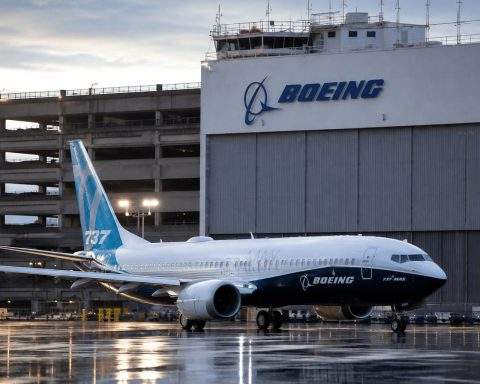

As of Saturday, December 20, 2025, U.S. markets are closed, so the latest read on The Boeing Company stock NYSE:BA is Friday’s finish: $214.08, up 2.79% on the day.
That Friday pop didn’t come out of nowhere. Boeing enters the year’s final stretch with a rare trifecta for investors to argue about at family gatherings: fresh analyst optimism, high-stakes regulatory timelines, and a cash-flow narrative that is finally starting to sound less like science fiction and more like a plan (with footnotes, risks, and the FAA hovering in the background).
What’s driving Boeing stock right now
1) JPMorgan raises its Boeing price target to $245
One of the most market-moving headlines into Dec. 20 is JPMorgan’s updated call: the bank raised its price target on Boeing to $245 from $240 and kept an Overweight rating, framing the move inside its broader aerospace and defense outlook for 2026.
At Friday’s $214.08 close, a $245 target implies about 14% upside (before you account for the market’s ability to change its mind faster than weather).
2) Boeing seeks an FAA emissions waiver tied to the 777 freighter bridge
Late-week reporting also highlighted a very “Boeing in the 2020s” kind of catalyst: Boeing is seeking an FAA waiver to sell 35 additional 777F freighters ahead of new U.S. emissions rules scheduled to take effect in 2028, arguing the exemption is needed because certification timing for the next-generation 777-8 Freighter won’t line up in time. Reuters
Reuters reported Boeing expects the first 777-8F delivery around 2029, and that the 777-9 passenger variant is expected in 2027.
Why it matters for BA stock: it’s a reminder that even when demand is strong, the timeline is often the real product—and timeline risk has a habit of showing up in valuation models as a discount rate with teeth.
3) FAA review of 737 MAX 10 alerting systems: progress, but not the finish line
On the regulatory front, the FAA said it will review Boeing’s proposed enhanced flight crew alerting system for the 737 MAX 10, including design elements intended to meet modern cockpit alerting requirements.
The same Reuters report noted that while Congress waived an earlier deadline for MAX 7 and MAX 10 cockpit alerting standards, it required retrofitting with future safety enhancements within three years of MAX 10 certification, adding a compliance “tail” even after approval. Reuters
It also underscored the reality of investor impatience: Southwest Airlines’ CEO told Reuters he expects MAX 7 certification by August 2026, with entry into service targeted for early 2027—another sign that key MAX variants remain a multi-year story, not a next-quarter catalyst.
The big narrative: Boeing’s 2026 free-cash-flow reset
If you want the simplest way to describe the Boeing stock debate in late 2025, it’s this:
Can Boeing convert backlog into deliveries—and deliveries into cash—fast enough to make 2026 feel like a true inflection year?
Boeing CFO Jay Malave gave bulls plenty to work with in early December, saying Boeing expects positive cash flow in 2026, after an expected negative $2 billion cash outflow in 2025, and describing “low single digits” (billions) of positive free cash flow as the directional goal. Reuters
He tied that expectation to higher deliveries—specifically pointing to growth on both the 737 and 787 programs.
That message matters because cash flow is the scoreboard that can’t be “adjusted” away: it’s what pays down debt, funds factory investments, and eventually re-opens the door to more shareholder-friendly capital allocation (after regulators, rating agencies, and common sense stop glaring).
A reality check from Boeing’s own numbers
In its third-quarter 2025 results, Boeing reported:
- Revenue of $23.3 billion (Q3 2025)
- 160 commercial deliveries (its highest quarterly total since 2018, per the release)
- Free cash flow (non-GAAP) of $0.2 billion (about $238 million) for the quarter
- Total backlog of $636 billion, including over 5,900 commercial airplanes
- Cash and investments of $23.0 billion and consolidated debt of $53.4 billion at quarter end Boeing Investors
Those figures show why the market keeps circling back to the same question: the demand is there, but the financial model hinges on stable production and predictable deliveries.
Spirit AeroSystems acquisition: supply chain control (and new labor complexity)
Another major “as of Dec. 20” pillar is Boeing’s completed acquisition of Spirit AeroSystems—a deal investors watched closely because Spirit has been central to both production bottlenecks and quality concerns, particularly for the 737 fuselage supply chain.
Boeing said it closed its $4.7 billion takeover of Spirit AeroSystems on December 8, 2025, while Airbus also completed its acquisition of parts of Spirit tied to Airbus programs as part of the broader breakup and realignment.
Boeing’s announcement emphasized that the acquisition brings key Spirit commercial operations in-house (including 737 fuselages and major structures for 767/777/787), with the stated goal of strengthening quality and production stability.
But integration comes with its own friction costs. Reuters reported that contract talks covering roughly 1,600 former Spirit white-collar workers in Wichita—now Boeing employees—were paused until January 5, 2026, highlighting the near-term labor-management complexity that can come with supply-chain “fixes.” Reuters
Demand is strong. Output is the bottleneck.
Boeing’s order book remains enormous, and late-2025 data points suggest customers are still buying—while the factory system works through constraints.
Reuters reported Boeing delivered 44 airplanes in November, down from 53 in October, while also reporting 164 gross orders in November with 38 cancellations (net 126).
And in the competitive scoreboard Boeing investors love to refresh: Airbus’ CEO said Boeing would likely “win” the annual order race, with Reuters citing Boeing at 1,000 gross orders and 908 net orders through January–November, versus Airbus at 700 net orders over the same period. Reuters
The market implication is straightforward: demand supports the long-term thesis, but delivery volume (and the quality/regulatory environment that governs it) controls the timing of cash generation—and the multiple investors are willing to pay today.
The 777X and widebody timeline: still a valuation overhang
Even as the market focuses on 2026 cash flow, Boeing’s widebody programs remain part of the risk mosaic.
In late October, Reuters reported Boeing pushed first delivery of the long-delayed 777X to 2027 and took a near-$5 billion charge related to the program.
Boeing’s own Q3 release similarly noted a $4.9 billion charge associated with updated 777X certification timing and reiterated that first delivery is anticipated in 2027.
Layer that onto the Dec. 19 emissions-waiver story—where Boeing is effectively asking to extend the 777F freighter runway because the 777-8F arrives later—and you get the same message from two angles:
Widebody demand can be great, but schedule risk can still be expensive.
Credit and balance-sheet tone: improving, but still debt-sensitive
Credit rating actions don’t move BA stock the way FAA headlines do, but they shape Boeing’s cost of capital—and investor confidence in the “turnaround math.”
Reuters reported that Fitch revised Boeing’s outlook to stable from negative and affirmed its BBB- rating earlier in 2025, pointing to improved financial flexibility and production improvements, while projecting Boeing could reduce gross debt below $50 billion in 2026.
Separately, reporting on Moody’s action in mid-December indicated Moody’s affirmed Boeing’s Baa3 rating and shifted its outlook to stable, with expectations centered on debt reduction and improving free cash flow over time.
Investors tend to translate this into a simple framework:
- Positive cash flow = de-leveraging momentum
- De-leveraging momentum = less rating pressure
- Less rating pressure = more strategic freedom
But Boeing is still operating with a large debt load (Boeing reported $53.4B consolidated debt at Q3 end), so execution mistakes remain more costly than they would be for a lightly levered industrial.
Other notable headlines investors are watching
A few additional items in the late-2025 news flow help explain why Boeing stock remains a headline-driven trade:
- U.S. Department of Homeland Security reportedly plans to spend close to $140 million to buy a fleet of Boeing 737s for deportations, per a Washington Post report cited by Reuters.
- In early November, a U.S. judge approved the Justice Department’s request to dismiss a criminal case tied to the 737 MAX crashes, while Boeing said it would honor obligations under its agreement, including payments and compliance investments described in the Reuters report.
- The FAA also publicly detailed proposed civil penalties totaling $3.139 million against Boeing for safety violations tied to a defined period (Sept. 2023–Feb. 2024), underscoring that heightened scrutiny remains part of Boeing’s operating environment.
None of these alone defines the thesis—but together they reinforce the central truth of Boeing as a stock: regulatory trust is a financial variable.
Boeing stock forecast: what analysts are implying into 2026
Analyst forecasts aren’t a crystal ball (they’re more like a weather app: useful, often wrong, and still the first thing everyone checks). But they matter for BA because the stock’s valuation is sensitive to how quickly Boeing can scale deliveries and restore cash generation.
Here’s the cleanest snapshot from this week’s widely circulated analyst notes:
- JPMorgan’s target: $245, with an Overweight rating intact.
- A separate market roundup reported Wall Street’s average target around the mid-$240s (figures can vary by data source and timing), reinforcing the idea that many analysts see upside if execution holds.
The important nuance is the conditional: targets are effectively probability-weighted execution bets. Boeing doesn’t need a perfect decade to justify bullish targets—but it does need a relatively boring run of quarters where production increases, quality holds, and regulators don’t hit the brakes.
Bull case vs. bear case for Boeing stock into 2026
The bull case
Bulls generally argue that Boeing stock is a leveraged play on normalization:
- Spirit AeroSystems is back inside Boeing, increasing direct control over quality and production flow.
- CFO guidance frames 2026 as a return to positive free cash flow, driven by higher 737 and 787 deliveries.
- Backlog remains enormous ($636B total as of Q3), meaning demand isn’t the limiting factor.
- Ratings outlook improvement (notably Fitch’s shift to stable) signals reduced near-term downgrade risk if operational progress continues.
The bear case
Bears point to the parts of the story that have historically surprised investors (in the bad way):
- FAA timelines for MAX variants remain complex, and certification and retrofit requirements can create multi-year obligations even after approvals.
- Boeing’s widebody programs still carry schedule and cost risk; 777X timing has already driven large charges and delays.
- The balance sheet remains debt-heavy (Boeing reported $53.4B debt at Q3 end), raising the cost of any stumble.
- Labor and integration challenges don’t disappear with an acquisition—witness the paused talks tied to former Spirit workers.
- Emissions rules and regulatory shifts can force “bridge” strategies like the 777F waiver request, which may also signal program timing pressure. Reuters
What to watch next for BA stock
Going into early 2026, Boeing stock catalysts cluster around a few practical questions:
- Deliveries: do monthly delivery numbers show consistent improvement without quality setbacks? Reuters+1
- MAX 7 and MAX 10 certification progress: does the FAA process move smoothly, and do airline timelines firm up or slip further? Reuters
- Spirit integration: does Boeing demonstrate measurable quality/throughput benefits, and can it avoid labor disruption during contract cycles? Reuters+1
- Cash flow proof: can Boeing turn “low single-digit billions” of 2026 free cash flow from narrative into quarterly reality? Reuters+1
Bottom line
On Dec. 20, 2025, Boeing stock sits at the intersection of improving sentiment and unforgiving execution risk. The market is responding to tangible steps—Spirit’s acquisition closing, improving production plans, and a clearer cash-flow target for 2026—while still pricing in the reality that Boeing’s recovery is regulated, operational, and occasionally allergic to schedules.
If Boeing delivers on the simplest promise in the industrial universe—build more planes, deliver them on time, collect cash—analyst targets like $245 begin to look less like optimism and more like math. If not, the stock will remain what it has been for much of this era: a headline-sensitive referendum on trust.
Related articles: NYSE:BA