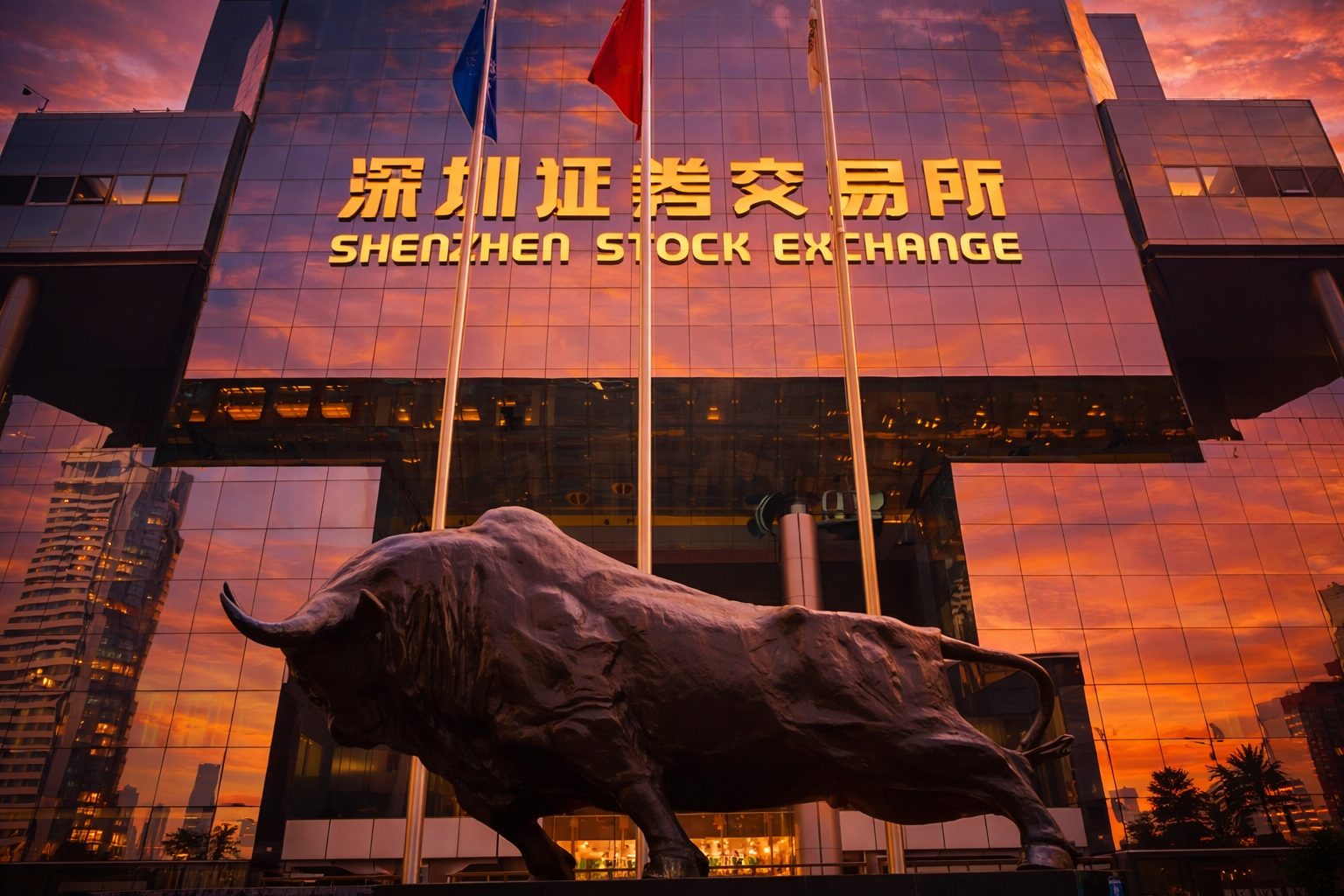

SHENZHEN / BEIJING — December 20, 2025. The Shenzhen Stock Exchange (SZSE) is closed on Saturday, but the story of Shenzhen-listed equities is still moving—because the most important forces driving prices right now are not limited to the trading day. Heading into the final stretch of 2025, investors are weighing a familiar China-market mix: selective optimism around innovation and “new economy” themes, a persistent drag from property-sector stress, and close attention to market-rule tweaks that can change liquidity in a hurry. TradingHours+2Trading Economics+2
Below is what matters for the SZSE as of December 20, 2025—including the latest market snapshot, the biggest Shenzhen-linked news catalysts, and where forecasters see the next risks and opportunities.
Shenzhen Stock Exchange market snapshot: where SZSE indexes stand into the weekend
The last trading session before the weekend (Friday, December 19) ended with Shenzhen stocks modestly higher on the day, even as the broader week’s performance stayed mixed:
- The Shenzhen Component Index rose 0.66% on Friday to around 13,140, while commentary tracking the week described it as down about 0.9% over the week.
- The tech-heavy ChiNext Index finished Friday at 3,122.24, and end-of-week reporting described ChiNext as up about 1.2% over the week.
That divergence—main Shenzhen benchmarks soft-to-flat weekly while ChiNext holds up better—is a clean summary of the current tape: investors are still willing to pay for growth narratives, but they’re picky, and they’re increasingly allergic to leverage and balance-sheet surprises.
Why the Shenzhen Stock Exchange matters right now (and why it’s not just “another China bourse”)
Shenzhen is where much of China’s listed innovation economy lives—especially via ChiNext, the Nasdaq-style board associated with growth and high-tech names. Structurally, Shenzhen’s equity market is often described today as having two primary boards: the Main Board and ChiNext, after reforms that merged the old SME board into the Main Board.
In scale terms, the SZSE is not a niche venue. The World Federation of Exchanges’ published statistics show that by October 2025 the Shenzhen Stock Exchange had 2,885 listed companies, and a domestic market capitalization around $5.58 trillion (USD) in that dataset.
For a more “near-real-time” read on market size, CEIC’s daily series (which focuses on tradable stock market value) put SZSE tradable stock market capitalization at about RMB 36.46 trillion on December 19, 2025. CEIC Data
So when Shenzhen moves, it’s not a sideshow. It’s a major temperature gauge for China’s listed private-sector manufacturing, hardware, and growth tech.
The biggest Shenzhen-linked news drivers as of Dec 20, 2025
1) Vanke’s bond negotiations keep property risk in the SZSE spotlight
No single Shenzhen-listed name has captured the market’s anxiety quite like China Vanke—because it sits at the uncomfortable intersection of “systemically important” and “still exposed to property deleveraging.”
This week, Reuters reported that Vanke is offering an interest payment while seeking a one-year principal extension on an onshore yuan bond that was due December 15, alongside a request to extend the bond’s grace period—moves tied to a bondholder vote scheduled for December 22.
Why it matters for the Shenzhen Stock Exchange:
- Vanke is Shenzhen-listed (and widely held), so its stress feeds directly into SZSE sentiment.
- The episode is a reminder that China’s equity rally attempts can still be derailed by “old economy” balance-sheet realities—especially when property headlines hit at year-end, when liquidity can be more fragile.
In plain English: even if traders want to talk about AI and robots, the market still has to price the probability of defaults.
2) A fresh delisting calendar item: Hangzhou Turbine Power set to leave the SZSE on Dec 22
Delistings aren’t always bearish—sometimes they’re the mechanical outcome of reorganizations—but they do matter because they change index composition, liquidity, and (often) retail positioning.
A Reuters item carried on TradingView said Hangzhou Turbine Power Group (200771) will be delisted from the Shenzhen Stock Exchange on December 22.
Company disclosure documents around the transaction describe it as a voluntary delisting tied to a merger/absorption structure, with shares expected to convert into stock of the surviving company and later reflect value again once re-listed.
Why this matters for SZSE-watchers:
- It’s another example of how China’s exchanges are continually “editing” the listed universe through mergers, restructurings, and rule-driven exits—especially in legacy industrial names.
- It’s also a reminder that headline “delisting” in mainland China often means process and restructuring, not necessarily the same thing as U.S.-style collapse narratives—though investor risk during the conversion window is real. Qixin
3) Index rebalancing on SZSE: the quiet lever that can shift flows
One underappreciated driver of Shenzhen trading is index construction. Index changes can mechanically reroute passive and semi-passive capital, and they influence what margin traders and thematic funds chase next.
Chinese state media reported earlier in December that the SZSE began regular constituent adjustments for major indices—including the Shenzhen Component Index and ChiNext-related indices—as part of efforts framed around supporting financing for technology-oriented firms.
Whether you view this as “smart industrial policy” or “guided capital allocation,” the market implication is the same: index methodology becomes a policy transmission mechanism, particularly for Shenzhen’s tech-heavy ecosystem.
Microstructure and rules: why “how trading works” is becoming part of the investment thesis
Program trading rules and the push for tighter monitoring
Across 2025, mainland regulators and exchanges have continued to sharpen oversight of program trading (algorithmic strategies). A legal summary of China’s programme trading framework noted that both the Shanghai and Shenzhen exchanges issued implementation rules in 2025, with provisions taking effect later in the year.
Separately, Hong Kong Exchange materials on northbound program trading reporting under Stock Connect highlight that cross-border channels are also building reporting and monitoring infrastructure.
Why this matters specifically for Shenzhen:
- SZSE liquidity—particularly in ChiNext—can be sensitive to fast money.
- If reporting requirements, risk controls, or latency-related constraints tighten, intraday volatility and turnover patterns can change, even if the macro story doesn’t.
“HFT crackdown” chatter: real policy signal or just market noise?
There has also been industry discussion about China potentially tightening around high-frequency trading practices such as co-location. One market-structure outlet reported debate and speculation around co-location limits and enforcement direction.
This is exactly the kind of topic where nuance matters: even the expectation of tighter constraints can reduce aggressive short-term strategies, which may lift or reduce volatility depending on who exits and how market-making adapts.
Sector themes powering Shenzhen: AI infrastructure, chips, and the “picks-and-shovels” trade
The SZSE’s identity is tightly tied to China’s hardware and industrial innovation base—so global technology narratives feed into Shenzhen pricing in a very direct way.
- Reuters published a deep dive this month describing China’s long-running drive to build domestic capability in advanced chipmaking tools, including EUV-related efforts—an ecosystem story that tends to boost attention on China-listed semiconductor supply chains and adjacent tech manufacturing names.
- The Financial Times reported strong investor interest in Chinese companies supplying power and energy equipment into the global AI build-out (data centers and grid infrastructure), a theme that has helped fuel sharp share gains in some China-listed industrial and energy-tech champions—categories where Shenzhen is heavily represented.
At the same time, not every “new energy” theme is clean. Reuters reported that China’s solar sector losses narrowed in Q3 while Beijing’s campaign against industrial overcapacity continues—relevant because many solar and renewable supply-chain names sit in the Shenzhen listing ecosystem. Reuters
The bottom line: Shenzhen is positioned where global capex cycles meet China’s industrial policy, which can create powerful momentum—until it collides with overcapacity, pricing pressure, or export restrictions.
The macro backdrop: why 2026 forecasts matter for SZSE valuations right now
Shenzhen valuations don’t exist in a vacuum. They live downstream from macro expectations—growth, credit conditions, and policy credibility.
Growth and policy: “support consumption” vs. “avoid a fiscal splurge”
Reuters coverage of China’s late-2025 macro data described signs of slowing momentum and renewed calls for reform, with weaker retail and industrial indicators reinforcing the market’s sensitivity to policy follow-through.
A separate Reuters analysis flagged the tension between official messaging about prioritizing domestic demand in 2026 and apparent reluctance to deliver an aggressive fiscal push—an uncertainty that matters to equity multiples, especially for cyclical and consumer-linked Shenzhen names.
Foreign flows: still a pressure point
Foreign direct investment data reported by Reuters showed year-to-date FDI (Jan–Nov) declining versus the prior year—one more signal that international capital’s “China comfort level” remains uneven, even during equity rebounds. Reuters
This is crucial for Shenzhen because foreign participation tends to concentrate in liquid, index-relevant names—precisely the area where Shenzhen’s benchmark constituents compete for global allocation.
IPO and listing outlook: what the pipeline says about Shenzhen’s next chapter
For exchange watchers, the IPO pipeline is like tree rings: it tells you what the ecosystem is doing even when price charts are noisy.
A Deloitte year-end review and outlook said Mainland China’s A-share market could see steady growth in 2026, with broader capital market activity expected to remain constructive in that scenario.
That matters for SZSE because:
- Shenzhen is one of the two core A-share venues.
- ChiNext’s identity as a growth and innovation board means it often benefits disproportionately when the policy mood favors “fundraising for innovation.”
What to watch next for the Shenzhen Stock Exchange (week of Dec 22)
With year-end approaching, three near-term items stand out:
- December 22: Vanke-related bondholder decisions are a calendar risk, because any “default vs. extension” narrative can ripple into banks, insurers, and sentiment broadly. Reuters
- December 22: Hangzhou Turbine Power’s scheduled SZSE delisting is a concrete, mechanical event that can move index-linked positioning and B-share niche flows.
- Rule and monitoring signals: further clarity on program trading enforcement and Stock Connect reporting infrastructure can affect liquidity—especially in the more momentum-sensitive segments of Shenzhen’s market.
The take: Shenzhen is ending 2025 as a “barbell market”—innovation hope on one side, balance-sheet reality on the other
As of December 20, 2025, the Shenzhen Stock Exchange is essentially pricing two worlds at once:
- A forward-looking world where AI infrastructure, industrial upgrading, and innovation financing keep capital flowing toward Shenzhen’s growth complex.
- A present-tense world where property-sector stress events—especially around bellwethers like Vanke—still have the power to yank risk appetite lower.
If 2026 delivers clearer consumption support and stable credit conditions, Shenzhen’s growth-heavy identity could regain narrative dominance. If not, traders may keep treating rallies as tactical—strong on headlines, fragile on fundamentals.
Related articles: Stock Market