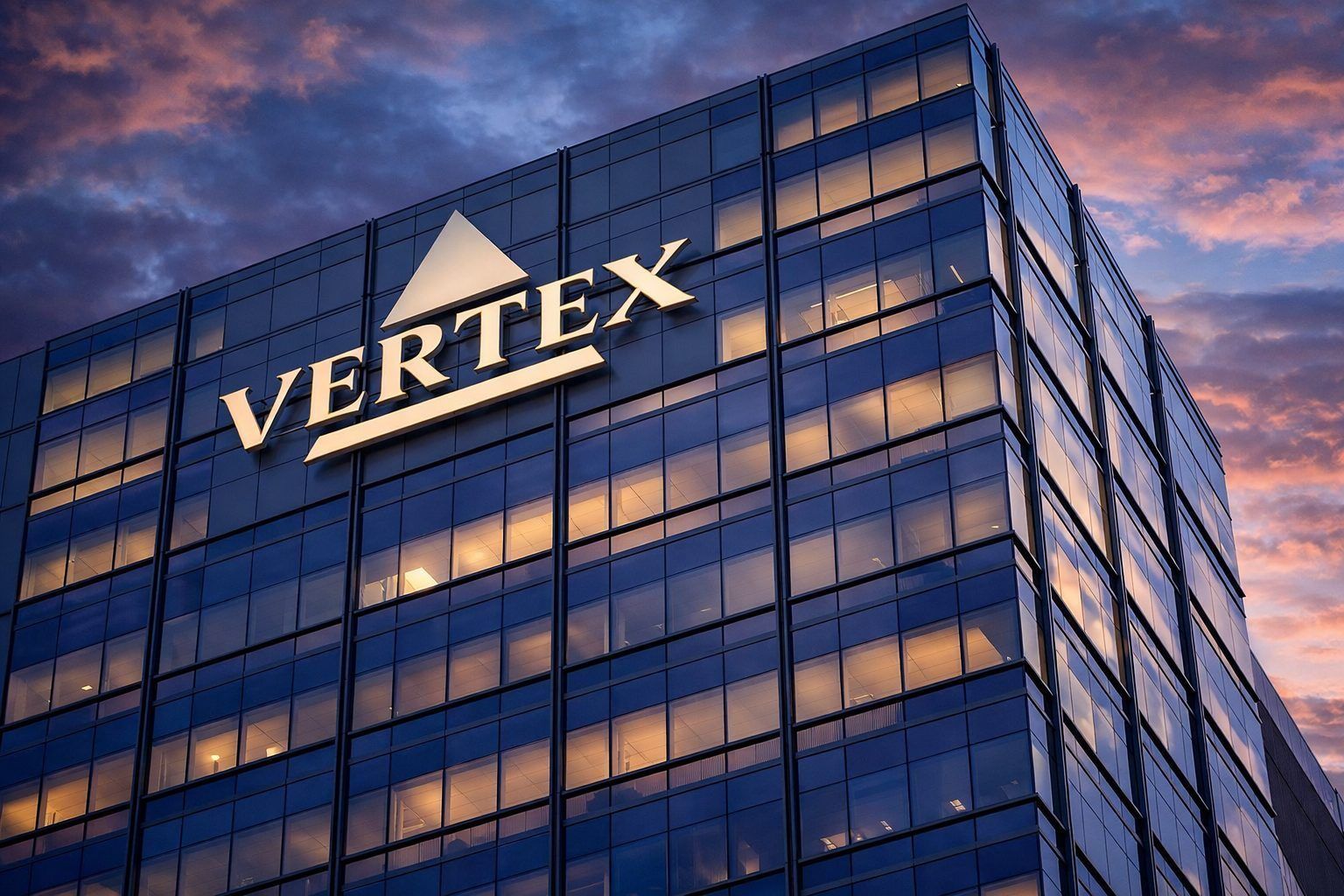
December 20, 2025 — Vertex Pharmaceuticals Incorporated (NASDAQ: VRTX) heads into the year’s final stretch with investors focused on a familiar question: can the biotech’s next wave of launches and late-stage programs begin to meaningfully diversify a cystic fibrosis (CF) business that has dominated its revenue for more than a decade?
VRTX shares most recently closed at $456.20 on Friday, Dec. 19, up 1.97% in that session.
Below is the current news, forecasts, and market analysis shaping Vertex stock as of Dec. 20, 2025, including the latest on Casgevy’s pediatric data, Journavx’s commercial ramp, and a kidney-disease pipeline that many analysts view as the company’s next major growth driver.
VRTX stock price action: what the market is signaling right now
A quick look at recent trading shows why Vertex is back on many watchlists: December has delivered several notable moves, including a sharp jump on Dec. 3 and a generally firmer tone into mid-December. On Dec. 3, VRTX closed at $463.13, up 6.92% on the day, according to historical pricing data.
That timing overlaps with a cluster of “stock-moving” developments—especially analyst actions (covered below) and investor attention around Vertex’s pipeline visibility at year-end.
The biggest Vertex news in December 2025: Casgevy posts pediatric results and plans filings
Casgevy shows encouraging outcomes in children ages 5–11
On Dec. 6, 2025, Vertex reported new results for Casgevy (exagamglogene autotemcel) in children ages 5–11 with severe sickle cell disease (SCD) and transfusion-dependent beta thalassemia (TDT), presented at the American Society of Hematology (ASH) annual meeting.
Key points reported across coverage:
- In a late-stage pediatric SCD study, all four children with sufficient follow-up were free of vaso‑occlusive crises for at least 12 consecutive months, with the longest duration approaching two years.
- In pediatric TDT, 12 patients were reported transfusion-free for at least 12 consecutive months, also with follow-up approaching two years in the longest case.
- Vertex said it plans to initiate global regulatory submissions in the first half of 2026 to expand use to younger children.
A notable regulatory accelerant—and a safety reminder
Reuters reported Vertex received a Commissioner’s National Priority Voucher tied to Casgevy in the 5–11 age group, intended to speed FDA review.
At the same time, the pediatric update came with an important safety detail: one TDT patient died from complications linked to pre-transplant chemotherapy (busulfan), underscoring the real-world complexity of cell and gene therapy pathways that still require intensive conditioning.
Why this matters for VRTX stock: Casgevy is one of Vertex’s key “beyond CF” pillars. Pediatric label expansion is a clear potential demand catalyst—but the therapy’s multi-step logistics and conditioning risks remain central to the commercialization debate.
Insider headline to note: Chairman files Form 144 to sell shares
On Dec. 3, 2025, a Reuters/Refinitiv item reported Vertex Chairman Jeffrey M. Leiden filed a Form 144 proposing a sale of 63,781 shares, executed under a prearranged 10b5‑1 trading plan.
Form 144 filings can attract attention because they often appear in market feeds as “insider selling,” but context matters: a 10b5‑1 plan is typically designed to reduce the appearance of trading on material nonpublic information.
Earnings and commercial execution: what Q3 2025 said about Vertex’s story
The most recent earnings cycle continues to reinforce a split narrative for Vertex investors:
- CF remains the cash engine, and
- new launches are progressing—yet still under scrutiny for pace and expectations management.
Q3 2025 snapshot: beats on earnings, but new product ramps were debated
Reuters reported that Vertex posted Q3 revenue of $3.08 billion and adjusted EPS of $4.80, beating estimates, while also raising its 2025 revenue outlook into the $11.9–$12.0 billion range.
But discussion quickly centered on the newer portfolio:
- Casgevy revenue in Q3 was reported around $16.9–$17 million, with launch metrics improving but commercialization still early and uneven.
- Journavx (Vertex’s non-opioid acute pain drug) recorded around $19.6–$20 million in Q3 sales, while Vertex highlighted that 300,000+ prescriptions had been written since launch and payer coverage was expanding.
Industry analysts and trade coverage pointed out the tension: prescription volume can look strong, yet revenue conversion may lag—especially if free-drug programs or payer frictions shape early quarters.
Earlier in 2025: a reminder of how quickly sentiment can shift
- In Q1 2025, Reuters reported Vertex missed estimates due to weaker-than-expected Trikafta sales, though it raised the lower end of its annual revenue forecast and noted early Journavx prescription traction shortly after launch.
- In August 2025, Reuters reported Vertex faced a setback in its pain franchise push after a trial failure and a scrapped study, which pressured the stock at the time.
Takeaway for VRTX stock: Vertex’s fundamentals remain heavily supported by CF, but the market’s near-term mood can swing on whether “next engines” (pain, gene therapy, kidney disease, diabetes) translate from scientific progress into scalable revenue.
Cystic fibrosis: defending the franchise while building the next generation
Vertex’s CF business is still the centerpiece—and management has been working to extend durability with next-generation products.
Alyftrek expands Vertex’s CF footprint
Reuters reported that Vertex’s next-generation CF treatment Alyftrek received EU approval in July 2025 for patients aged six and older with qualifying CFTR mutations, positioning it as part of Vertex’s long-term franchise defense as older products eventually face patent cliffs.
Reuters also noted Alyftrek had been approved by the FDA in December (referenced in a May 2025 report), reinforcing its role in the company’s CF strategy.
A growing access and pricing debate is also part of the CF story
In October 2025, Fierce Pharma reported a cystic fibrosis “buyers club” initiative aiming to introduce a discounted generic version of Trikafta (referred to as “Triko”) in certain markets using a trade-policy/patent workaround involving manufacturing in Bangladesh (an LDC under TRIPS). The piece cited a proposed price of $12,750/year for adults versus a $370,000 U.S. list price, while also emphasizing that U.S. personal importation is often illegal for unapproved drugs. Fierce Pharma
Why this matters for investors: even if near-term financial impact is limited (especially in the U.S. market), the story highlights persistent political and ethical pressure around CF drug access—pressure that can influence policy, negotiations, and public perception over time.
The diversification bet: kidney disease is becoming a central “next chapter” narrative
If CF is the foundation, kidney disease is increasingly positioned as one of Vertex’s strongest shots at a second major franchise.
Povetacicept: Breakthrough Therapy Designation and late-stage momentum
A Nasdaq/RTTNews report said the FDA granted Breakthrough Therapy Designation to povetacicept for IgA nephropathy (IgAN), with the therapy being studied in the Phase 3 RAINIER trial.
More detailed clinical and regulatory context came via Ono Pharmaceutical (Vertex’s partner in Japan), summarizing Vertex’s November 2025 update:
- 48-week data showed a 64% decrease in proteinuria (UPCR) in IgAN and an 82% decrease in primary membranous nephropathy (pMN), alongside eGFR stabilization in both cohorts.
- Vertex indicated it was on track to initiate a rolling BLA submission for potential accelerated approval in IgAN, and noted an intent to use a priority review voucher to shorten review timelines.
- The company stated RAINIER was fully enrolled, while pMN received Fast Track Designation and a pivotal Phase 2/3 program was underway.
Separately, the ASN Kidney Week materials describe RAINIER as a global Phase 3 study and outline an interim analysis after 36 weeks with the potential to support accelerated approval in the U.S.
Inaxaplin and other kidney programs
The same Nasdaq/RTTNews item also highlighted progress in Vertex’s kidney portfolio beyond povetacicept, including enrollment completion milestones for inaxaplin in APOL1-mediated kidney disease, and initiation of a Phase 2 study for VX‑407 in ADPKD.
Investor lens: Kidney disease represents a massive market opportunity, but also a clinical, regulatory, and commercial “execution marathon.” If povetacicept’s pivotal program and regulatory strategy stay on track, it could become a defining driver of medium-term valuation debates around Vertex stock.
Type 1 diabetes: zimislecel remains a high-upside (and high-complexity) asset
Vertex’s cell therapy program for type 1 diabetes continues to draw attention, particularly after 2025 clinical publications and ongoing pivotal work.
- Breakthrough T1D reported in December 2025 that results published in The New England Journal of Medicine showed 10 of 12 participants (83%) in the study were insulin-independent, and described zimislecel as moving closer to a regulatory submission pathway.
- A Nasdaq opinion piece also noted management was planning to submit regulatory applications “next year,” and framed zimislecel alongside other late-stage programs as part of Vertex’s multi-launch runway. Nasdaq
This program is widely viewed as transformative if it scales—but it also comes with typical cell-therapy constraints (specialized centers, complex manufacturing logistics, and in some cases immunosuppression requirements).
Analyst forecasts for Vertex stock: price targets, rating trends, and what changed in December
Across major aggregators tracking Wall Street coverage, the consensus view remains constructive with moderate single-digit to low double-digit upside implied from current levels—though not without debate about pacing of the new launches.
Here’s what the analyst landscape looks like as of Dec. 20, 2025:
- StockAnalysis shows a consensus average price target of $494.64 (22 analysts), implying roughly 8% upside from recent prices, with targets ranging from $411 (low) to $575 (high).
- MarketBeat lists a 12‑month average forecast around $498.42 and characterizes consensus sentiment as “Moderate Buy.” MarketBeat
- Benzinga reports a consensus price target around $497.04 based on 26 analysts and flags the three most recent analyst updates as coming in Dec. 3, Dec. 5, and Dec. 10.
The key December analyst actions investors tracked
Recent changes highlighted by these aggregators include:
- Morgan Stanley: upgrade action on Dec. 3, and a subsequent target adjustment higher (reported in early December).
- Wells Fargo: maintained a positive stance and raised its price target on Dec. 10 (as tracked by multiple aggregators).
What this suggests: Wall Street appears to be re-centering the Vertex story on (1) cash-flow durability in CF, and (2) the probability-weighted value of kidney disease, diabetes, and gene therapy programs—while still demanding clearer evidence that Journavx and Casgevy can become meaningfully scaled growth drivers.
What could move Vertex (VRTX) stock next: the near-term catalyst checklist
As of Dec. 20, 2025, market focus for the next 1–3 quarters typically clusters around five themes:
- Casgevy label expansion filings (2026)
Vertex plans submissions in 1H 2026 for the 5–11 age group, which could help broaden the addressable population—while investors continue to watch real-world adoption and center capacity. - Journavx revenue conversion
Prescription volume has been a headline metric, but the market is watching how quickly those scripts translate into revenue as coverage expands and free-drug programs normalize. - Povetacicept and the kidney portfolio’s regulatory tempo
Breakthrough Therapy Designation, pivotal enrollment, and the described accelerated-approval pathway put kidney disease at the center of “next franchise” expectations. Nasdaq+2Ono Pharmaceutical+2 - Zimislecel visibility
Continued updates on enrollment, manufacturing readiness, and regulatory plans will matter as investors pressure-test whether this program can become commercial at scale. - Drug pricing policy risk rising into 2026–2027
While not Vertex-specific, the U.S. policy environment is shifting. CMS announced two pilot programs designed to link certain Medicare drug payments to international price benchmarks beginning in 2026 and 2027. Reuters
Separately, Reuters reported the Trump administration finalized drug-pricing agreements with nine large drugmakers on Dec. 19, 2025—another signal that pricing and reimbursement could remain a headline issue for the sector.
Bottom line: how VRTX looks as of Dec. 20, 2025
Vertex stock enters late 2025 in a position that many large-cap biotech investors recognize well:
- Strength: a highly profitable CF core with next-generation lifecycle management (Alyftrek) and a deep late-stage pipeline that’s increasingly anchored by kidney disease and advanced cell/gene therapies.
- Pressure points: proving that the “new Vertex” can scale commercially beyond CF—particularly Casgevy and Journavx—while navigating safety/logistics realities and an evolving pricing environment. Fierce Pharma+2Reuters+2