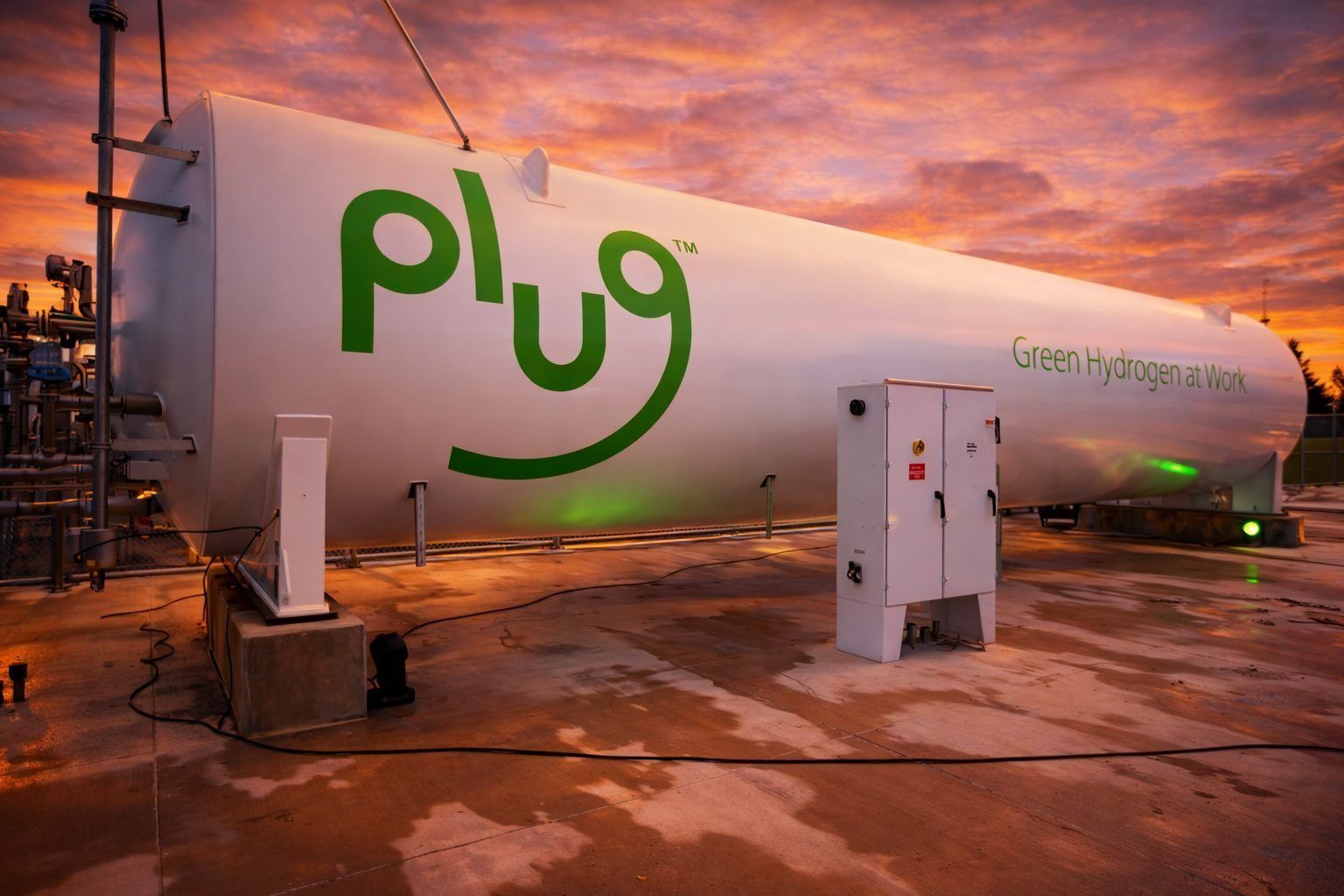

Plug Power Inc. stock NASDAQ:PLUG heads into the final stretch of 2025 with the market still asking the same blunt question it’s been asking for years: can this hydrogen pioneer turn scale into sustainable margins before the next funding round becomes inevitable?
As of Dec. 21, 2025 (a Sunday, with U.S. markets closed), PLUG last traded around $2.20. The stock remains deeply volatile, with heavy trading volumes recently and a wide gap between bull and bear narratives — and the latest headlines have only sharpened that split.
Below is a roundup of the most current Plug Power news, forecasts, and analyst-style takes available as of 21.12.2025, plus what they mean for PLUG stock heading into 2026.
Plug Power stock price today: Where PLUG stands on Dec. 21, 2025
PLUG shares are hovering around $2.20, reflecting the latest available trading data heading into the weekend. On Friday, Dec. 19, MarketWatch data showed PLUG closed at $2.20, down 2.65%, with trading volume around 133 million shares — notably above its recent average.
That “high-volume, low-price” combo matters because it signals active disagreement: plenty of investors trading, but no consensus yet that Plug Power’s turnaround is “real” rather than “another chapter.”
The biggest Plug Power news catalysts right now
1) Plug Power’s Africa milestone: a 5MW electrolyzer at Namibia’s green hydrogen facility
One of the most marketable near-term headlines is also one of the most tangible: Plug Power announced it successfully installed a 5MW GenEco electrolyzer for Cleanergy Solutions Namibia at Walvis Bay, described as Africa’s first fully integrated commercial green hydrogen facility.
Key project details Plug disclosed:
- Integrated into an off-grid site combining a 5MW solar park (over 6.5 hectares) and a 5.9 MWh battery energy storage system.
- Hydrogen intended for trucks, port and rail equipment, and small ships operating through the Port of Walvis Bay.
The same milestone was also picked up in trade coverage dated Dec. 21, 2025, reinforcing that it’s still a “current” narrative for PLUG going into 2026. Indian Chemical News
Why it matters for PLUG stock: electrolyzers are increasingly the part of Plug’s story the market wants to believe — because selling equipment and related services can be a cleaner margin path than subsidizing hydrogen fuel economics.
2) NASA contract: Plug begins first liquid hydrogen supply deal
On Dec. 1, 2025, Plug said it began a contract with NASA to supply up to 218,000 kilograms (480,000 pounds) of liquid hydrogen to NASA facilities in Ohio, with a contract value up to $2.8 million.
Why it matters for PLUG stock: this is small in dollars, but big in signaling. NASA is a high-spec customer, and Plug explicitly framed this as entry into the growing space industry as a potential liquid hydrogen demand driver.
3) The “liquidity patch”: $431.25M convertible notes and $399M net proceeds
Plug’s financial footing improved (at least on paper) after it closed an offering of 6.75% convertible notes due 2033, totaling $431.25 million in principal amount, with approximately $399.4 million in net proceeds.
Plug said the proceeds allow it to:
- Retire remaining high-cost 15% debt
- Refinance 2026 convertible notes
- Eliminate the first lien held by its former debt provider
Plug also emphasized the refinancing extends lower cost of capital through an eight-year tenor balloon note structure with no required amortization during that period, which it argues preserves liquidity and reduces near-term repayment pressure.
A separate industry outlet recap similarly described the financing as enabling debt retirement/refinancing and leaving the current business plan “fully financed” alongside the data-center-related agreement. Renewables Now
Why it matters for PLUG stock: liquidity has been the existential variable. This financing doesn’t “solve” profitability — but it can buy time for execution, and time is literally the commodity this stock trades on.
4) The data center pivot: monetizing electricity rights for $275M+ liquidity improvement
Plug has also been leaning into a surprising angle: data centers. Reuters reported Plug expected to generate more than $275 million by monetizing assets, releasing restricted cash, and lowering maintenance expenses, while shifting focus toward higher-return opportunities and the fast-growing data center market.
Plug’s own Q3 highlights echoed the same theme: a non-binding LOI to monetize electricity rights in New York and another location and collaborate with a major U.S. data center developer, targeting more than $275 million in liquidity improvement.
A Times Union report added context: Plug put plans to build up to six new hydrogen plants on hold (despite $1.66B in DOE loan guarantees) and planned instead to buy hydrogen from an existing supplier while redirecting secured electric power toward a data center developer arrangement.
Why it matters for PLUG stock: data centers are a mega-trend in power demand — and the market loves any credible “bridge” story from today’s losses to tomorrow’s cash-generating infrastructure role. But Plug’s mention of non-binding agreements also signals execution risk.
Why Plug Power shares surged mid-week — and what that says about sentiment
PLUG didn’t just drift quietly this week. A Motley Fool analysis described Plug Power shares surging sharply on Thursday (Dec. 18), citing three catalysts, including the Namibia electrolyzer news.
The same piece also pointed to sector sympathy: FuelCell Energy’s results and its commentary around growth opportunities in data centers, plus broader speculative sentiment tied to a fusion-energy-related headline — framed as a political tailwind thesis for alternative energy.
MarketWatch’s recap of that day showed PLUG rising 4.63% on Dec. 18 (to $2.26) with volume around 122 million shares.
The takeaway: PLUG still trades partly like a macro sentiment instrument — it can pop on “hydrogen is back” vibes — but it also fades quickly when investors return to the unromantic math of margins and cash burn.
Plug Power’s operating story: The margin problem is still the boss battle
A Dec. 21, 2025 Motley Fool analysis comparing Wolfspeed and Plug Power summarized Plug’s core historical issue in blunt terms: Plug’s business has included selling hydrogen fuel at a cost less than what it costs to distribute it, leading to negative gross margins and major cash outflows.
That same analysis said Plug is trying to become an end-to-end hydrogen solutions company by building its own hydrogen plants — but it hasn’t yet scaled enough to meet commitments and remains margin-negative. It cited Q3 results including negative adjusted gross profit of $37 million, and relayed management’s belief it can reach gross margin breakeven by the middle of next year via increased hydrogen production, price increases, and Project Quantum Leap restructuring.
Meanwhile, a Reuters earnings recap (via TradingView) put numbers around the “improving, but still not there” theme:
- Q3 revenue about $177 million (missing analyst expectations in that recap)
- Adjusted EPS improved to a loss of $0.12 per share
- Plug aims for EBITDAS-positive results in the second half of 2026
MarketBeat’s financial summary also highlighted improved operating cash flow in Q3 2025 (cash from operating activities around -$89.8M, improved from the prior year), while still emphasizing continuing losses and gross margin pressure.
The electrolyzer growth angle: Plug’s brighter-looking segment
If Plug has a “cleaner” narrative lane right now, it’s electrolyzers.
A Nasdaq-hosted Zacks analysis published this week said that in the first nine months of 2025, revenue from Plug’s electrolyzer product line surged 61% year over year, representing 24.7% of total business.
Plug’s own year-end blog post (dated Dec. 18, 2025) claimed it shipped more than 185 MW of GenEco electrolyzers in 2025 (about 203% YoY growth vs. 2024), and total electrolyzer shipments surpassed 317 MW across 70+ units.
Why it matters: investors tend to reward equipment sales narratives (especially global, repeatable deployments) more than “we’ll lose money on fuel now but fix it later” narratives.
Leadership transition: New CEO coming in March 2026
Leadership is another active storyline. Reuters reported Plug named insider Jose Luis Crespo as its next CEO, succeeding longtime leader Andy Marsh, with Crespo formally taking the CEO role after Plug files its 2025 annual report in March 2026.
This is important because management credibility has been a recurring issue in Plug’s market perception — the company has ambitious long-term plans, and investors are sensitive to any sign the roadmap is drifting.
Plug Power stock forecast: What Wall Street and management are signaling
Management targets (the “company forecast” side)
As of the latest reporting cycle and commentary in widely distributed coverage:
- Plug aims to become gross-margin breakeven by mid-2026 (as described in Dec. 21 analysis).
- Plug aims for EBITDAS-positive results in 2H 2026.
These are company-linked expectations and should be treated like what they are: targets, not guarantees.
Analyst price targets (the “market forecast” side)
Analyst and aggregator forecasts remain mixed — and even the averages disagree depending on whose dataset you use:
- MarketBeat (Nov. 2025 coverage) shows a consensus “Hold” rating and a consensus price target around $2.50, while noting a wide spread of ratings. MarketBeat
- StockAnalysis (13 analysts) shows a “Hold” average rating and a 12-month target around $2.15. StockAnalysis
- Benzinga reports a “Hold” consensus and a mean price target of $4.10 based on 30 analyst ratings, while noting more recent ratings skewing lower. Benzinga
What to do with these conflicting targets: treat them as a temperature check on uncertainty. When targets range this widely, it typically means analysts are struggling to handicap (1) margins, (2) funding, and (3) the pace of hydrogen adoption — all at once.
The legal headline risk: investor “alerts” and investigations
Plug also faces periodic legal noise. A Pomerantz LLP press release dated Dec. 11, 2025 announced the firm was investigating claims on behalf of Plug Power investors, describing it as an inquiry into potential securities fraud or unlawful business practices.
These “investor alerts” are not the same thing as a court judgment or proven wrongdoing — but they can add headline risk and weigh on sentiment, especially for already-volatile small/mid-cap names.
The policy and macro wildcard: U.S. hydrogen incentives and infrastructure support
Hydrogen businesses don’t just compete on engineering — they compete inside policy frameworks.
Reuters reporting earlier in 2025 highlighted concerns that a Trump-linked tax bill and potential funding cuts could threaten clean hydrogen investment and regional hydrogen hubs, while also noting Plug Power’s role in operating large PEM electrolyzer capacity in Georgia.
More recently (Dec. 2025), the Financial Times reported that U.S. green hydrogen players have been shifting attention toward Europe amid U.S. policy headwinds and competitive pressure, explicitly naming Plug Power among companies adjusting strategy.
Why this matters for PLUG stock: changes in tax credits, hub funding, or other support mechanisms can hit project economics fast — and Plug is still in the phase where project economics and capital availability are make-or-break.
Bottom line: Plug Power stock remains a “prove it” story heading into 2026
As of Dec. 21, 2025, Plug Power stock is being pulled by two forces that don’t like sharing the same room:
- Real operational progress and credibility-building contracts (NASA liquid hydrogen supply, visible electrolyzer deployments like Namibia, and a clearer electrolyzer growth narrative).
- Persistent structural challenges (deeply negative margins historically tied to hydrogen economics, ongoing losses, and dilution/financing overhang).
For investors watching PLUG into 2026, the most important checklist isn’t hype-driven — it’s mechanical:
- Does gross margin actually approach breakeven on the company’s timeline?
- Does cash burn keep narrowing without constant dilution?
- Do data-center power and electrolyzer projects move from LOIs and pilots into repeatable revenue?
Finally, for anyone timing catalysts: multiple earnings-calendar sources suggest Plug’s next report is expected around late February to early March 2026, though dates vary by tracker and may be unconfirmed by the company.
Related articles: NASDAQ:PLUG