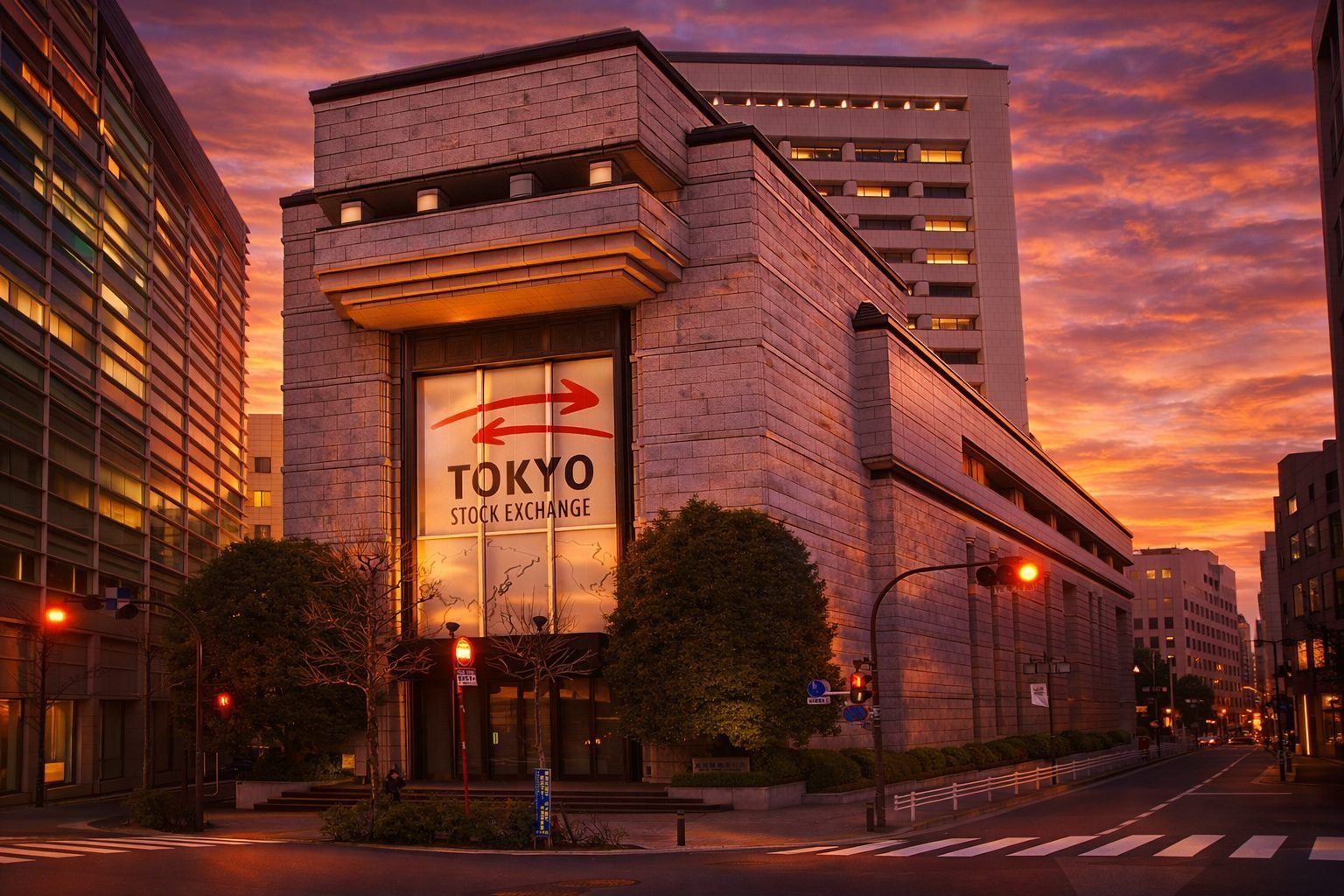
TOKYO — As Japan heads into the final full week of trading before year-end holidays, the Tokyo Stock Exchange (TSE) is balancing three big forces at once: a higher-rate era after the Bank of Japan’s latest hike, fresh volatility tied to global AI enthusiasm (and occasional panic), and a steady drumbeat of market-structure changes—from IPO mechanics to new indices and AI-powered disclosure search.
With Tokyo markets closed over the weekend, traders are using futures, FX, and bond moves to game out Monday’s open. One early clue: yen-denominated Nikkei 225 futures were last marked around 50,375 as of Sunday, Dec. 21 (U.S. time), a level above Friday’s cash close—suggesting risk appetite hasn’t evaporated.
Where the Tokyo Stock Exchange stands right now: strong levels, choppy leadership
The last cash session (Friday, Dec. 19) ended with Japan’s benchmark Nikkei 225 up about 1%, buoyed by a tech rebound even as bond yields climbed after the BOJ decision.
But the tape hasn’t been one-way. Just one day earlier (Thursday, Dec. 18), the Nikkei slid 1.03% to 49,001.5, its lowest close in about three weeks, pressured by heavyweight tech names as investors reassessed the near-term outlook for AI and data-center spending.
That push-and-pull—“AI growth” versus “rates and real economy”—has become the defining rhythm for Tokyo equities going into 2026.
The macro driver: BOJ lifts rates to 0.75%, and markets debate what “normal” even means
On Dec. 19, the Bank of Japan raised its short-term policy rate to 0.75% from 0.5%, a widely expected move that still matters because it reinforces Japan’s slow exit from ultra-easy money. Reuters reported the decision was unanimous.
In the immediate aftermath, the market reaction was a little counterintuitive: investors sold the yen after the hike, while Japanese government bond yields pushed higher, with Reuters noting the 10-year yield hit a multi-decade peak as the Nikkei finished higher.
Why that matters for the Tokyo Stock Exchange:
- Banks and insurers typically like higher yields (better lending/investment margins).
- High-multiple growth and tech can wobble when discount rates rise.
- Exporters care intensely about the yen’s direction—both for translated earnings and competitiveness.
Some strategists are also focused on 2026 as a “risk of surprise” year. A Reuters interview with BlackRock’s Japan chief investment strategist warned markets could be jolted if the BOJ ends up “behind the curve” on inflation. Reuters
AI jitters aren’t a U.S.-only story—Tokyo’s tech heavyweights feel it fast
The TSE’s headline index is unusually sensitive to a handful of large, high-priced stocks. So when global investors question whether AI infrastructure spending is peaking—or simply getting repriced—Tokyo can move sharply.
Reuters’ global market coverage late last week described a tech-driven swing in sentiment across regions, with investors weighing whether parts of the AI trade were getting stretched.
In Japan specifically, the Dec. 18 selloff was framed around “AI-business outlook” anxiety and data-center questions. TradingView
One important nuance for TSE-watchers: the pain hasn’t always been broad-based. On certain down-tech days, TOPIX (a broader, market-cap-weighted index) has been steadier than the price-weighted Nikkei—often a sign of rotation rather than full risk-off.
The next catalyst on the Tokyo Stock Exchange: a late-December IPO cluster and first-day trading rules
While macro headlines dominate globally, the Tokyo Stock Exchange also has a very “nuts-and-bolts” catalyst list for the coming week: new listings.
According to JPX’s official new listings calendar (updated Dec. 19), several companies are slated to debut in late December, including:
- Startline CO., LTD. (477A) — listing Dec. 22 on the Growth market segment (offering price shown as JPY 480).
- Tera Technology, Inc. (483A) — listing Dec. 23 on Standard.
- Additional late-December Growth listings are scheduled for Dec. 24–25 (per JPX’s table).
For traders, Startline is particularly notable because TSE published the special matching mechanism for its first session. Among the key details:
- The order book “center price” is set to the public offering/secondary distribution price (JPY 480).
- Daily price limits do not apply until the initial price is determined.
- Market orders are prohibited on the listing date (and remain prohibited until the initial price is determined if no trades occur on day one).
This kind of microstructure matters because late-year IPOs can temporarily concentrate liquidity and attention, especially when macro-driven volatility is already elevated.
Delistings and volatility controls: TSE shows its “referee” side heading into Monday
Two other exchange-level items are on the near-term radar:
1) A delisting scheduled for Monday, Dec. 22
JPX market news notes that The Furukawa Battery Co., Ltd. is set for delisting on Dec. 22, 2025, following a reverse stock split structure that triggers delisting rules; the designation period referenced in the notice runs through Dec. 21 (Sun.).
2) Daily price limit expansions for specific stocks
TSE also announced it will broaden one-sided daily price limits for two issues on the next business day (Dec. 22), citing conditions like limit hits with zero volume. The notice specifies:
- Abalance Corporation (3856) — broadened lower daily price limit (with numbers stated in yen).
- TORICO Co., Ltd. (7138) — broadened upper daily price limit (with numbers stated in yen).
These are the kinds of operational updates that don’t always make global headlines—but they shape day-to-day trading risk and are part of why the Tokyo Stock Exchange is closely watched by systematic and volatility-sensitive investors.
ETF pipeline: a currency-hedged U.S. equity product gets a green light
On Dec. 19, TSE approved a new ETF managed by BlackRock Japan: iShares S&P 500 Ex-Financials JPY Hedged ETF (code 491A), with a stated listing date of Wednesday, Jan. 28, 2026.
The thematic signal here is bigger than one product: demand for currency-hedged exposures often rises when FX volatility is top-of-mind—exactly the environment markets are in after the BOJ move and the yen’s fast reactions.
New TOPIX indices: JPX expands the toolkit for product builders ahead of 2026
JPX Market Innovation & Research (JPXI) is also setting the table for new index-linked products:
- A TOPIX 100 Net Total Return Index will begin calculation with a base date of Jan. 16, 2026 and a launch date of Jan. 26, 2026, using free-float adjusted market-cap weighting.
- JPXI will also launch a TOPIX High Dividend Growth Index (50 constituents selected from TOPIX 500, focusing on factors including growth potential and dividend yield), also with a Jan. 26, 2026 launch date, and with index licensing details published for ETF applicants.
For the Tokyo Stock Exchange ecosystem, these index expansions are more than branding. They tend to:
- Encourage ETF innovation (especially factor and income strategies),
- Support institutional benchmarking, and
- Make it easier for global allocators to express views on “Japan quality,” “Japan dividends,” or “Japan breadth” without single-stock concentration.
AI meets disclosure: JPX rolls out “J-LENS” beta to search TDnet filings with natural language
One of the more quietly consequential upgrades is in market information plumbing.
On Dec. 9, JPXI announced the beta release of J-LENS, an AI-based natural-language search service for corporate disclosure information. The release highlights use cases that go beyond keyword search (variations in notation, negation, numeric conditions, and more abstract themes), and states:
- Coverage includes TDnet disclosure materials from three years ago up to two days ago.
- It covers companies listed on the Tokyo Stock Exchange.
- Filters include time period, market, industry, and disclosure type.
- JPX explicitly cautions that AI outputs should be verified by checking the underlying disclosure documents.
In plain terms: JPX is trying to reduce the “needle in a haystack” problem of Japanese corporate disclosure—useful for both investors hunting signals and issuers benchmarking peers.
The structural reform backbone: “cost of capital and stock price” pressure continues into 2026
Behind the daily market noise is a deeper multi-year project: getting listed companies to focus on capital efficiency and market valuation.
JPX’s market restructuring follow-up materials note that on March 31, 2023, TSE requested Prime and Standard companies take action to implement management conscious of cost of capital and stock price. Since January 2024, TSE has also published and updated (monthly) a list of companies that have disclosed information aligned with that request.
The same TSE update page (updated Dec. 15, 2025) outlines how the framework has been tightened over time—adding disclosure update dates, enabling investor contact preferences, and setting a time limit for firms listed as “under consideration.” JPX
This matters for Tokyo Stock Exchange valuation debates because it directly targets long-standing investor complaints about low return on equity, excess cash, and limited buyback discipline across parts of corporate Japan.
Forecasts for the Tokyo market in 2026: upside, but with more speed bumps—and more dispersion
Forecasting Japan equities is always hazardous (the market loves plot twists), but a few themes dominate the “2026 playbook” in current research:
- Moderate upside expectations: In a Reuters global markets survey published Nov. 26, strategists projected Japan’s Nikkei could rise around 13% in 2026, supported by earnings and growth assumptions.
- Rate-path risk: BlackRock’s warning (via Reuters) is essentially that inflation persistence could force the BOJ to move faster than markets are priced for, which could jolt both bonds and equities.
- Broader-market catch-up: A 2026 outlook document from Asset Management One argues that 2025’s AI-led rally pushed the Nikkei well ahead of TOPIX and drove concentration signals to extremes—implying 2026 could reward broader earnings growth and reduce reliance on a handful of names.
- Rotation toward domestic exposure: MarketPulse analysis after the BOJ decision pointed to domestic-exposure indices outperforming global-exposure peers in December, consistent with the idea that a gradual tightening cycle may shift leadership away from pure exporters and toward more Japan-demand-linked stocks.
Put together: the base case in much of the current analysis is not “Japan crashes,” but “Japan gets trickier”—with sector selection and policy interpretation doing more of the heavy lifting than simple multiple expansion.
What investors are watching when Tokyo reopens (Mon., Dec. 22)
Going into Monday’s Tokyo Stock Exchange session, the market’s short list looks like this:
- Yen direction after the BOJ hike (FX moves can quickly reshape exporter leadership and overseas flows).
- Japanese government bond yields, especially whether higher yields stay orderly or start to rattle equity duration-sensitive sectors.
- Global AI sentiment spillover, after a week where AI optimism and AI anxiety took turns steering risk appetite.
- IPO pricing and early trading quality, starting with Startline’s first session and TSE’s special matching mechanics.
- Exchange-level market controls (daily price limit expansions can be a tell for where single-name stress is building).
Bottom line
As of Dec. 21, 2025, the Tokyo Stock Exchange is heading into the week with supportive index levels, but also with unusually clear cross-currents: higher Japanese rates, a still-restless AI trade, and an exchange that’s actively modernizing how listings, indices, and disclosures work. The next few sessions may be less about whether Japan is “in” or “out,” and more about which Japan investors want: global tech beta, domestic reflation, dividends and governance, or newly listed growth names finding their first real price.