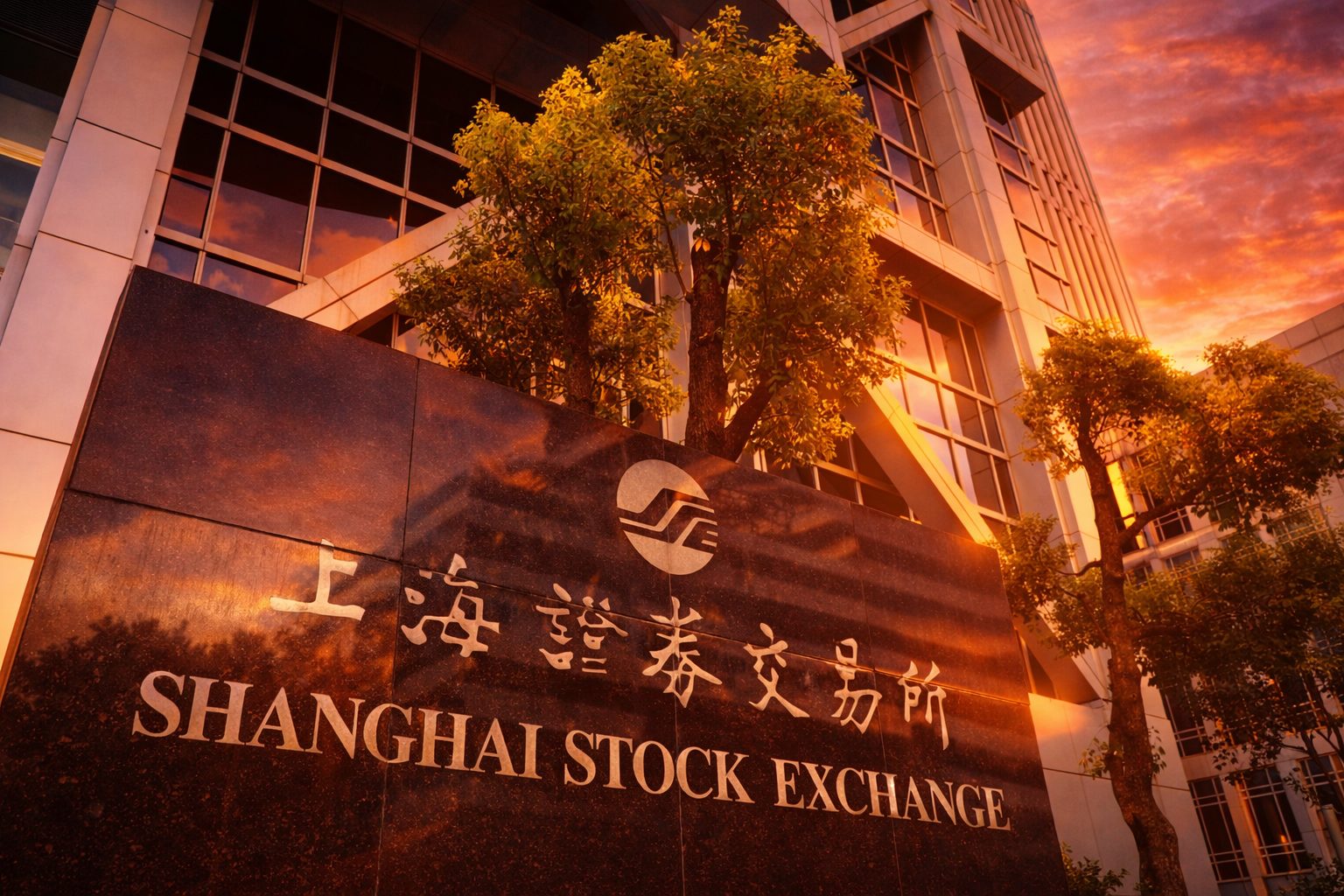
The Shanghai Stock Exchange (SSE) heads into the final full trading stretch of 2025 with two stories unfolding at once: a steadier, policy-sensitive main board and a turbo-charged STAR Market where “hard tech” listings—especially AI chipmakers—are setting the tone for risk appetite.
As of Sunday, Dec. 21 (when the mainland market is closed), the latest official close for the benchmark Shanghai Composite Index is Friday’s session, when it rose 0.36% to 3,890.45.
Shanghai Composite ends the week flat, with investors waiting for fresh signals
Friday’s uptick helped steady the market after choppy trading earlier in the week. Reuters’ market wrap described a cautious tone, noting that China’s blue-chip CSI300 and the Shanghai Composite both gained around 0.3% on Friday, but the week finished roughly flat as an earnings lull kept investors on the sidelines ahead of new policy cues.
That “flat but tense” finish is an increasingly familiar pattern for onshore China: the market has been supported by policy expectations and selective optimism around innovation, yet repeatedly tugged back by soft domestic demand and persistent property-sector stress.
Why sentiment cooled into late 2025, despite strong annual gains
A Dec. 21 Financial Times analysis (published the same day) described a broader cooling in Chinese equities over recent months: the MSCI China Index was down 7.4% since September, even as the index remained up 28.7% for the year—an arc the FT attributed to a mix of profit-taking and weak economic readings, alongside debate over whether policy support has been strong enough to decisively lift growth momentum.
For the Shanghai market, that backdrop matters because it shapes how investors price the “policy put”—the belief that Beijing will step in when volatility or growth concerns become too uncomfortable.
Macro reality check: weak November data and the property drag
The most market-moving domestic narrative in mid-December was a fresh set of weaker-than-hoped activity data. Reuters reported that China’s industrial output growth slowed to 4.8% year-on-year in November, while retail sales rose just 1.3%—their weakest pace since late 2022—highlighting how the property downturn and fading consumption support measures are weighing on confidence.
The same Reuters report noted that fixed-asset investment figures were dragged by property, with property investment down 15.9% in January–November, and warned that leaning on exports is getting harder as trade partners push back against China’s massive trade surplus.
Independent institutions remain cautious on the growth trajectory into 2026. In its December 2025 update, the World Bank estimated China’s growth at 4.9% in 2025 and projected 4.4% in 2026, citing subdued consumption, continued property adjustment, and only a modest boost from fiscal support.
For Shanghai-listed cyclicals and consumer names, the takeaway is straightforward: policy support can cushion the downside, but earnings recovery still needs households to feel less anxious—and for the property sector to stop being a slow-motion confidence drain.
Interest rates: steady now, easing expectations shift into early 2026
Monetary policy is central to the Shanghai Stock Exchange narrative because lower rates can support equity valuations and liquidity—yet China’s central bank is also balancing banking-system profitability and a still-manageable headline growth target.
A Reuters survey published Dec. 19 said all respondents expected China to keep the one-year and five-year Loan Prime Rates unchanged at 3.0% and 3.5%, respectively, marking a seventh straight month on hold. Reuters added that the PBOC had kept its seven-day reverse repo rate unchanged at 1.4%, and highlighted that banks are dealing with record-low net interest margins (reported at 1.42%), limiting appetite for immediate rate cuts.
What’s shifting is the timing of easing expectations. Reuters reported that some major institutions anticipate cuts in early 2026—citing forecasts such as Citi expecting easing as early as January 2026, while other analysts projected 10–20 basis points of cuts across 2026.
For the Shanghai Composite, the rate story is less about “one more hold” and more about whether 2026 becomes a year of incremental easing that supports valuations—without signaling that growth is slipping beyond policymakers’ comfort zone.
Beijing’s governance push: dividends, buybacks, and “market stabilization mechanisms”
A key policy theme heading into 2026 is capital-market “quality”—a mix of governance, returns to shareholders, and longer-horizon institutional behavior.
A China Daily report posted on the Shanghai Stock Exchange’s website said China’s securities regulator (CSRC) plans a new governance campaign aimed at fostering high-quality listed firms and guiding strong performers to increase dividend payouts and share buybacks. The same report said the CSRC pledged to implement long-cycle performance assessments for institutional investors and improve long-term market stabilization mechanisms, alongside other reform priorities.
This matters for the SSE because it targets one of the market’s historic weak spots: investor skepticism that listed companies will reliably translate growth into shareholder returns. A sustained shift toward dividends and buybacks—if it shows up in actual cash returns—can change how domestic and foreign investors value Shanghai’s big, cash-generative incumbents.
The STAR Market’s headline act: AI-chip IPOs and the return of “dream pricing”
If the main board is a policy-and-macro balancing act, Shanghai’s STAR Market has been the adrenaline channel.
Reuters reported that AI chipmaker MetaX Integrated Circuits surged in its Shanghai debut on Dec. 17, jumping as much as the market responded to Beijing’s push to reduce reliance on U.S. chip leaders; Reuters said MetaX opened far above its IPO price and ended the session up 693%, and that the share sale was heavily oversubscribed by retail investors.
Two weeks earlier, Reuters reported that Moore Threads—often dubbed “China’s Nvidia”—soared over 400% on its Shanghai debut, after raising about $1.1 billion in its IPO. In the same report, Reuters flagged the valuation gap inside Shanghai’s tech universe: the SSE STAR Chip index was trading at 118 times earnings, compared with about 12 times for the broader Shanghai Composite. Reuters+1
That spread captures the market’s current contradiction in one image-free sentence: Shanghai’s broad index looks inexpensive by global standards, while parts of STAR are priced for dramatic technological breakthroughs.
There is also a genuine fundamental growth thesis behind the froth. Reuters cited a Frost & Sullivan forecast projecting China’s AI chip sales to top $189 billion by 2029 (versus $54 billion in 2026), underscoring why policymakers and investors are aggressively funding domestic chip ecosystems.
IPO and fundraising: SSE’s 2025 scorecard and what it implies for 2026
Beyond individual debuts, the bigger structural question is whether Shanghai can keep financing innovation while maintaining market quality and investor confidence.
KPMG’s “Chinese Mainland and Hong Kong IPO Markets 2025 Review and 2026 Outlook” reported that A-share IPO fundraising reached RMB 163.7 billion in 2025 (up 23% versus 2024), with 130 completed IPOs. In KPMG’s breakdown, the Shanghai Stock Exchange accounted for RMB 67.2 billion raised (36 deals) and the STAR Market for RMB 34.6 billion (18 deals), and KPMG noted that the listing of 20 REITs was a significant driver. KPMG Assets+1
KPMG also described reforms to the STAR Market in July, noting that three pre-profit companies had listed on a new growth tier following those changes—an important signal that Shanghai is trying to widen the pipeline for earlier-stage tech firms while still managing disclosure and risk.
On outlook, KPMG said it expects the global IPO recovery trend to continue into 2026, and specifically pointed to AI-related listings as poised to accelerate as adoption broadens.
For the Shanghai Stock Exchange, the 2026 challenge is not simply “more IPOs.” It’s balancing three forces that often fight each other:
- Funding national-priority technology (which encourages risk-taking),
- Preventing speculative excess (which demands discipline), and
- Delivering durable returns for long-term investors (which requires governance and earnings).
Foreign confidence: selective return, mixed signals
Shanghai’s international story is improving, but not in a straight line.
In early December, Reuters reported that some strategists see the market at an early stage of foreign reallocation back into China, highlighting that the Shanghai Composite and Hong Kong’s Hang Seng were trading at roughly 12 times earnings in that period—far below U.S. multiples. The same Reuters report also described rotation inside China, with investors favoring cheaper cyclical and industrial areas while some tech-heavy exposures saw outflows.
At the same time, capital-flow signals remain complicated. Reuters reported on Dec. 19 that China’s foreign direct investment (FDI) total for January–November fell 7.5% year-on-year, even though November alone rose 26.1% from a year earlier—an illustration of why global investors still talk about “green shoots” and “structural caution” in the same breath. Reuters
What to watch next: the near-term catalysts for the Shanghai Stock Exchange
With the Shanghai Composite near the 3,900 level, investors are essentially asking whether the market ends 2025 in consolidation—or sets up for a new leg in 2026.
The next big swing factors are already on the calendar (or looming just off it):
Monetary policy timing
Reuters’ survey-based expectation of steady LPRs now, but potential easing in early 2026, means each policy signal will be parsed for whether cuts are “supportive” or “worrying.” Reuters
Follow-through from the governance and “stabilization” agenda
The CSRC’s push for better governance, dividends, and buybacks is only market-moving if it translates into measurable shareholder returns and credible enforcement across listed firms. Shanghai Stock Exchange
Economic data vs. policy ambition
Weak November activity data—and the ongoing property drag—keeps the burden on policymakers to show that consumption, confidence, and private investment can recover without constant emergency measures.
The STAR Market’s valuation discipline
Blockbuster debuts like MetaX and Moore Threads can keep liquidity flowing into “hard tech,” but they also raise the risk that a sharp re-pricing in high-multiple themes spills into broader sentiment. Reuters+1
Bottom line
On Dec. 21, 2025, the Shanghai Stock Exchange looks less like a single market and more like a two-speed system: the broad Shanghai Composite, supported by policy expectations and comparatively modest valuation; and the STAR Market, where national-tech priorities and IPO demand are driving bursts of speculative intensity.
Whether Shanghai’s 2026 story is “steady bull” or “stop-start chop” will likely hinge on three things working together: credible macro stabilization, visible shareholder-return improvements, and a controlled landing for the most exuberant corners of the tech trade. KPMG Assets+4Xinhua News+4Reuters+4