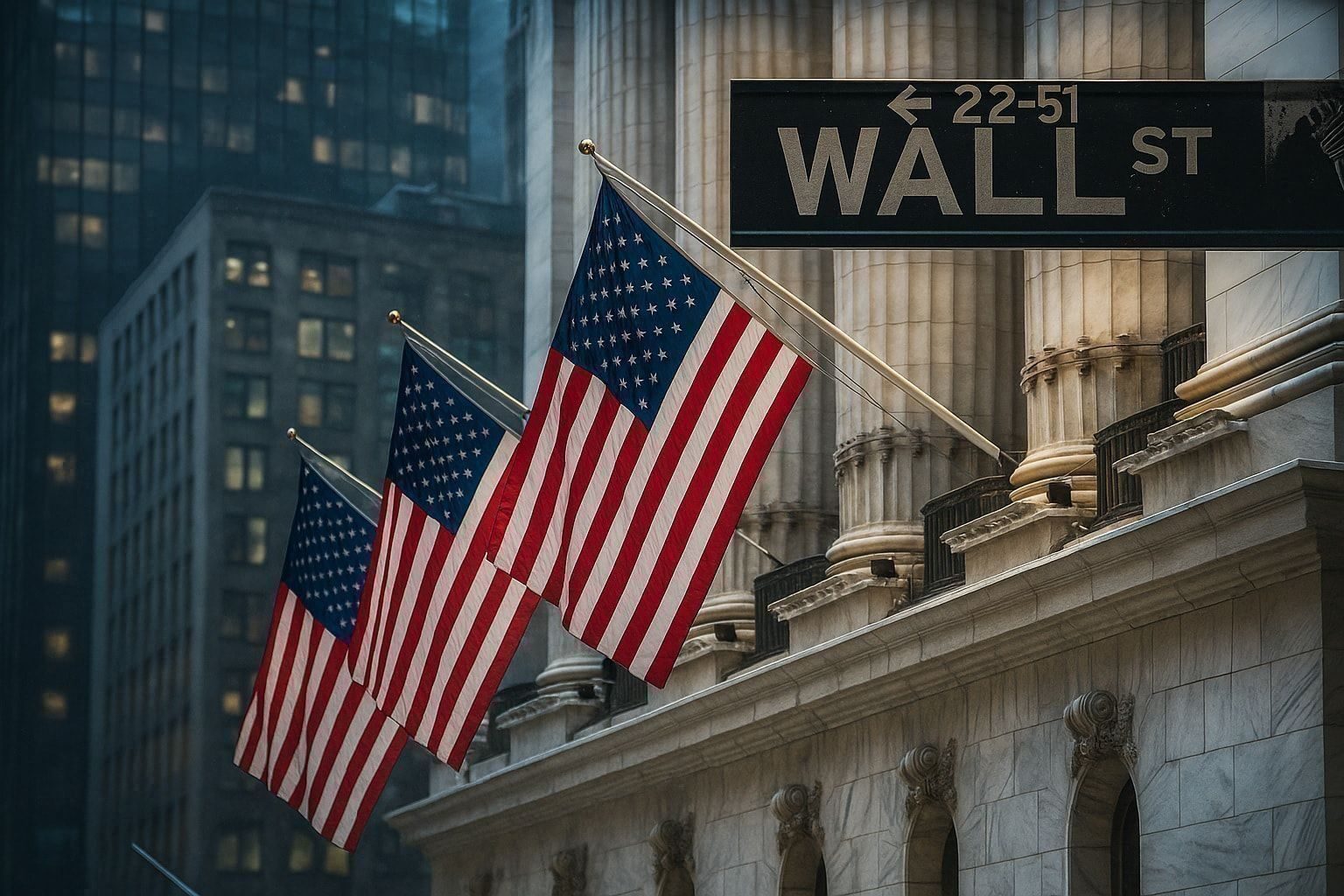
Wall Street heads into Christmas week with a familiar year-end setup—strong full‑year gains, a choppy December, and a market that can swing sharply when trading desks are half-staffed.
Stocks finished the last full trading week of 2025 with a late rebound powered by a renewed bid for AI-linked names. On Friday, Dec. 19, the S&P 500 rose 0.88% to 6,834.50, the Nasdaq Composite gained 1.31% to 23,307.62, and the Dow added 0.38% to 48,134.89.
The bigger story: investors are about to get a burst of long-delayed U.S. economic data—starting with a first look at third‑quarter GDP—at the same time the Federal Reserve is debating whether to pause after a run of rate cuts. Add in lingering “AI spend” skepticism and holiday‑thin liquidity, and the week ahead looks anything but sleepy. Schwab Brokerage+3Reuters+3Investopedia+3
Where the market stands heading into Christmas week
Even with December turbulence, 2025 has still been a solid year for U.S. equities. By the Dec. 19 close, year‑to‑date gains were roughly +16.2% for the S&P 500 and +20.7% for the Nasdaq, according to AP’s index recap.
But the path into year‑end has not been a straight line. Reuters describes two forces driving recent swings:
- Scrutiny of massive AI infrastructure spending (and when it turns into profits), and
- Rapidly shifting expectations for additional Fed rate cuts in 2026.
In other words: the market’s 2025 winners are still the market’s biggest drivers—but they’re also where investors are most nervous.
The Santa Claus rally is coming… but 2025 hasn’t played by the usual script
The “Santa Claus rally” is one of Wall Street’s most watched seasonal patterns. Reuters notes that, since 1950, the S&P 500 has risen an average 1.3% during the last five trading days of the year plus the first two trading days of January, using Stock Trader’s Almanac data. Reuters+1
Here’s the key timing detail for 2025: because Christmas falls midweek, that classic Santa‑rally window “technically” begins Wednesday, Dec. 24 and runs through Monday, Jan. 5, as both Reuters and Schwab’s weekly outlook highlight. Reuters+1
The catch: several strategists say the market doesn’t yet feel like it’s in a clean seasonal melt‑up. The Financial Times points to the drag from uncertainty around AI capex and volatility in mega‑cap tech, noting sharp drawdowns in some marquee names during the recent stretch (for example, FT cites Oracle down steeply since September and Nvidia off since November).
Schwab’s weekly outlook strikes a similar tone—seasonality may be bullish, but forecasting direction is difficult with mixed economic signals and low-liquidity holiday conditions.
The week’s main event: delayed Q3 GDP and a mini-flood of backlogged data
The biggest “week ahead” catalyst isn’t earnings—it’s data. A 43‑day federal government shutdown disrupted the normal flow of official releases, and markets are still working through the backlog. Reuters+1
What’s on the calendar (and why it matters)
Tuesday, Dec. 23 is the focal point:
- Q3 GDP (initial/advance estimate) — delayed from its original schedule and now arriving when investors are already positioning for 2026. Investopedia notes the delay means the BEA will publish fewer iterations than usual for the quarter.
- Durable goods orders (October) — another delayed report hitting the tape alongside GDP.
- Industrial production and capacity utilization (October/November) — a key read on manufacturing and utilization trends.
- Consumer confidence (December) — arriving on its regular schedule, offering a timely check on household sentiment into year‑end.
Wednesday, Dec. 24 brings:
- Weekly jobless claims — a market-moving release this year as investors watch for labor-market cooling.
Reuters’ Morning Bid podcast framed it bluntly: a backlog of indicators (GDP, confidence, jobless claims and more) lands right as markets are trying to “read” the economy into the holidays. Reuters
What analysts are forecasting for GDP
Kiplinger’s weekly economic calendar preview emphasizes that, even in a slow holiday week, all eyes are on Q3 GDP. It cites Kiplinger Letter economist David Payne, who expects Q3 growth around a “robust” ~3%, supported by consumer spending (including EV buying ahead of a tax credit end) and continuing AI-related business investment. kiplinger.com
That sets up a market-sensitive question: will GDP and confidence validate the “soft landing” narrative—or push Treasury yields higher and force traders to reconsider how many Fed cuts are realistic in 2026?
The Fed outlook: “pause” is back in play, and inflation data credibility is a live issue
If the market’s next move depends on data, the Fed’s next move depends on whether policymakers trust the data.
Hammack signals “steady for months” after the latest cuts
On Sunday, Dec. 21, Reuters reported that Cleveland Fed President Beth Hammack said she sees no need to change rates “for months,” pointing to lingering inflation concerns after the Fed’s cumulative 75 basis points of cuts over the past few meetings. Reuters says she would prefer holding the benchmark rate (currently 3.5%–3.75%) at least until spring to better judge inflation dynamics, including tariff-related effects working through the supply chain. Reuters
That matters for the week ahead because holiday trading often amplifies macro surprises. If GDP or consumer confidence comes in hot—and the Fed’s “pause” camp sounds louder—stocks can react quickly via higher yields and tighter financial conditions.
Why the inflation debate isn’t settled
Investors got some relief from November inflation readings, but multiple outlets have warned the government shutdown complicated the picture.
- Reuters noted that optimism around cooling inflation could be tempered by distortions tied to delayed data collection and holiday discounting timing.
- The Wall Street Journal similarly described the shutdown as a source of distortion and cautioned that headline numbers may understate underlying price pressures.
- Hammack explicitly argued the November CPI figure likely understated 12‑month price growth.
Bottom line: even if the next data prints look “Goldilocks,” the market may still debate whether they’re clean enough to anchor rate expectations.
AI stocks bounced—now the market wants proof, not just positioning
The final sessions of the week ended with a clear message: investors aren’t done with the AI trade, but they’re increasingly selective.
Reuters reported that mega-cap tech extended gains after Micron reignited optimism with strong forecasts. Micron hit a record closing high and finished the day up 7%, while Nvidia rose 3.9% amid a U.S. review involving one of its AI chips.
Oracle also jumped after news tied to TikTok’s U.S. operations and a group of investors including Oracle, adding another headline-driven tailwind to the tech tape.
Still, Reuters’ week-ahead analysis argues investors are increasingly focused on a tougher question: when does the AI infrastructure buildout generate durable returns? Reuters
The Financial Times echoed that concern, pointing to how capex fears and recent volatility have interrupted the usual year-end pattern.
Rotation watch: will leadership broaden into 2026?
One potential stabilizer—highlighted by Reuters—is that areas outside tech have been helping keep the market “range-bound,” including economically sensitive groups like transportation and financials, plus pockets of small caps that have performed better in December. Reuters
That rotation dynamic is important in a holiday week: if tech is quiet but “the rest of the market” holds up, Santa-rally seasonality can still work—even without a mega-cap melt-up.
Holiday trading mechanics: early close, thin liquidity, and why volatility can spike
The week ahead is shortened by Christmas, which can change market behavior as much as any economic report.
- Wednesday, Dec. 24: U.S. stock markets close early at 1:00 p.m. ET and bond markets at 2:00 p.m. ET.
- Thursday, Dec. 25: markets closed.
- Friday, Dec. 26: markets open for regular trading hours, per Kiplinger’s calendar.
Schwab also warns that volume is expected to be light, which can lead to outsized moves even on modest headlines.
And there’s an options-market footnote worth noting: Reuters highlighted that “triple witching” (the quarterly expiration of stock options, stock index futures and stock index options) can clear positioning, but may also leave markets more vulnerable to swings after the holiday as liquidity thins. Reuters
Three scenarios to watch for the US stock market next week
No one data point “decides” a holiday week—but the mix of GDP, confidence, and Fed messaging can shape how traders position into year‑end.
1) The bullish path: “soft landing” confirmed, Santa rally ignites
This scenario looks like:
- GDP and confidence come in supportive (strong, but not inflationary),
- Treasury yields stay contained,
- AI leaders stabilize while rotation remains healthy.
Strategists at Reuters pointed to the idea that recent data could still provide a “green light” for a Santa rally, even after a shaky December. Reuters
2) The base case: choppy, range-bound trade in thin markets
This is the most typical holiday setup:
- Data prints are mixed or debated (especially given shutdown-related distortions),
- Investors avoid big bets until January liquidity returns,
- Small moves feel bigger because volume is low.
3) The bearish risk: yields pop, the Fed “pause” narrative hardens
If GDP surprises to the upside (or inflation fears re-emerge), the market may reprice:
- fewer cuts in 2026,
- tighter financial conditions,
- renewed pressure on high‑duration tech and richly valued AI names.
Hammack’s comments underline that at least some policymakers are comfortable sitting tight for months—and are focused on inflation risks, including tariff pass-through.
What investors will be talking about by Friday
By the end of the week, the debate is likely to center on two questions:
- Did the backlogged data finally clarify the economy—or just add noise?
Reuters’ Morning Bid framed the week as a test of what the delayed indicators really “say” about growth and resilience. Reuters - Did the market get a true Santa rally start… or just a holiday head fake?
With the traditional Santa window beginning midweek, traders will be watching whether gains broaden and hold—or fade once the early close and thin liquidity hit.
One thing is clear heading into Dec. 22: the week is shorter, but the list of potential catalysts isn’t—and in holiday conditions, it doesn’t take much to move the tape.