
DroneShield Limited ASX:DRO is back in the spotlight on Monday, December 22, 2025, after the company’s board moved to tighten executive alignment with shareholders—an issue that has hung over the stock since the highly publicised insider selling and disclosure controversy in November.
In early trade, DroneShield shares rose as much as ~9% to around A$3.03, hitting a more-than-one-month high after news that the company will require directors and senior management (including the CEO) to maintain minimum shareholdings.
The market reaction matters because DroneShield has been living two lives in 2025:
- Operational momentum (contract wins and rapid growth narratives), and
- A trust overhang (governance optics, communication errors, and leadership questions).
What follows is a detailed, publication-ready rundown of today’s key developments, the latest forecasts and analyst targets visible as of 22.12.2025, and the practical “watch list” that will likely shape where DroneShield stock goes next.
What changed today: DroneShield’s minimum shareholding policy and governance review update
The headline catalyst is a new mandatory minimum shareholding policy for the board and senior leadership—an explicit attempt to rebuild confidence after investors reacted badly to earlier director share sales.
Key points reported today include:
- Directors will be expected to hold DroneShield shares equivalent to their annual base fee within three years of the policy being established.
- CEO Oleg Vornik will be required to hold shares worth 200% (two times) his annual salary, with an expectation to meet that threshold within 12 months.
- The company signalled updates to governance plumbing such as its securities trading policy (to align with expectations of an ASX 200-style governance regime).
- DroneShield also flagged a broader governance overhaul: plans to appoint an additional independent non-executive director within the next 12 months, and continued work on improving how ASX announcements are verified.
- Today’s reporting also notes that independent directors Simone Haslinger and Richard Joffe oversaw review work engaging legal firm Herbert Smith Freehills Kramer.
Separately, Reuters reporting indicates DroneShield will review director and executive pay, and expects to provide an update in the remuneration report in February 2026.
The market’s message here is pretty blunt: for a defence-tech stock selling “trust and reliability” as much as hardware and software, governance isn’t a side quest—it’s part of the product.
Why the market cares: the November sell-down and the “trust gap”
To understand why a shareholding policy can move the price meaningfully, you have to rewind to what shook investors.
In late November, Reuters detailed how DroneShield shares were hit amid concerns tied to:
- A$70 million in share sales by senior insiders over a short period,
- a contract disclosure error (misclassification of an existing order as new),
- and the abrupt exit of its U.S. head—all of which amplified governance concerns and prompted calls for tighter transparency.
Reuters also described the volatility whiplash: the stock had surged sharply earlier in 2025 on contract wins and results, then suffered a steep drawdown from its October peak as confidence cracked and short interest rose.
That context matters because today’s governance changes are, effectively, DroneShield trying to close the loop: “We heard you; here are structural rules so this doesn’t happen again.”
The fundamentals haven’t gone away: the A$49.6m European military contract and Q1 2026 delivery timeline
While governance is grabbing headlines, DroneShield still trades like a growth stock: contracts and delivery cadence are the oxygen.
The most concrete near-term commercial datapoint remains DroneShield’s A$49.6 million contract (announced mid-December) for an in-region European reseller supplying a European military end-customer. The order covers handheld counter-drone systems, accessories, and software updates.
Two details investors are likely to fixate on heading into 2026:
- DroneShield says a significant portion is already on-the-shelf, reducing execution risk versus a long, custom build cycle.
- DroneShield expects deliveries and cash payments to be completed in Q1 2026.
Put simply: the market doesn’t have to wait a year to test whether “contract win” turns into “cash in bank.” Q1 2026 is close enough to matter.
What DroneShield actually sells (and why the sector stays hot)
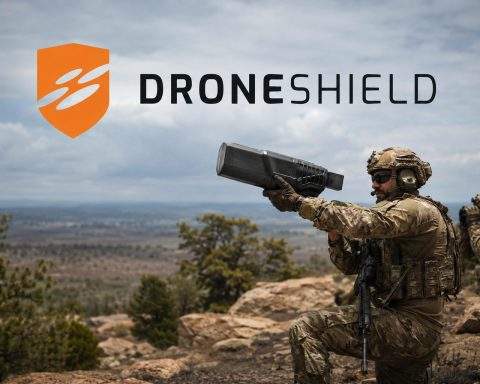
DroneShield positions itself as a counter-UAS (counter-drone) specialist built around RF sensing, AI / machine learning, sensor fusion, and electronic warfare, selling solutions to military and critical infrastructure customers.
One important, easily overlooked commercial constraint is right there in the company’s own disclaimer language: certain “disruption capable” products are not authorised for sale/lease/use in the United States except to the U.S. government and properly delegated representatives (and subject to law). DroneShield
That matters for investors because it shapes both:
- total addressable market in practice (not just in PowerPoints), and
- the channel strategy (government procurement cycles versus open commercial distribution).
DroneShield stock forecasts as of 22.12.2025: analyst targets cluster around A$4.40–A$5.00, but not everyone agrees
Forecasts for DroneShield remain unusually spread out for a stock of this profile—partly because 2025’s volatility forces analysts to choose how much weight to put on growth momentum versus governance risk.
Consensus-style targets (A$4.70 average, “buy”-leaning)
MarketScreener data (citing major market-data providers) shows a mean target price of ~A$4.70 with two analysts, versus a last close around A$2.78, implying meaningful upside if execution stays on track.
Investing.com’s DroneShield page echoes a similar range: high ~A$5.00, low ~A$4.40, and an average around A$4.70.
Bell Potter: still constructive, but targets have moved with volatility
Australian retail-facing coverage citing Bell Potter research suggests:
- a Buy stance with a trimmed target around A$4.40 (reported Dec 18), The Motley Fool Australia
and also a separate piece discussing a A$5.30 target in the context of a “double in 2026” style scenario (reported Dec 14). The Motley Fool Australia
Those two targets can both be “true” in context: brokers adjust targets as assumptions change (risk premium, growth runway, margins, delivery confidence), and DroneShield’s 2025 price swings have been dramatic enough to force frequent recalibration.
More cautious framing: Hold ratings and lower targets exist
TipRanks’ newswire summary around late November referenced a Hold view with a A$2.50 price target as the most recent rating cited there—showing that governance risk can meaningfully compress valuation models.
Bottom line: the bullish case says, “big contracts are arriving and could normalise,” while the cautious case says, “even a great product can be kneecapped by credibility problems.”
What to watch next: the catalyst checklist into Q1 2026
If you’re tracking DroneShield stock from here, the next few months have unusually “binary” milestones—events likely to either validate the turnaround narrative or reopen doubts.
- Q1 2026 deliveries and cash receipts tied to the A$49.6m European contract.
- Governance follow-through, including:
- updates to trading/disclosure practices, Capital Brief+1
- progress toward adding an additional independent director within 12 months, Capital Brief+1
- and the promised remuneration framework update expected around February 2026.
- Quality of future contract announcements: after prior corrections and controversy, investors will likely judge DroneShield less on the headline number and more on clarity—what’s truly “new,” what’s “repeat,” what’s through a reseller, and what delivery/payment terms look like. Reuters+1
The key risks investors keep circling
Even with today’s share price bounce, the “risk list” hasn’t disappeared—DroneShield is trying to outrun it.
- Governance risk (ongoing): once investors start discounting management credibility, rebuilding trust takes time and consistent behaviour, not just policy PDFs.
- Contract lumpiness: defence procurement is famously non-linear—big wins can cluster, and quiet periods can be brutal for sentiment. (Today’s price action itself is evidence of how headline-driven the stock can be.
- Regulatory and market-access limits: DroneShield’s own disclosures note U.S. restrictions around certain disruption-capable products outside authorised government channels.
- Crowded and evolving threat environment: counter-drone is a fast-moving domain; what worked last quarter may need reinvention next quarter (hardware, software, electronic warfare techniques, and the cat-and-mouse of drones versus countermeasures).
Where this leaves DroneShield ASX:DRO on 22.12.2025
Today’s news doesn’t magically erase the past—DroneShield’s board is implicitly admitting that the market demanded stronger guardrails, and it’s now delivering them.
At the same time, the company still has a clean, near-term operational test: deliver and collect cash in Q1 2026 on a A$49.6m European military-linked contract.
That combination—governance repair + near-dated commercial delivery—is why DroneShield stock is moving again. In the end, this story is going to be decided less by slogans (“defence tech darling” vs “governance mess”) and more by boring, beautiful proof: accurate disclosures, repeatable execution, and cash conversion.