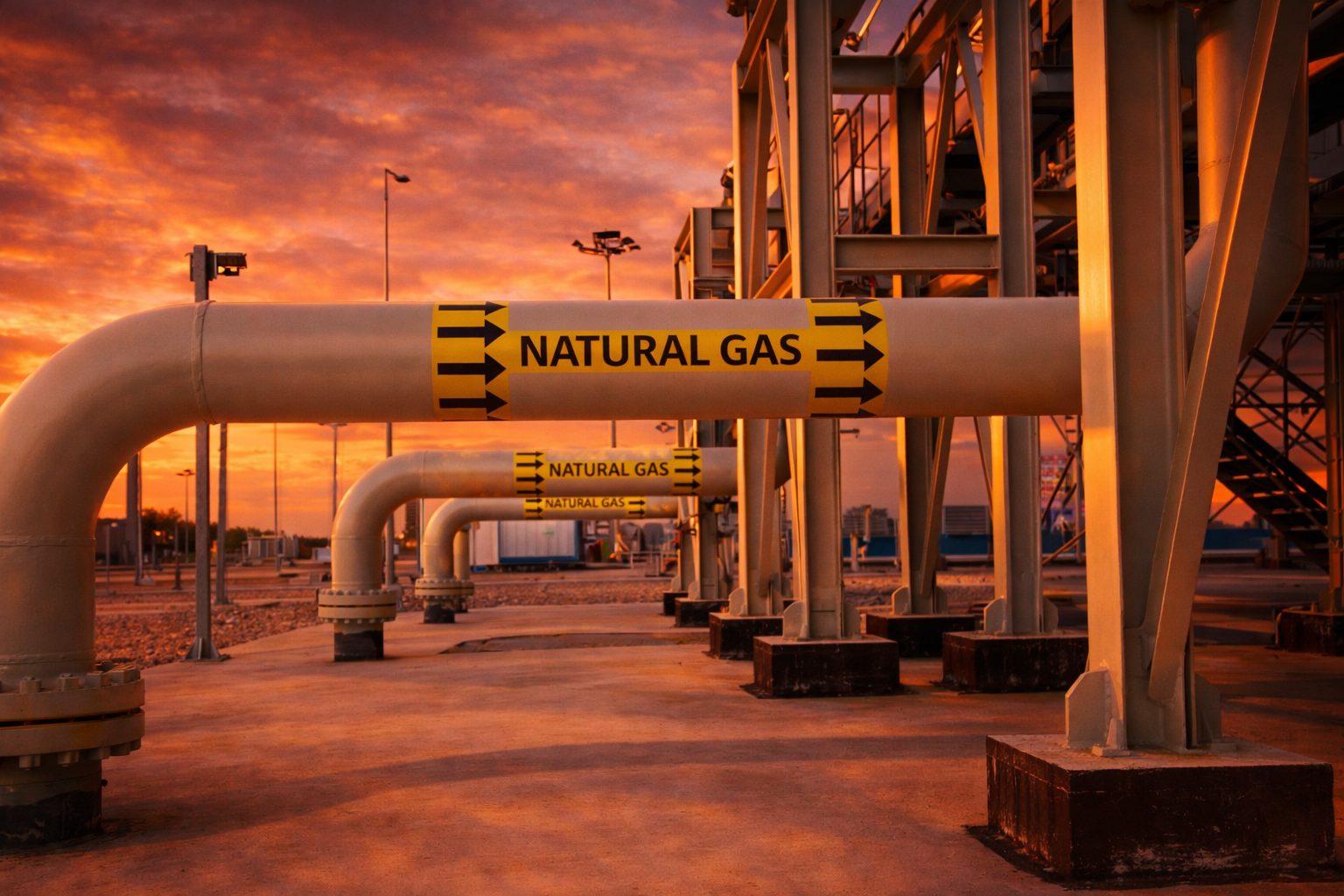

December 22, 2025 — Natural gas markets are closing in on the end of the year with a familiar tug-of-war: weather-driven demand versus record-level supply, all while LNG (liquefied natural gas) export flows keep the global market tightly connected.
In the U.S., benchmark natural gas futures traded around the $4 per MMBtu level on Monday, with traders weighing milder temperature forecasts against near-record production and still-busy LNG terminals. Overseas, Europe’s benchmark gas pricing remains subdued around the high-€20s per megawatt-hour. Meanwhile, one of the day’s biggest policy headlines came from Australia, where the government announced a new plan to force LNG exporters to reserve a slice of gas for domestic use in a bid to lower local prices.
Natural gas prices today: where the market stands
U.S. natural gas futures were indicated around 4.11 (previous close near 3.98), keeping prices elevated versus much of 2024 but off the sharpest highs seen earlier in December. Daily trading ranges remained relatively tight, reflecting a market that is still volatile—but no longer in “panic winter” mode. Investing.com
That price level matters because it sits near the psychological line where producers, power generators, industrial buyers, and LNG exporters all start recalculating behavior—especially heading into a holiday-shortened period when liquidity can thin out and forecasts can swing prices quickly.
The big driver: weather forecasts are softening demand expectations
For natural gas, weather is the master switch—especially in winter. Updated forecasts calling for warmer-than-normal conditions into early January have reduced expectations for heating demand, pulling the market away from “tight balance” fears. TradingView
LSEG projections cited in market reporting show average U.S. gas demand (including exports) easing from roughly 144.6 Bcf/d in the near term to about 127.5 Bcf/d over the next two weeks—an unusually large step down that helps explain why rallies have struggled to accelerate.
Supply remains heavy: U.S. production is still near record levels
On the supply side, the U.S. continues to pump gas at extraordinary rates. Lower-48 output has been holding around 109.6 Bcf/d in December, matching November’s record monthly levels in widely cited tracking estimates.
High output doesn’t automatically crush prices—winter can absorb a lot of molecules—but it raises the bar for any sustained rally. The market typically needs either (1) sustained colder-than-normal forecasts, (2) a major freeze-off or production disruption, or (3) a material jump in LNG feedgas demand to overpower supply at these levels.
LNG exports are still the market’s “floor,” even when weather turns mild
The most important structural shift in gas markets over the last several years is that U.S. natural gas is no longer mainly a domestic story. LNG export capacity has effectively wired Henry Hub into global pricing.
This month, average gas flows to major U.S. LNG export plants have been running around 18.5 Bcf/d, above November’s record monthly average, according to widely cited flow estimates. That export pull has been a major source of support—even as domestic demand expectations soften.
The U.S. Energy Information Administration’s latest weekly update also underscored the sheer scale of export activity: 33 LNG vessels departed U.S. ports in the week ending December 17, with a combined capacity of about 126 Bcf. The same update noted an LNG tanker arriving at Golden Pass as the terminal’s initial cool-down cargo—a commissioning milestone that signals the next wave of U.S. LNG capacity is moving closer to operations.
Corporate signal: one LNG project hits pause as economics tighten
Not every LNG project is racing ahead. Energy Transfer said it is suspending development of its Lake Charles LNG export project in Louisiana, citing factors including cost pressures and a shifting risk/reward preference toward pipeline investments. The move stands out because it signals that, even in a world hungry for flexible gas, LNG project economics are becoming more selective as global supply grows.
Storage check: inventories look “comfortable,” not overflowing
U.S. storage is often the reality check that keeps weather narratives honest.
The EIA reported net withdrawals of 167 Bcf for the week ending December 12, leaving working gas stocks at 3,579 Bcf. Inventories were described as slightly above the five-year average and below last year’s level at the same time—tight enough to keep winter risk on the radar, but not tight enough to force sustained panic buying.
Also notable: the EIA’s weekly update pointed out the next Natural Gas Weekly Update publication schedule around the holidays (no releases on Dec. 25 or Jan. 1, with the next release on Jan. 8, 2026). That matters because fewer “official” datapoints during holiday weeks can push traders to lean even more heavily on private weather and flow models—sometimes amplifying short-term moves. U.S. Energy Information Administration
Europe: prices stay subdued, reinforcing the “well-supplied” narrative
Europe’s benchmark natural gas pricing remains relatively low compared with the peaks of the 2022–2023 crisis era. On December 22, the Dutch TTF benchmark was indicated around €27.86/MWh, continuing a broader downtrend seen through parts of December.
A key reason is that global LNG availability has been strong, and Europe has been able to attract cargoes without dramatically outbidding Asia. Earlier reporting this month highlighted how surging U.S. LNG flows and softer demand dynamics have contributed to Europe’s price declines—even when winter weather is present.
The EIA’s weekly update adds another lens: it cited weekly average front-month pricing around $9–$10/MMBtu for both Europe (TTF) and Northeast Asia LNG benchmarks during the mid-December reporting window—numbers that are far less extreme than the levels that once triggered widespread industrial curtailment.
Asia LNG: weaker demand keeps spot prices pressured
Asia’s spot LNG market has also been soft, with Reuters-reported pricing for February delivery into Northeast Asia around $9.50/MMBtu, described as the lowest since April 2024. Analysts pointed to muted regional demand and ample supply conditions, with weather again playing a key role.
This matters for U.S. gas because the global arbitrage (the incentive to ship LNG to one region versus another) influences LNG netbacks—ultimately affecting how hard U.S. terminals pull on domestic feedgas.
Major policy headline: Australia moves toward an east-coast gas reservation scheme
One of the most consequential natural gas headlines on 22.12.2025 came out of Australia.
The Australian government announced a new “gas reservation” approach aimed at lowering domestic energy costs by requiring major LNG exporters to set aside roughly 15–25% of production for Australian use beginning in 2027 (with figures discussed up to ~350 petajoules annually). The policy is designed to address forecast domestic supply shortfalls and reduce local price pressure—particularly on the east coast—by ensuring a baseline of gas remains available at home rather than being fully exposed to export-linked pricing. The Guardian+1
The announcement triggered an immediate debate that is likely to run for months:
- Supporters argue it improves energy security and bargaining power for households and manufacturers in a country that is a top LNG exporter but has faced domestic price spikes.
- Critics warn it could deter investment or distort markets if not structured carefully, especially if exporters perceive rising sovereign-risk-like policy uncertainty.
Either way, it’s a reminder that gas markets are not just meteorology and molecules—they’re also politics and industrial strategy.
What to watch next in natural gas markets
Heading into the final stretch of 2025, several near-term catalysts could move prices quickly:
- Weather model shifts: a colder turn in early January forecasts can reprice the curve fast.
- LNG feedgas variability: any operational issues at major terminals—or new commissioning milestones like Golden Pass—can change demand for U.S. gas meaningfully.
- Storage reports: withdrawals that deviate sharply from expectations tend to produce outsized moves, especially when trading volumes thin around holidays.
- Policy follow-through in Australia: details and enforcement mechanisms will matter as much as the headline percentage.
- Global LNG pricing signals: if Asia rebounds or Europe tightens, the direction of cargo flows can shift—and Henry Hub often feels it.
Bottom line
Natural gas today is a market balancing act: milder weather forecasts and record production are bearish forces, but LNG exports and steady storage fundamentals provide a persistent underpinning near the $4 level in U.S. futures. Globally, Europe’s relatively soft prices and Asia’s subdued spot LNG demand reinforce the view that supply is currently adequate—yet winter volatility always leaves room for surprises.
And beyond the trading screens, Australia’s new gas reservation plan shows how governments are increasingly willing to intervene in gas markets when domestic affordability and supply security collide with the economics of being a major LNG exporter.
Related articles: NYSE:LNG