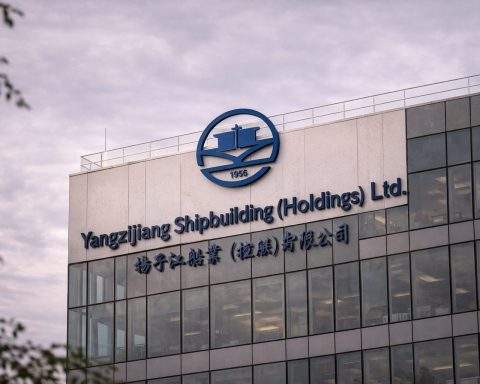

SINGAPORE, Dec. 23, 2025 — Yangzijiang Shipbuilding (Holdings) Ltd’s shares were trading around S$3.45 in afternoon trade on Tuesday, down about 0.29% on the session, after a strong jump the prior day. The stock’s intra-day range has been tight — roughly S$3.45 to S$3.48 — with a few million shares changing hands by mid-day.
That calm tape hides a louder debate underneath: whether Yangzijiang’s multi-year, green-leaning orderbook can keep compounding earnings into 2026, or whether escalating U.S.-China maritime trade pressure eventually crimps demand and pricing power for Chinese yards.
Below is a roundup of the latest company updates, market drivers, and analyst forecasts available as of 23.12.2025, in plain English.
Yangzijiang Shipbuilding share price today: what the market is saying
As of Dec. 23, the Singapore-listed counter BS6 (also traded in RMB as SO7) is hovering near S$3.45, after closing S$3.46 on Dec. 22 (a +2.67% day).
For investors who think in “range and regime,” the recent context matters:
- The stock’s 52-week range is about S$1.80 to S$3.58, placing it much closer to highs than lows.
- Some market screeners today even bucket it among “lower-priced” Asian stocks despite its much larger scale (a reminder that labels like “penny stock” often reflect price, not business size). Yahoo Finance
- Market cap estimates around late Dec. 2025 put it in the low-teens billions of SGD, with valuation metrics (like P/E) that screens often describe as single-digit to low-double-digit depending on methodology and earnings basis.
Technical posture (Dec. 23): Investing.com’s daily technical dashboard tagged the stock as “Strong Buy,” with RSI around the mid-50s (often interpreted as “neutral momentum,” not overbought). Investing.com
The fundamental bull case: a US$22.8b orderbook and “green” vessel mix
Yangzijiang’s core story is still the same: shipbuilding is a long-cycle, backlog-driven business, and backlog is the oxygen.
In its latest business update (data as of 17 Nov 2025), the company reported:
- Outstanding orderbook: about US$22.8b (company snapshot) / US$22.83b (orderbook breakdown slide), spanning 2025–2030 deliveries SGX Links+2SGX Links+2
- Orderbook size:245 vessels SGX Links
- “Green” share:~71% of orderbook value is tied to green vessels, with containerships the dominant category by value SGX Links
- Order momentum: year-to-date order wins of US$2.17b, versus US$0.54b in 1H2025 (a sharp pickup in the second half) SGX Links+1
- Deliveries:46 vessels delivered year-to-date, about 82% of the full-year delivery plan DBS Bank+1
DBS, in a research note following the 3QFY25 update, framed it similarly: order momentum rebounded, deliveries were on track, and the orderbook — even if slightly off a quarterly peak — remained historically elevated and supportive of multi-year revenue visibility.
Why the orderbook mix matters in 2025
The orderbook breakdown highlights where Yangzijiang’s backlog is concentrated:
- Containerships:126 vessels, about US$16.21b total value
- Oil tankers:47 vessels, about US$2.40b
- Gas carriers (LEG/LPG/VLAC/VLEC):26 vessels, about US$2.36b
- Bulk carriers:46 vessels, about US$1.86b SGX Links
Translation: the market is not valuing “shipbuilding in general.” It’s valuing Yangzijiang’s particular exposure — especially to large and mid-size containership newbuilds and a meaningful slice of gas/alternative-fuel capacity.
Management’s tone: “lead times close to five years,” focus on 2029 slots
In the same update, Executive Chairman and CEO Ren Letian pointed to improving customer sentiment and a modest recovery in orders, but also emphasized how constrained the industry remains — order backlogs at historical highs and lead times stretching close to five years for large vessels at top-tier yards.
The company’s near-term operational priority is less flashy but crucial: execute the existing orderbook on time and with quality, while filling remaining 2029 delivery slots (primarily small to mid-sized vessels).
That execution focus matters because, in shipbuilding, backlog only becomes earnings if it turns into delivered hulls without margin leakage (delays, cost overruns, or contract renegotiations).
The macro “risk cloud”: U.S. port fees and pressure on China-built ships
The big external variable hanging over the sector is policy: the U.S. has been exploring measures (including port fees) aimed at challenging China’s maritime dominance.
Reuters reported earlier this year that ship orders stayed strong despite U.S. port fee proposals, noting the resilience of contracting activity even as policy uncertainty rose. Reuters
The Financial Times, meanwhile, has covered how proposed port fees could weaken the dominance of Chinese shipyards by shifting incentives for shipowners over time.
In plain terms: investors are trying to price two competing truths at once:
- Shipyard slots are scarce globally, and fleet renewal plus emissions rules keep demand alive.
- Geopolitical friction can reroute demand — not overnight, but enough to affect margins, contract flow, and investor sentiment.
HSBC’s view (as cited in maritime outlet gCaptain) leaned constructive: it maintained a “Buy” and raised its target price to S$3.80 (from S$3.30), arguing for margin expansion driven by execution of higher-quality orders, muted steel price movement, and efficiency gains — while acknowledging the trade headwinds. gCaptain
Contract cancellations and sanctions headlines: what investors should know
One reason Yangzijiang’s risk premium occasionally flares is that shipbuilding contracts sit at the intersection of global finance, compliance, and sanctions.
In 2025, the company terminated shipbuilding contracts for an aggregate of four 50,000 DWT MR oil tankers (as referenced in its business update).
Riviera (a maritime trade publication) reported additional details around tanker contract terminations tied to U.S. sanctions allegations and legal considerations. The report said Yangzijiang indicated:
- No revenue or profit had been recognized from the contracts up to 30 June 2025
- The company had received a 10% deposit at signing, plus an additional 10% instalment for one vessel where construction had begun
- Yangzijiang did not expect a material impact on net tangible assets or EPS for FY2025 Riviera Maritime Media
Whether investors treat that as “contained” or “concerning” depends on their tolerance for headline risk — but the key analytical point is this: compliance and counterparty risk can be financially small yet sentimentally large.
Analyst forecasts as of Dec. 23, 2025: “Strong Buy,” but watch the range
Across major forecast aggregators, the consensus tone remains upbeat — though not unanimous, and not perfectly aligned across platforms.
Investing.com (11 analysts):
- Consensus rating: “Strong Buy”
- 10 buy, 1 sell, 0 hold
- Average 12‑month target: ~S$3.79
- High: ~S$4.51
- Low: ~S$1.59 Investing.com
TipRanks (5 analysts, past ~3 months):
- Consensus: Strong Buy (5 buy, 0 hold, 0 sell)
- Average target: S$3.98
- High: S$4.51
- Low: S$3.80 TipRanks
Broker target moves flagged on MarketScreener (Nov. 19 notes):
- UOB Kay Hian: target raised to S$4.10 (from S$3.90)
- CGS International: target raised to S$4.51 (from S$3.90), rating “Add” MarketScreener Saudi Arabia
The headline takeaway: with the stock around S$3.45 on Dec. 23, much of the street’s target set implies high-single-digit to mid‑teens upside — but the dispersion (especially the low-end estimates) signals that analysts still disagree on cycle risk and policy risk.
What counts as “current news” on Dec. 23: filings are quiet, the narrative isn’t
As of today, the most recent widely-circulated company announcement captured on major SGX-tracking feeds remains the Nov. 17 business update, meaning there’s no fresh filing driving today’s trade — it’s more about investors repositioning into year-end on the back of backlog strength, broker upgrades, and sector policy headlines.
That’s a common pattern for shipbuilders: earnings cadence + contract wins + macro shocks tend to matter more than daily newsflow.
What to watch next: earnings timing and the “order wins vs. slots” puzzle
A few near-term markers are on investors’ calendars:
- FY2025 / Q4 2025 earnings are tracked by market calendars for early March 2026 (projected).
- Order wins and pricing for 2027–2029 delivery windows — because Yangzijiang itself is signaling it is working to fill remaining 2029 slots, which effectively sets the next leg of revenue visibility.
- Any evolution of U.S. trade measures that changes shipowner behavior (even indirectly), especially for containership ordering patterns.
Bottom line
On Dec. 23, 2025, Yangzijiang Shipbuilding stock is being priced like a company with real operating momentum — a large, long-dated orderbook, a heavy “green” vessel tilt, and analyst optimism that margins can continue to expand as higher-quality orders roll through the income statement. SGX Links+2DBS Bank+2
But it’s also being priced like a company that operates in the blast radius of geopolitics: U.S.-China maritime policy, sanctions and compliance noise, and the always-lurking shipbuilding cycle can all compress multiples even when the yards are full.
Related articles: SGX:BS6