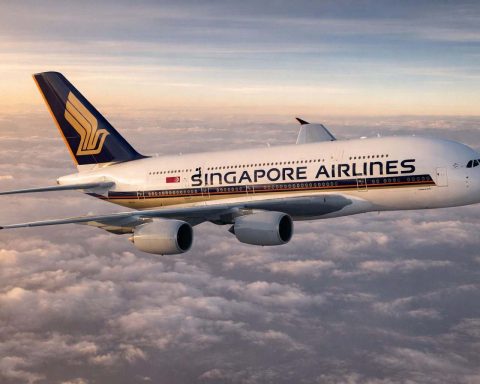
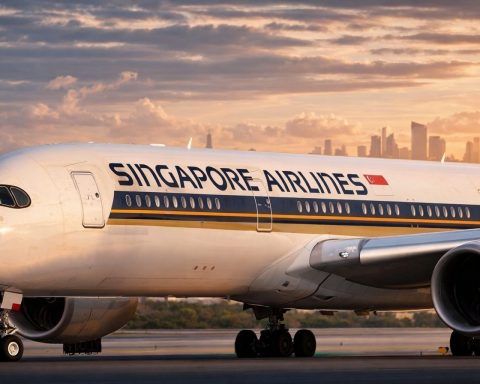
Singapore Airlines Ltd (Singapore Airlines / “SIA”, SGX: C6L) is back in the spotlight on Tuesday, December 23, 2025—not because of a flashy headline about a new route or aircraft order, but because this is the day shareholders receive a cash dividend payout that has become central to the current SIA stock narrative: strong travel demand and high load factors on one hand, but softer profitability and intensifying competition on the other.
SIA shares were trading around S$6.35 on Dec 23, with a day range of S$6.31–S$6.36 and a 52-week range of S$5.90–S$7.63, according to Investing.com’s market data snapshot for the session.
Below is what’s current as of 23.12.2025 across news, forecasts, and analyst analysis, and how investors are framing the next few quarters.
Singapore Airlines stock today: why Dec 23 matters
The simple version: cash hits accounts.
SIA’s investor relations dividend page lists two payments dated 23 December 2025 for 1H FY2025/26:
- Interim dividend: 5 Singapore cents per share
- Interim special dividend: 3 Singapore cents per share
- Ex-date: 5 December 2025 (for both)
- Payment date: 23 December 2025 (for both) singaporeair.com
That makes 8 cents per share paid for the first half—material enough that the dividend is now part of how the market “anchors” SIA’s valuation discussion.
Dividend recap: the special dividend plan is bigger than one payout
Dec 23 is not just an interim dividend moment; it’s also the first visible step in a larger capital return plan.
In its Nov 13 results communication, SIA said it proposes a capital return plan built around a special dividend package of 10 cents per share annually over three financial years, and confirmed the interim 5-cent dividend plus 3-cent interim special dividend would be paid on 23 December 2025.
Reuters added a key scale point: the special dividend plan totals about S$900 million, structured as 10 cents per share per year (subject to shareholder approval for future tranches).
Why investors care: dividend visibility can support a share price even when earnings momentum cools—but only as long as the underlying cash-generation story stays credible.
The latest operating update: November traffic shows demand (still) has teeth
SIA’s most recent monthly datapoint (a favorite among airline investors because it’s frequent and operationally “clean”) is its November 2025 operating results, released mid-December.
Highlights from the company’s November operating statistics:
- Group passenger traffic (RPK) +2.6% year-on-year, versus capacity (ASK) +2.2%
- Group passenger load factor: 87.3% (up 0.3 percentage points year-on-year)
- Passengers carried: 3.5 million (up 6.0% year-on-year, combined SIA + Scoot)
- Cargo and mail carried: +12.4% year-on-year
- Cargo load factor: 60.2% (up 3.6 percentage points) singaporeair.com
Two important subtexts buried in those clean numbers:
- Scoot continues to matter. The operating update explicitly separates load factor performance for SIA and Scoot, reinforcing that the group’s low-cost arm is not just “extra,” it’s part of the utilization engine. singaporeair.com
- Cargo improved on year-end peak demand, but the company also signals uncertainty around cargo yield conditions elsewhere in its reporting (more on that below).
Earnings backdrop: why SIA’s profit fell even with strong demand
If you’re wondering why investors can look at 87%+ load factors and still argue about downside risk, the answer sits in SIA’s latest half-year earnings picture.
For the half-year ended 30 September 2025, Reuters reported:
- Half-year net profit fell to S$239 million (from S$742 million a year earlier)
- Revenue rose 1.9% to a first-half record of S$9.68 billion
- The share of results from associated companies plunged S$417 million, largely due to Air India’s losses
- Reuters also pointed to rising non-fuel expenses, and noted competition squeezed yields Reuters
SIA’s own results release aligns with that “operationally solid, financially pressured” framing:
- Operating profit: S$803 million
- Net profit: S$239 million
- It flags share of losses from Air India and lower interest income as drags
- It states passenger yields declined 2.9% (competition is doing what competition does)
- It describes cargo as uncertain, with yields under pressure even where volumes grow singaporeair.com
This is the current tension in SIA stock in one sentence: the planes are full, but the unit economics are normalizing.
Air India exposure: the associate that keeps showing up in the footnotes (and the stock debate)
SIA’s stake in Air India has become a recurring factor in analyst notes and news coverage.
Reuters noted SIA has a 25.1% stake in Air India and began accounting for Air India’s earnings in December 2024 after the Vistara integration, which helps explain why associate contributions can swing sharply year-on-year.
Separately, Reuters reported that Air India sought at least 100 billion rupees (about US$1.14 billion) in financial support from owners Tata Sons and Singapore Airlines, according to a Bloomberg report cited by Reuters. Reuters also reported SIA said it was continuing to support Air India’s transformation program.
For SIA stockholders, the question is less “Is Air India strategically valuable?” (many agree it can be) and more: How long does the earnings drag last, and does it require additional capital?
Analyst forecast and target prices: the consensus picture on Dec 23, 2025
Consensus data sources used by investors are painting a notably cautious view right now.
What the consensus says
MarketScreener’s consensus page for Singapore Airlines (C6L) shows:
- Analyst consensus: “Sell / Underperform”
- Number of analysts: 14
- Average target price: ~S$6.169
- High target: S$7.00
- Low target: S$5.25
- With the stock around the S$6.33–S$6.35 area, that average target implies modest downside on the consensus midpoint MarketScreener
Investing.com shows a similar set of figures and explicitly breaks out the rating mix as:
- 0 Buy, 6 Hold, 8 Sell
- Average 12-month target: 6.17
- Current trading snapshot on Dec 23: S$6.35, previous close S$6.33 Investing.com+1
What it means (without pretending it’s destiny)
Consensus targets are not prophecies; they are a crowd-sourced model output—and airline models are famously sensitive to variables like yields, jet fuel, FX, and capacity behavior. Still, a “Sell” consensus while a company is paying a meaningful dividend is a signal that analysts see earnings pressure and risk factors dominating the near-term narrative.
Fuel and hedging: the swing factor people argue about at parties they shouldn’t attend
Fuel is typically one of the biggest cost lines for an airline, and SIA has provided unusually specific disclosure around hedging.
In its analyst/media briefing deck (fuel hedging status as of 1 November 2025), SIA disclosed:
- Fuel price (before hedging) in 1H FY25/26: US$91.49/bbl vs US$104.75/bbl in 1H FY24/25
- Fuel price (after hedging) in 1H FY25/26: US$94.28/bbl vs US$102.22/bbl in 1H FY24/25
- Average hedged prices shown for upcoming periods (example figures listed): FY25/26 Q3 Brent 66 / MOPS 87; FY25/26 Q4 Brent 69 / MOPS 85 singaporeair.com
Two investor takeaways:
- Lower headline fuel prices help, but the realized outcome depends on hedge structure and timing (SIA explicitly notes shifts between hedging gains and losses).
- In a world where pricing power is contested, fuel volatility can decide whether “good loads” convert into “good margins.”
Fleet and aircraft delivery risk: SIA says the 777-9 delay won’t be a major hit
Aircraft availability is a sector-wide constraint—good for load factors, bad for operational flexibility if deliveries slip.
On that front, Reuters reported SIA CEO Goh Choon Phong said the airline is not expecting a major impact from the delay in Boeing 777-9 deliveries, citing flexibility built into fleet planning. Reuters also noted Boeing pushed first deliveries of the 777X program out to 2027.
Investors will still watch execution: even if the company expects minimal impact, fleet timing can influence capacity growth, product deployment, and maintenance cost curves.
Sector outlook: what 2026 forecasts imply for airlines like Singapore Airlines
To avoid getting trapped in one-company tunnel vision, it helps to look at the industry’s forward shape.
In IATA’s December 2025 global outlook, the association forecasts:
- Global passenger traffic growth of 4.9% in 2026
- Passenger load factor expected around 83.8% in 2026 (slightly higher than 2025’s expected average)
- Global passenger yields projected to remain flat in 2026 versus 2025, tied to an expectation of stabilizing jet fuel prices IATA
For SIA stock, that backdrop supports a realistic base case: demand continues, but the “post-pandemic pricing sugar high” is not guaranteed to come back—meaning execution and cost discipline matter more.
Sustainability policy: Singapore’s SAF levy is a real (and quantifiable) future cost item
One under-discussed factor that could affect airline pricing strategies is policy-driven cost pass-through.
Singapore is set to impose a Sustainable Aviation Fuel (SAF) levy on passengers flying out of Singapore starting October 1, 2026, applying to tickets sold from April 1, 2026. Channel News Asia reported the levy ranges from S$1 to S$41.60 per ticket depending on destination and travel class, citing a CAAS media release.
The Business Times also reported the same levy range and added that premium cabins can face higher charges (and that cargo is included via a separate mechanism).
For SIA, the key investment question is not whether this levy exists—it’s how smoothly airlines can pass it through without damaging demand on price-sensitive routes, and whether it changes competitive dynamics at the margin.
Macro snapshot on Dec 23: Singapore inflation data is cooling (and markets notice)
While not SIA-specific, macro conditions influence travel sentiment, FX, and the interest income airlines can earn on cash.
Reuters reported on Dec 23, 2025 that Singapore’s core inflation was 1.2% year-on-year in November, slightly below the median forecast in a Reuters poll, and unchanged from October.
Lower inflation pressure can matter for airline stocks through the usual channels—consumer confidence, corporate travel budgets, and the rate path that feeds into currency and financing conditions.
Key risks and catalysts investors are watching right now
Here’s the short list that keeps coming up in coverage and disclosures:
- Passenger yield pressure as competition intensifies, even when loads remain high.
- Air India earnings drag (and the non-zero possibility of additional capital needs).
- Fuel volatility and hedge outcomes (especially if pricing power weakens).
- Cargo yield uncertainty amid shifting trade lanes and redeployed capacity.
- Dividend sustainability vs. profit normalization—markets like cash returns, but they demand a believable earnings runway.
Bottom line: SIA stock on Dec 23, 2025 is a “cash return + normalization” story
On 23 December 2025, Singapore Airlines stock sits at a crossroads of three forces:
- Near-term shareholder returns (the 8-cent payout today, plus the broader special dividend plan).
- Operational resilience (load factors remain high; November traffic and cargo volumes are healthy).
- Earnings reality checks (Air India losses, cost inflation, and yield compression are weighing on profit—and analyst consensus remains cautious).
That combination is why SIA shares can look “busy” even without a dramatic breaking-news catalyst: the debate is about what the new normal should be for airline profitability—and how much investors should pay for a premium carrier when the post-COVID fare environment fades into the rear-view mirror.