
D-Wave Quantum Inc. (NYSE: QBTS) is giving investors a familiar late-December combo: a euphoric spike, followed by a sharp reality-check pullback. After surging about 20% on Monday (Dec. 22), QBTS reversed course on Tuesday (Dec. 23) and closed down roughly 9%, as traders digested the catalyst behind the jump—and the stock’s already sky-high expectations.
That “up big / down big” rhythm isn’t a bug in the QBTS experience; it’s basically the product. Quantum computing stocks are still early in their commercial story, and D-Wave—despite having real customers and real revenue—is priced like the future arrived yesterday.
What happened to D-Wave Quantum stock today?
On Dec. 23, 2025, QBTS closed at approximately $29.20, down about 9.29% on the day, according to historical pricing data. The move came one session after QBTS closed at roughly $32.19, up about 20.02% on Dec. 22.
This kind of whiplash is common in the stock’s recent tape—and it’s showing up in derivatives, too. A widely circulated pre-market options note listed QBTS with 30-day implied volatility around 105 and a call/put ratio around 2.2, signaling that traders are still paying up for big swings.
The spark for Monday’s surge: D-Wave’s CES 2026 appearance
The key headline driving Monday’s momentum was D-Wave’s announcement that it will participate in CES 2026 as a sponsor of the CES Foundry event in Las Vegas on Jan. 7–8, 2026. The company said it plans to showcase its annealing quantum computing technology, hybrid quantum-classical solvers, and customer use cases—plus a scheduled “masterclass and demo” led by D-Wave executive Murray Thom on Jan. 7 (1:00–1:30 p.m. PT). Business Wire
In other words: CES isn’t an earnings report, but it’s a high-visibility stage. For a stock that trades heavily on narrative and attention, “quantum goes mainstream” is rocket fuel—at least for a day.
Market commentary captured the immediate effect: QBTS popped sharply after the CES news hit, with coverage explicitly linking the rally to the upcoming CES presentation and D-Wave’s plan to discuss the “synergy” between quantum, AI, and blockchain. The Motley Fool+1
Why QBTS fell today after the CES-fueled pop
A one-sentence explanation: profit-taking meets gravity.
A longer explanation: CES is marketing (important marketing, but still marketing). The stock’s valuation, meanwhile, is already pricing in a future where quantum adoption accelerates dramatically—fast enough to justify today’s market cap despite current revenue that remains relatively small.
One market analysis piece summed it up bluntly: even after strong operational progress, D-Wave is still doing “barely” a few dozen million dollars of annual business while being valued in the multi‑billions, implying a very high price-to-sales ratio and a stock that behaves like a momentum trade. The Motley Fool
So Tuesday’s drop looks less like “bad news” and more like the market doing what it often does with momentum names: overshoot, then snap back.
QBTS stock forecast: Wall Street is piling on… with bullish targets
The most notable “forecast” trend into late December is that analyst coverage is expanding, and multiple firms have put out Buy/Outperform calls with price targets well above where QBTS finished today.
Recent analyst notes and coverage changes reported across market aggregators include:
- Jefferies: initiated Buy with a $45 target (per aggregated coverage) MarketBeat
- Mizuho: initiated Outperform with a $46 target MarketBeat
- Evercore ISI: initiated Outperform with a $44 target MarketBeat
- Canaccord Genuity: raised target to $41 and kept a Buy rating MarketBeat
- Cantor Fitzgerald: raised target to $40 and kept Overweight MarketBeat
- Wedbush: initiated Outperform with a $35 target as part of broader quantum-sector coverage Investopedia
Aggregated consensus at one point showed QBTS at roughly a “Moderate Buy” with an average target price around $33.67 (and a mix of Buy/Hold/Sell ratings skewing strongly bullish). MarketBeat
The “92% upside” headline—and the fine print
One widely read retail-facing analysis argued that price targets implied upside as high as ~92% into 2026, noting that analysts covering the name were broadly positive and pointing to higher targets (with an upper target in the high‑$40s). The same piece also warned that valuation is extreme, citing a very large forward price-to-sales multiple and framing QBTS as “highly speculative.” The Motley Fool
That’s the tension investors need to hold in their heads at the same time: analysts see upside, but the stock is priced such that any stumble—technical, commercial, or macro—can hit like a trapdoor.
D-Wave’s business in plain English: why annealing is different
D-Wave isn’t trying to win the exact same race as every other quantum company.
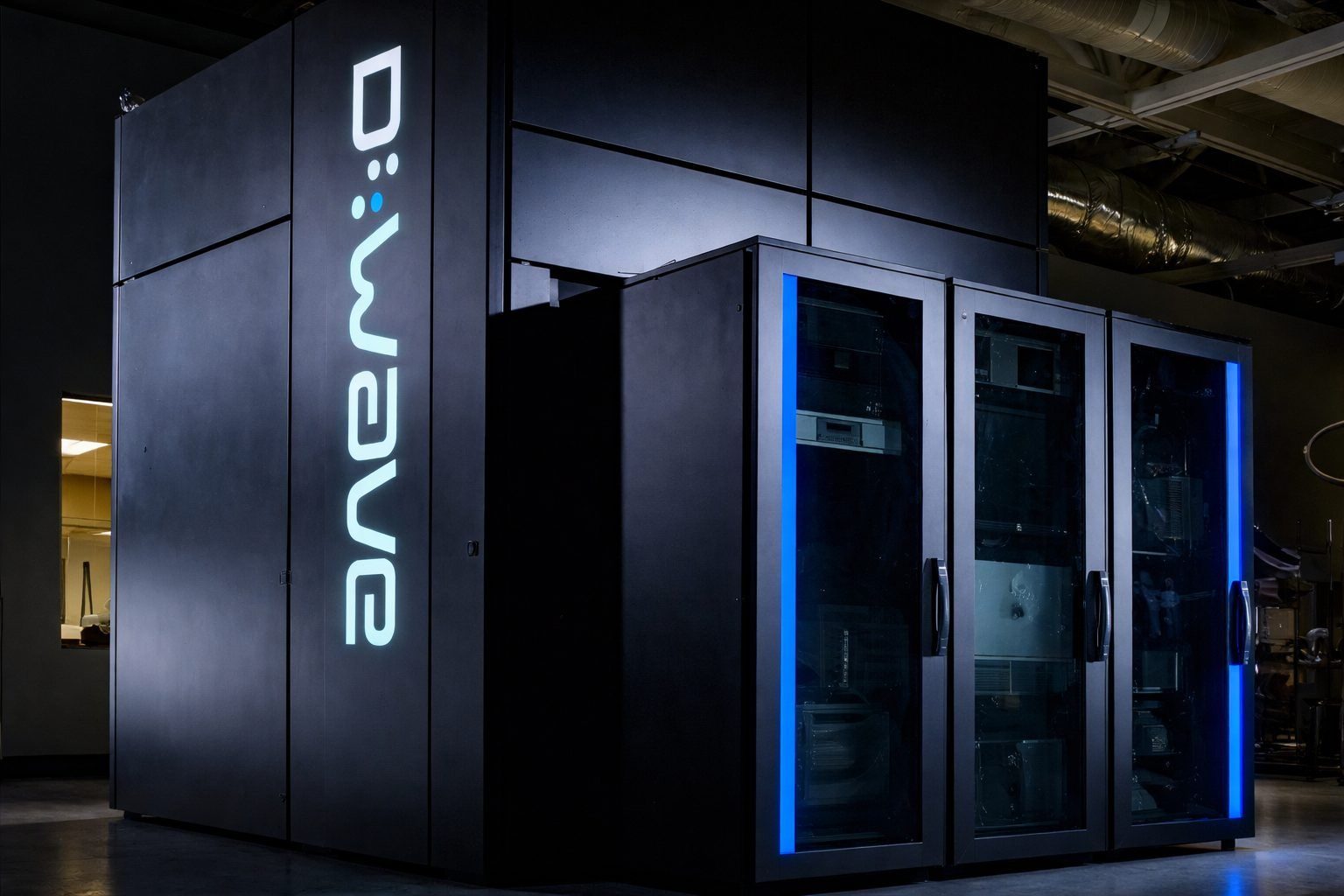
Most quantum hype centers on gate-based quantum computers (the kind people imagine cracking encryption and transforming chemistry), but those systems are notoriously error-prone at scale. D-Wave’s commercially focused approach is quantum annealing, which targets optimization-style problems where the “best” solution is hard to find and a near-best solution can still be valuable (logistics, scheduling, routing, portfolio-type optimization, certain materials and sampling problems, etc.). The Motley Fool
D-Wave also pushes a hybrid story—quantum plus classical—because in the near term, that’s how most practical quantum workloads get done.
Fundamentals check: growth is real, profitability is not (yet)
D-Wave’s latest quarterly update (for Q3 2025, reported Nov. 6, 2025) showed genuine operating progress on revenue and margins, but also highlighted how noisy GAAP results can be due to non-cash accounting items.
Key figures from the company’s Q3 2025 release include:
- Revenue:$3.7 million, up about 100% year over year D-Wave Quantum
- GAAP gross margin:71.4% (company cited mix and system upgrade impacts) D-Wave Quantum
- Adjusted net loss:$18.1 million (about $0.05 per share) D-Wave Quantum
- GAAP net loss:$140.0 million, driven largely by non-cash warrant-related charges as the share price moved D-Wave Quantum
- Nine-month revenue (ended Sept. 30, 2025):$21.8 million, up about 235% year over year D-Wave Quantum
- Post-quarter bookings: the company said it closed over $12 million in additional bookings after quarter-end D-Wave Quantum
Translation: the top line is growing, but the company is still investing heavily and not yet profitable. The GAAP “loss” number can look terrifying because of accounting remeasurement items tied to warrants—something that matters for financial statements, but doesn’t reflect day-to-day cash burn in the same way. D-Wave Quantum
Product and commercial momentum: Advantage2 and expanding deployments
Earlier in 2025, D-Wave announced general availability of its Advantage2 system via its Leap quantum cloud service, and described increasing customer usage on Advantage2 prototypes (including millions of problems run over time). The company also highlighted planned and ongoing deployments and upgrades, including an on-premises Advantage2 system intended for Davidson Technologies and an upgrade path tied to the Jülich Supercomputing Centre.
This matters for the stock story because analysts and investors keep coming back to a single question:
Is D-Wave selling something customers will keep paying for—or is it still mostly a science project with a stock ticker?
The bull case says Advantage2 plus hybrid solvers equals an early commercial wedge.
The bear case says revenue is still small relative to valuation, and quantum spending remains discretionary for many customers.
Near-term catalysts investors are watching
CES Foundry (January 2026)
D-Wave’s CES Foundry presence is now a clear calendar event, with a scheduled masterclass, demos, and a booth presence aimed at showcasing “measurable benefits” and real-world use cases. Business Wire
Qubits 2026 user conference (late January 2026)
D-Wave also announced its Qubits 2026 user conference will take place Jan. 27–28, 2026 in Boca Raton, Florida, and said it will share product roadmap updates across annealing, gate-model efforts, hybrid solvers, and “quantum AI.” D-Wave Quantum
U.S. government push
In early December, D-Wave announced the formation of a U.S. Government Business Unit, citing growing demand signals and naming a leader for federal go-to-market efforts.
For investors, government is attractive for two reasons: (1) budgets can be large, and (2) multi-year programs can stabilize revenue—if D-Wave can convert interest into contracts.
Insider trading headlines: what’s actually in the filings
Whenever a momentum stock moves this violently, traders start scanning insider transactions like it’s a detective novel.
Two relevant SEC Form 4 filings in November–December show that:
- CEO Alan Baratz reported a sale of 168,102 shares (dated Nov. 13, 2025) explicitly described as a mandatory “sell to cover” for tax withholding tied to vested restricted stock units—not a discretionary sale. SEC
- Director John D. DiLullo reported a sale of 8,000 shares (dated Dec. 5, 2025) described as an automatic sale under a Rule 10b5‑1 trading plan.
This doesn’t “prove” anything bullish or bearish by itself—but it does help separate routine, planned activity from truly discretionary insider sentiment.
The bottom line on D-Wave (QBTS) stock on Dec. 23, 2025
QBTS is trading like a stock caught between two timelines:
- Timeline A (the bull timeline): quantum adoption accelerates, D-Wave’s annealing + hybrid strategy becomes a practical workhorse, revenue scales, and today’s valuation starts to look like an early ticket to a much bigger market.
- Timeline B (the harsh timeline): commercialization takes longer, gate-based systems improve, budgets tighten, and a stock priced for a near-future breakout gets repriced like a normal, loss-making small-cap tech company.
Today’s move—down ~9% after a 20% surge—fits neatly into that “narrative vs. numbers” tug-of-war. The CES 2026 spotlight helped ignite momentum, analysts have been adding bullish coverage and high targets, and D-Wave’s revenue growth is real. But the stock’s volatility (and valuation) means investors are paying for execution, not just potential. D-Wave Quantum+3StockAnalysis+3Business Wire+3
Related articles: NYSE:QBTS