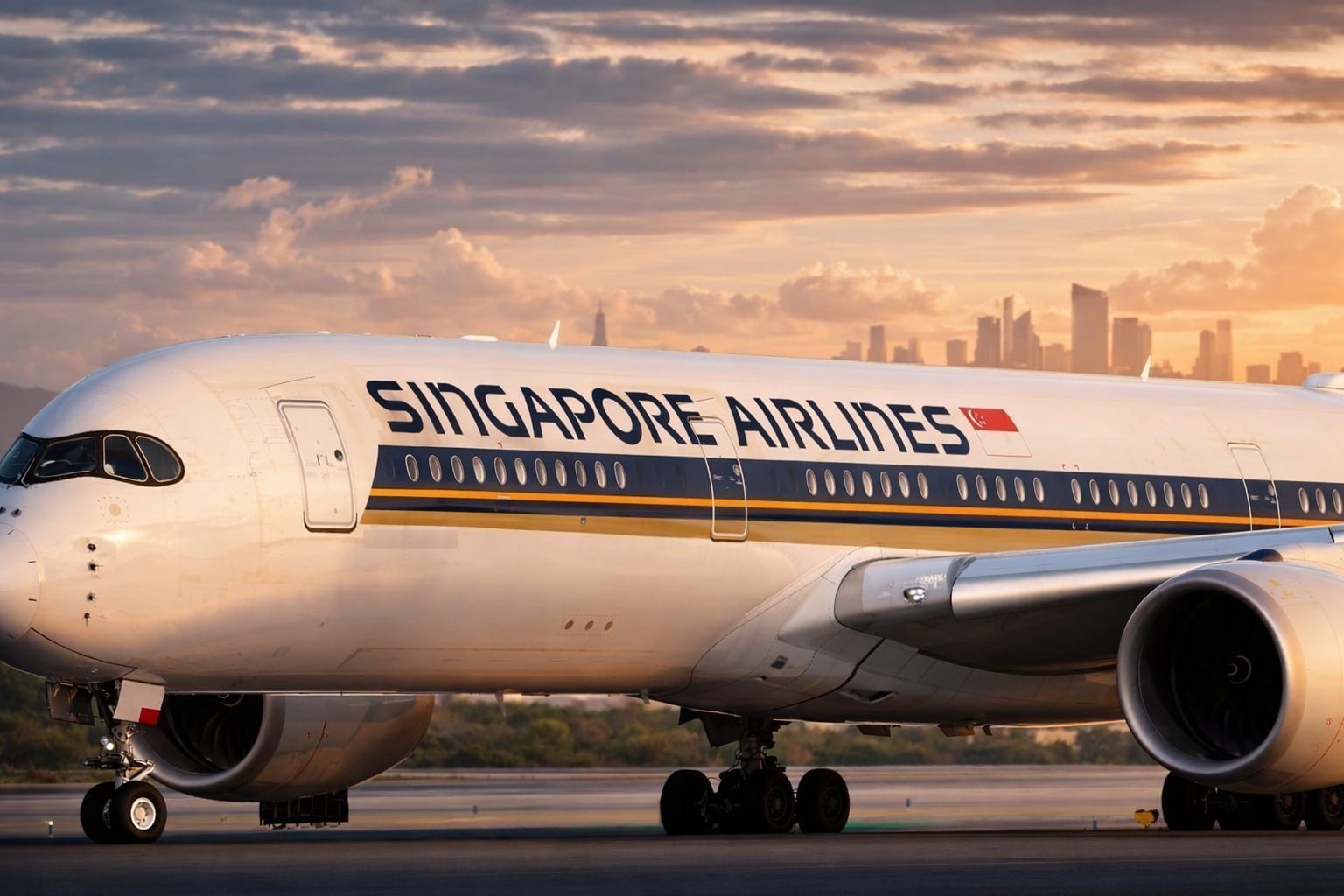

Singapore Airlines Ltd (SIA) stock ended Christmas Eve trading (24.12.2025) at S$6.40, up 0.63% on the day, with S$6.43 as the session high and S$6.37 as the low on volume of about 3.45 million shares.
That move may look modest, but it lands at an interesting moment for shareholders: cash dividends were just paid on 23 December 2025, and fresh operating statistics for November have reinforced a familiar post-pandemic pattern—planes are still full, but pricing power is softer and costs/competition are louder.
Below is the full, investor-focused roundup of the most relevant news, forecasts, and analysis available as of 24.12.2025, and what they imply for Singapore Airlines stock heading into 2026.
Singapore Airlines share price today and what the market is “saying” in numbers
As of 24 Dec 2025, SIA shares are effectively trading in a tight band around the mid-S$6 range. Over the last month (Nov 24 to Dec 24 on the same dataset), prices ranged roughly S$6.23 to S$6.53, averaging around S$6.37.
Zooming out, the stock’s 52-week range is S$5.90 to S$7.63, which matters because it frames the current debate: are you buying a high-quality airline franchise at a “normalised earnings” valuation… or buying into a profit downcycle with a few extra headaches (Air India, yield pressure, costs)? Investing.com Nigeria
Dividend news: the payout arrived, and the special dividend plan is now the headline
The “just paid” dividends (23 Dec 2025)
Singapore Airlines declared and paid, for the half-year ended 30 September 2025:
- Interim dividend: 5 cents per share
- Interim special dividend: 3 cents per share
- Total for 1H FY2025/26: 8 cents per share, paid 23 December 2025 to shareholders on record as of 8 December 2025 SGX Links
The bigger story: a three-year special dividend package
The more structural (and market-moving) point is SIA’s announced intention to return capital via a special dividend package of 10 cents per share annually over three financial years, totaling about S$0.9 billion across the period.
Key detail investors should not sleepwalk past:
- The first 3 cents has already been declared (and is part of the 23 Dec payment).
- The second tranche (7 cents) for FY2025/26 is subject to shareholder approval at the AGM in 2026.
- Subject to approval and “barring unforeseen circumstances,” SIA expects to pay 10 cents per share in each of FY2026/27 and FY2027/28 as well. SGX Links
Reuters also framed this explicitly as a move to “keep investors onside” amid profit pressure, which is… a very Reuters way of saying “yes, earnings are messy, so here’s cash.” Reuters
Latest operating update: November 2025 traffic stayed strong, with Scoot doing the heavy lifting
On 15 December 2025, Singapore Airlines released its November 2025 Operating Results, and the headline is steady demand into the year-end peak.
At the group level (Singapore Airlines + Scoot):
- Passenger traffic (RPK) +2.6% year-on-year
- Passenger capacity (ASK) +2.2% year-on-year
- Group passenger load factor: 87.3% (up 0.3 percentage points) SGX Links+1
On volume:
- Passengers carried: 3.53 million (group airlines), up 6.0% year-on-year SGX Links
The split is telling:
- Singapore Airlines (mainline) load factor 86.4% (slightly down year-on-year)
- Scoot load factor 90.7% (up meaningfully year-on-year) SGX Links
Cargo also perked up:
- Cargo and mail carried +12.4%
- Cargo load factor: 60.2% (up 3.6 percentage points) SGX Links+1
Operationally, SIA noted network and schedule changes, including Scoot launching services to Nha Trang and SIA resuming seasonal services to Sapporo (Chitose), and said that by end-November the passenger network covered 131 destinations.
Singapore’s Business Times echoed the same operating-stat snapshot and also noted that SIA shares closed S$6.32 on the day of that release (Dec 15) after the news cycle—useful context for how “priced in” the traffic numbers appeared to be. The Business Times
Financial performance: record revenue, steady operating profit, but net profit hit by Air India and financing dynamics
The tension in the SIA story is that the core airline operation still looks operationally competent—but reported net profit is being dragged by factors that don’t show up in a seat map.
From SIA’s 1H FY2025/26 briefing materials (half-year ended 30 Sept 2025):
- Group revenue: S$9.675 billion (a first-half record, +1.9% YoY)
- Group operating profit: S$802.9 million (+0.9% YoY)
- Group net profit: S$238.5 million (down 67.9% YoY) SGX Links+1
Two big forces drove the net profit drop:
- Share of losses from associated companies, “notably Air India,” with equity accounting for Air India commencing from December 2024 SGX Links+1
- A swing in interest/financing effects, as the prior period had net interest income and the current period reflected net interest expense dynamics (as described in the briefing highlights).
Reuters’ coverage is blunt: half-year profit fell to S$239 million from S$742 million, missing Visible Alpha consensus, and it explicitly attributes the associate-company hit largely to Air India’s losses.
What SIA itself says about demand and cargo ahead
In its outlook section, the company said:
- Air travel demand remains resilient heading into the third quarter of FY2025/26 (the year-end peak),
- but air cargo remains uncertain, with yields pressured as airlines redeploy cargo capacity away from the U.S. to other lanes,
- and the industry faces geopolitical tensions, macro headwinds, inflationary cost pressures, and supply chain constraints.
That’s a very airline way of saying: “We’re busy, but the world is weird.”
Analyst forecasts on Dec 24, 2025: price targets imply limited upside (and some outright caution)
Analyst consensus is not screaming “moon mission” right now.
1) Investing.com consensus snapshot (as displayed)
On an Investing.com consensus page for Singapore Airlines:
- 14 analysts
- Average 12-month price target: ~S$6.169
- High estimate: S$7
- Low estimate: S$5.25
- Consensus rating shown as “Sell” (0 buy, 8 sell, 6 hold) Investing.com Nigeria
2) Local broker-style compilation (SGinvestors)
A compilation of recent target prices (dated within the prior months and shown “as of 2025-12-24”) put targets in a tighter band:
- Range: S$6.03 to S$6.40
- Median: S$6.195 (about 3.2% downside from the reference price shown)
- Average: S$6.205 SG Investors
That clustering near the current share price is the market’s way of shrugging: “SIA is good, but the cycle is normalising.”
The analytical “why” behind cautious targets
Reuters quoted Morningstar’s Lorraine Tan saying the half-year profit drop is not far off their forecast decline (for fiscal 2026) and attributed much of the decline to normalisation of passenger yields post-COVID.
In plain English: the airline is still flying full, but the industry has more seats to sell, so fares/yields aren’t as magical as they were during the rebound.
DBS research coverage (from earlier in 2025, but still relevant to the same pressure points) similarly described strong demand being offset by weaker yields and cost inflation, while flagging Air India as a near-term drag.
Air India: the strategic upside is real, but the near-term financial drag is also very real
Singapore Airlines owns a 25.1% stake in Air India, and began accounting for Air India earnings in December 2024 following the integration of Vistara into Air India.
The problem: while the long-term strategy is “build a major Indian aviation platform,” the near-term reality is “transformation programmes cost money.”
One of the most important risk datapoints in recent months: Reuters reported (via a Bloomberg News report) that Air India sought at least 100 billion rupees (~US$1.14 billion) in financial support from owners Tata Sons and Singapore Airlines, with funding potentially proportional to ownership and possibly structured as loan or equity.
Even if the final structure changes, this frames the investor question clearly: does the Air India stake become a future earnings engine… or an extended capital call? Markets dislike uncertainty almost as much as they dislike turbulence.
“Network synergy” is happening alongside the financial drag
Not all Air India-linked developments are negative. On 11 Dec 2025, Air India announced a unilateral interline partnership with Scoot (SIA’s low-cost subsidiary) to expand connectivity via Singapore across Asia and Australasia, including through check-in on single-ticket itineraries.
Strategically, this fits the narrative of using Singapore as a hub for regional flows—commercially sensible, even if the accounting impact of Air India today is painful.
Fleet and operations: Boeing 777-9 delay risk looks contained (for now)
Fleet delivery timelines matter because they influence capacity, costs, and product competitiveness.
On 14 Nov 2025, Reuters reported SIA’s CEO saying the airline does not expect a major operational impact from Boeing’s delayed delivery timeline for the 777-9 (pushed to 2027), citing flexibility built into fleet planning.
This is a “risk reduced, not risk removed” situation: delays can still affect long-term product/capacity strategy, but SIA is signaling it has buffers.
Policy and cost outlook: Singapore’s SAF Levy is coming in 2026
Aviation decarbonisation is steadily turning into a line item, and Singapore has put a very clear marker down.
The Civil Aviation Authority of Singapore (CAAS) announced a Sustainable Aviation Fuel (SAF) Levy:
- Applies to flights departing from 1 Oct 2026
- Applicable for tickets/services sold from 1 Apr 2026
- Collected by airlines (as a distinct line item) CAAS – CWP
For investors, this is less about the first-year dollar amounts and more about the mechanism: it’s a new regulated cost flow that airlines will likely try to pass through, but the pass-through success depends on demand strength and competitive dynamics.
What matters next for Singapore Airlines stock
SIA’s story into 2026 is likely to hinge on four moving parts—each pulling in a different direction:
- Demand and load factors: still strong (November data says so), especially into year-end peak.
- Yields and competition: normalising (i.e., getting less favourable), which pressures margins unless costs fall faster.
- Air India: potentially a long-term strategic win, but currently a material swing factor for reported net profit and possibly capital needs.
- Shareholder returns: the special dividend package provides a tangible support narrative—cash now, not vibes later—though future tranches remain subject to approvals and circumstances.
Put differently: SIA looks like a premium franchise operating in an increasingly un-premium industry cycle, and the stock price around S$6.40 reflects that tug-of-war.
Related articles: SGX:C6L