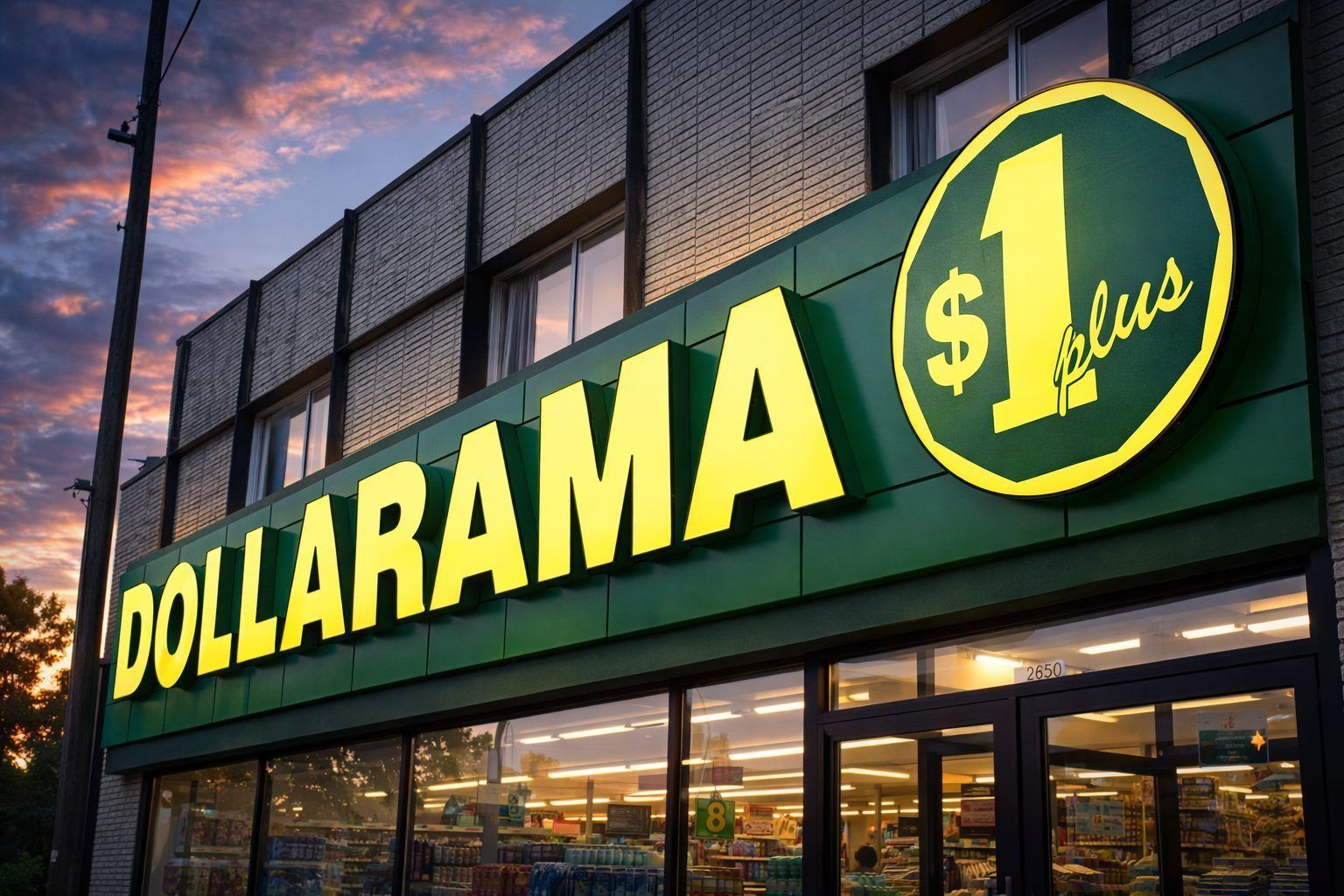

Dollarama is ending 2025 in the spotlight as investors weigh a familiar question with an unusually sharp edge: how much is too much to pay for a business that keeps delivering? On December 24, 2025, the discussion is unfolding against a holiday-thinned trading session in Canada—markets are scheduled to close early—after the S&P/TSX set new records and heads toward its best annual performance since 2009.
At the stock level, Dollarama has been pressing toward the upper end of its recent range, closing around C$204.69 in the latest session cited by multiple market trackers—right where the latest valuation commentary is anchoring its debate.
What’s driving the attention today isn’t a single breaking headline from the company. Instead, it’s the convergence of three forces that often define big winners late in the year: fresh fundamental proof, expanding ambitions beyond the core market, and a valuation that forces discipline.
What’s new on Dec. 24, 2025: a market that’s running hot, and a stock that’s priced like it knows it
Christmas Eve trading tends to bring lighter volumes, and Reuters notes TSX futures edged lower ahead of the shortened session even as the index remains on track for a standout year.
Dollarama’s story fits that broader mood: the stock has climbed into “fresh highs” territory in the eyes of at least one widely circulated valuation read on December 24. That same analysis frames the stock as only modestly undervalued—a small gap that matters because it implies the market is already pricing in a lot of what makes Dollarama attractive. Simply Wall St.
In other words, today’s “news” for Dollarama investors is less about surprises—and more about whether the company’s execution can keep justifying a premium multiple in 2026.
The business case getting repeated: defensive demand, execution, and a long runway
The investment thesis being circulated in late December is remarkably consistent across recent commentary. A recent Motley Fool Canada piece (also syndicated via Yahoo Finance) highlights three pillars:
- A reliable, defensive business model
- A long track record of execution
- Growth opportunities that extend beyond the roughly 60–70 new stores per year often discussed for Canada The Motley Fool Canada+1
Those points resonate because the latest official results show the company is still compounding at a rate that’s hard to ignore—particularly in a retail environment where many chains are fighting to protect traffic and margins.
Q3 Fiscal 2026: the numbers that powered Dollarama’s momentum
Dollarama’s most recent quarterly report (for the third quarter ended November 2, 2025) helps explain why bullish commentary keeps finding oxygen.
In its Q3 release, Dollarama reported:
- Sales up 22.2% to $1,909.4 million
- Comparable store sales in Canada up 6.0%
- Net earnings up 16.6% to $321.7 million
- Diluted EPS up 19.4% to $1.17 Dollarama
The quarter also showed ongoing network expansion and aggressive capital returns:
- 19 net new stores opened in Canada (versus 18 a year earlier)
- 6 net new stores opened in Australia under The Reject Shop (TRS) banner
- 2,605,912 shares repurchased for cancellation for $484.6 million Dollarama
Just as importantly for sentiment, management raised key elements of its outlook for the Canadian segment:
- Comparable store sales guidance increased to 4.2%–4.7% (from 3%–4%)
- Gross margin guidance increased to 45.0%–45.5% Dollarama
Reuters separately underscored the macro backdrop supporting those results: shoppers seeking lower-cost alternatives amid still-elevated inflation helped lift demand, and Dollarama raised its annual comparable-sales forecast accordingly.
This is the kind of combination that often sustains premium valuations: growth + resilience + guidance that moves higher.
Canada is still the engine, but the growth narrative is increasingly international
One reason Dollarama’s valuation debate has intensified is that the business is no longer “just” a Canadian discount-store compounding machine. It’s increasingly an international value-retail platform with multiple growth vectors—each with its own risk profile.
Dollarcity: Latin America momentum and Mexico optionality
Dollarama’s Q3 release emphasizes the progress of Dollarcity, its Latin American growth vehicle (accounted for as an equity investment). Dollarama reported its share of Dollarcity net earnings at $42.4 million (for the July 1–Sept. 30, 2025 period), up from $27.1 million year over year—an increase of 56.5%.
Dollarcity’s footprint growth remains central to the long-run story:
- Dollarcity opened 25 net new stores in the quarter (vs 18 a year earlier).
- Store count reached 683 locations as of Sept. 30, 2025 (up from 588 a year earlier).
Management also pointed to continued progress in Mexico, noting additional store openings after quarter-end and capital contributions tied to expansion plans.
Australia: The Reject Shop is a strategic bet, not an immediate profit engine
Dollarama’s acquisition of The Reject Shop gives it a foothold in a large, developed retail market—but the company has been clear about timing. The Q3 release states it does not expect the Australian segment to have a positive impact on overall profitability in the near term, including fiscal 2027, as it works through transformation plans.
That long-dated payoff is a double-edged sword for investors: it supports a bigger total addressable market, but it also introduces execution and integration complexity that Dollarama didn’t previously have to manage at this scale.
The valuation debate: modest “undervaluation” vs. an undeniably premium multiple
On December 24, Simply Wall St’s widely shared narrative frames Dollarama as around 3.2% undervalued, with a fair value estimate near C$211 against a price around C$204.69.
But in the same breath, the analysis highlights why skeptics won’t back down: Dollarama’s P/E ratio is described at roughly 42.8x, well above the “fair” ratio used in that framework (31.8x) and above the global retail average cited (19.5x). Simply Wall St.
That’s the tension at the heart of Dollarama’s December narrative:
- Bulls see a premium business that deserves a premium.
- Bears see a premium that creates fragility—especially if growth slows even slightly or if sentiment shifts.
This isn’t a purely academic argument. When a stock trades at an elevated multiple, the path to disappointing investors doesn’t necessarily require bad news. Sometimes it only requires less-good news.
Why investors keep coming back to Dollarama anyway
Even after a big multi-year run, Dollarama continues to appear in “buy” lists and valuation debates for a few practical reasons that go beyond slogans.
1) Discount retail can be surprisingly durable in mixed economies
Dollarama’s results point to steady traffic and basket dynamics—Q3 comparable growth in Canada was driven by both more transactions (+4.1%) and a higher average transaction size (+1.9%), per the company’s own breakdown.
That matters because it suggests Dollarama isn’t relying on just one lever (like price inflation alone) to generate growth.
2) The company is actively returning capital while expanding
Dollarama’s Q3 share repurchases—about $484.6 million in a single quarter—stand out in a market where many retailers are more cautious with cash.
Buybacks can amplify per-share growth when underlying performance is strong. They can also help explain why bullish commentary often emphasizes “execution” as much as expansion. The Motley Fool Canada+1
3) The “runway” story is broader than Canada now
Historically, a major part of Dollarama’s narrative was simple: open stores, improve merchandising, keep turns high, maintain discipline, repeat.
Now, that model is being exported—through Dollarcity’s Latin American growth and Australia’s multi-year reset—giving investors a story that can extend well beyond the natural maturing of the Canadian store base.
The key risks heading into 2026: where the story could wobble
No matter how strong the quarter looks, the late-December debate exists for a reason. Several issues stand out as realistic swing factors:
Premium valuation risk
When a stock trades at a high multiple versus broader retail benchmarks, multiple compression becomes a real possibility even if the company continues growing. The December 24 valuation commentary explicitly warns that if sentiment cools, the valuation gap could unwind.
International execution, especially in Australia
The market is still learning what Dollarama’s long-run economics look like once The Reject Shop transformation progresses. The company itself cautions about the near-term profitability impact.
Cost pressures and operational variables
The same December 24 analysis notes that missteps abroad, cost inflation, or regulatory shifts could pressure margins—exactly the kind of “non-linear” risks that premium valuations tend to punish quickly. Simply Wall St.
What to watch next: signals that matter more than the day-to-day price
With Christmas Eve trading likely to be quiet, the more important Dollarama catalysts are fundamental:
- Holiday-season sell-through and seasonal mix (the company has cited seasonal demand as a driver of recent performance) Dollarama
- Updates on Canada comps and margins relative to the company’s raised guidance Dollarama
- Dollarcity store growth and profitability contribution, especially as Mexico builds out Dollarama
- Progress milestones in Australia—store renovations, merchandising changes, and early evidence the model can translate
Dollarama has already shown it can grow in a tough consumer environment. The bigger 2026 question is whether it can keep doing so at a pace—and with enough predictability—to justify a valuation that leaves little room for error.
Related articles: Earnings Reports