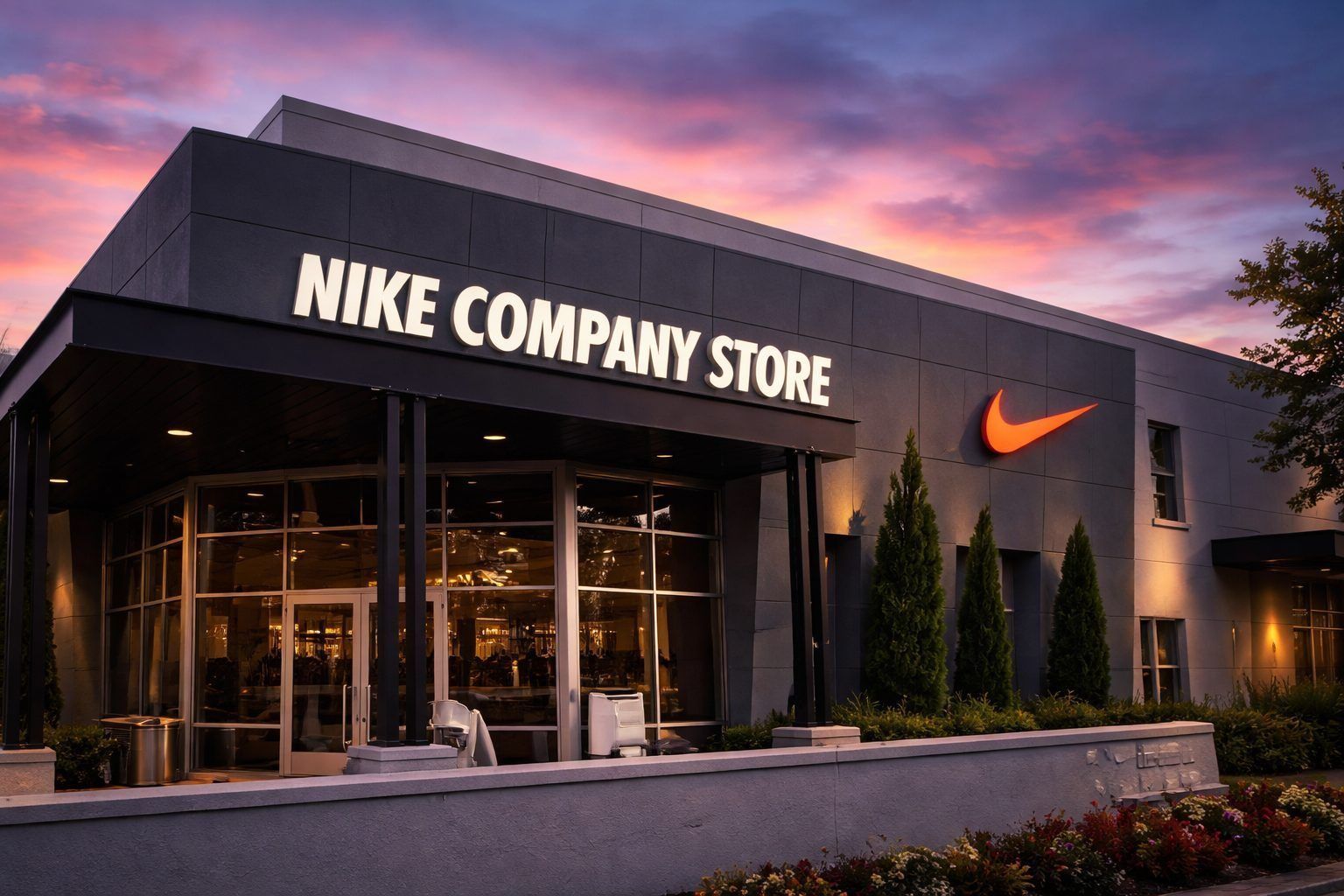

Nike, Inc. NYSE:NKE stock is getting a rare kind of holiday-season lift: a high-profile insider purchase. In the holiday-shortened U.S. trading session on Wednesday, December 24, 2025, shares climbed roughly 4%–5% after filings showed Apple CEO Tim Cook—also Nike’s long-time board member and lead independent director—bought about $3 million worth of Nike shares on the open market.
The move arrives at a sensitive moment for investors. Nike shares had fallen sharply after the company’s latest quarterly results and guidance, as management works through a wide-ranging reset under CEO Elliott Hill. Cook’s purchase doesn’t erase the fundamentals overnight—but it has forced Wall Street to re-run the debate: is Nike stock a battered blue-chip poised for a multi-quarter recovery, or a marquee brand still stuck in margin and China-related headwinds?
What happened to Nike stock on December 24, 2025
U.S. markets were open only briefly—NYSE and Nasdaq closed early at 1:00 p.m. ET for Christmas Eve—so moves were amplified by thinner holiday liquidity.
Against that backdrop, Nike stood out. Reuters reported Nike shares were up about 5% and trading around $60 after the Form 4 disclosure, after sliding nearly 13% since Nike’s December 18 results. Reuters Investopedia also noted Nike was among the day’s top S&P 500 gainers during the shortened session, driven by the insider-buy headline.
The catalyst: Tim Cook (and another Nike director) bought shares in the open market
The core “today” story is straightforward—and unusually tangible:
- Tim Cook bought 50,000 Nike shares at an average price of $58.97, an open-market purchase worth about $2.95–$3.0 million, disclosed in a regulatory filing. Reuters said the purchase nearly doubled Cook’s personal stake to about 105,000 shares.
- Reuters also reported the buy was described by a Baird analyst as potentially the largest open-market stock purchase for a Nike director or executive in more than a decade.
- Another Nike director, Robert Swan (former Intel CEO), also bought roughly $500,000 of Nike shares around the same time.
Why it mattered: insider buying is often treated as a signal that leadership views the stock as undervalued relative to long-term prospects—especially when the purchase is open market (cash outlay) rather than a grant or option exercise. Several outlets highlighted that the timing followed a steep post-earnings drawdown.
The backdrop: Nike’s quarter beat on revenue and EPS—but margins and guidance disappointed
To understand why Cook’s purchase grabbed headlines, it helps to see what investors were reacting to over the prior week.
In Nike’s fiscal 2026 second-quarter results (quarter ended Nov. 30, 2025), Nike reported:
- Revenue of $12.4 billion, up 1% reported (flat currency-neutral)
- Wholesale revenue of $7.5 billion, up 8%
- NIKE Direct revenue of $4.6 billion, down 8% (with NIKE Brand Digital down 14%)
- Gross margin of 40.6%, down 300 basis points
- Diluted EPS of $0.53 and net income of $0.8 billion, down 32%
Management framed the period as transitional. In Nike’s release, CEO Elliott Hill said Nike is in the “middle innings” of its comeback and described “Win Now” actions such as realigning teams, strengthening partner relationships, and rebalancing the portfolio. Nike Investor Relations
Reuters added more color on what’s weighing on the story:
- China sales fell for the sixth straight quarter (down 17%)
- Tariffs were a major pressure point; Reuters reported Nike’s CFO said tariffs on Southeast Asian manufacturing nations would cost Nike $1.5 billion this year
- Nike expected revenue in the coming quarter to be down low single digits, and Reuters reported Nike expected additional margin pressure (gross margin down 175–225 bps in the current quarter)
That combination—earnings beats but margin compression and cautious outlook—is why the stock sold off hard after the report, creating the “dip” that Cook ultimately bought.
Nike’s turnaround plan: “Win Now,” wholesale rebuilding, and a sharper product focus
Much of the current Nike stock thesis rests on whether Hill’s plan can restore growth without permanently damaging profitability.
Reuters described Nike’s efforts as a push to refresh innovation and marketing—especially in running and sports—while also repairing wholesale relationships to raise visibility in stores. Reuters+1 Nike’s earnings release also emphasized wholesale strength and partner relationships as key parts of the approach.
But the trade-off is real: wholesale typically carries different economics than direct-to-consumer, and clearing older inventory has often required promotions—both of which can weigh on margins. Reuters explicitly tied the reset to near-term margin pain, noting discounting and channel mix as headwinds.
Nike stock forecast: what analysts are projecting after the December selloff
On December 24, the market got a split-screen view:
- Price is down sharply from prior highs, reflecting skepticism about the near-term path.
- Sell-side targets are still well above the current share price, reflecting confidence in Nike’s brand and eventual recovery.
Here’s what widely cited consensus trackers show around this date:
- Investopedia cited Visible Alpha data showing a mean price target around $80, notably above the ~$60 trading area on Dec. 24.
- MarketBeat listed a consensus price target of $78.14 and a “Moderate Buy” consensus (based on a broad set of analysts). MarketBeat
- StockAnalysis showed a similar picture: an average target in the high-$70s and a consensus “Buy.” StockAnalysis
What that means in plain English: even after target cuts in the wake of the quarter, many analysts still model a recovery path that implies meaningful upside over 12 months—if margins stabilize and the brand regains momentum.
But the target cuts are real: UBS, Citi, and others pull forecasts down
The “December 24” narrative isn’t purely optimistic. A major theme in recent research notes has been that the turnaround is taking longer than expected—particularly in China—and that Nike’s valuation may still be demanding if the earnings trough lasts.
Examples from recent notes tied to the post-earnings reset:
- UBS cut its price target to $62 from $71 while keeping a Neutral rating, citing slower turnaround progress and more time needed to right-size inventory.
- Citi cut its price target to $65 from $70 and kept a Neutral stance, warning that North America growth may have been helped by liquidations and that China weakness could persist through fiscal 2026.
These target changes help explain why Cook’s purchase was interpreted as a high-conviction signal: it came as Wall Street was actively marking down near-term expectations.
December 24 analysis roundup: the bull case vs. the bear case
Below is a synthesis of the major viewpoints circulating on Dec. 24, 2025—the same-day analysis and the immediate context it drew from.
The bull case for Nike stock right now
1) “The bar is low” after a punishing year.
Even after the Dec. 24 bounce, Investopedia noted Nike was still down roughly 20% on the year, keeping expectations muted and making any incremental progress on product and execution more impactful for the stock. Investopedia+1
2) Analysts still see upside in a normalized earnings scenario.
Consensus targets in the high-$70s/around $80 suggest the Street still believes Nike can re-earn a premium multiple if the turnaround holds.
3) Wholesale strength is showing up in the numbers.
Nike’s own results showed wholesale revenue up 8%—a data point that supports the “rebuild partnerships and distribution” strategy. Nike Investor Relations
4) Shareholder returns remain part of the story.
Nike reported returning about $598 million through dividends in the quarter and highlighted a long streak of dividend increases.
The bear case: why some see the December bounce as fragile
1) Margin pressure is the headline risk, not revenue.
Nike’s gross margin fell 300 bps to 40.6%, and Reuters reported expectations for further margin decline in the current quarter.
2) China remains a persistent drag.
Reuters reported China sales down 17% and falling for a sixth consecutive quarter—one of the clearest “show me” metrics the market is watching. Reuters
3) Tariffs are not just noise—they’re being priced into guidance.
Reuters reported Nike’s CFO put the annual tariff cost at $1.5 billion this year, and Nike itself attributed margin pressure to higher tariffs in North America.
4) Some commentators are explicitly turning more cautious.
A Seeking Alpha analysis published Dec. 24 downgraded the stock’s stance (buy to hold), pointing to margin pressure, macro headwinds, and a still-elevated forward valuation in the face of near-term earnings pressure.
What forecasts imply for 2026: the “choppy recovery” scenario
Several Dec. 24 analyses converged on a similar middle-ground conclusion: Nike is not being treated as a broken brand, but the recovery could be uneven.
For example, a Barchart analysis highlighted that consensus expectations implied tough year-over-year comparisons ahead, including lower projected EPS for the quarter ending February 2026 and a down-year EPS outlook for the fiscal year ending May 2026—yet still paired that with a “Moderate Buy” street consensus and targets well above the current level. Barchart.com
And that’s the key tension in the Nike stock forecast right now:
- Near-term: investors want evidence that promotions, channel changes, and tariff pressure won’t keep squeezing margins.
- Medium-term: investors want proof that innovation, wholesale rebuilding, and brand heat can restart durable growth—especially outside North America.
What to watch next for Nike (NKE): catalysts and “tell me” metrics
With Nike stock now reacting to both insider confidence and fundamental caution, the next few checkpoints matter more than the day-to-day headlines:
- China trajectory: stabilization (or continued declines) in Greater China revenue is likely to drive sentiment.
- Gross margin and promotions: whether Nike can reduce discounting and protect margin while rebalancing channels.
- Channel mix: wholesale momentum vs. NIKE Direct weakness—both the growth rates and the profitability implications.
- Tariff impact: how much of the $1.5B headwind persists and whether pricing/sourcing actions can offset it.
- Next earnings date: Barchart listed the next earnings release as March 19 (per its calendar).
Bottom line: Nike’s December 24 pop is a confidence signal—yet the turnaround still has to earn it
Tim Cook’s open-market buy gave Nike stock a meaningful one-day boost and a stronger narrative heading into year-end: insiders are willing to put real money behind the Elliott Hill turnaround.
But the debate hasn’t changed overnight. Nike is still working through a reset where tariffs, China weakness, and margin compression remain the central risks—while the upside case rests on product innovation, wholesale rebuilding, and a return to steadier profitability.
Note: This article is for informational purposes and is not investment advice.
Related articles: NYSE:NKE