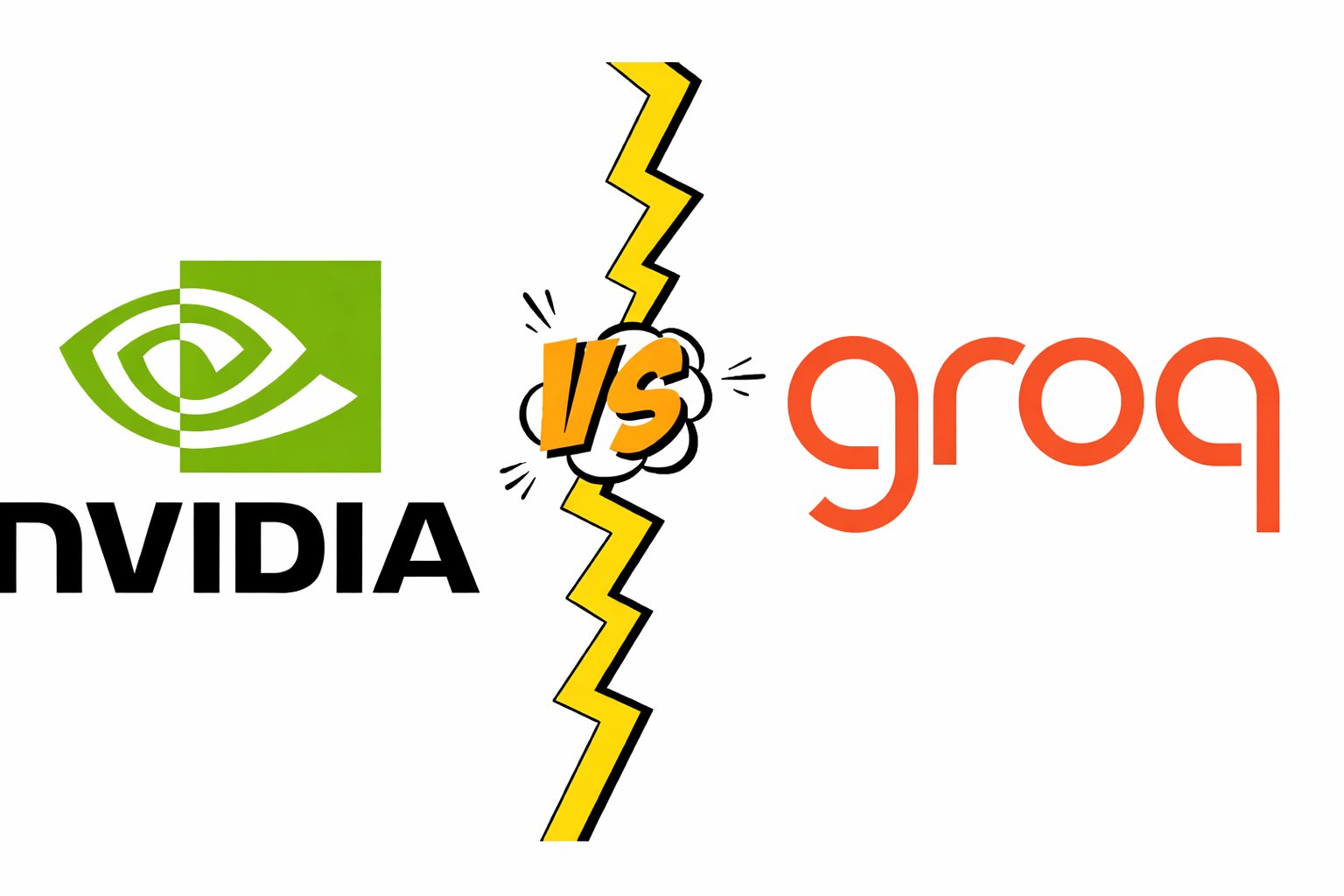

On December 24, 2025, the AI hardware world got a Christmas Eve shock: reports circulated that Nvidia had agreed to a $20 billion deal involving Groq, a fast-rising AI chip startup known for ultra-low-latency inference hardware. But as markets and social media lit up with “acquisition” headlines, Groq published its own update framing what’s actually been announced—a non-exclusive licensing agreement—and it came with a major talent move: Groq’s founder and top executives are heading to Nvidia. Groq+2TechCrunch+2
The result is a rare modern tech deal ambiguity—part acquisition rumor, part licensing-and-talent transaction—that underscores where the AI boom is heading next: from training dominance to inference supremacy.
What happened on Dec. 24, 2025: the report, then the official statement
Here’s what is confirmed from primary statements made on or tied directly to Dec. 24, 2025:
- Groq says it entered a “non-exclusive licensing agreement” with Nvidia for Groq’s AI inference technology. Groq
- Jonathan Ross (Groq’s founder) and Sunny Madra (Groq’s president)—plus other team members—will join Nvidia to help advance and scale the licensed technology.
- Groq will continue operating as an independent company, with Simon Edwards stepping in as CEO.
- GroqCloud will continue operating “without interruption,” according to Groq. Groq
At the same time, here’s what was reported (but not confirmed as a formal acquisition announcement by the companies):
- CNBC reported Nvidia had agreed to a deal valued around $20 billion involving Groq, which fueled “Nvidia acquires Groq” headlines. TechCrunch+1
- Nvidia told TechCrunch the transaction was not an acquisition of the company, and Nvidia did not publicly detail the full scope in that exchange.
- Reuters reported that financial details weren’t disclosed in Groq’s announcement, and that neither company commented on CNBC’s acquisition framing—while confirming the licensing and hiring components.
So the cleanest reading of Dec. 24 is this: the only primary-source announcement describes a licensing agreement plus a leadership migration—not a standard “we bought the company” press release. Groq+1
Why this deal matters: AI inference is becoming the next major chip battleground
For the first wave of generative AI, the story was largely about training—massive GPU clusters turning raw data into capable frontier models. Nvidia’s GPUs became the default engine for that phase.
But inference—the moment a trained model answers your prompt, powers a chatbot, summarizes a document, or runs a real-time agent—is different. It’s:
- Continuous (it happens all day, every day, once apps are deployed)
- Latency-sensitive (users feel delays immediately)
- Cost-sensitive (at scale, pennies per request become real money)
That’s why multiple reports emphasized that while Nvidia dominates training, competition is tougher in inference, with challengers ranging from AMD to specialized startups like Groq and Cerebras.
A licensing deal that pulls Groq’s inference technology—and key people—into Nvidia’s orbit is therefore more than a headline. It’s Nvidia making an explicit play for the “serving layer” of AI.
What Groq brings to Nvidia: the LPU approach and low-latency design
Groq has built its reputation on a chip it calls the LPU (Language Processing Unit)—hardware designed for fast, predictable inference rather than the broad, flexible workloads GPUs typically handle.
Coverage on Dec. 24 highlighted several technical themes behind Groq’s positioning:
- Efficiency claims: Groq has said its approach can run inference with dramatically better power efficiency than conventional graphics cards (often framed as an order-of-magnitude improvement in some workloads).
- Deterministic execution: One explanation reported is that Groq emphasizes a more deterministic design—aiming to reduce unpredictable delays that can affect latency.
- On-chip SRAM instead of external HBM: Reuters noted Groq is among a group of upstarts leaning heavily on SRAM (very fast on-chip memory) rather than relying as much on scarce HBM (high-bandwidth memory)—a strategy that can speed response times but can also constrain which model sizes can be served.
- Systems-level networking: Another reported differentiator is how Groq links servers into inference clusters, including discussion of its interconnect approach.
In plain terms: Groq isn’t trying to be “another GPU.” It’s selling a purpose-built inference path for the real-time AI era—exactly the phase the market is now racing into.
The talent move is the loudest signal: Groq’s founder is heading to Nvidia
In an era where “deal structure” can be engineered any number of ways, the people often tell you what’s strategic.
Groq’s statement confirms that Jonathan Ross and Sunny Madra are joining Nvidia, alongside additional Groq personnel.
Ross matters because he’s not just a startup CEO—Reuters described him as a Google veteran who helped start Google’s AI chip program. Reuters That combination—deep chip architecture experience plus leadership—fits Nvidia’s pattern of betting on both platform technology and the teams who can ship it into production.
This is also why some observers characterize arrangements like this as a form of “reverse acquihire”: rather than buying the whole company outright, a giant licenses core technology and recruits key builders, often with fewer regulatory and integration hurdles than a conventional acquisition. SiliconANGLE+1
Is this a $20B acquisition or a licensing deal? Here’s the careful answer
As of the news cycle tied to Dec. 24, 2025, the most accurate phrasing is:
- Confirmed: a non-exclusive licensing agreement + key executive and engineering hires + Groq remains independent + GroqCloud continues.
- Reported: a $20B transaction described in acquisition terms by CNBC and echoed through other coverage, but not confirmed as a standard acquisition announcement by Nvidia or Groq in their public-facing statements.
Even in the reporting that discussed a $20B figure, Reuters emphasized that Groq’s post did not disclose financial details and that the companies did not confirm CNBC’s acquisition framing—while validating the licensing arrangement.
That distinction matters for two reasons:
- Non-exclusive licensing changes the competitive math. If Groq’s core technology can be licensed to more than one party (in theory), it’s not the same as Nvidia owning and locking it up.
- Regulatory scrutiny is a real constraint. Reuters noted a broader pattern where Big Tech firms structure deals around licensing and hiring rather than outright acquisitions—partly because acquisitions can attract heavier antitrust attention.
What Nvidia could be building: “AI factory” inference at scale
Several outlets framed the strategic goal in a phrase Nvidia has been pushing for years: the “AI factory”—a full-stack data center concept combining compute, networking, and software to produce and serve AI at industrial scale.
Reporting around the Groq deal suggested Nvidia aims to integrate Groq’s low-latency inference capabilities into that broader platform vision.
If Nvidia can pair:
- its massive GPU ecosystem and software stack, with
- Groq-style low-latency inference designs and the engineers who built them,
…it strengthens Nvidia’s pitch not just as the training king, but as a full-spectrum AI infrastructure provider—especially for real-time applications where latency and cost can dominate design decisions.
What this means for Groq and GroqCloud users
Groq’s statement was explicit about continuity: GroqCloud continues without interruption and Groq remains independent under new leadership.
But independence in corporate structure doesn’t automatically mean “business as usual” in product execution. The departure of a founder and key leadership can raise practical questions customers will care about, such as:
- Who owns the product roadmap now?
- How much of the engineering org moves vs. stays?
- Will Groq prioritize cloud customers differently if parts of the core technology are being scaled inside Nvidia?
None of those questions were fully answered in the Dec. 24 statements. What was clear is that Groq is trying to signal stability and continuity for its cloud offering, even as top talent moves to Nvidia.
The bigger trend behind the headline: licensing + hiring is the new “deal playbook”
This story isn’t just about Nvidia and Groq—it’s also about how AI-era transactions are evolving.
Reuters highlighted multiple examples of major tech firms using large licensing fees and selective hiring to access technology and talent without purchasing the entire company—deals that can draw scrutiny but may be easier to execute than full acquisitions in a more aggressive regulatory environment.
Whether the Groq arrangement ultimately becomes a traditional acquisition later is unknown based on Dec. 24 information. What’s knowable now is that the structure being described fits a recognizable pattern: get the tech, get the team, avoid the clean “merger” label. Reuters+1
What to watch next after Dec. 24
If you’re tracking this story as a business leader, developer, or investor, the next wave of updates will likely revolve around specifics that weren’t in the initial statements:
- Scope of the licensed IP: What exactly counts as “inference technology”—chip designs, software toolchains, interconnect methods, or some combination? Groq+1
- Productization timeline: When (and where) will Nvidia surface Groq-related capabilities—new silicon, reference architectures, or integrated offerings?
- GroqCloud roadmap: Groq says the service continues uninterrupted, but the market will watch how fast Groq can execute with leadership changes.
- Competitive response: Inference is where rivals are attacking Nvidia—expect AMD, Cerebras, and other inference-first providers to sharpen messaging around cost-per-token and latency.
Bottom line: Nvidia is moving early to win the inference era
The Dec. 24 headlines may have started with a simple (and dramatic) storyline—“Nvidia buys Groq for $20B”—but the most defensible summary of what’s been publicly described is more nuanced:
Nvidia has secured a non-exclusive license to Groq’s inference technology and hired Groq’s top leadership and engineers to scale it, while Groq continues independently and keeps GroqCloud running.
In the AI boom’s second act—where serving models efficiently may matter as much as training them—this is the kind of move that can reshape the competitive map without looking like a traditional acquisition. And that may be exactly the point.
Related articles: NASDAQ:NVDA