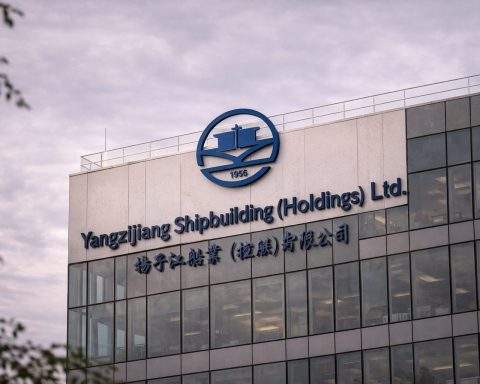

Singapore markets are shut for Christmas Day, so Yangzijiang Shipbuilding (Holdings) Ltd (often referred to as “YZJ Shipbuilding”) is being viewed off the last traded print: S$3.48 at the 24 Dec 2025 close. TradingHours
That year-end level matters because the stock has spent 2025 toggling between two competing narratives: a multi‑year, clean‑energy shipbuilding supercycle supported by a towering orderbook, versus macro and geopolitical uncertainty that can freeze contracting momentum without much warning.
Below is a full, up-to-date rundown of the most recent company news, the latest analyst forecasts, and the key investment debates surrounding Yangzijiang Shipbuilding stock as of 25 December 2025.
Yangzijiang Shipbuilding stock price check: where the market left it
- Last close (24 Dec 2025): S$3.48, up about 0.29% on the day, according to technical-tracking data.
- Platform consensus data shows a 52‑week range around S$1.80 to S$3.58, putting the stock near the top end of its annual band heading into the holiday break.
This “near-highs into year-end” setup is one reason Yangzijiang continues to surface in Singapore market commentary: when a cyclical industrial stock trades like a growth name, investors start asking whether fundamentals have permanently changed—or whether they’re just late-cycle hallucinating.
The biggest late‑2025 headline: order momentum rebounded, and the orderbook stayed enormous
The anchor update for the year-end investment case is the company’s 3QFY2025 business update (17 Nov 2025). In that presentation, management highlighted:
- Outstanding orderbook: US$22.8 billion (as at 17 Nov 2025)
- Clean‑energy vessels: ~71% of total orderbook value
- Year-to-date (YTD) order wins: US$2.17 billion, versus US$0.54 billion in 1H2025 (i.e., a sharp second-half pickup)
Management also framed the industry backdrop bluntly: shipyard backlogs remain historically high, lead times are close to five years at top-tier yards, and large-vessel delivery slots are limited—pushing both shipowners and shipyards to stay cautious on commitments for 2030+ deliveries.
That matters for shareholders because Yangzijiang’s earnings visibility is increasingly a function of (1) how high-quality the backlog is and (2) whether the yard can keep signing profitable work without blowing out execution risk.
Deliveries stayed on track (the part of shipbuilding that actually turns into revenue)
A giant orderbook is only as good as the yard’s ability to deliver. As of the same 17 Nov 2025 update, Yangzijiang reported:
- 46 vessels delivered YTD, stated as 82% of the FY2025 delivery target
- FY2025 target: 56 vessels scheduled for delivery, with early 4Q progress already underway at the time of the update
The update also flagged “vessel delivery highlights” that underscore the yard’s technical progression—such as deliveries involving dual‑fuel gas carriers and LNG dual‑fuel containerships. SGX Links
Investors care about this because higher‑spec ships generally carry better economics—if built efficiently.
September 2025: a sanctions-linked contract termination, plus fresh orders
Late 2025 wasn’t only upside. In September 2025, Yangzijiang announced it had terminated contracts for four 50,000 DWT MR oil tankers worth about US$180 million, after the buyer disclosed allegations involving a scheme to circumvent U.S. sanctions laws and regulations.
Key details from the company’s termination announcement:
- The tankers had been scheduled for delivery from 2026 to 2027.
- No revenue or profit related to those contracts had been recognised up to 30 June 2025.
- The group had received a 10% deposit (US$18 million) at signing, and collected an additional instalment for one vessel where construction had begun.
- The company said the termination was not expected to have a material impact on FY2025 NTA and EPS.
In the same late-September window, the company also announced new contract wins: eight vessels worth US$0.44 billion, including containerships (up to 11,800 TEU) and bulk carriers (71,000 DWT), with deliveries scheduled between 2027 and 2029. It specifically noted that the two 11,800 TEU ships were placed by Seaspan Corporation, described as a long-standing partner.
By 27 Sep 2025, the company said it had secured 44 effective shipbuilding contracts year-to-date with an aggregate value of US$1.90 billion.
Takeaway for stock-watchers: the termination headline looked ugly, but the financial damage was framed as contained—and the company kept signing forward work.
Profitability: margins expanded sharply in 1H2025
If 2024–2025 has had a “secret sauce” for Yangzijiang, it’s been margin strength.
In its 1H2025 results (for the six months ended 30 Jun 2025), the company reported:
- Revenue: RMB12.9 billion (roughly flat YoY)
- Gross profit: RMB4.4 billion, up meaningfully YoY
- Gross margin: 34.5%
- Net profit attributable to shareholders: RMB4.18 billion, up 36.7% YoY
- Net cash position: RMB18.3 billion as at 30 Jun 2025
Management attributed the stronger profitability to factors including lower steel costs, “favourable contract pricing,” and smooth delivery of large dual‑fuel containerships (a higher-spec product mix). SGX Links
The press release also noted the group had begun unlocking value from its investment in Tsuneishi Zhoushan, contributing to results in 1H2025.
For equity investors, this is the crucial link: shipbuilding is notoriously cyclical, but margin durability can turn a cyclical name into a compounder—at least until competition and capacity expansion erode pricing.
Ownership and flow: BlackRock ceased to be a substantial shareholder
Flow and positioning sometimes move shipbuilder stocks as much as fundamentals.
Yangzijiang disclosed via SGX that it received a notification of ceasing to be a substantial shareholder on 4 Nov 2025.
Market reporting around that disclosure said Yangzijiang shares reacted after BlackRock sold a large block of shares in late October, bringing its stake below the “substantial shareholder” threshold. The Business Times
This doesn’t change shipbuilding economics—but it can change short-term trading dynamics (liquidity, supply overhang, and sentiment).
Analyst forecasts as of 25 Dec 2025: “Strong Buy” consensus, targets clustered above spot
Analyst views into year-end 2025 are broadly constructive, with targets typically above the last traded price.
Street-style consensus (multi-analyst platforms)
One widely used consensus snapshot shows:
- Consensus rating: “Strong Buy”
- 11 analysts in the sample; 10 Buy, 1 Sell
- Average 12‑month target: ~S$3.78
- High estimate: ~S$4.49; Low estimate: ~S$1.59
Notable broker calls in late 2025
- UOB Kay Hian: raised target price to S$4.10 (from S$3.90). Commentary cited “active negotiations” and relayed management confidence about potentially securing around US$4.5 billion of new orders for 2026, with margins supported by exchange rates, steel prices, and earlier equipment procurement. The Edge Singapore
- CGS International: reiterated an “add” call, with reporting indicating a higher target price of S$4.51 (from S$3.90) in mid‑November coverage. The Edge Singapore
- DBS Group Research (18 Nov 2025): reiterated BUY with a S$3.80 target price, pointing to the US$22.8b orderbook, the clean‑energy skew, and delivery progress. DBS also flagged potential catalysts including fresh large-vessel wins and further evidence of margin expansion.
The practical message across these views: analysts are treating Yangzijiang less like a “one‑year trade” and more like a multi‑year earnings visibility story—assuming execution remains clean.
Strategy investors are underwriting: green ships + capacity expansion
Yangzijiang is leaning into decarbonisation-linked demand. Management’s own disclosures show the backlog is increasingly dominated by “green” tonnage (clean‑energy vessels), which represented about 71% of orderbook value as of mid‑November. SGX Links
At the same time, the group is spending for future capacity and adjacent infrastructure:
- A Hongyuan new yard (capex referenced around RMB3.0 billion)
- An LNG terminal and LNG storage facilities project (capex referenced around RMB2.0 billion)
- Both projects referenced as scheduled for completion around 1H2027
DBS Research also flagged the possibility of some revenue contribution from the new yard from 2H2026, which helps explain why 2026–2027 forecasts focus not only on backlog execution but also on how smoothly new capacity gets integrated.
The risk list: what could break the bull case in 2026
No shipbuilding stock write-up is complete without acknowledging the ways the sea can get choppy fast.
1) Macro policy shocks can freeze contracting
In the company’s own 1H2025 commentary, it noted that global shipbuilding contracting fell sharply in 1H2025 and pointed to macro uncertainty—including concerns tied to U.S. tariffs and proposed U.S. port fees—as factors weighing on sentiment.
2) Competition is rising inside China
Broker commentary (including late‑November coverage) noted management had cited stiffer competition from second‑tier Chinese yards expanding capacity to chase orders—exactly the dynamic that can pressure pricing over time.
3) Sanctions and compliance risk is real
The September contract termination shows how quickly geopolitical/legal issues can intrude, even after due diligence. While management said the earnings impact should not be material for FY2025, the headline risk is obvious.
4) Commodity and FX sensitivity
Steel and USD/RMB dynamics are repeatedly cited as key drivers of margin assumptions. Broker analysis tied margin expectations to steel price ranges and currency stability—meaning surprises there can quickly reshape forward earnings.
What investors will watch next (into early 2026)
As of 25 Dec 2025, with the stock near year-end highs, the next “make-or-break” signals are straightforward:
- New order flow: whether the 2H2025 rebound continues and whether the yard can fill later delivery slots without conceding price.
- Margin durability: whether 2025’s elevated profitability proves structural (mix + execution) or cyclical (timing + steel + tight capacity).
- Execution cadence: steady deliveries and “no surprises” project management—because shipbuilding punishes operational drama. SGX Links
- Capacity expansion progress: investors will increasingly discount (or reward) the Hongyuan yard and LNG terminal projects based on timeline confidence.
Bottom line on Yangzijiang Shipbuilding stock as of 25 Dec 2025
Yangzijiang Shipbuilding ends 2025 in a position many industrial cyclicals envy: a huge multi‑year orderbook, a backlog skewed toward clean‑energy vessels, and a financial profile that—at least through 1H2025—showed unusually strong margins and cash strength.
Analysts are mostly constructive into 2026, with widely cited targets in the S$3.80 to S$4.51 range from major Singapore broker coverage, and platform consensus still reading as a “Strong Buy.” DBS Bank
But shipbuilding remains shipbuilding: the upside comes from disciplined execution and tight yard capacity; the downside usually arrives through macro shocks, pricing pressure, or a sudden slowdown in contracting. The late‑2025 data suggests momentum improved—not that risk disappeared.
Related articles: SGX:BS6