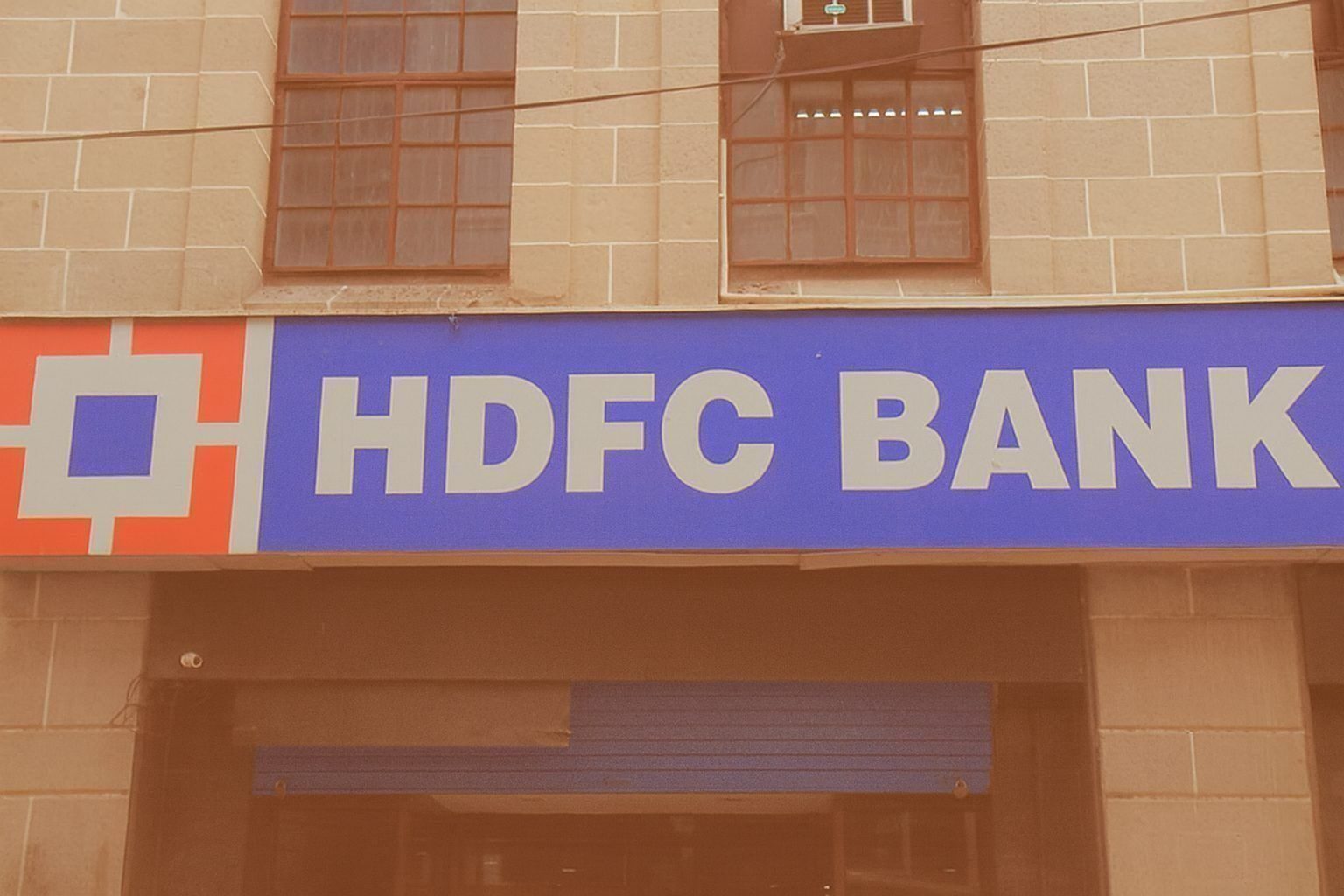

HDFC Bank Limited (NSE: HDFCBANK; BSE: 500180) traded slightly lower on Friday, 26 December 2025, moving broadly in line with a subdued Indian equity session marked by thin year-end volumes and weakness across key sectors such as financials and IT. By early afternoon, HDFC Bank was quoted around the ₹990 level, down roughly 0.7% on the day, with an intraday range just under ₹1,000.
That “quiet drift” matters for a stock like HDFC Bank because the market is increasingly treating it as a referendum on two things at once: (1) how quickly post-merger balance-sheet normalisation converts into faster growth and (2) whether the new rate-cut cycle improves system liquidity without pressuring bank margins for too long.
HDFC Bank share price today: what the stock did on 26.12.2025
HDFC Bank was indicated around ₹990 in the early afternoon on 26 December, with the day’s trade clustered roughly between the high-₹980s and just under ₹1,000, and a 52-week band (per widely tracked market data) spanning the low-₹800s to just over ₹1,020.
A separate live market feed from The Economic Times also showed the stock trading around ₹992–₹996 through late morning, marginally down on the day.
Market backdrop: year-end “thin trade” and a softer tone for benchmarks
The broader mood on 26 December was muted. Reuters reported Indian benchmarks slipping in low-volume year-end trade, with the Nifty 50 down about 0.25% and the Sensex down about 0.26% during the morning session, as investors looked ahead to quarterly earnings season for the next clear catalyst.
Moneycontrol’s live market coverage similarly described selling pressure and benchmark weakness, with financials and IT contributing to the drag even as broader segments held up relatively better.
For HDFC Bank shareholders, that context is important: when liquidity is thin, large index constituents can “wiggle” without telling you much. The more actionable signals tend to come from fundamentals, policy, and near-term catalysts—especially earnings.
The next big catalyst: HDFC Bank’s Q3 FY26 results date is set
One of the most concrete, stock-specific updates into year-end is the calendar: HDFC Bank has informed the exchange that its board meeting is scheduled for 17 January 2026 to consider and approve unaudited standalone and consolidated financial results for the quarter/nine months ending 31 December 2025.
In practical terms, that sets up January as a potential volatility window for the stock—particularly if the market is focused on deposit growth, margin trajectory, and any commentary around the loan-to-deposit ratio.
Fundamentals investors are watching: post-merger normalisation, growth and margins
Recent bank commentary (as reported by ETBFSI) has leaned into the idea that the “hard part” of the merger transition is largely behind, with a renewed push toward stronger growth. ETBFSI reported that management is positioning for “renewed growth momentum,” aiming for above-system loan growth in FY27, while also working to moderate the loan-to-deposit ratio to below 90% over coming quarters. ETBFSI.com
Margins remain the other pillar of the narrative. ETBFSI reported that net interest margin (NIM) declined sequentially in Q2 FY26 and that management expects deposit repricing dynamics and easing liquidity to support gradual improvement over the next 6–9 months.
Deposit and advances trajectory: what recent updates showed
In an earlier Q2 FY26 business update, The Economic Times reported average deposits up 15.1% year-on-year and average advances under management up 9% year-on-year for the quarter ended 30 September 2025, alongside period-end deposit and advances figures that also showed low double-digit growth.
Why this still matters on 26 December: for large banks in a competitive cycle, the market tends to reward funded growth (advances supported by deposits) more than growth that depends on an elevated loan-to-deposit ratio. So deposit growth and deposit cost become the “quiet protagonists” of the HDFC Bank story.
Rate cuts and liquidity: supportive tailwinds, but the margin path matters
December brought meaningful policy signals for the banking system:
- RBI cut the repo rate to 5.25% on 5 December 2025, and signalled a supportive stance for growth amid easing inflation (per Reuters).
- RBI also announced liquidity measures to inject substantial rupee liquidity via government bond purchases and a dollar-rupee swap, according to Reuters reporting on 23 December.
For HDFC Bank, easier system liquidity can reduce the intensity of deposit competition over time. But there’s a catch the market will debate endlessly: in the early phase of rate cuts, asset yields can reprice faster than deposit costs, pressuring NIMs until liabilities catch up.
That’s why investors noticed HDFC Bank’s own deposit pricing moves. Business Standard reported that HDFC Bank cut fixed deposit (FD) rates by 15 bps in select tenors, reducing its peak deposit rate to 6.45% effective 17 December 2025, following the RBI’s easing cycle.
Competitive landscape: PSU banks clawing back share, but “core leaders” still favored
A 26 December market note carried by The Economic Times highlighted how public sector banks have been regaining market share in areas such as MSME and home loans, shifting the competitive map. In the same breath, it cited Motilal Oswal’s view that investors should still focus on a smaller set of “core” players—explicitly including HDFC Bank—through a more structured credit cycle. The Economic Times
That framing matches what many long-only investors are doing: treating HDFC Bank as a “quality compounder” candidate, while pressure-testing whether competitive intensity (especially in secured retail and MSME) caps near-term pricing power.
IndusInd stake approval: a headline item with read-through for risk discipline
One notable December development: HDFC Bank disclosed that its group entities (including units such as HDFC Mutual Fund and insurance/pension businesses) received RBI approval to hold up to 9.5% aggregate stake in IndusInd Bank, valid for a year from the RBI letter date. LiveMint also emphasised that HDFC Bank said it does not plan to make a direct investment, and that approval was sought due to expected cumulative group holdings exceeding the prior 5% threshold.
Why this stayed in the orbit on 26 December: IndusInd Bank itself was in the news that morning after The Economic Times reported SFIO initiated steps related to an investigation into accounting discrepancies, based on the bank’s disclosures and filings.
This is not the same as HDFC Bank taking on IndusInd risk directly—but it keeps investor attention on governance standards, risk management, and how financial conglomerates manage reputational spillovers.
Regulation watch: RBI ringfencing push and compliance scrutiny
Two regulatory items from December are relevant to the “long-run shape” of Indian banks:
- Reuters reported that RBI asked banks to submit plans by March 2026 to ringfence core banking operations from riskier non-core businesses, with implementation timelines extending to 2028.
- Earlier in the month, the Times of India reported RBI imposed a ₹91 lakh penalty on HDFC Bank tied to compliance deficiencies related to KYC norms (as described in the report).
Neither item alone necessarily changes HDFC Bank’s earnings trajectory, but both matter for “quality premium” valuations: large private banks are often priced as governance-and-execution machines, so compliance narratives can influence sentiment at the margin.
Analyst forecasts and target prices: where the Street sits into year-end
As of 26 December, widely followed consensus aggregators showed bullish longer-term expectations even amid short-term choppiness:
- Investing.com’s analyst consensus for HDFC Bank showed a “Strong Buy” consensus, with an average 12-month target around ₹1,166 (with a broad high/low range). Investing
- TradingView’s analyst forecast page similarly showed a target zone centred around roughly ₹1,170 with a wide dispersion between low and high estimates.
The key point isn’t the exact rupee number (targets move). It’s the shape of expectations: analysts are pricing in that HDFC Bank’s earnings engine and funding profile improve enough to justify meaningful upside over a 12-month horizon—despite the market’s ongoing debate about deposit costs, NIMs, and competitive pressure.
Broader “2026 playbook” research that still includes HDFC Bank
LiveMint also reported that Axis Securities listed HDFC Bank among its high-conviction stock picks for December, alongside a broader market framework that looked out to late 2026 index targets under multiple scenarios.
Technical and momentum signals: short-term caution vs longer-term strength
Short-term technical dashboards were more mixed on 26 December. Investing.com’s technical summary for the stock showed strong sell signals on shorter timeframes (including intraday and “Daily”), while simultaneously indicating strong buy on longer windows such as “Monthly” (and “Weekly” in the snapshot shown). Investing
This kind of split is common in large-cap banks near year-end: near-term positioning, low volumes, and macro headlines can push momentum indicators around, while longer-horizon models remain anchored to earnings power and valuation.
What to watch next for HDFC Bank stock: the 5 drivers that matter most
Heading out of 26 December and into early 2026, the stock’s next decisive move will likely hinge on how these threads resolve:
- Q3 FY26 results and commentary (Jan 2026): the board meeting date is set, and market attention will be intense on deposit growth, margins, and guidance.
- Loan-to-deposit ratio path: investors want evidence that growth is increasingly “funded” and that balance-sheet normalisation is durable. ETBFSI.com
- NIM trajectory in a rate-cut cycle: deposit repricing and liquidity improvements can help—but timing is everything.
- Competition in core lending pools: as highlighted in sector research, PSU banks are more relevant competitors again in MSME and housing-related credit.
- Regulatory/compliance headlines: from ringfencing expectations to KYC scrutiny, governance narratives can still swing sentiment for “quality premium” names. Reuters
Bottom line on 26.12.2025
On a day when Indian markets were largely marking time into the year-end, HDFC Bank stock did what big, liquid bellwethers often do: it moved modestly with the tape.
The bigger story is the setup into January—when earnings season begins, HDFC Bank’s Q3 board meeting is scheduled, and investors will demand proof that post-merger normalisation plus easier liquidity can translate into stronger, cleaner growth without prolonged margin pain.
Related articles: NSE:HDFCBANK