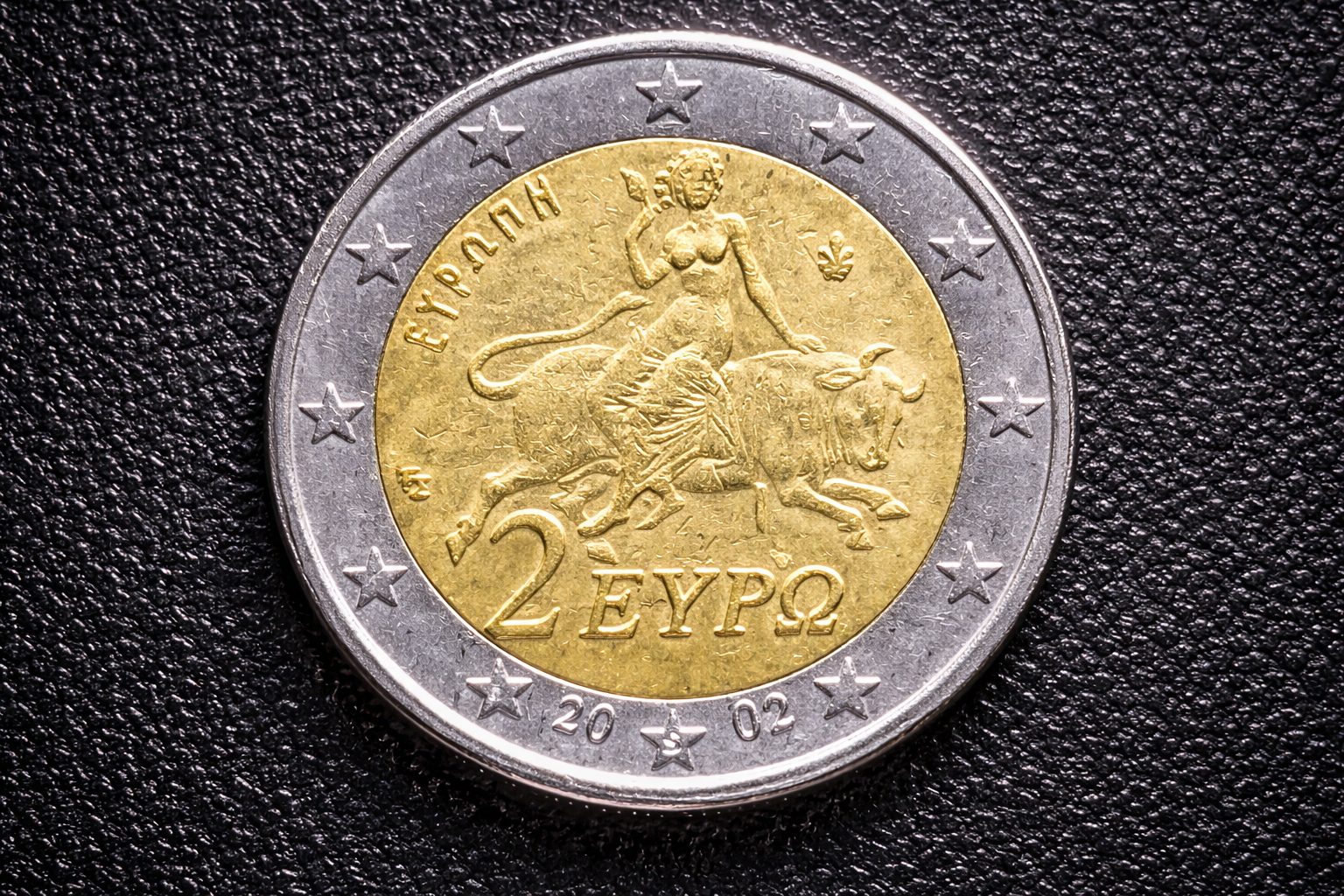
A flurry of headlines and social posts in recent days has encouraged people to rummage through wallets, jars, and sofa cushions for a “rare” €2 coin that could supposedly be worth far more than its face value. The buzz tends to center on a specific €2 coin dated 2002, and a tiny detail collectors are told to look for: an “S” inside one of the stars.
If you’ve seen those claims and you’re now squinting at your loose change, you’re not alone. As one specialist publication observed, coin dealers have been “practically inundated with phone calls” about alleged rarities and minting errors tied to viral posts. zinio.com
Here’s what that coin actually is, why it became a magnet for online hype, what it’s realistically worth, and which €2 coins truly can command serious premiums.
The viral €2 coin: what “S in the star” really means
The coin at the center of the chatter is typically a Greek €2 coin from the first years of euro circulation. On the national side, Greece’s €2 design features Europa seated on a bull—a reference to the myth of Europa and Zeus.
How to spot it in 10 seconds
Pick up your €2 coin and check:
- Country: Greece (Greek lettering and design)
- Year: usually 2002
- Detail: a small “S” that appears inside one of the stars on the national side
- Design clue: the myth of Europa and the bull is a giveaway for Greek €2 coins
Why is there an “S” at all?
The “S” is not a secret code and not automatically a minting error. Numista’s catalog lists the mints for this coin type and notes that “S” refers to the Mint of Finland (Suomen Rahapaja). Numista
In other words, some Greek euro coins—especially in the early euro years—were struck with the help of other European mints. The “S” is essentially a mint mark indicating where that particular batch was produced.
Is the 2002 Greek €2 “S in the star” coin actually rare?
This is where the internet hype often falls apart.
According to the NGC World Coin Price Guide (powered by NumisMaster), the Greek €2 has very large mintages:
- 2002 (no “S”): 75,400,000
- 2002 “S in star”: 70,000,000 NGC Coin
Seventy million is a big number in coin terms. That doesn’t mean nobody will pay a premium—collectors often like notable varieties—but it does mean the “S” coin is not inherently scarce in the way a low-mintage commemorative or microstate issue can be.
What it’s realistically worth
Pricing depends heavily on condition (circulated vs. uncirculated) and on the market at the time you sell. NGC’s own guide includes a reminder that its prices are compiled from third-party sources and are averages, not specific prices for individual coins.
Still, the NGC guide’s value grid for these Greek €2 issues is generally in low, single-digit territory for common dates (with higher values attached to genuinely low-mintage years like 2003 and mint-set-only issues).
So if you have a well-worn 2002 Greek €2 with an “S,” the most realistic outcome is:
- interesting find,
- maybe a small collector premium,
- but not a “quit your job” coin.
Why the “rare €2 coin” stories keep going viral
The “S in the star” story has the perfect ingredients for the algorithm: tiny detail, everyday object, and a big implied payoff. But as that Coin Collector issue synopsis points out, the euro “rare coin” craze has led to waves of claims that can quickly outpace reality—prompting dealers and specialists to field constant questions about supposed errors. zinio.com
A practical rule: treat extraordinary valuations as suspect unless they’re backed by reputable auction results or a recognized price guide.
The €2 coins that really can be valuable
If you want to focus your coin hunt where it actually matters, look beyond mass-minted circulation coins and toward categories where genuine scarcity is more common.
1) €2 commemorative coins
The European Central Bank explains that euro countries may issue €2 commemorative coins (with a special national-side design), and these are legal tender throughout the euro area.
Commemoratives aren’t automatically rare—but some have lower mintages, higher demand, or special collector interest.
A helpful historical marker: the ECB notes the first €2 commemorative coin was issued by Greece in 2004 for the Athens Olympic Games.
2) Microstate euro coins: Vatican City, Monaco, San Marino
Coins issued by microstates are a completely different game. Many of these coins are produced in limited quantities and are bought up by collectors quickly, meaning they rarely appear in everyday change.
For example, a CoinsWeekly report on Vatican €2 coins states the 2002 Vatican €2 coin (with Pope John Paul II) is “hardly offered for less than 300 euros,” highlighting how dramatically microstate scarcity can shift pricing. CoinsWeekly
San Marino is another standout. NGC’s price guide lists the San Marino 2 Euro (KM#447) with a 2002R mintage of 255,760—tiny compared to the tens of millions for mainstream circulation issues.
A fast checklist: how to check your €2 coins like a collector
If you want a method that’s quick, realistic, and doesn’t rely on viral hype, here’s a simple workflow:
Step 1: Identify the country and year
- Country matters because mintages and collector demand vary widely.
- Year matters because early-year issues, special series, and mint-set-only years can be different.
Step 2: Look for commemorative designs
If the national side doesn’t match the standard design you’re used to for that country, it may be a commemorative. The ECB confirms that commemorative €2 coins exist and circulate as legal tender.
Step 3: Look for mint marks and small letters
The “S” on a Greek coin is a good example of why you should verify what the mark means before assuming it’s an error. Numista explicitly lists S = Mint of Finland for the Greek €2 type. Numista
Step 4: Judge condition honestly
Two identical coins can have very different market value depending on:
- scratches and wear,
- rim nicks,
- staining and corrosion,
- sharpness of the design details.
Most viral valuations assume unusually high condition.
Step 5: Rule out counterfeits before you do anything else
Counterfeit €2 coins do exist, and if you suspect one, treat it as a safety/consumer issue—not a collecting opportunity.
The Central Bank of Ireland says that if you believe you have a suspect counterfeit, you are obliged to submit it to your financial institution, the Gardaí, or the Central Bank’s analysis centres.
The Central Bank also provides practical indicators for suspect counterfeit coins, such as poor image detail, different colour ring/core, and edge lettering issues, as well as differences in size, thickness, diameter, and weight.
How to value a “maybe rare” €2 coin without getting misled
If you think you’ve found something special, here’s how to avoid the most common traps:
Don’t use listing prices as proof
Online marketplaces are full of optimistic asking prices. What matters is what buyers actually pay, and ideally what reputable price guides or auction archives support.
Use reputable references—and read the fine print
The NGC World Coin Price Guide is useful for sense-checking mintages and typical values, and it also includes a key warning: guide prices are averages compiled from sources NGC believes reliable and do not guarantee what any specific coin will sell for.
Numista is helpful for identifying designs, inscriptions, and mint marks (like the Greek “S”), which can prevent you from confusing a normal mint mark for a rare error. Numista
If the claim is “worth thousands,” demand auction-grade evidence
Coins can absolutely sell for thousands—but those cases usually involve:
- extreme rarity,
- verified provenance,
- top-tier grading,
- major collector demand.
That’s not the typical profile of a mass-mintage circulation €2 coin.
Bottom line: should you check your change?
Yes—checking your €2 coins is a fun, low-effort way to learn what’s in circulation, and occasionally you can find coins with genuine collector interest. But the most viral claim—the 2002 Greek €2 with an “S” in the star—is better understood as a mint-mark variety with a huge mintage, not a guaranteed jackpot. NGC Coin+1
If you want to maximize your odds of finding something meaningfully valuable, focus on:
- microstate coins (Vatican, Monaco, San Marino),
- low-mintage commemoratives,
- and any coin that reputable guides confirm as genuinely scarce.
And if a coin seems “off” in weight, detail, or edge lettering, treat it as a suspected counterfeit and follow central bank guidance—don’t try to sell it online. Central Bank of Ireland – English+1