
NEW YORK, Dec. 27, 2025, 10:49 a.m. ET — Market closed
IonQ, Inc. NYSE:IONQ stock is heading into the final trading days of 2025 with momentum still split between two powerful narratives: growing commercial traction for quantum hardware and networking, and persistent concerns that the share price has been discounting a best-case future far ahead of today’s fundamentals.
With U.S. markets closed for the weekend, investors are left to assess Friday’s sharp move and the latest wave of sell-side commentary before the next regular session begins Monday.
IonQ stock price: What happened in the last session
IonQ shares finished Friday, Dec. 26 at $46.00, down $3.80 (-7.63%) on the day, after trading between roughly $45.78 and $50.08 on heavy volume near 19.7 million shares, according to consolidated market data.
That drop came in a thin, post-Christmas market where major U.S. indexes slipped only slightly and volume was light—conditions that can amplify moves in high-beta, high-sentiment stocks like pure-play quantum names.
Several market trackers and newswires highlighted the speed of IonQ’s decline on Friday, with reports noting the stock was last changing hands around the mid-$46 area after touching the mid-$45s intraday.
Why IonQ fell: No single headline, but valuation debate is back in focus
There was no new IonQ press release dated Dec. 26–27 on the company’s investor news feed. Instead, much of the most recent “news” around IONQ has been analysis-driven, centered on valuation, sector volatility, and expectations for commercialization timelines. IonQ
A widely circulated commentary published via Nasdaq argued that—even after IonQ’s recent system-sale headlines—the stock remains “priced for perfection,” emphasizing how far-forward the valuation sits relative to current revenue scale. Nasdaq
Motley Fool columnist Geoffrey Seiler, in a separate piece published Friday, framed IonQ’s 2025 trading as a “roller-coaster,” noting the stock is down more than 35% from its highs even after being one of the most watched quantum names this year. The Motley Fool
Taken together, the latest read-through from market commentary is that IonQ’s Friday selloff looked less like a reaction to a new company-specific negative catalyst—and more like a reminder that year-end positioning + thin liquidity + stretched expectations can create abrupt downdrafts in high-volatility themes.
The IonQ headline investors are still digesting: South Korea 100-qubit Tempo system
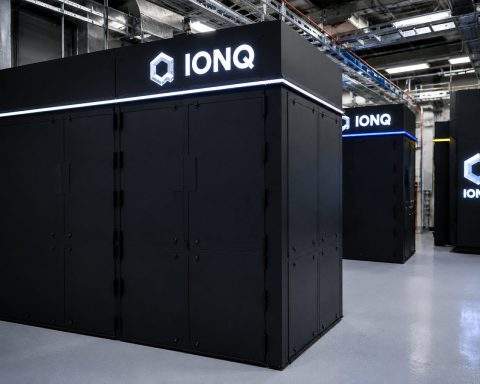
The most recent major company announcement arrived earlier in the week. On Dec. 23, IonQ said it finalized an agreement with South Korea’s Korea Institute of Science and Technology Information (KISTI) to deliver a 100‑qubit IonQ Tempo quantum system, designed to be integrated into KISTI‑6 (“HANKANG”), which IonQ described as Korea’s largest high-performance computing cluster. IonQ
IonQ Chairman and CEO Niccolo de Masi positioned the deal as a milestone deployment of IonQ’s “most advanced quantum systems,” while KISTI President Dr. Sik Lee said the integration is intended to enable practical research and innovation across fields including healthcare, finance, and materials science. IonQ
For investors, the key question isn’t whether a 100‑qubit system sale is strategically important—it likely is—but how quickly such deployments translate into recurring revenue, utilization, and follow-on demand at a pace that can justify the valuation frameworks being used across the sector.
Forecasts and analyst outlook: Targets cluster in the $70s, with bulls still calling $100
Despite Friday’s pullback, Wall Street price targets remain materially above the current quote—though the range is wide.
Consensus snapshots (varies by data provider):
- MarketBeat lists a consensus price target of $72.08 on IonQ, describing overall analyst sentiment as “Hold” based on 17 ratings, with targets ranging from $30 to $100. MarketBeat
- TradingView, citing a separate analyst dataset, shows an average target around $75.50, with a $47 low and $100 high, and describes the recent rating mix as leaning strong buy (based on ratings within the last three months).
The most-cited “street-high” view:
Jefferies’ Kevin Garrigan initiated coverage with a Buy rating and a $100 price target, according to multiple market news summaries. TipRanks+1
In published coverage of that initiation, Jefferies’ thesis was framed around:
- “Ecosystem tailwinds” supporting adoption, and
- IonQ’s trapped-ion architecture differentiating on coherence, fidelity, and native all-to-all connectivity.
Investing.com’s write-up of the call added that Jefferies’ $100 target was derived from discounted 2030 revenue projections, and highlighted IonQ’s expansion beyond quantum computing into networking and sensing, while also noting the company remains unprofitable.
What the fundamentals say: Growth, cash, and big GAAP losses tied to scaling and deals
IonQ’s latest reported quarter remains a central reference point for both bulls and bears.
In its third-quarter 2025 results (released Nov. 5), IonQ reported:
- Revenue of $39.9 million (up 222% year over year) IonQ
- GAAP EPS of ($3.58) and Adjusted EPS of ($0.17) IonQ
- A stated intent to raise full-year revenue expectations to $106 million–$110 million IonQ
- And a pro-forma cash, cash equivalents, and investments figure of $3.5 billion after an October equity offering, underscoring balance-sheet capacity to fund R&D and commercialization.
That combination—rapid top-line growth, significant cash, but large GAAP losses—helps explain why IonQ can simultaneously attract premium long-duration forecasts and sharp valuation skepticism in the same news cycle.
The broader tape matters: Post-holiday market conditions can magnify IONQ volatility
Friday’s broader market environment provides important context for IonQ’s move. Reuters described the session as a quiet, post-Christmas day with limited catalysts and light volume, while the Associated Press also characterized trading as subdued with indexes only marginally lower.
IonQ is frequently described as a high-volatility name—MarketBeat and other market summaries list a beta in the ~2.6 range—so when liquidity is thin and investors are rebalancing, IonQ can swing more than the market.
What investors should know before the next session
With the exchange closed, the most actionable setup for Monday is not a single headline—it’s a checklist of catalysts and pressure points that can move IONQ quickly in either direction.
1) Watch for follow-through news on the KISTI system delivery
IonQ’s Dec. 23 announcement is strategically significant, but investors will be listening for incremental detail: delivery timeline, how the system is monetized (system sale vs. services), utilization expectations, and whether the deployment catalyzes additional regional demand.
2) Track the “valuation vs. adoption” narrative—because it’s driving day-to-day sentiment
In the last 24–48 hours, some of the most-read IonQ coverage has been explicitly valuation-centered, arguing that even meaningful technical progress doesn’t automatically make the stock attractive at current multiples. Nasdaq+1
3) Know where the Street is anchored on targets
Even after Friday’s decline, widely cited targets remain clustered in the low-to-mid $70s on average, with the most optimistic published targets still at $100. That target dispersion is a signal: IonQ’s upside case is compelling to some analysts, but the uncertainty band remains large.
4) Put the next earnings window on your calendar—but treat it as an estimate
Zacks lists IonQ’s next earnings as expected around Feb. 25, 2026, while other market calendars similarly label the date as estimated based on historical reporting patterns. Investors should confirm timing via IonQ’s investor relations updates as the date approaches.
5) Expect volatility to remain part of the trade
Market commentators have repeatedly pointed to quantum stocks as one of 2025’s most sentiment-driven themes, with large swings common even when the broader market is calm.
Bottom line
IonQ stock enters the final stretch of 2025 after a sharp Friday drawdown that appears driven more by positioning, liquidity, and valuation debate than by fresh company-specific bad news. The company’s latest major operational headline—its 100‑qubit Tempo system agreement with South Korea’s KISTI—continues to support the long-term commercialization narrative, while analysts remain divided on how much of that future is already priced in.
When markets reopen Monday, IONQ is likely to trade on the same factors that dominated the last 48 hours: high expectations, high volatility, and a widening gap between long-term forecasts and near-term financial reality.