
NEW YORK, Dec. 27, 2025, 12:40 p.m. ET — Market closed (weekend).
Quantum computing stocks are ending the week on a cautious note after a sharp Friday pullback, even as the broader U.S. market remains close to record levels in what’s typically a thinly traded, post-holiday stretch.
In the latest regular session (Friday, Dec. 26), several of the most-followed “pure-play” quantum names fell meaningfully, underscoring the sector’s defining trait for investors: extreme sensitivity to sentiment, liquidity, and narrative shifts—especially during year-end trading conditions.
As of Friday’s close, IonQ (IONQ) finished around $46.00 (-7.6%), D-Wave Quantum (QBTS) near $25.29 (-8.1%), Rigetti Computing (RGTI) about $22.38 (-8.6%), Quantum Computing Inc. (QUBT) around $10.66 (-6.5%), while quantum-safe encryption name Arqit (ARQQ) ended near $22.81 (-9.6%).
The market backdrop: thin liquidity, big moves in high-beta names
Friday’s tape was quiet at the index level. Reuters described a “light-volume post-Christmas session” with few catalysts and modest declines across the major benchmarks; trading volume was below recent averages—exactly the kind of environment that can amplify moves in speculative, story-driven stocks. Reuters
Ryan Detrick, chief market strategist at Carson Group, characterized the broader market’s pause as “catching our breath” after a strong run, while pointing to the seasonal “Santa Claus rally” window that often brings an upward tilt—but not without volatility. Reuters
That matters for quantum computing stocks because many of these tickers trade like high-octane sentiment vehicles: they can surge on incremental milestones and then snap back quickly when profit-taking appears or when liquidity thins.
Reuters’ “Week Ahead” note also flagged that year-end portfolio adjustments and light volumes can increase volatility into the final sessions of the year, with investors watching macro catalysts such as Fed meeting minutes due Tuesday for clarity on the 2026 rate path. Reuters
Why quantum computing stocks are so reactive right now
Quantum investing is still a long-duration bet on engineering breakthroughs and commercialization timelines. The sector sits at the intersection of:
- Hardware roadmaps (qubits, error rates, scaling)
- Real-world utility (hybrid quantum-classical workflows that produce measurable value now)
- Funding and dilution risk (R&D intensity and cash burn for many early-stage players)
- Narratives tied to AI infrastructure (where “quantum + AI” is increasingly marketed as a next-wave platform theme)
A MarketBeat screen published Friday highlighted D-Wave, IonQ, and Quantum Computing Inc. among the quantum names drawing attention, while emphasizing their speculative, long-horizon nature and higher volatility/risk profile relative to established sectors.
IonQ: a headline 100-qubit sale—and the “million-qubit problem”
IonQ’s week-end conversation has been dominated by a fresh round of debate over what “progress” really means in quantum hardware.
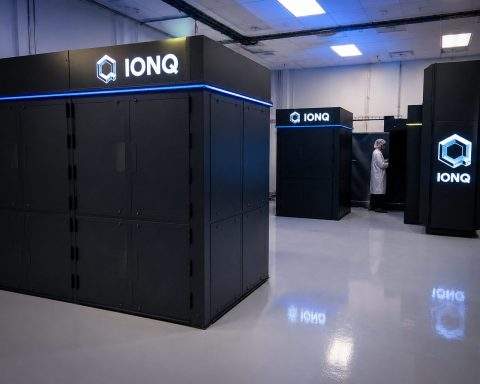
IonQ recently finalized an agreement tied to delivering a 100-qubit IonQ Tempo system to South Korea’s Korea Institute of Science and Technology Information (KISTI), positioning the system as part of a national hybrid quantum-classical initiative and integrating it into KISTI’s HPC environment.
But in a widely circulated analysis this week, Motley Fool contributing analyst Anders Bylund argued the deal—while notable—doesn’t solve the core gap between today’s machines and the scale required for many “game-changing” use cases. He highlighted the difference between physical qubits and the smaller number of algorithmic qubits available after error correction, saying IonQ’s 100 physical qubits translate to about 64 algorithmic qubits in this context. The Motley Fool
The broader point: the industry may need thousands of algorithmic qubits and millions of physical qubits for certain transformative workloads, which keeps the commercialization timeline—and competitive winners—uncertain.
Meanwhile, another Motley Fool analysis by Geoffrey Seiler took a more constructive long-term view, emphasizing IonQ’s trapped-ion approach and the company’s push to widen its moat through partnerships, acquisitions, and government-linked work. Seiler noted IonQ’s progress on system performance and referenced government interest, including defense-related initiatives.
Investor takeaway going into Monday: IonQ remains a bellwether quantum stock—meaning it can move the entire cohort. When IONQ sells off hard (or rips higher), it often pulls peers with it. With markets closed this weekend, any company update, contract chatter, or major macro headline can show up as a gap move at Monday’s open.
D-Wave: commercial traction story meets Friday profit-taking
D-Wave has a distinct profile in the group because it has long emphasized practical, near-term optimization use cases, often delivered through annealing systems and hybrid solvers—while also pursuing gate-model development.
On Friday, the stock slid sharply. MarketBeat reported D-Wave shares down roughly 8% in the session and discussed the company in the context of analyst ratings and recent financial results.
At the same time, D-Wave is leaning into a visibility strategy as 2026 approaches. In a Dec. 22 company announcement, D-Wave said it will participate in CES 2026 (Jan. 7–8 in Las Vegas), aiming to showcase customer success stories and position quantum computing as moving toward mainstream awareness. In that release, D-Wave executive Murray Thom said that showcasing quantum computing at CES “signals that the technology is quickly moving into the mainstream.” D-Wave Quantum
Investor takeaway going into Monday: D-Wave is trying to keep attention on “value today” (hybrid solvers, optimization wins, and customer outcomes) rather than on distant, fault-tolerant quantum dreams. That makes CES and related events potential sentiment catalysts—especially in a market tape where speculative themes can rotate quickly.
Rigetti: a pullback after a momentum burst—and “big money” filings
Rigetti’s Friday drop was notable not just for the magnitude, but for what it says about the current trading regime in quantum names: rallies can be fast, crowded, and fragile.
Benzinga’s Henry Khederian described the move as a pullback after a surge that had been driven by retail momentum and broader sector optimism, noting that holiday trading conditions can exaggerate reversals when liquidity is thin.
At the same time, another theme is gaining traction in the Rigetti narrative: institutional ownership signals. In a Dec. 26 Motley Fool piece, contributing analyst Lyle Daly pointed to SEC filings showing that large managers and hedge funds have built or added positions in Rigetti during 2025, including major asset managers and several well-known hedge fund platforms. Daly also cautioned that institutional buying doesn’t erase the company’s financial risks, highlighting the stock’s high valuation relative to revenue and the firm’s heavy losses.
Investor takeaway going into Monday: RGTI is increasingly trading at the intersection of two forces:
- a technology roadmap story (superconducting quantum computing and scaling plans), and
- a positioning/flow story (high volume, sharp swings, and a market increasingly focused on who’s buying).
If broader markets stay calm, these “flow” stocks can drift; if volatility rises, they can move violently in either direction.
Quantum Computing Inc.: photonics ambitions, corporate moves, and volatility
Quantum Computing Inc. is often grouped with quantum computing stocks, though its emphasis on quantum optics and integrated photonics gives it a different angle than the qubit-hardware pure plays.
On Saturday, AAII highlighted QUBT’s latest decline, pointing to the way analyst actions and momentum characteristics can influence near-term price behavior in volatile small-cap names.
Beyond the daily move, QUBT has also been in the news recently for corporate actions that investors are still digesting heading into year-end:
- On Dec. 15, the company announced an agreement to acquire Luminar Semiconductor in an all-cash transaction valued at $110 million, positioning it as a way to accelerate its photonics roadmap and strengthen supply-chain and engineering depth.
- On Dec. 17, the company confirmed Dr. Yuping Huang as CEO effective Jan. 1, 2026, framing the leadership change as part of a transition from prototypes toward manufacturing scale.
Investor takeaway going into Monday: For QUBT, the next session may be less about “quantum headlines” and more about how investors price execution risk around acquisitions, integration, and manufacturing scale—particularly in a market where small-cap volatility can spike during thin year-end flows.
What investors should watch before the next session (Monday)
With U.S. markets closed for the weekend, investors in quantum computing stocks should be prepared for gap risk and heightened volatility when trading resumes.
Here are the key items likely to matter most on Monday:
1) Liquidity and spreads
Quantum stocks can trade with wide spreads and rapid intraday reversals during low-volume periods. Reuters has highlighted how light trading volumes can exaggerate price moves into year-end.
2) Macro sensitivity—especially rate expectations
High-growth, long-duration equities are more sensitive to shifts in interest-rate expectations. Reuters’ week-ahead preview highlighted Fed minutes due Tuesday and ongoing investor focus on the path of rate cuts in 2026.
3) Company-specific “proof points”
In this group, narratives swing on milestones:
- IonQ’s system delivery timelines and what “100-qubit” systems mean in practical terms. IonQ+1
- D-Wave’s push to frame quantum as commercially useful today, including visibility catalysts like CES 2026.
- Rigetti’s roadmap credibility versus financial burn—and whether institutional filings keep feeding a “smart money” story. The Motley Fool+1
- QUBT’s photonics strategy and execution on acquisitions/leadership transition.
4) Sector sympathy and basket trading
Because quantum computing stocks often trade as a basket, Monday’s first hour can be driven as much by “risk-on/risk-off” flows as by any single headline.
Bottom line
Quantum computing stocks ended the week with a sharp pullback—an outcome that fits both the sector’s inherent volatility and the broader market’s thin post-holiday conditions.
For investors, the setup into Monday is clear: the story is still compelling, but the path is uneven. The next wave of upside will likely require either (a) concrete proof of commercial value, (b) credible hardware scaling milestones, or (c) a renewed rush into speculative growth driven by broader macro tailwinds.
Until then, quantum computing stocks remain what they’ve been all year: high-conviction, high-volatility bets, where timing, sizing, and news discipline matter as much as the technology itself.
Related articles: NASDAQ:IONQ