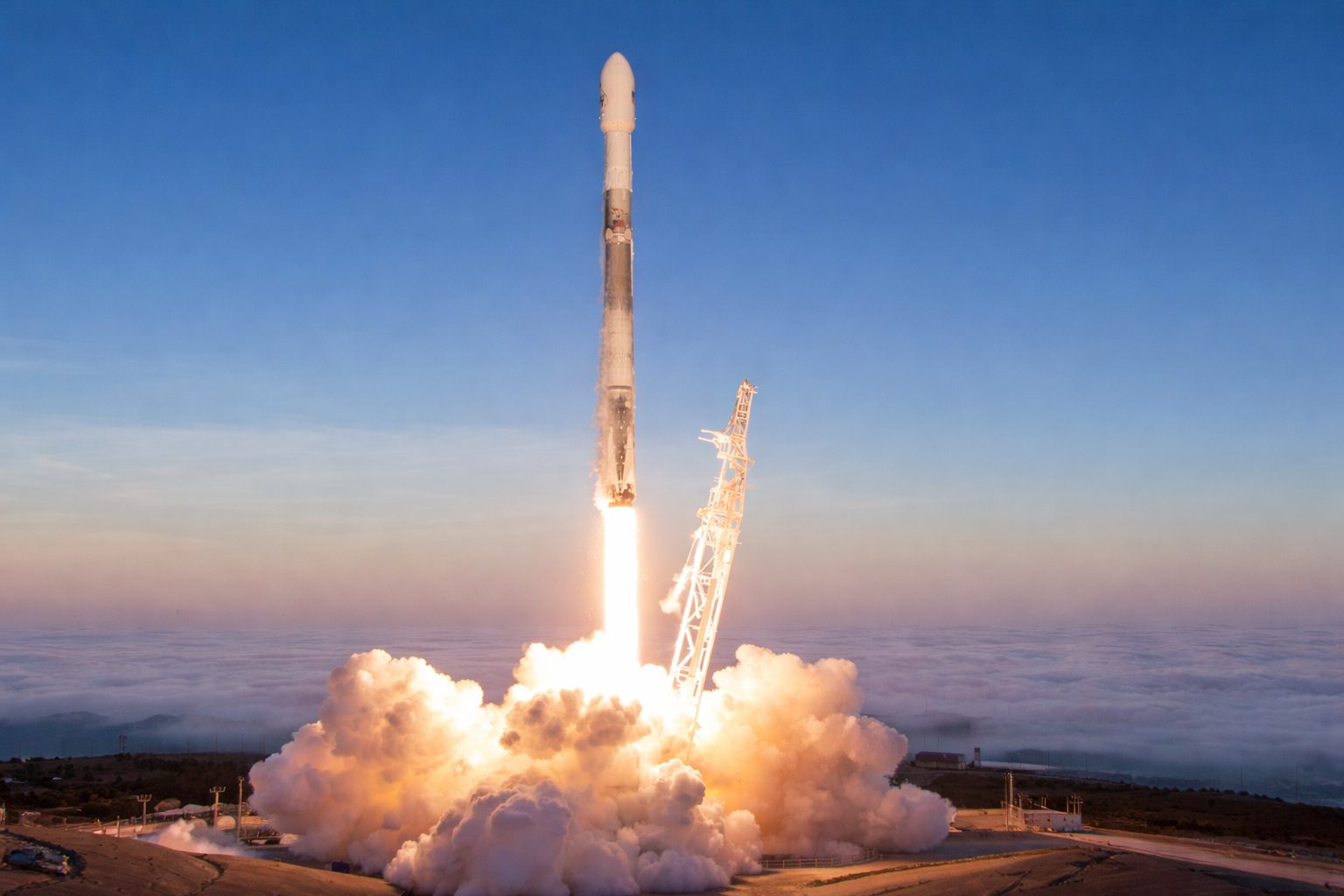

SpaceX has scrubbed its planned year-ending Falcon 9 mission from Vandenberg Space Force Base in California after a ground systems issue at the launch pad, delaying the launch of Italy’s COSMO-SkyMed Second Generation Flight Model 3 (CSG-FM3) Earth-observation satellite. Spaceflight Now reported the scrub late Saturday (U.S. time) and said SpaceX was targeting a Sunday attempt, though an updated official launch time had not yet been confirmed by the company at the time of reporting.
When it flies, the mission is set to carry a dual-use (civil and defense) synthetic-aperture radar satellite for the Italian Space Agency (ASI) and Italy’s Ministry of Defence—an all-weather imaging platform designed to deliver high-resolution views of Earth day or night. The launch also caps a relentless year of Falcon 9 operations, with SpaceX aiming to close out 2025 with one more West Coast liftoff-and-landing sequence.
What caused the scrub—and what happens next
According to Spaceflight Now’s live updates, SpaceX called off the attempt because of a ground systems issue at the Vandenberg launch pad. The same report said the company was “targeting Sunday, Dec. 28,” while noting that SpaceX had not yet announced a new official launch date and time. Spaceflight Now
Local outlets covering the launch window ahead of time—including Edhat and KEYT—had pointed to a Saturday evening liftoff target with a backup opportunity the following day around the same time, reflecting how frequently Falcon 9 missions build in 24-hour recycle options when range and vehicle readiness allow.
Launch details: Falcon 9 from Vandenberg, landing back on the California coast
The mission is slated to lift off from Space Launch Complex 4 East (SLC-4E) at Vandenberg Space Force Base. Spaceflight Now described the rocket as roughly 70 meters tall and said the payload—the CSG-FM3 satellite—will separate about 17 minutes after liftoff.
The first-stage booster assigned is Falcon 9 B1081, flying for the 21st time. Spaceflight Now reported that after stage separation, B1081 is expected to attempt a return-to-launch-site landing at Landing Zone 4 (LZ-4) around 8.5 minutes into flight. If successful, the landing would mark the 31st touchdown at LZ-4 and SpaceX’s 554th Falcon booster landing overall, according to the same report.
Spaceflight Now’s launch schedule listing also notes that the satellite is intended for a sun-synchronous orbit at about 620 km altitude with an inclination near 97.8 degrees—an orbital geometry widely used for Earth-observation missions because it keeps lighting conditions consistent for repeat imaging.
What is COSMO-SkyMed Second Generation—and why this satellite matters
CSG-FM3 is the third spacecraft in Italy’s second-generation COSMO-SkyMed radar constellation, managed jointly by ASI and the Ministry of Defence. Spaceflight Now reported that the first second-generation satellite launched in January 2021 on a Soyuz rocket from French Guiana, followed by a second launch about a year later on a Falcon 9 from Cape Canaveral. The constellation plan calls for four second-generation satellites in total, manufactured by Thales Alenia Space, Spaceflight Now said.
In Italy, the program is viewed as both a strategic capability and an industrial showcase. In November, Italian news agency Agenzia Nova reported that CSG-FM3’s pre-shipment milestone was marked at Thales Alenia Space’s headquarters in Rome with senior figures from ASI, the Ministry of Defense, and major industrial partners—including Thales Alenia Space Italia CEO Giampiero Di Paolo and Leonardo Space Division executive Marco Brancati—highlighting the breadth of the national supply chain behind the mission.
Agenzia Nova also reported that ASI President Teodoro Valente framed the satellite’s launch preparations as the result of a “virtuous collaboration” among government and industry—an emphasis that reflects how COSMO-SkyMed is positioned as a flagship dual-use system. Agenzia Nova
How the satellite “sees” through clouds: the power of synthetic aperture radar
Unlike optical satellites that rely on reflected sunlight (and can be hampered by darkness or cloud cover), COSMO-SkyMed uses synthetic aperture radar (SAR). NASA Earthdata explains that SAR is an active remote-sensing technique: the instrument transmits pulses of energy and measures the return signal, enabling high-resolution imagery “night or day” and “regardless of weather conditions.” NASA Earthdata
NASA’s overview also notes that radar instruments operate at longer wavelengths than optical sensors, allowing them to produce imagery of landforms that may be obscured by clouds—or even under dense vegetation canopies in some cases—depending on frequency band. COSMO-SkyMed’s radar operates in X-band, a higher-frequency SAR band commonly associated with high-resolution imaging for applications such as urban monitoring and ice/snow observation.
That capability is a major reason SAR constellations are prized for time-sensitive monitoring—ranging from disaster response and flood mapping to maritime surveillance—because they can maintain consistent data collection even when weather disrupts optical imaging.
New hardware on CSG-FM3: antenna upgrades and precision tracking
Agenzia Nova reported that CSG-FM3 incorporates a “new dynamic radar antenna” and a laser retroreflector array system (described as Cora‑S), designed by Italy’s National Institute for Nuclear Physics (INFN) to support millimetric localization precision—an upgrade intended to improve speed and flexibility in data acquisition. The outlet also described the mission’s broad target set, spanning security, emergency management, environmental monitoring, and tracking urban, forestry, and geological change. Agenzia Nova
The industrial and “expert” voices behind COSMO-SkyMed
Beyond the launch itself, COSMO-SkyMed Second Generation is tightly linked to Italy’s space industrial base.
A Telespazio press release detailing the constellation’s expansion describes a division of responsibilities across major partners: Thales Alenia Space leading satellite design and development and end-to-end system work; Telespazio responsible for the ground segment and operations; and Leonardo supplying key subsystems including star trackers and power-related hardware. The same statement describes COSMO-SkyMed as a dual-use system financed by ASI, the Ministry of Defense, and Italy’s Ministry of Education, University and Research, designed to monitor Earth “day and night, under any weather conditions, using high-resolution X-band radars.” Telespazio
That release also includes on-the-record assessments from senior industry executives. Thales Alenia Space executive Massimo Claudio Comparini said the additional satellites would help guarantee a “leap forward” in technology and performance for the constellation, while Telespazio CEO Luigi Pasquali pointed to “operational continuity” and improved performance across both space and ground segments. Telespazio
In a broader sign of Europe’s push to scale space manufacturing, Reuters reported this fall that Italy’s space agency and Thales Alenia Space were preparing to launch operations at a large new satellite manufacturing facility near Rome, aimed at boosting production capacity and competitiveness—context that underscores why missions like COSMO-SkyMed matter not only operationally, but industrially.
How to watch the SpaceX Falcon 9 launch
Ahead of the original launch window, KEYT reported that SpaceX’s webcast is expected to begin roughly 15 minutes before liftoff and can be viewed via SpaceX’s website and the company’s official social channels.
Edhat similarly pointed readers to SpaceX’s livestream and noted that the U.S. Space Force had approved the launch window—typical for Vandenberg missions, where range safety and airspace coordination are managed through Space Force infrastructure.
Because the mission was scrubbed for a ground issue and is now being retargeted, viewers should watch for the latest official timing closer to the next attempt—especially since instantaneous launch windows for precise orbits can shift by minutes depending on range availability and vehicle readiness.
What Californians (and the Southwest) might see and hear: sonic booms and the “twilight effect”
For communities along the Central Coast, the most noticeable part of the mission may come after liftoff.
Edhat warned that if Falcon 9’s booster returns to land at Vandenberg, residents in parts of Santa Barbara, San Luis Obispo, and Ventura counties could hear sonic booms—depending on weather and atmospheric conditions, which can refract sound and change how far it carries.
For viewers farther inland—including parts of Arizona—some Falcon 9 launches from Vandenberg have produced striking “comet-like” plumes. Arizona’s Family (azfamily.com) has explained that the phenomenon is often tied to the “twilight effect,” when the Sun has recently set for observers on the ground, but the rocket’s exhaust plume is still illuminated at high altitude, making it appear unusually bright against a darkening sky. https://www.azfamily.com+1
Visibility depends heavily on cloud cover, haze, and the rocket’s flight path—so even with a clear forecast, sightings can vary across neighborhoods and elevations.
Why this mission is a year-end milestone for SpaceX
Even by 2025 standards, this launch stands out for its timing and cadence.
Spaceflight Now described it as SpaceX’s final Falcon 9 flight of the year—an endpoint to a schedule defined by rapid turnaround, routine reuse, and frequent landings on both drone ships and land pads.
Earlier in December, Space.com reported that SpaceX notched its 550th Falcon 9 booster landing, a reminder of how central recoveries have become to the company’s high-tempo manifest. If B1081 lands successfully on this COSMO-SkyMed mission, it would add yet another data point to the operational maturity of reusability.
The bottom line
SpaceX’s COSMO-SkyMed Second Generation (CSG-FM3) mission remains one of the most consequential late-year launches: a dual-use Italian radar satellite designed for all-weather, day-night Earth imaging, paired with a high-flight-count Falcon 9 booster aiming for a precision landing back at Vandenberg.
But after Saturday’s scrub for a ground systems issue, the most important detail for readers is the moving target: the next attempt is expected to come after a recycle, with local outlets and Spaceflight Now pointing to a Sunday retarget while SpaceX finalizes the official call.
Related articles: Space