
NEW YORK, Dec. 28, 2025, 12:26 a.m. ET — Market closed (Weekend).
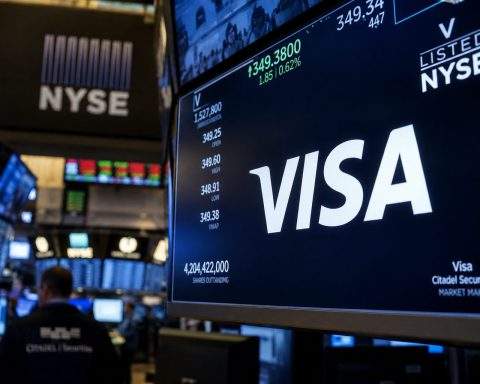
Visa Inc. NYSE:V enters the final, holiday-thinned stretch of 2025 with its shares hovering around $355, after finishing Friday’s session down modestly on the day (about -0.04%) and still well within a $299–$375.51 52-week range.
That “quietly resilient” tape fits the broader market mood heading into the last three trading days of the year. In Friday’s light, post-Christmas session, U.S. stocks drifted slightly lower with thin volumes—still near record territory—while investors sized up the classic year-end “Santa Claus rally” window and the next set of macro catalysts. Reuters+1
For Visa stock, the near-term narrative is a tug-of-war between a steady consumer-spending backdrop (good for payment volumes), evolving technology initiatives (AI-enabled commerce and stablecoin settlement), and ongoing legal/regulatory overhangs that periodically flare up across the card-network ecosystem.
What’s new on Visa in the last 24–48 hours
Company-specific, market-moving headlines for Visa have been relatively sparse over the past 24–48 hours—not unusual on a winter weekend when U.S. equity markets are shut. Still, a few items have shaped investor conversation heading into Monday:
Fresh investor analysis comparing Visa vs. Mastercard.
A widely circulated opinion piece published Friday argued that Visa and Mastercard remain a durable “duopoly” benefiting from scale and secular digital-payment growth, but favored Visa on a mix of profitability, balance sheet and valuation considerations. (It’s commentary—not a company filing—but it’s part of the current discourse.) Seeking Alpha
Institutional-ownership updates.
Several weekend write-ups highlighted new or updated positions reported by investment firms, reflecting the steady churn of institutional ownership around mega-cap compounders like Visa. These are typically backward-looking disclosures rather than real-time trading signals, but they can influence sentiment at the margin when news flow is otherwise quiet.
Macro context that matters for Visa: consumers keep spending, markets eye catalysts.
A key support for payment networks is that spending hasn’t collapsed—even when sentiment data looks gloomy—an idea echoed in recent consumer coverage. The Washington Post Meanwhile, Reuters’ “Week Ahead” outlook flagged year-end positioning, light liquidity, and upcoming Fed communications as potential volatility triggers as the market tries to finish a strong year on a high note. Reuters
The market backdrop: why Visa investors are watching next week closely
Visa doesn’t take credit risk the way lenders do—its model is more about transaction volumes, cross-border activity, and value-added services—so the stock often trades as a high-quality “financial infrastructure” name whose valuation can be sensitive to rates, growth expectations, and risk appetite.
Reuters described Friday’s session as a “catching our breath” pause after a strong run, with strategists emphasizing the Santa Claus rally window and the reality that thin trading can exaggerate moves. Reuters Looking into the coming week, Reuters noted the market’s focus on Fed minutes (due Tuesday) and the ongoing debate over the path of rates, alongside year-end adjustments. Reuters
That matters for Visa because:
- Stronger spending and stable employment tend to support payment volume growth.
- Rate expectations can affect what investors are willing to pay for consistent, premium-multiple compounders.
- Thin liquidity late in December can make even “small” headlines feel larger in the stock price.
Key Visa developments still steering the narrative into year-end
Even if they didn’t hit in the last 48 hours, several December developments are still very much “active ingredients” in how investors frame Visa stock right now.
1) Visa’s holiday spending data: growth, but consumers stayed value-conscious
Visa’s annual Retail Spend Monitor pointed to 4.2% year-over-year growth in U.S. holiday retail spending (across all payment types, not inflation-adjusted), with e-commerce up 7.8% and in-store activity still dominant.
Visa Chief Economist Wayne Best said AI tools helped shoppers compare prices and stretch budgets—language that fits a broader theme: consumers are spending, but they’re spending more deliberately. Visa+1 Reuters also cited Michelle Meyer, chief economist at the Mastercard Economics Institute, highlighting early shopping and promotions as key drivers.
For Visa investors, the takeaway is less about any single holiday season print and more about confirmation that payment volumes are still compounding—even in a “careful consumer” environment.
2) Litigation escrow funding: a technical move with real capital-structure implications
In an 8-K filed Dec. 23, Visa disclosed it authorized a $500 million deposit into a U.S. litigation escrow account under its retrospective responsibility plan. Visa explained that funding the escrow dilutes Class B conversion rates and has the same EPS effect as repurchasing Class A shares. The filing was signed by CFO Chris Suh.
A follow-on analyst note summarized by Investing.com said Baird reiterated an Outperform rating and a $425 price target, describing the transaction as expected to be neutral to annual EPS, and modeling roughly 15 million shares repurchased in fiscal Q1 2026 (in the context of Visa’s broader buyback cadence).
Translation for normal humans: this isn’t a “new product” catalyst, but it’s a reminder that Visa’s capital-return engine and legacy legal structures can create headline risk—and occasionally create financial engineering that looks buyback-like in its EPS impact.
3) Stablecoin settlement in the U.S.: Visa pushes settlement closer to “always on”
Visa announced Dec. 16 that it is bringing USDC settlement to U.S. issuer and acquirer partners, highlighting benefits like seven-day availability and improved operational resilience “across weekends and holidays,” while keeping the consumer card experience unchanged. Visa
Visa said initial participants include Cross River Bank and Lead Bank, settling in USDC over Solana, with broader U.S. availability planned through 2026.
Notable voices attached to this announcement include:
- Visa’s Rubail Birwadker, who said banks aren’t just asking about stablecoin settlement—“they’re preparing to use it.” Visa
- Circle’s Nikhil Chandhok, who framed Visa+USDC as a milestone for “internet native money” moving at software speed. Visa
- Lead Bank CEO Jackie Reses emphasizing treasury precision and speed.
- Cross River CEO Gilles Gade arguing interoperability between stablecoins and traditional networks is foundational.
Investors don’t need to believe stablecoins replace card networks to see why this matters: Visa is positioning itself as the rails beneath the rails—making settlement more continuous and programmable for institutions, while preserving the familiar “tap/swipe” experience for consumers.
4) AI-enabled commerce: Visa says “agentic” payments are moving from demos to pilots
Visa also announced Dec. 18 that it and partners completed “hundreds” of secure, agent-initiated transactions, with the company pitching 2026 as the year AI agents start completing purchases (not just recommending products). Visa
Birwadker again served as the key executive voice, tying the initiative to Visa’s standards, scale, and security posture for “agentic commerce.” Visa
Legal and regulatory overhang: still the shadow on the wall
Visa’s long-run story is often described as “high-quality compounding,” but periodic legal settlements can puncture the calm. In December, Reuters reported:
- A proposed ATM fee class action settlement involving Visa and Mastercard.
- A revised merchant swipe-fee settlement tied to long-running disputes over acceptance costs.
These items tend to evolve slowly—court approvals, revised terms, implementation details—but they remain part of the risk checklist for anyone underwriting the stock at a premium multiple.
Analyst forecasts: price targets cluster above current levels
Across major market-data aggregators, Visa’s consensus analyst stance remains broadly constructive:
- One widely referenced analyst aggregation shows an average price target around $398.88 (roughly low-double-digit upside from the mid-$350s), with targets ranging from $330 on the low end up to $450.
- MarketBeat similarly describes consensus sentiment as “buy,” with projected upside in the low-teens based on compiled 12-month forecasts. MarketBeat
- In the wake of the litigation-escrow disclosure, Baird reiterated $425 as a stated target.
No single price target is prophecy, but the clustering is telling: analysts generally model Visa as a steady grower with enough margin, buybacks, and operating leverage to justify upside—so long as regulation and legal costs don’t meaningfully reset the economics.
Next major catalyst: earnings timing is “late January,” but calendars differ
Visa has not confirmed its next earnings date, and third-party calendars don’t perfectly agree:
- MarketBeat lists an estimated earnings date of Jan. 29, 2026, explicitly noting it is not confirmed by the company.
- Investing.com lists the next report on Jan. 22, 2026.
For investors, the practical point is the same: the next big fundamental reset is likely late January, when Visa’s tone on consumer spending, cross-border trends, and expenses will matter more than any single day of year-end tape.
Market is closed: what Visa investors should know before Monday’s session
Because it’s the weekend, Visa won’t trade again until Monday’s U.S. session opens. Here are the high-signal items to have in mind before the bell:
Know the clock.
NYSE core trading runs 9:30 a.m. to 4:00 p.m. ET, with a pre-opening session beginning at 6:30 a.m. ET.
Expect thin liquidity—and sharper-than-usual reactions.
Reuters emphasized year-end adjustments and light volumes can amplify market moves. That’s especially relevant for widely held mega-caps like Visa, where positioning can matter as much as headlines in the final days of December.
Watch Tuesday’s Fed minutes (Dec. 30) and the rate narrative.
Reuters flagged the Fed minutes as the standout scheduled event in the holiday-shortened week ahead, with markets still “handicapping” how many cuts come next year. Reuters A shifting rate outlook can move the multiple investors are willing to pay for Visa’s consistency.
Remember the holiday schedule.
Investopedia reports a full trading day on New Year’s Eve (Wed., Dec. 31), with U.S. stock markets closed on New Year’s Day (Thu., Jan. 1, 2026).
Visa-specific watchlist going into the open.
Heading into Monday, the most actionable “watch items” are:
- Any fresh developments on the litigation/settlement front (these can surface unexpectedly).
- Additional disclosures or follow-through around stablecoin settlement partnerships and institutional adoption.
- Read-throughs from holiday spending and consumer data that could affect volume expectations.
Bottom line
Visa stock is ending 2025 near $355 with the market closed for the weekend and the broader tape still hovering close to record levels. Visa Investor Relations+1 With only a few sessions left in the year, near-term trading could be driven as much by liquidity and macro headlines as by Visa-specific news.
Under the surface, the company’s December storyline remains intact: a resilient spending backdrop, continued push into AI-enabled commerce, and a clear effort to modernize institutional settlement via USDC—offset by the perennial reality that legal and regulatory chapters are never fully “done” for the card networks. Reuters+4Visa+4Visa+4
Related articles: NYSE:V