
NEW YORK, Dec. 28, 2025, 7:52 a.m. ET — Market closed
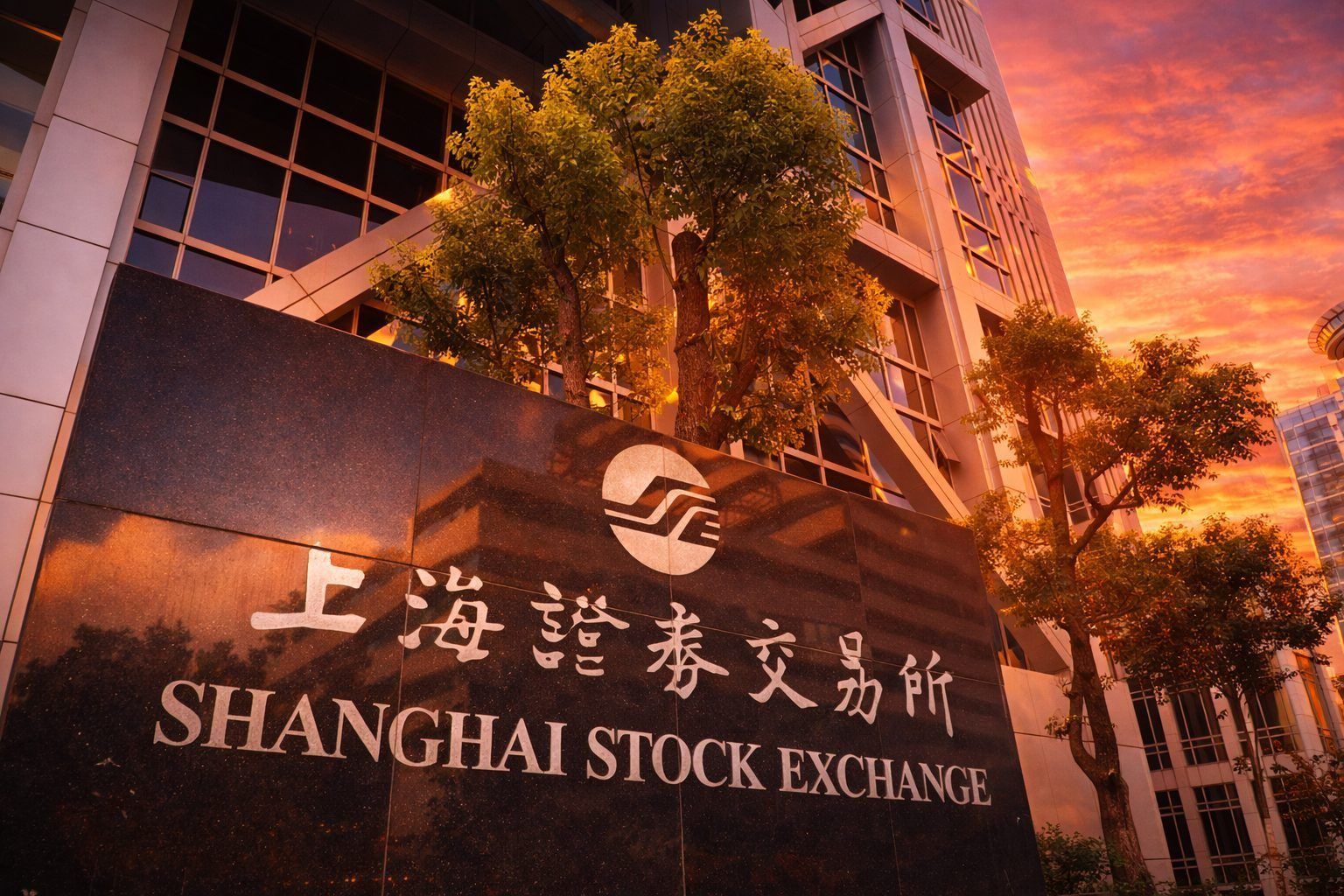
The Shanghai Stock Exchange (SSE) heads into the final stretch of the year with momentum still intact—but with a growing “show me the earnings” demand from investors as policy headlines and macro data collide. The benchmark Shanghai Composite ended Friday at 3,963.68, up 0.1%, with combined turnover across Shanghai and Shenzhen totaling about 2.16 trillion yuan, as gains in themes such as commercial spaceflight and lithium batteries helped offset weakness elsewhere. Xinhua News
With U.S. markets shut for the weekend, global investors are using the downtime to game out what matters most for mainland China equities when the next session begins: a firmer yuan, fresh signals that Beijing wants 2026 policy to lean more supportive, and a new set of SSE rules that could accelerate listings for strategically important tech—starting with reusable rocket developers on the STAR Market.
For New York-based traders, the Shanghai open effectively arrives “early”: the SSE’s cash session begins at 9:30 a.m. in Shanghai (8:30 p.m. Sunday ET), with a midday break and a 3:00 p.m. local close, alongside specific call-auction windows spelled out by the exchange. Shanghai Stock Exchange
Yuan strength is back in the narrative—and so are foreign-flow expectations
One of the cleanest “near-term” signals for A-shares has been the currency. Mainland stocks rose Friday with the CSI 300 up 0.3% to 4,657.24, while the Shanghai Composite edged higher, as optimism built around a stronger yuan and the possibility that policymakers may tolerate gradual appreciation to support confidence. Strategists at Yingda Securities said the yuan’s appreciation has eased pressure from foreign outflows and reinforced expectations of incremental inflows—arguing that policy support and currency strength are feeding each other. South China Morning Post
That matters for the Shanghai Stock Exchange specifically because the SSE carries a heavy weight of large-cap financials, industrials, and “national champion” technology names that tend to react sharply when currency moves change the perceived attractiveness of onshore assets for global allocators.
Weekend policy signal: Beijing says fiscal policy will be “more proactive” in 2026
The biggest new headline landing into the weekend is Beijing’s renewed emphasis on domestic demand. China’s finance ministry said Sunday that fiscal policies will be more “proactive” next year, reiterating priorities that include boosting consumption, expanding investment in new growth drivers, supporting technological innovation, and strengthening the social safety net. Reuters
For Shanghai-listed sectors, the transmission mechanism is straightforward: more supportive fiscal posture can underpin consumption-linked companies, industrial upgrades, and segments tied to strategic technologies—while also helping stabilize sentiment that has been dented by a prolonged property downturn and uneven domestic demand. The same Reuters report noted expectations around maintaining a growth target near 5% for 2026 and the need to keep policy supportive to counter deflationary pressures.
Macro reality check: industrial profits just posted their sharpest drop in over a year
Policy intent is one thing; the data tape is another. On Saturday, China reported a 13.1% year-on-year fall in industrial profits for November—described as the steepest decline in over a year—highlighting the drag from weak domestic demand even as exports showed resilience.
Reuters cited Xu Tianchen, senior economist at the Economist Intelligence Unit, saying the profit figures match a broader cooling in fourth-quarter activity, largely tied to soft domestic demand. Xu also pointed to the idea that profitability could improve under “anti-involution,” as firms scale back investment over time—though he noted that competing overseas can come “at the cost of their global peers.” Reuters
An accompanying statement referenced by Reuters quoted NBS Chief Statistician Yu Weining emphasizing that profitability recovery still needs to be put on a firmer footing amid structural adjustment and an uncertain external environment.
For SSE investors, that combination—policy support talk alongside profit pressure—often produces a market that becomes more selective: rewarding sectors with visible earnings resilience (or credible margin recovery stories) while punishing crowded themes that were driven mostly by valuation expansion.
Trade policy risk is rising again—and markets are listening
Adding another layer to the 2026 setup, China has passed revisions to its Foreign Trade Law that will take effect March 1, 2026, aimed at strengthening its ability to respond in trade conflicts while also emphasizing areas like digital and green trade and intellectual property provisions.
This is not a “pure equities” headline, but it can matter a lot for Shanghai-listed exporters, advanced manufacturers, and supply-chain heavyweights—especially in periods when investors try to handicap the probability and severity of renewed trade frictions, new export restrictions, or shifting compliance burdens. The market impact is typically indirect: it shows up through sector risk premia and through currency expectations, which then feed back into foreign-flow assumptions.
Shanghai’s own headline: STAR Market IPO “fast lane” for reusable rockets
The most Shanghai-specific development in the last 48 hours is coming straight from the venue itself. The Shanghai Stock Exchange said Chinese companies developing reusable commercial rockets will have access to a faster IPO pathway on the tech-heavy STAR Market, exempting them from some financial requirements such as profitability and minimum revenue thresholds—provided they meet specified technological milestones. Reuters
Under the new guidance reported by Reuters, the bar shifts from near-term profits to demonstrated technical progress, including at least one successful orbital launch using reusable rocket technology, and the guidelines take effect immediately.
This matters for two reasons that go beyond a single niche industry:
First, it reinforces the STAR Market’s role as a financing channel for “strategic” technology priorities, which can influence how investors value the broader board—especially if they expect more pre-profit, R&D-intensive companies to enter the pipeline.
Second, it connects directly to what was already moving the tape Friday: Xinhua reported that stocks tied to commercial spaceflight were among the leaders on the day. In other words, the exchange’s rule change is landing on a market that’s already trading the theme.
Capital controls meet capital markets: new rules on overseas listing proceeds
Another development investors are parsing for 2026 implications: China will require domestic firms to repatriate funds raised from overseas listings “in principle” under new rules aimed at tightening oversight of cross-border financing, according to Reuters. The guidance was jointly issued by China’s central bank and the foreign-exchange regulator, and is set to take effect April 1, 2026. Reuters
For Shanghai and broader A-share markets, this is a double-edged signal. On one hand, it could support onshore liquidity if more capital is brought back into domestic accounts. On the other, it may change how CFOs and boards weigh offshore listings versus onshore options—potentially tilting marginal issuance and fundraising decisions toward domestic venues such as Shanghai’s Main Board and the STAR Market.
Property stress remains a live wire: Vanke’s bond decision and rating downgrades
No China equities outlook is complete without the property-credit channel—and it continues to inject event risk.
Reuters reported that China Vanke bondholders approved a plan to extend the grace period on a 3.7 billion yuan bond repayment, while rejecting a proposal to delay repayment by a year. The grace period was extended to 30 trading days from five, according to a filing.
The same report noted that S&P Global Ratings downgraded China Vanke to “SD” (selective default) after viewing a grace-period extension on another onshore bond as distressed restructuring, and that Fitch also downgraded Vanke to “RD” (restricted default). Reuters
Even when the troubled developer isn’t listed on the Shanghai Stock Exchange, this kind of episode matters for SSE investors because the market is heavily exposed—directly and indirectly—to credit conditions, bank sentiment, and consumer confidence. It also acts as a barometer for how aggressively authorities will backstop systemically important firms.
Forecasts and analysis: 2026 becomes an “earnings year”
Year-end is when markets love narratives—and then punish them if the numbers don’t show up.
A South China Morning Post analysis published Saturday argued that after a 2025 rally driven largely by confidence and valuation expansion, the next leg in 2026 is expected to hinge on earnings growth—supported by macro policy, a push for technological self-reliance, and efforts to address oversupply and pricing discipline in parts of the green industry.
The same SCMP report cited forecasts that put numbers on that shift: UBS Group predicted profit growth would accelerate to 8% from 6% in 2025, while JPMorgan Chase expected growth ranging between 9% and 15%.
That framework maps cleanly onto Shanghai’s market structure. The Shanghai Stock Exchange is home to mega-cap banks and insurers that tend to trade on credit, growth, and dividend expectations; heavy industrials that respond to margin cycles; and STAR Market tech firms where earnings expectations can reset violently when policy incentives or funding conditions change.
Institutional outlooks: how global allocators are thinking about risk and flows
Some of the most actionable “forecast” content for Shanghai isn’t a point target on the index—it’s the direction of flows and the assumptions behind them.
Deloitte, in its 2026 outlook for China’s A-share market, described expectations for continued development and smoother growth next year, while also emphasizing that cross-border listing and fundraising conditions matter for where capital ultimately concentrates. In its U.S. capital markets outlook, Deloitte China’s Zhang Wei (National U.S. Offering leader) said he expects “more Chinese companies will list in the U.S.” as market conditions improve and as companies continue to view the U.S. as a strategic platform for global capital and visibility. Deloitte
Meanwhile, Morgan Stanley Investment Management’s Andrew Slimmon has highlighted a global macro configuration that often matters for emerging markets: he argues that a weaker U.S. dollar could be “especially positive” for emerging market stocks, and he expects emerging markets to “do quite well” in that scenario. Morgan Stanley
That’s not a Shanghai-specific call—but it’s relevant because currency and global risk appetite can influence the willingness of international investors to increase exposure to onshore China equities.
Global backdrop: U.S. equities near records, rate-cut expectations in focus
Shanghai doesn’t trade in a vacuum. Reuters’ global markets wrap Friday described major U.S. stock indexes closing near record peaks, with investors focused on the path of Federal Reserve rate cuts and the U.S. dollar under pressure—conditions that can influence cross-border allocation decisions as Asia reopens.
What investors should know before the next Shanghai Stock Exchange session
With both U.S. and Shanghai cash markets closed right now, the next meaningful price discovery for SSE-linked risk will come as Asia opens.
Here’s what typically matters most into the next Shanghai session—based on the last 24–48 hours of news flow:
The “policy put,” now with 2026 language: the finance ministry’s “more proactive” fiscal stance is supportive in tone, but investors will scrutinize implementation details and how quickly it can translate into steadier nominal growth and improved corporate margins. Reuters+1
Macro data that forces selectivity: November’s sharp industrial profit decline raises the bar for cyclical exposure and puts renewed emphasis on sectors with clearer earnings visibility or policy-backed demand.
Yuan direction and the foreign-flow story: a firmer yuan has already been tied to improved sentiment and expectations of incremental inflows, and it will remain a key read-through for how international investors treat China risk into year-end and early 2026.
STAR Market pipeline signals: the SSE’s reusable rocket IPO fast lane is a reminder that certain strategic industries may get financing support even when broader macro conditions are uneven—often boosting sentiment for adjacent “theme baskets,” but also raising questions about valuation discipline. Reuters+1
Property-credit headlines: Vanke’s grace-period extension and the associated rating actions are the kind of credit event that can ripple across financials and consumer sentiment—both heavily represented in Shanghai’s large-cap ecosystem.
Timing and mechanics: for anyone trading from the U.S., remember the SSE’s Monday cash open arrives Sunday evening ET, and the exchange’s auction windows and session structure can concentrate volatility around the open, the midday restart, and the close.
Related articles: China Economy