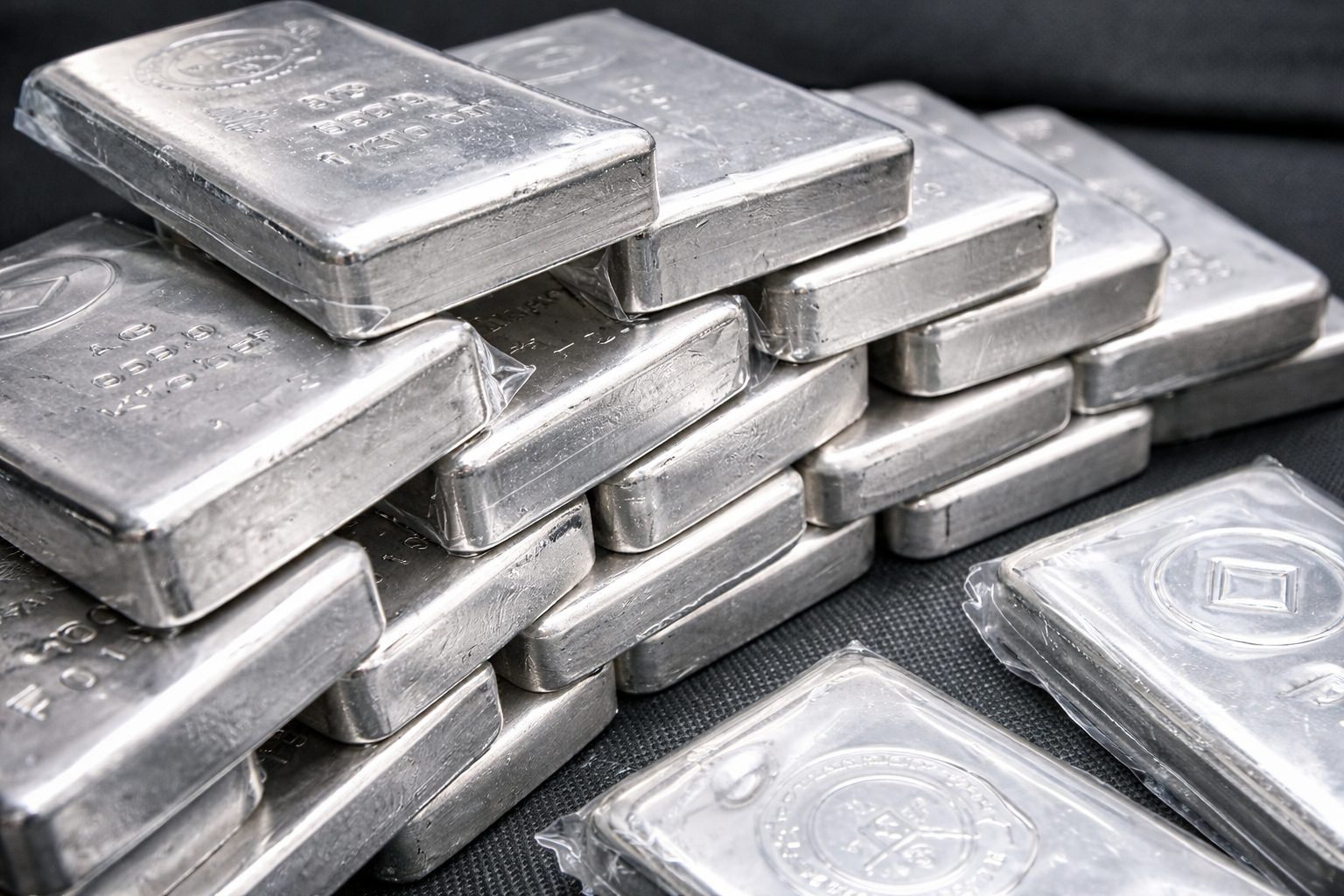

Silver is ending 2025 with a move few traders will forget: prices have raced to fresh records, briefly approaching the psychologically powerful $79-per-ounce level as the precious-metals complex pushes higher into year-end.
On Friday, December 26, 2025, silver surged as much as 9% to a record $78.53/oz, while gold hit an all-time high of $4,549.71/oz in the same session—part of a broader surge that also lifted platinum and palladium.
The rally has been so dramatic that some market watchers are now treating silver not just as a “metal trade,” but as a story about tight physical supply, tech-driven industrial demand, shifting rate expectations, and a growing wave of retail participation—all colliding in a market known for volatility.
Silver’s leap toward $79: what happened in the final week of 2025
Silver’s record run accelerated in thin, post-holiday trading conditions, where relatively modest flows can have outsized price impact. Reuters reported that silver pushed through $77 earlier in the day—touching $77.40/oz—before the later spike toward the high-$78s.
That move has placed silver among the standout performers of 2025: Reuters pegged silver’s year-to-date gain around 167% at one point on December 26, with gold up ~72% in the same timeframe (figures vary by timing and instrument, but the gap in performance has been a defining feature of the year).
Mainstream financial outlets have highlighted the milestone from different angles:
- Forbes described silver as nearing $79 after crossing above $78/oz, underscoring how rare it is for silver to print new nominal highs after decades of false starts.
- Bloomberg noted gold trading above $4,500/oz and cited spot silver crossing $77/oz during the surge.
- The Wall Street Journal focused on how the rally has broadened beyond institutions to include hobbyists and first-time buyers—an echo of past “silver moments,” but with a distinctly 2025 mix of drivers. Wall Street Journal
Why silver is surging now: deficits, demand, and macro tailwinds
Silver tends to rally for the same big-picture reasons as gold—fear, inflation, rates, geopolitics—but it often moves more because the market is smaller and silver demand is more economically sensitive. In 2025, several forces lined up at once.
1) A market that’s been running structural deficits
A central pillar of the bull case is that silver entered 2025 already tight—and stayed that way.
In a November market update, the Silver Institute said the market remained in deficit for the fifth consecutive year in 2025, estimating a ~95 million ounce shortfall and pointing to a cumulative deficit of nearly 820 million ounces from 2021–2025 as a key explanation for ongoing tightness.
The same update also highlighted constraints on the supply side: mined silver supply was expected to be roughly flat year-over-year, and much of global production remains tied to the economics of other metals because silver is often mined as a byproduct.
2) Industrial demand isn’t just “solar” anymore
Silver’s unique role is that it’s both a precious metal and a critical industrial input—an identity that can amplify rallies when investors start treating industrial tightness like a macro hedge.
The Silver Institute has emphasized growth from technology-driven end markets. In a December 2025 release citing a report produced by Oxford Economics, the Institute said demand growth over the coming years is being driven by solar photovoltaics, electric vehicles and charging infrastructure, and AI/data centers—with solar’s share of industrial silver demand rising sharply over the past decade.
That report also estimated that EVs consume materially more silver than internal combustion vehicles, citing average silver use of roughly 25–50 grams per EV (depending on vehicle type and systems).
3) Rates, the dollar, and geopolitics: the classic precious-metals fuel is back
Even when the physical story is compelling, silver usually needs macro support to go parabolic. That support showed up late in 2025 as traders leaned into the idea of easier policy ahead.
In one of the key year-end market dispatches, Reuters pointed to ramping rate-cut expectations, geopolitical tensions, and investor appetite for non-yielding assets as drivers across gold and silver.
Peter Grant, vice president and senior metals strategist at Zaner Metals, described the mix as a recipe for volatility in thin markets—Fed-easing expectations, a weaker dollar, and heightened geopolitical tensions—while still characterizing the trend as strong.
Retail investors are piling in—and silver’s structure makes that matter
One reason the 2025 rally has felt unusually “loud” is that participation has broadened. The Wall Street Journal reported that silver’s surge has drawn in amateur investors buying everything from physical metal to silver-backed ETFs, alongside a pickup in speculative activity in ETF options. Wall Street Journal
That matters because silver can behave like a “crowded trade” faster than gold: the market is smaller, liquidity can thin out quickly, and narratives can flip.
Reuters also noted how easily retail investors can access silver exposure today through exchange-traded products and trading apps, which lowers the friction that once kept newcomers out of the market.
Inside the silver market: London, COMEX, Shanghai—and why plumbing drives headlines
To understand why silver can sprint (and snap back), it helps to know where price is actually discovered.
Reuters described the London over-the-counter (OTC) market as the biggest marketplace for physical silver, underpinned by bullion bars held in major-bank vaults. It also reported that London vaults held 27,187 tons of silver as of the end of November 2025—a figure closely watched by traders trying to gauge physical availability.
On the derivatives side, Reuters highlighted the role of large futures venues including CME Group’s COMEX in New York and the Shanghai Futures Exchange—markets that can transmit momentum quickly because futures are traded on margin and are often rolled rather than taken to delivery.
CME itself has also pointed to supply disruptions and industrial/store-of-value demand as key ingredients behind late-December record-setting moves in silver futures.
ETF demand and flows: the accelerant many traders watch
In modern metals markets, ETFs can act like a demand shock—especially when flows reverse quickly.
One widely followed vehicle is iShares Silver Trust (SLV). As of December 26, 2025, BlackRock’s SLV product page showed:
- ~$38.0 billion in net assets
- ~16,390.56 tonnes of silver in trust (about 526.97 million ounces)
- A one-day trading volume of about 139 million shares BlackRock
ETF.com also documented how 2025’s silver breakout coincided with a sharp change in ETF flow trends, reporting that SLV took in about $2.3 billion year-to-date (as of early December) and that SIVR also drew sizable inflows—signs that investor appetite had swung from persistent selling in prior years to aggressive buying.
And in Reuters’ year-end metals roundup, Standard Chartered analyst Suki Cooper said silver exchange-traded product inflows had surpassed 4,000 tons—a striking number for a market where investment flows can meaningfully tighten available supply.
The gold connection: why silver’s outperformance can also raise risk
Silver rarely tells its story alone—gold is often the anchor. In 2025, gold’s surge helped pull silver into “catch-up mode,” and the relative-value trade became part of the narrative.
Reuters reported that the gold–silver ratio compressed dramatically in 2025 (i.e., it took fewer ounces of silver to buy an ounce of gold), reflecting silver’s outperformance and, potentially, a more speculative tone.
But that relative-value dynamic cuts both ways. StoneX analyst Rhona O’Connell warned Reuters that once the most feverish phase of trading fades, silver can become the underperformer—especially if the buying is driven more by positioning than by steady industrial offtake.
What to watch next: signals that could extend—or crack—the rally in 2026
Silver doesn’t need a reason to be volatile; it’s volatile by nature. Still, several signposts can help explain whether the market is building a durable base or running hot.
Watch 1) Physical tightness indicators and leasing costs
Investopedia reported that Deutsche Bank flagged unusually tight industrial availability and noted that the cost to lease silver hit its highest level since 2002—a classic sign of scarcity when fabricators need metal now, not later.
Watch 2) ETF and ETP flows
In 2025, flows helped drive the upside. If that reverses, price can drop quickly—because the same mechanism that pulls metal into vaults can send it back out when investors sell.
Watch 3) Rate expectations and real yields
Precious metals tend to like falling real yields and a softer dollar. Reuters quoted market participants pointing to macro data and policy expectations as major inputs into the year-end surge.
Watch 4) “Thin market” conditions and positioning
Late December’s moves were intensified by lower liquidity, a point emphasized in both Reuters commentary and Bloomberg’s reporting on the record-setting run.
Bottom line
Silver’s rush toward $79/oz in late 2025 is not just a headline about a shiny metal hitting a big number. It’s a story about a supply-constrained market meeting next-generation industrial demand and a renewed global appetite for hard-asset hedges—all while retail participation and ETF flows reshape how quickly the market can move.
But the same ingredients that can power upside—tight supply, momentum, leverage, and thinner liquidity—can also make silver unforgiving if positioning unwinds.