
NEW YORK, Dec. 28, 2025 — 8:58 a.m. ET — Market closed
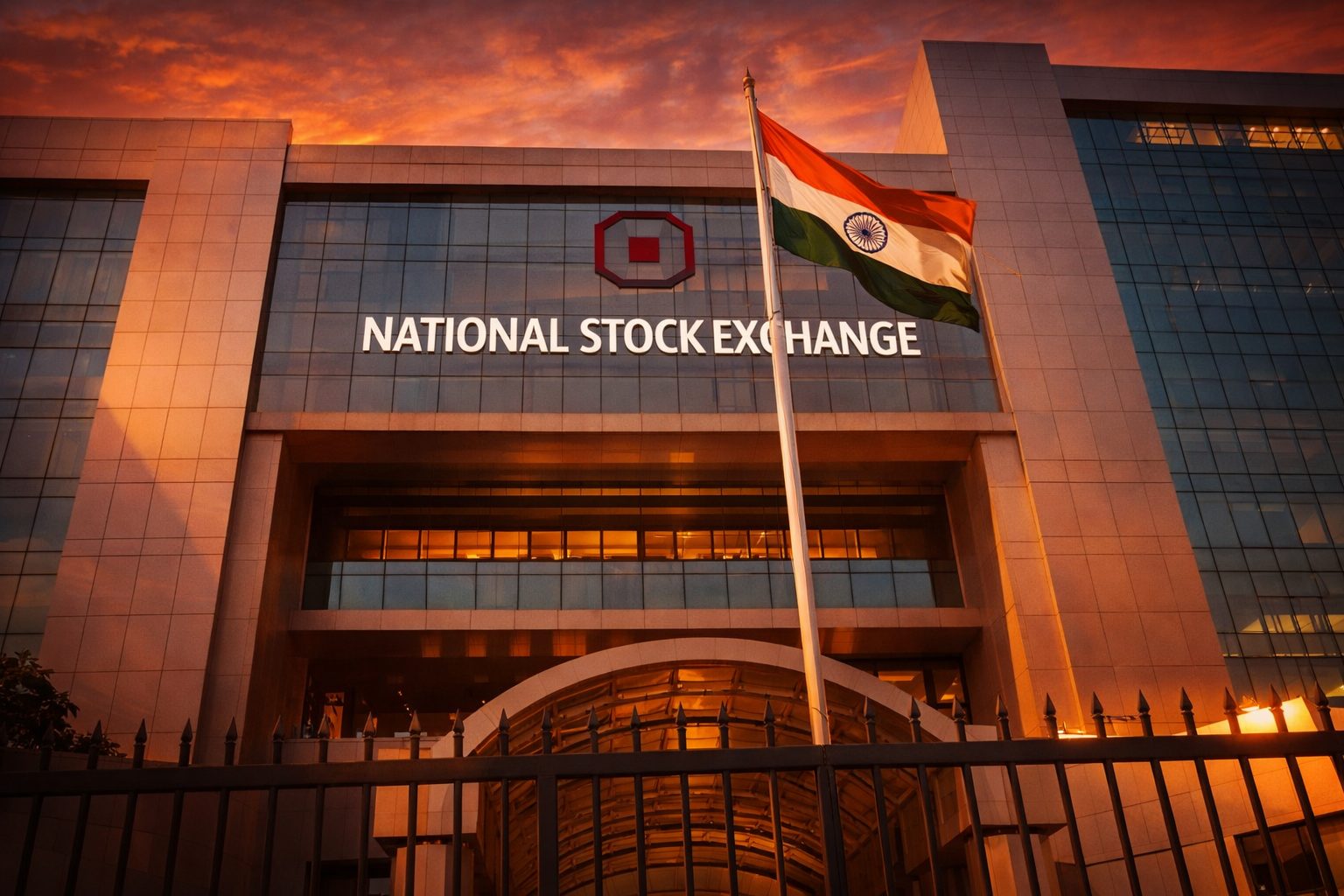
India’s National Stock Exchange (NSE) is shut for the weekend, but the conversation around Dalal Street isn’t taking a day off. After a soft finish on Friday, the Nifty 50 is still hovering near record territory, and the next session’s tone is likely to be set by a familiar year-end cocktail: thin liquidity, foreign flows, macroeconomic data releases, and a calendar that’s about to flip to 2026.
For global investors watching from New York, the timing matters. The NSE’s cash market runs on Indian Standard Time (IST), with the main session opening at 9:15 a.m. IST and closing at 3:30 p.m. IST—roughly 10:45 p.m. ET to 5:00 a.m. ET.
Where NSE left off: Nifty slips, but the weekly tape turns green
The NSE’s benchmark Nifty 50 ended Friday (Dec. 26) at 26,042.30, down 0.38% on the day, as investors booked profits near record highs amid muted year-end participation.
Despite the daily drop, the week still managed to close slightly higher: Reuters reported the Nifty and Sensex posting modest weekly gains, snapping a three-week losing streak.
NSE’s own market snapshot around the close also highlighted the sheer scale of India’s listed equity universe: market capitalization of NSE-listed companies was shown at about ₹471.58 lakh crore (about $5.25 trillion) as of Dec. 26.
“Consolidation near record highs”: why the rally paused
The core story of the past two weeks is less “panic” and more “pause.”
Siddhartha Khemka, head of research for wealth management at Motilal Oswal Financial Services, described the action as consolidation near record-high levels, pointing to muted year-end activity and a lack of fresh triggers.
Reuters also noted a clear footprint of thinner participation: average daily trading volumes for Nifty 50 stocks in December were running below the prior month’s pace.
That matters because markets near highs can behave like a crowded elevator: not inherently dangerous, but extremely sensitive to new information—especially when liquidity is low and “who’s buying” becomes as important as “what’s happening.”
Sector and stock highlights: metals lead, select names stay lively
Even in quieter tape, there were pockets of motion:
- Metals were among the stronger sectoral performers on the week, helped by demand signals out of China and a softer U.S. dollar backdrop tied to expectations for additional U.S. rate cuts in 2026, according to Reuters.
- Broader gauges showed mixed participation: Reuters reported small-caps up on the week while mid-caps ended flat.
At the single-stock level, Reuters flagged notable moves including Shriram Finance (after Japan’s Mitsubishi agreed to buy a 20% stake) and Coal India (after in-principle approval tied to listing certain units), while Ola Electric rose after government approval related to a production-linked incentive payout.
Times of India also framed Friday’s weakness as being influenced by foreign investor selling and thin year-end volumes, and cited Vinod Nair, Head of Research at Geojit Investments Limited, who pointed to profit booking, fading “Santa Claus rally” hopes, and continued FII outflows weighing on sentiment. The Times of India
What the next NSE session may trade on: data calendar, flows, and year-end positioning
Looking into the coming week, the market’s “macro-to-micro” checklist is filling up quickly.
A Press Trust of India report carried by Upstox said analysts expect the Indian market to remain largely range-bound, albeit with a constructive bias, as the year ends. The same report emphasized that macroeconomic announcements, global trends, and foreign investor activity are likely to dictate sentiment.
Among the key watch items cited:
- India’s industrial production (IIP) data for November Upstox – Online Stock and Share Trading
- The final HSBC manufacturing PMI reading Upstox – Online Stock and Share Trading
- Monthly auto sales data as a real-economy pulse check Upstox – Online Stock and Share Trading
- The December F&O (futures & options) expiry, which can amplify short-term volatility Upstox – Online Stock and Share Trading
Ajit Mishra, SVP of Research at Religare Broking Ltd., said the shift into calendar year 2026 could bring heightened volatility around the December F&O expiry, while also pointing to U.S. macro cues and FOMC minutes as global inputs into risk sentiment.
Ponmudi R, CEO of Enrich Money, likewise highlighted domestic IIP and auto sales as important signals of consumption and sector momentum heading into 2026.
Technical levels in focus: 26,000 as the “line in the sand”
While fundamentals drive longer arcs, the next few sessions may be unusually technical—simply because positioning and liquidity can overpower narrative in the final trading days of a year.
A Sunday report from The Economic Times said analysts flagged 26,000 as a crucial support area for the Nifty. Rupak De, Senior Technical Analyst at LKP Securities, said the Nifty slipping below a key short-term average suggested rising bearish bets, adding that if 26,000 holds decisively the index could retrace toward 26,200 and higher—but a sustained move below 26,000 could trigger further weakness.
The same Economic Times piece also carried technical commentary and stock-specific breakout calls attributed to Kunal Kamble, Sr. Technical Research Analyst at Bonanza Portfolio.
(Important distinction for readers: those are analysts’ views reported by the publication, not a guarantee of outcomes—year-end markets are famous for making confident charts look silly.)
IPO pipeline watch: Zepto filing adds to the “next-year listings” drumbeat
Even with the cash market closed this weekend, IPO chatter is very much open.
On Saturday, Reuters reported that Indian quick-commerce firm Zepto confidentially filed for an IPO, positioning itself among anticipated listings next year as competition heats up in the fast-delivery space.
IPO momentum matters for the NSE ecosystem because new listings don’t just add headlines—they add potential liquidity magnets, sector narratives, and index implications over time. In a market that’s consolidating near highs, “what’s coming to market next” can be as sentiment-moving as “what’s already listed.”
What investors should know before the next NSE session opens
With both Wall Street and the NSE closed right now, the most practical edge is preparation—knowing what can move prices when liquidity returns.
1) Know the clock (and the pre-open mechanics).
NSE’s pre-open session runs for 15 minutes, from 9:00 a.m. to 9:15 a.m. IST, before regular trading begins. NSE India
The exchange’s market timings also list the normal open for the cash market at 09:15 hrs and close at 15:30 hrs.
2) Watch the “first tell” indicators—but treat them as hints, not verdicts.
NSE’s own market page showed Gift Nifty futures modestly higher in the latest available reading, a data point many traders use as an early directional cue (especially for Monday’s open). NSE India
3) Respect year-end liquidity.
Multiple reports pointed to thin year-end participation and profit booking near highs. In this environment, price moves can be exaggerated, stop-loss runs are more common, and headlines can have outsized impact.
4) Put macro and policy events on the mental dashboard.
Analysts highlighted domestic data (IIP, PMI, auto sales) and global cues (including Fed communications) as key drivers for sentiment in the week ahead. Upstox – Online Stock and Share Trading
In the U.S., markets are heading into a New Year’s holiday week, with New Year’s Day closures and altered bond-market hours that can influence global liquidity and risk appetite.
5) Focus on the market’s current obsession: 26,000.
With 26,000 widely cited as a key level, the market’s reaction around that zone may dictate whether the next session looks like “healthy consolidation” or “breakdown risk.” The Economic Times
The bottom line for NSE heading into the next open
The National Stock Exchange of India enters the final stretch of 2025 in a familiar posture: strong enough to stay near highs, cautious enough to hesitate without new catalysts.
Friday’s decline didn’t break the broader structure, but it did reinforce what several analysts have been saying in different ways: this is a market looking for the next reason to move—earnings updates, a macro surprise, a policy signal, or a shift in foreign flows.
When trading resumes, expect investors to weigh that “range-bound but constructive” outlook against a technical battlefield at 26,000 and a news cycle that’s already seeding 2026 narratives—starting with the IPO pipeline. Reuters+1
Related articles: IPO News