
April 26, 2026, 11:07 PDT, Palo Alto, California.
- D-Wave is scheduled to release its first-quarter fiscal 2026 earnings on May 12, ahead of the U.S. market open.
- QBTS slipped 4.3% to finish Friday at $18.49. IonQ and Rigetti both closed in the red as well.
- D-Wave faces a fresh hurdle: converting those early-2026 bookings into a more predictable revenue stream.
D-Wave Quantum Inc. shares slipped Friday, adding to the pressure ahead of the quantum-computing firm’s first-quarter earnings set for May 12. Investors are eyeing the report for any specifics on demand, especially after a spate of new bookings and swings across the sector. Chief Executive Alan Baratz and Chief Financial Officer John Markovich are set to run through results and guidance during an 8 a.m. Eastern call that day.
The report carries weight now because D-Wave has shifted gears—from spotlighting its tech advancements to facing pressure to prove just how much of that buzz translates into real revenue. Back in February, the company disclosed that first-quarter-to-date 2026 bookings had topped $32.8 million, already blowing past the $18.7 million it recorded for all of 2025. Bookings, in this context, are customer commitments expected to generate future net revenue.
D-Wave booked $24.6 million in revenue for 2025, a jump of 179% over 2024. Still, it’s a modest sum next to the company’s roughly $6.3 billion market cap as of Friday’s close. That mismatch is why the May data matters, despite the fact that a single quarter won’t make or break the story.
QBTS fell 4.3% to finish the week at $18.49, with shares moving between $17.91 and $19.93 during the session. IonQ dropped 2.2% to $42.69, and Rigetti Computing gave up 1.5%, closing at $16.61.
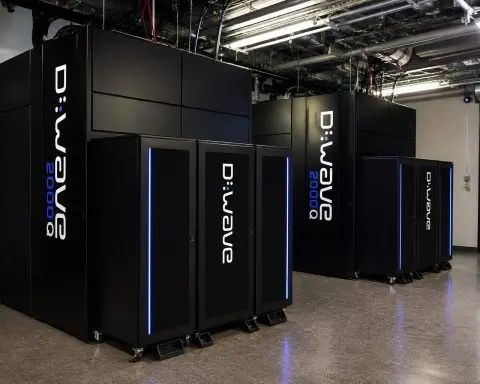
D-Wave offers quantum systems, software, plus access through the cloud. The firm’s mainstay is annealing tech, designed for tasks like scheduling and routing—specific optimization problems. Gate-model quantum computing, favored by much of the competition and many research groups, aims broader. D-Wave claims to be the sole operator working on both annealing and gate-model quantum systems.
Back in February, Baratz called 2025 a year of “meaningful growth across every key business metric,” highlighting revenue, bookings, and new technical achievements. For 2026, he described it as “a defining year” for D-Wave, referencing January bookings, the Quantum Circuits acquisition, and a major enterprise quantum-computing-as-a-service deal. D-Wave Investor Relations
Opinions are far from unified in the sector. Northland Capital Markets’ Nehal Chokshi kicked off coverage on D-Wave, assigning a Market Perform and tagging it with a $22 price target. Over at IonQ, Chokshi took a more bullish stance, rating it Outperform and setting a $55 target. For Rigetti, Chokshi also went with Market Perform and a $20 target, per data from MarketBeat.
Chokshi pitched quantum computing as a potential fix for the surging demands of AI, but he didn’t give D-Wave or Rigetti the same vote of confidence as IonQ. According to Investing.com, he pointed to D-Wave and Rigetti as niche players, not likely to lead AI training anytime soon. Still, he wrote that buying a mix of quantum stocks could help balance out tech risk.
The flipside carries clear risk. In its annual report, D-Wave flagged its ongoing track record of losses, projecting hefty costs and more red ink ahead. For 2025, net losses came in at $355.1 million, with operating cash outflows at $72.0 million. The company also noted that setbacks in research, production, or the integration of Quantum Circuits could put pressure on results.
Another item for shareholders: D-Wave’s annual meeting lands June 4, according to a proxy filing. Investors will cast votes on the board spots for Alan E. Baratz and Sharon Holt, sign off on executive compensation, and decide on ratifying Grant Thornton as 2026 auditor.
At this point, nobody doubts that quantum computing can grab the spotlight. It does. But looking ahead to May 12, the challenge for D-Wave centers on something else: Are bookings, cloud usage, and system sales scaling quickly enough to meet what investors want from the business?
Related articles: NASDAQ:QBTS