
SAN DIEGO, April 26, 2026, 13:02 PDT
Kratos Defense & Security Solutions tumbled 6.5% to $61.26 in the latest U.S. session, slicing its market cap to roughly $10.6 billion as investors weighed how fast fresh contract wins might actually turn into profit. AeroVironment, another drone play, dropped 2.8%. L3Harris and Northrop Grumman, both bigger defense names, lost 3.9% and 2.1%.
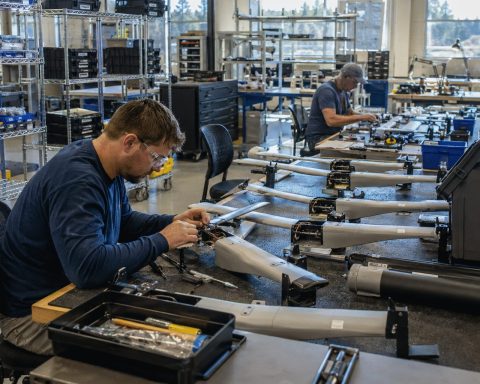
It’s a sensitive juncture for Kratos. The company is working to transition from its roots in specialized defense tech into larger-scale production of unmanned aircraft, missile systems, and space-to-ground infrastructure—a leap that demands capital, tight factory operations, and reliable Pentagon contracts.
Kratos announced April 21 it wrapped up the initial flight series for its Mk1 Firejet—a J85 engine-powered version of its Firejet unmanned aerial system. The company is targeting the sub-$500,000 range, banking on the idea that the tactical jet drone’s lower price could spur bigger orders and wider use.
“Affordability is a technology,” Chief Executive Eric DeMarco said in the Firejet announcement, noting Kratos has invested its own funds in military-grade jet engines and Firejet’s integration. Steve Fendley, who heads Kratos Unmanned Systems, said the updated model uses a U.S.-made engine with U.S.-sourced components and delivers gains in range, endurance, speed, and climb rate. Kratos Defense
That’s the bullish argument. For now, the market is watching to see if Kratos can ramp up while holding onto its margins.
Back in February, Kratos set the price for its public offering at $84 a share, moving 14.3 million shares and looking to bring in roughly $1.17 billion in net proceeds. According to the company, those funds are earmarked for capital expenditures, product development, bolstering the balance sheet, and financing both the Nomad acquisition and the pending deal for Orbit—plus any other strategic opportunities that come up.
Jefferies analyst Sheila Kahyaoglu bumped up Kratos to buy on April 6, with an $85 price target. She pointed to strength in the Government Solutions segment, advances in hypersonics, the Prometheus missile-propulsion partnership, and a boost in Valkyrie drone output for both the U.S. Marine Corps, U.S. Air Force, and foreign buyers. Her note suggests a scenario where Government Solutions revenue could climb at a compound annual rate above 30% through 2028.
Contract wins keep rolling in. On April 8, Kratos announced it landed a Space Systems Command deal worth up to $446.8 million—assuming all options go through—for ground management and integration on the U.S. Space Force’s Resilient Missile Warning and Tracking effort. Northrop Grumman joins the Kratos-led team, linking the smaller defense player with one of the primes on this program.
Back in March, Kratos announced it had landed a contract from the Naval Surface Warfare Center, Port Hueneme Division, covering as many as 36 Oriole solid rocket motors—plus three thrust-vector-control nozzle kits. Thrust vector control hardware, which is used to direct a rocket’s exhaust for steering, makes up the core of the deal. The package is valued at approximately $39.1 million for the rockets, with an added option worth about $10.1 million for the nozzle kits.
The international piece fits right in. Back in February, Reuters said Kratos and Taiwan’s military had put the Mighty Hornet IV—a new jet-powered attack drone—through tests after Kratos engineers in Oklahoma City cleared a Taiwanese mission payload. The goal: supply Taiwan with more affordable drones as Beijing ramps up military pressure near the island.
Kratos’ most recent annual report spells out the impact of government schedules. U.S. government contracts made up roughly 68% of total revenue in 2025. As of Dec. 28, the backlog stood at $1.57 billion, with $1.23 billion of that funded. The company projected it would pull in about 54% of the remaining backlog as revenue in 2026.
Still, backlog doesn’t translate directly to cash. In its filing, Kratos noted that government contracts are vulnerable—they can be pushed back, changed, or scrapped entirely for convenience. Fixed-price deals accounted for around 69% of projected 2025 revenue, so if labor, materials, or technical expenses jump, Kratos bears the risk. Margins took a hit in 2025 as well, with the unmanned systems segment squeezed in part by unrecoverable labor and material costs tied to some multi-year fixed-price contracts.
Kratos finds itself in a well-worn spot for defense stocks. Orders keep piling up for its drones, missiles, and space-sensing gear, but investors remain unconvinced—what they want is hard evidence that higher output will translate into real profits. Judging by the shares, that evidence hasn’t landed yet.