
New York, May 5, 2026, 18:14 (EDT)
- Transocean ended the day down 9.16% after the offshore driller posted an adjusted net loss for the first quarter.
- The company landed about $1.6 billion in new orders, lifting its total contracted backlog to around $7.1 billion.
- There’s fresh movement for investors to track: U.S. antitrust regulators have filed an additional request tied to Transocean’s planned acquisition of Valaris.
Transocean Ltd. shares tumbled 9.16% Tuesday, closing at $6.25, after the company posted an adjusted first-quarter loss. Losses overshadowed gains in revenue and stronger rig utilization, despite about $1.6 billion in new contract wins. Shares nudged slightly higher after the bell.
For Transocean, the stakes are high: persuading investors that the offshore sector’s rebound goes beyond just higher activity levels. The focus now is on dependable cash generation. New contracts just secured work for rigs in Norway, Brazil, and the Eastern Mediterranean—areas where operators are still chasing high-spec rigs, despite oil price volatility.
Transocean is still seeking approval for its planned all-stock acquisition of Valaris, the offshore drilling rival. Valaris revealed in a filing that the U.S. Department of Justice has sent a “Second Request”—essentially a call for more information that extends the antitrust review. That pushes the clock out to 30 days past the point when both companies supply every detail requested.
Transocean pulled in $1.081 billion in contract drilling revenue for the first quarter, up from $906 million a year earlier. Net income landed at $71 million, or 6 cents per diluted share. Excluding items such as tax effects and debt-retirement costs, adjusted net loss came to $28 million, or 3 cents a share.
The company logged adjusted EBITDA of $440 million, a sharp climb from $244 million a year ago. Free cash flow swung to $136 million, compared to a negative $34 million in the first quarter of 2025.
Transocean CEO Keelan Adamson said the driller “exceeded our revenue expectations,” with margins topping 40%. He called it “early days of a multi-year upcycle” for offshore exploration and development drilling. Transocean Ltd.
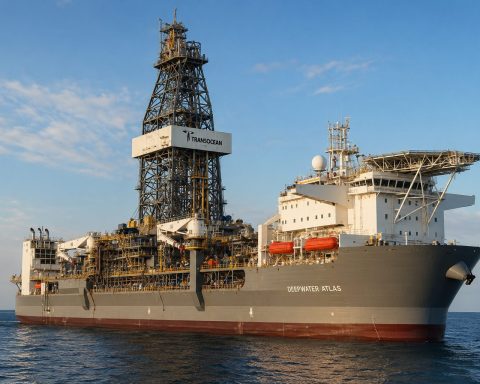
Five deals fueled the surge in backlog. Vår Energi locked in Transocean Barents for 1,095 days of work offshore Norway. Petrobras renewed contracts for Deepwater Orion, Deepwater Aquila, and Deepwater Corcovado over in Brazil. Deepwater Asgard picked up a five-well assignment in the Eastern Mediterranean. Transocean says these latest wins come with an average dayrate of about $410,000—the figure operators shell out daily to keep each rig and crew on the job.
Adamson told analysts average daily revenue hit $476,000, the highest in over a decade. Uptime reached 98%, with rigs active and available for nearly every contracted slot. He also reiterated the company’s goal: $250 million in cost cuts from its 2024 baseline by 2026.
Back in March, the company cleared its final $358 million chunk of 8.375% Deepwater Titan notes, touting nearly $40 million in interest savings through maturity. By the end of the quarter, total debt had fallen to $5.137 billion, a sharp drop from $6.734 billion twelve months earlier.
Valaris isn’t just another acquisition—it’s a step up in the game. Reuters first reported in February that Transocean was set to acquire Valaris in an all-stock deal valued at $5.8 billion, a move that would create a heavyweight in offshore rigs, from deepwater to harsh and shallow waters. “This transaction addresses that,” Adamson noted then, pointing to Transocean’s debt concerns. Reuters
Timing and execution take center stage here. The DOJ’s request doesn’t block the Valaris transaction outright, but it may slow things down. Valaris has warned investors: finalizing the deal still requires regulatory and shareholder approvals, and there’s no promise it will close on time. Any dip in dayrates, contract expirations, or a drop in oil prices could squeeze Transocean’s free-cash-flow outlook.
Transocean expects contract drilling revenue to fall somewhere between $930 million and $970 million in the second quarter. For 2026, management is guiding for contract drilling revenue of $3.8 billion to $3.9 billion. Total liquidity, including its undrawn credit facility, is forecast at $1.25 billion to $1.35 billion.
Related articles: NYSE:RIG